
Buyers searching "who made wheels" rarely want a history lesson. They want to know whether the supplier in front of them — the one with a polished website and a gallery full of renders — actually has the manufacturing capability to deliver. That anxiety is legitimate, and this article addresses it directly.
The real question behind "who made your wheels" is a sourcing risk check. It asks: does this supplier manufacture, or do they just market? A genuine forged wheel manufacturer will have verifiable certifications (ISO9001, DOT, TÜV, IATF169491), in-house tooling, transparent lead times, and a clear answer about their production structure. A trading company with a logo will not.
Most buyers realize this distinction matters only after a problem surfaces — a delayed shipment, a wheel that arrives with inconsistent finish, or a supplier who goes quiet after payment. The sections below give you a framework to run this check before you place the order, not after.
Does Your Supplier Actually Manufacture, or Just Market?
Most wheel brands visible online don’t own a forge. They source from factories and apply branding on top. That’s not automatically a problem — but it changes what you can expect from them, how you should evaluate them, and who carries the risk when something goes wrong.
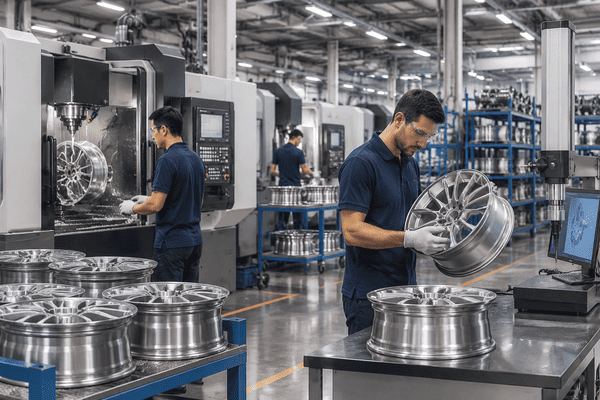
A manufacturing supplier controls lead times, tooling modifications, and quality inspection at the source. A trading company relies on a third-party factory’s schedule. When you need a custom offset, a non-standard diameter, or a specific surface treatment, only the manufacturer can confirm whether that change is actually possible — and how long it will take.
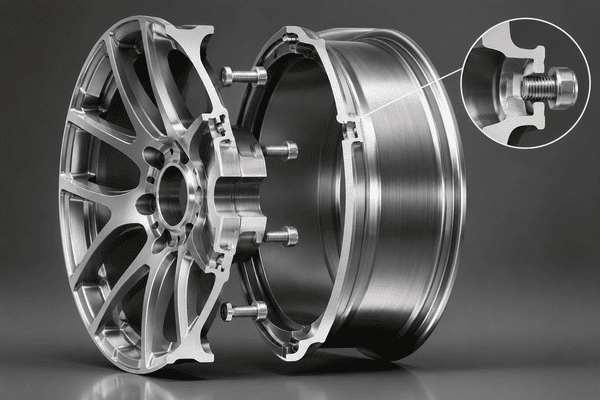
Understanding which type of supplier you’re dealing with shapes every other conversation — pricing, lead time, customization depth, and post-delivery support.
How to Tell a Manufacturer from a Middleman
The clearest signal isn’t what a supplier says — it’s what they can answer without hesitation. When I talk to prospective clients, I often notice that buyers who’ve been burned before ask sharper, more specific questions. Here’s what those questions look like:
- Ask for their MOQ. A genuine forged wheel manufacturer can accommodate small runs because they control the tooling. At Tree Wheels, the MOQ is 4 wheels — something possible only because production is handled in-house. A trading company typically passes a factory’s MOQ through, which is often 50+ units2.
- Ask for their production timeline broken down by wheel type. At our facility, one-piece forged wheels take 15–20 days, two-piece takes 20–25 days, and three-piece takes 30–35 days. A supplier who gives you a single flat answer for every wheel type likely doesn’t have direct production visibility3.
- Ask where the tooling lives. Forged wheel production requires dies and molds4. If a supplier can’t tell you whether the tooling is in-house or third-party managed, that’s a meaningful gap.
- Ask for certification documentation — not logos. ISO9001, DOT, TÜV, and IATF16949 are verifiable. Certificate numbers can be cross-referenced. Treat them as documents, not marketing badges.
| Question | Manufacturer Answer | Middleman Answer |
|---|---|---|
| What’s your MOQ? | 4–10 wheels per order | 50+ units (factory minimum) |
| Lead time for 3-piece? | 30–35 days | "Depends on the factory" |
| Is tooling in-house? | Yes, with modification flexibility | Usually vague or deflected |
| Can you share cert numbers? | Yes, verifiable documents | Logo images only |
The pattern here isn’t about catching anyone in a lie. It’s about gauging whether the person you’re talking to has real production visibility — or is reading from a spec sheet someone else wrote.
Does Wheel Type Change Who You Should Buy From?
The short answer is yes. A hot rod builder ordering 4 custom monoblock wheels has completely different sourcing requirements than a modification shop placing monthly orders for 20 staggered fitment sets. Matching your use case to a supplier’s actual structure prevents most order problems before they begin.
One-piece forged wheels suit buyers who prioritize strength-to-weight ratio5 and simpler customization. Two-piece and three-piece wheels offer deeper fitment flexibility — adjustable offsets, mixed finishes, mixed diameters — but require a supplier with multi-component manufacturing capability and longer lead time tolerance. The right supplier depends on the application, not just the price.
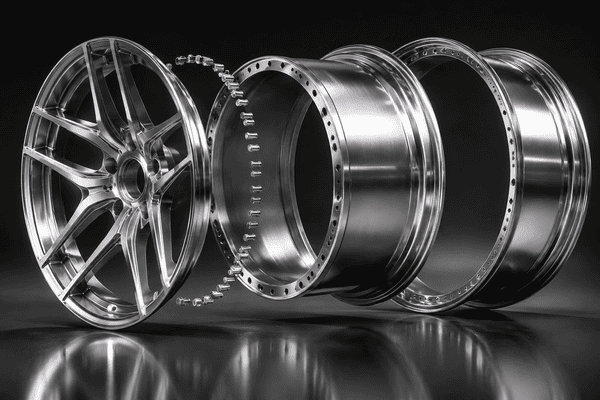
Here’s how I’ve seen different buyer profiles approach this, based on actual consultations:
Scenario 1: The Hot Rod Builder (Small Custom Order)
A custom car builder sourcing 4 wheels for a one-off project needs a supplier willing to run a small quantity with high design flexibility. This rules out most large-volume manufacturers. The relevant questions become:
- Can you produce from a customer-supplied drawing? Some builders have very specific spoke geometry or face profiles. At Tree Wheels, we support design sketches, 3D models, and sample production — but not every manufacturer offers this, especially at 4-unit quantities.
- What’s the customization depth on color and surface treatment? A single car build often requires a finish that matches bodywork. Generic catalog colors won’t work.
- How are samples handled? A builder doing a bespoke build may want to approve a sample before committing. Ask explicitly whether sample production is available, and what the turnaround is.
Scenario 2: The Modification Shop (Recurring B2B Orders)
A shop owner running a modification business cares about reliability across multiple orders, not just the first one. The evaluation shifts:
- Lead time consistency, not just stated lead time. Ask a supplier for delivery records or client references. Promotional lead times are easy to write. A supplier who can tell you what their on-time delivery rate looks like across the past 12 months is showing you something real.
- Packaging and arrival condition. I’ve spoken to shop owners who’ve switched suppliers specifically because of arrival damage. At Tree Wheels, packaging uses foam protection, corner guards, and seven-layer corrugated cartons6 — because we’ve seen what inadequate packaging does to a wheel in transit.
- What happens when something goes wrong? Ask directly: what is your warranty process? Our standard is a 1-year warranty covering replacement or repair — but more importantly, ask what documentation they need and what the resolution timeline looks like.
Scenario 3: The Luxury Car Owner (Individual Enthusiast)
An individual buyer sourcing forged wheels for a high-end vehicle is usually making a larger financial decision with less institutional knowledge. For this buyer, transparency is the key variable:
- Can the supplier provide before/after photos from similar projects?
- Is there a point of contact who can walk through fitment specs — PCD, offset, center bore — with the buyer?
- Are certifications relevant to the buyer’s market? DOT matters for US road use. TÜV matters for European-spec vehicles. These aren’t interchangeable.7
What Does Delivery Actually Tell You About a Supplier?
Promotional claims are easy to produce. Delivery outcomes are harder to fake. The real quality signal isn’t a supplier’s website — it’s whether their lead time held, whether the packaging protected the product, and whether they communicated proactively when something shifted.
When evaluating a forged wheel supplier, ask for specific delivery evidence: documented lead times per wheel type, packaging photos, and a written description of their warranty process. Any supplier worth buying from should be able to provide all three without hesitation. Vague answers to these questions are the clearest sourcing risk signal available.
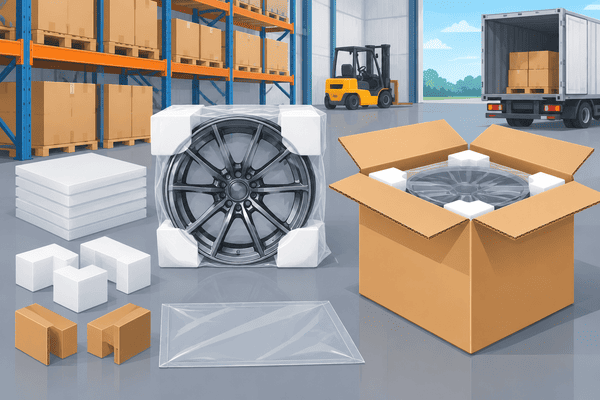
Here’s why this matters more than most buyers realize:
Lead Time Claims vs. Lead Time Reality
A supplier might quote 15 days on a one-piece wheel. But that clock can start from different points — from order confirmation, from payment clearance, or from design approval. Ask explicitly: when does your production timeline start? Then ask what happens if there’s a design revision after production begins.
At Tree Wheels, our stated lead times — 15–20 days for one-piece, 20–25 days for two-piece, 30–35 days for three-piece — start from confirmed order and approved design. That’s a specific, checkable commitment. If a supplier can’t tell you what triggers their production clock, that’s worth noting.
Packaging as a Quality Proxy
Packaging decisions reveal a supplier’s assumptions about their own product. Cheap packaging on an expensive forged wheel suggests one of two things: the supplier doesn’t take responsibility for arrival condition, or they’ve calculated that your expected re-order volume makes a few damaged wheels an acceptable cost.
Neither assumption serves the buyer. When a client receives a damaged wheel, the burden of proof falls on them unless the supplier has documented the outgoing packaging condition. Ask whether your supplier photographs outgoing shipments before dispatch.
Warranty Process as a Supplier Confidence Signal
A supplier who explains their warranty process clearly — scope, timeline, documentation required, resolution options — is demonstrating confidence in their own quality control. A supplier who is vague about warranty terms, or who redirects to "contact us if there’s a problem," is not.
The warranty itself matters less than the clarity of the process. A well-structured warranty shows the supplier has thought through what happens when something goes wrong, which suggests they’ve had to handle it8 — and that they intend to handle it again, correctly.
Frequently Asked Questions
How do I know if a wheel supplier actually manufactures their products?
Ask for in-house tooling details, production lead times broken down by wheel type, and verifiable certification numbers (ISO9001, DOT, TÜV, IATF16949). Manufacturers can answer all three without hesitation. Trading companies typically can’t — or they provide vague answers that point back to a third-party factory.
What certifications should a forged wheel manufacturer hold?
For most markets, the relevant certifications are ISO9001 (quality management), IATF16949 (automotive-specific quality)9, DOT (US road compliance), and TÜV (European safety standard). Treat these as verifiable documents — ask for certificate numbers and cross-reference them. Don’t accept logo images as proof.
Is a low MOQ a good sign when choosing a forged wheel manufacturer?
It depends on context. A low MOQ (such as 4 wheels) is a genuine sign of manufacturing control — only suppliers with in-house tooling can accommodate small runs profitably. If the low MOQ comes from a trading company, ask how they’re achieving it, since it usually means the factory minimum is being absorbed elsewhere in the pricing.
What’s the difference between one-piece, two-piece, and three-piece forged wheels?
One-piece (monoblock) wheels are forged from a single billet10 — lighter and stronger for many applications, with less customization flexibility. Two-piece wheels separate the face and barrel, allowing offset adjustments11. Three-piece wheels add further component separation, enabling the widest fitment and finish customization. Each type has different lead times and manufacturing complexity.
How should I evaluate packaging and delivery quality before placing a large order?
Ask the supplier to share photos of outgoing packaging from a recent order. Ask whether they photograph shipments before dispatch. Review their warranty terms in writing, and ask specifically what documentation they require for a warranty claim. These are concrete, verifiable signals — not marketing language.
Conclusion
The question "who made wheels" is a sourcing risk question in disguise. When buyers ask it, they’re really asking whether the supplier they’re evaluating has genuine manufacturing capability — or just a polished brand built on top of someone else’s production line. Identifying the difference comes down to a few direct questions: MOQ, lead time structure by wheel type, tooling ownership, and verifiable certifications.
Buyer profile matters too. A hot rod builder, a modification shop, and an individual enthusiast all need different things from a forged wheel manufacturer — different customization depth, different order volume tolerance, and different communication structures. Matching your use case to a supplier’s actual capabilities is the most effective risk reduction available.
Before placing your next forged wheel order — with Tree Wheels or any other supplier — ask for lead times per wheel type with a defined start point, packaging documentation from a recent shipment, and warranty terms in writing. Any capable manufacturer will answer all three without hesitation. That’s your benchmark.
-
"IATF 16949", https://en.wikipedia.org/wiki/IATF_16949. IATF 16949 is an automotive-specific quality management standard developed by the International Automotive Task Force, building on ISO 9001 requirements; TÜV certification for wheels is issued by independent German technical inspection associations and is recognized across European markets as a road-safety compliance standard. Evidence role: definition; source type: institution. Supports: What IATF 16949, ISO 9001, DOT, and TÜV certifications cover and which bodies issue them. Scope note: DOT compliance for wheels is a self-certification process under FMVSS rather than a third-party audit, which the article does not distinguish from the other certifications listed. ↩
-
"Trading Companies vs Manufacturer : r/ecommerce", https://www.reddit.com/r/ecommerce/comments/10ic0b0/trading_companies_vs_manufacturer/. Research on B2B sourcing intermediaries in Chinese manufacturing supply chains indicates that trading companies generally transmit factory-imposed minimum order quantities to buyers, as they lack the production control to negotiate below the factory floor, a structural difference from direct manufacturer relationships documented in supply chain management literature. Evidence role: general_support; source type: research. Supports: That intermediary trading companies in manufacturing supply chains typically relay factory-set minimum order quantities rather than setting their own, resulting in higher MOQs than direct manufacturer relationships. Scope note: The specific 50-unit figure is illustrative rather than an industry-wide statistic; actual MOQs vary substantially by product category, factory scale, and negotiation context. ↩
-
"Supply chain transparency, explained", https://mitsloan.mit.edu/ideas-made-to-matter/supply-chain-transparency-explained. Supply chain management literature on supplier qualification identifies operational specificity — including the ability to provide process-level data such as stage-by-stage lead times, tooling details, and capacity constraints — as a distinguishing characteristic of direct manufacturers versus intermediaries, who typically have access only to aggregate delivery commitments from upstream factories. Evidence role: expert_consensus; source type: research. Supports: That the ability to provide granular, process-specific operational data is a recognized indicator of direct manufacturing capability in supplier qualification frameworks. Scope note: This is a general supply chain principle; no published study specifically validates differentiated wheel-type lead times as a qualification criterion for the forged wheel industry. ↩
-
"How to Start an Industry for Manufacturing Alloy Wheels?", https://treewheels.com/how-to-start-an-industry-for-manufacturing-alloy-wheels/. Closed-die forging of aluminum alloy wheels requires precision-machined steel dies engineered to the specific geometry of each wheel design; die sets for automotive wheel production represent capital investments typically ranging from tens to hundreds of thousands of dollars depending on complexity, making in-house tooling ownership a substantive indicator of direct manufacturing capability rather than resale activity. Evidence role: mechanism; source type: research. Supports: That forged wheel production requires purpose-built dies that represent significant capital investment and are specific to each wheel design, making tooling ownership a meaningful indicator of manufacturing capability. Scope note: Some contract forging arrangements allow brands to own dies while outsourcing production; tooling ownership alone does not guarantee that manufacturing occurs at the supplier’s own facility. ↩
-
"Casting Wheels vs. Forged Wheels: Which Offers Better …", https://treewheels.com/casting-wheels-vs-forged-wheels-which-offers-better-performance-for-your-vehicle/. The forging process aligns the grain structure of aluminum alloys along the contours of the part, resulting in higher tensile strength and fatigue resistance relative to cast components of equivalent mass, a property documented in materials engineering literature on wrought versus cast aluminum. Evidence role: mechanism; source type: research. Supports: That the forging process produces a grain structure in aluminum alloys that yields higher strength-to-weight ratios compared to casting. Scope note: Comparative performance depends on alloy grade, wheel geometry, and load conditions; a general strength-to-weight advantage does not apply uniformly across all forged wheel designs. ↩
-
"Recognized Consensus Standards: Medical Devices – FDA", https://www.accessdata.fda.gov/scripts/cdrh/cfdocs/cfStandards/results.cfm?title=ISO%2011607. International packaging standards for export shipments of heavy industrial components, including guidance from bodies such as the International Safe Transit Association (ISTA), recommend multi-wall corrugated constructions and internal cushioning materials to absorb shock and vibration loads encountered in ocean and air freight. Evidence role: general_support; source type: institution. Supports: That multi-layer corrugated packaging with internal cushioning is an established practice for protecting heavy precision components during export shipping. Scope note: No universal standard mandates a specific number of corrugated layers for wheel packaging; the seven-layer specification cited is a supplier claim rather than a regulated minimum. ↩
-
"Interpretation ID: 86-1.39", https://www.nhtsa.gov/interpretations/86-139. The US Department of Transportation requires wheel manufacturers to self-certify compliance with applicable Federal Motor Vehicle Safety Standards, while TÜV approval in European markets involves independent third-party testing under ECE regulations; the two frameworks operate under separate legal regimes and are not mutually recognized. Evidence role: definition; source type: government. Supports: That DOT compliance for wheels is a US-specific requirement under Federal Motor Vehicle Safety Standards and is not equivalent to or recognized as TÜV approval in European markets. Scope note: Some manufacturers hold both certifications independently; the non-interchangeability refers to regulatory acceptance, not to the physical safety performance of the wheel. ↩
-
"Supplier Quality Management: A Complete Guide", https://www.deltek.com/resources/articles/supplier-quality-management/. Quality management standards including ISO 9001 require organizations to maintain documented processes for handling nonconforming outputs and customer complaints; procurement research indicates that the existence and clarity of such documented processes correlates with overall quality system maturity, as suppliers who have systematized failure response have typically encountered and resolved quality issues at scale. Evidence role: expert_consensus; source type: research. Supports: That a clearly documented warranty and nonconforming product process is an indicator of quality management system maturity in manufacturing suppliers. Scope note: A well-written warranty document can be produced without underlying quality system maturity; warranty clarity is a necessary but not sufficient indicator of supplier reliability. ↩
-
"IATF 16949", https://en.wikipedia.org/wiki/IATF_16949. IATF 16949:2016, published by the International Automotive Task Force, is the quality management system standard for automotive production and relevant service part organizations; it incorporates the requirements of ISO 9001:2015 and adds automotive-specific requirements, meaning IATF 16949 certification subsumes ISO 9001 compliance rather than being a separate parallel standard. Evidence role: definition; source type: institution. Supports: That IATF 16949 is an automotive sector-specific quality management standard that incorporates and extends ISO 9001 requirements for automotive supply chain participants. Scope note: Not all wheel manufacturers supplying the automotive aftermarket are required to hold IATF 16949; the standard is primarily mandated within OEM supply chains, and its presence in the aftermarket context is a quality signal rather than a regulatory requirement. ↩
-
"Single-piece wheel manufacturing", https://en.wikipedia.org/wiki/Single-piece_wheel_manufacturing. In automotive wheel manufacturing, a monoblock or one-piece forged wheel is produced by pressing a single aluminum alloy billet under high pressure to form the near-net shape, followed by CNC machining to achieve final dimensions and surface finish. Evidence role: definition; source type: encyclopedia. Supports: That monoblock or one-piece forged wheels are produced from a single aluminum billet through a forging and machining process. Scope note: The term ‘monoblock’ is used inconsistently across the industry and may refer to both forged and flow-formed single-piece constructions; the citation should clarify the forging-specific definition. ↩
-
"Why Are Deep Concave Designs Popular in the Premium Wheel …", https://treewheels.com/why-are-deep-concave-designs-popular-in-the-premium-wheel-market/. Wheel offset, defined as the distance between the wheel’s mounting face and its centerline, can be adjusted in two-piece and three-piece wheel assemblies by selecting barrel sections of different depths, enabling fitment customization without retooling the face component. Evidence role: mechanism; source type: encyclopedia. Supports: That two-piece wheel construction allows offset to be varied by changing the relationship between the face and barrel components. Scope note: The degree of offset adjustability depends on the specific barrel depth options a manufacturer stocks; this is a general mechanical principle rather than a guarantee of unlimited adjustment range. ↩