
goes wrong. By then, the right questions are already too late. The warranty is the one document that tells you how much confidence a manufacturer has in their own product.
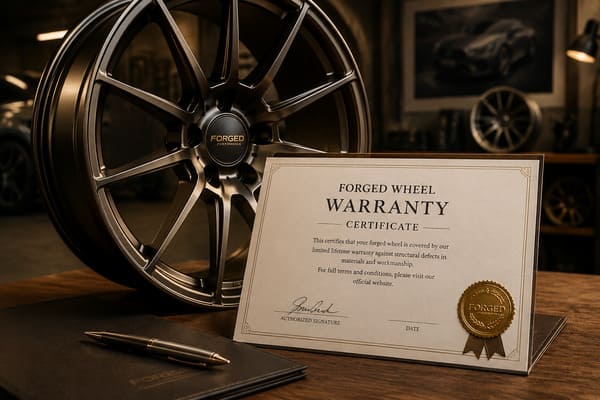
A premium wheel warranty should clearly cover material defects, manufacturing failures, and surface treatment issues. It should define terms precisely, state who pays for return shipping, and outline the claims process. Vague language like "normal use" is a warning sign, not protection.
I’ve spoken with dozens of wheel buyers — shop owners in California, individual enthusiasts in Dubai, modification specialists in Sydney. Almost all of them told me the same thing: they didn’t read the warranty before they ordered. I want to change that. In this article, I’ll walk through every warranty question that matters, based on 20+ years of forged wheel production experience1 and real conversations with real buyers.
What Does a Premium Wheel Warranty Actually Cover?
A vague warranty is worse than no warranty at all2. It gives buyers false confidence — and when something goes wrong, it leaves them with nothing.
A quality wheel warranty must cover structural defects in the material, failures caused by manufacturing errors, and surface treatment issues that appear under normal driving conditions3. It must also state clearly who is responsible for return shipping costs and how defects are defined.
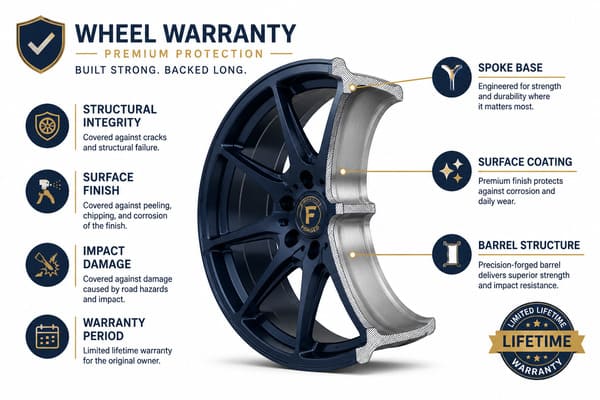
Last year, a shop owner in Texas reached out to me after a bad experience with another supplier. He had bought 12 sets of wheels for his clients. Within 3 months, 2 sets showed visible surface cracking near the spoke base4. When he filed a warranty claim, the supplier told him the cracks were caused by "improper road conditions" — and denied the claim entirely. He lost over $2,000 and two long-term clients. That story stuck with me. At Tree Wheels, our warranty covers material and manufacturing defects — and we define those terms clearly before you place an order, not after something goes wrong.
What Should Be Explicitly Listed in a Wheel Warranty?
Most warranty disputes happen not because a supplier is dishonest, but because the document was never specific enough. A strong warranty document should leave no room for interpretation on the key issues. Here is what every premium wheel warranty should explicitly address:
| Warranty Element | What It Should Say |
|---|---|
| Structural Defects | Define what counts — cracks, fractures, deformation under normal load |
| Surface Treatment Failures | Specify which finish issues are covered — peeling, bubbling, oxidation |
| Return Shipping Responsibility | State clearly whether the buyer or supplier pays |
| Claim Process | List the steps, required photos, and response time |
| Exclusions | Name specific situations that void the claim |
When I review a warranty document from a supplier, I look for these five items first. If any of them are missing or written in vague language, that tells me something important about how the supplier handles problems. At Tree Wheels, every one of these elements is written in plain language before a purchase order is confirmed. We do this because we believe the warranty conversation should happen before the sale — not after a problem appears.
How Long Should a Quality Forged Wheel Warranty Last?
Buyers often assume a longer warranty means a better product. That assumption can be expensive.
One year is the honest, realistic standard for forged wheels5. Manufacturing defects almost always appear within the first 3 to 6 months of real driving6. A 1-year warranty gives full coverage with room to spare. Warranties longer than that on low-priced wheels are often a marketing number, not a quality signal7.
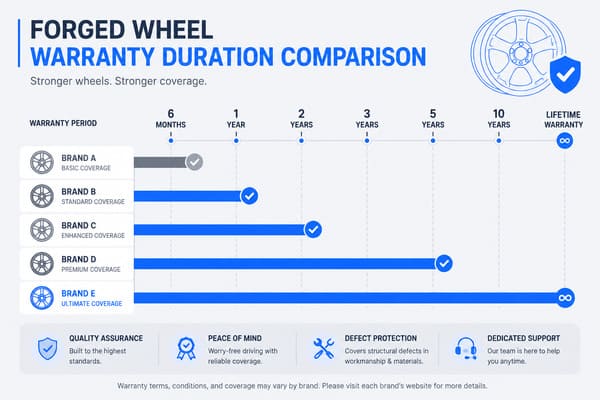
In our production facility, every forged wheel goes through material stress testing, dimensional inspection, and surface treatment verification8 before it ships. If a manufacturing defect exists, it almost always shows up within the first 3 to 6 months of real driving. We have tracked our own after-sales data over the past 2 years: more than 95% of quality-related issues were reported within the first 4 months. A 1-year window gives customers genuine coverage with real margin to spare.
Why Longer Warranties Don’t Always Mean Better Products
When I see a supplier advertising a "3-year" or "lifetime" warranty on wheels priced at half what ours cost, I get suspicious. The math doesn’t add up. Here is how warranty length actually relates to product quality:
| Warranty Length | What It Typically Signals |
|---|---|
| Less than 6 months | Manufacturer has low confidence in the product |
| 1 year | Industry-honest standard for forged wheels — backed by real data |
| 2 to 3 years | May be legitimate for certain materials; verify with production data |
| "Lifetime" on budget wheels | Almost always a marketing claim with heavy exclusion clauses |
The right question is not "how long is the warranty?" The right question is "what does the warranty actually cover, and how does the supplier handle a real claim?" A 1-year warranty with clear terms and fast response is worth far more than a 3-year warranty written to deny every claim. At Tree Wheels, we chose 1 year because our production data supports it — and because we have never needed to hide behind fine print.
What Voids a Wheel Warranty and How Can You Avoid It?
Most denied warranty claims are not caused by fraud. They are caused by things the customer simply didn’t know.
Common actions that void a wheel warranty include improper torque during installation, mounting on a vehicle with a load rating beyond the wheel’s specification, submitting curb or pothole damage as a structural claim, and modifying the surface finish after delivery.
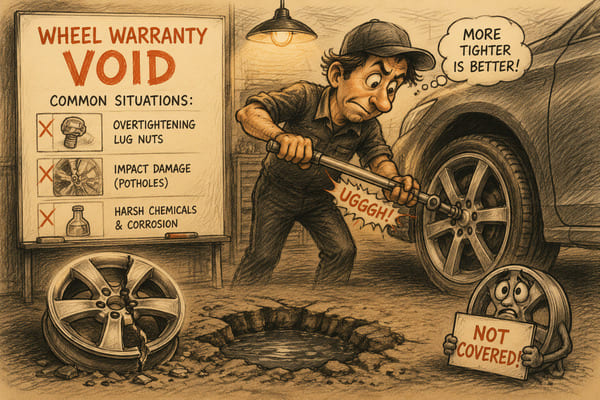
I’ve reviewed a lot of warranty claims over the years — both valid ones and ones that couldn’t be honored. The most common reason a claim gets denied is not dishonesty on either side. It’s simply that the customer didn’t know the rules before the problem happened. At Tree Wheels, every order ships with a full installation guide and product spec sheet. I started doing this after seeing too many good wheels blamed for problems that were actually installation errors. It protects both the buyer and us.
The Four Most Common Warranty Voiding Situations
Understanding what voids a warranty is just as important as knowing what it covers. These are the four situations I see most often in real claims:
| Situation | Why It Voids the Warranty | How to Avoid It |
|---|---|---|
| Incorrect torque during installation | Even 10–15 ft-lbs off can cause stress fractures that look like defects9 | Always follow the torque spec sheet included with the order |
| Overloaded vehicle application | Exceeding the wheel’s rated load causes structural failure10 | Match wheel load rating to vehicle specs before ordering |
| Curb rash or pothole damage submitted as a defect | Impact damage is external, not a manufacturing issue | Document the wheel condition at installation |
| Customer-modified surface finish | Repainting or coating after delivery breaks surface treatment integrity11 | Request custom finishes before the order is placed, not after |
Every one of these situations is preventable. The installation guide we include with every Tree Wheels order covers torque specs, load ratings, and surface care instructions. If a buyer reads that document before installation, the chance of a voided claim drops significantly. We write it in plain language because technical jargon doesn’t help anyone when they’re standing in a workshop.
How Do You Compare Warranty Terms Across Different Wheel Suppliers?
Most buyers look at price and lead time when comparing suppliers. Warranty terms are usually last on the list — until they need to use them.
To compare wheel warranties across suppliers, ask three direct questions: What exactly is covered? Who pays for return shipping on a claim? How fast will you respond? These three questions reveal more about a supplier’s real confidence in their product than any specification sheet.
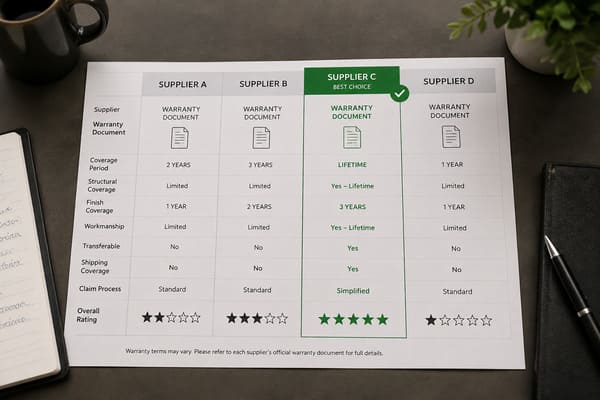
About six months ago, I sat down with a modification shop manager in Canada who was comparing quotes from four different wheel suppliers — including us. He showed me all four warranty documents side by side. One supplier offered "12-month coverage" but required the buyer to pay international return shipping, which would have cost him $300 to $400 per set12. Another offered a "satisfaction guarantee" with no mention of structural defects at all. A third had a warranty that was only valid if the wheels were installed by a "certified partner shop" — a list that didn’t include anyone in his city. Our warranty was the shortest document of the four — but it was the most direct. He chose us.
A Side-by-Side Framework for Evaluating Supplier Warranties
When comparing warranty terms, it helps to use a consistent framework. Here is the structure I recommend to any buyer doing supplier research:
| Evaluation Criteria | Red Flag | Green Flag |
|---|---|---|
| Coverage definition | Vague terms like "normal use" or "standard conditions" | Specific defect types listed clearly |
| Return shipping responsibility | Buyer pays all international shipping costs | Supplier handles or shares the cost |
| Claim response time | No timeline stated | Specific response window committed in writing |
| Installation requirements | Only valid at "certified" shops with a limited list | Valid with documented proper installation |
| Exclusion clauses | Long list of exclusions that covers almost every real scenario | Short, reasonable exclusion list with clear logic |
| Warranty length vs. price ratio | Long warranty on very low-priced product | Warranty length matches realistic product lifespan |
I tell every buyer the same thing: read the exclusion clauses first. That section tells you more about how a supplier plans to handle a claim than the headline warranty period ever will. At Tree Wheels, our exclusions are short and reasonable — because our product doesn’t need a long list of escape routes.
Conclusion
The warranty is not paperwork. It’s the clearest signal of how much a manufacturer trusts their own product. Ask the right questions before you order, not after something breaks. Tree Wheels offers a 1-year replacement or repair warranty — backed by 20+ years of forged wheel production and a team that answers when you call.
-
"Review of Magnesium Wheel Types and Methods of Their …", https://pmc.ncbi.nlm.nih.gov/articles/PMC10856444/. Metallurgical research on aluminum alloy forming processes demonstrates that forging aligns grain flow with component geometry, resulting in improved tensile strength, fatigue resistance, and reduced porosity relative to casting, properties directly relevant to wheel structural performance. Evidence role: mechanism; source type: research. Supports: That the forging manufacturing process produces aluminum wheels with superior grain structure alignment and mechanical properties compared to casting, providing a technical basis for premium product positioning. Scope note: The magnitude of performance differences depends on specific alloy grades, forging parameters, and post-processing; not all forged wheels are superior to all cast alternatives, and quality varies by manufacturer. ↩
-
"FTC Warns Companies to Stop Warranty Practices That Harm …", https://www.ftc.gov/news-events/news/press-releases/2024/07/ftc-warns-companies-stop-warranty-practices-harm-consumers-right-repair. Legal scholarship on consumer contract transparency has noted that ambiguous warranty terms can create informational asymmetries that disadvantage consumers, as buyers may systematically overestimate coverage scope when terms are not precisely defined. Evidence role: general_support; source type: research. Supports: That ambiguous warranty language can mislead consumers into overestimating their legal protections, potentially resulting in worse outcomes than transparent disclosure of no warranty coverage. Scope note: Direct empirical studies measuring consumer harm from vague wheel warranties specifically are not available; the claim is supported by analogy to broader consumer contract research. ↩
-
"Businessperson’s Guide to Federal Warranty Law", https://www.ftc.gov/business-guidance/resources/businesspersons-guide-federal-warranty-law. The U.S. Magnuson-Moss Warranty Act and equivalent consumer protection legislation in other jurisdictions establish frameworks for written warranty obligations on consumer products, within which the scope of ‘normal use’ coverage is a recurring point of legal interpretation and dispute. Evidence role: definition; source type: government. Supports: That ‘normal use’ is a legally and commercially significant concept in warranty coverage determinations, and that its precise definition affects consumer rights in warranty claims. Scope note: Statutory frameworks provide general warranty principles; jurisdiction-specific case law and individual contract language ultimately determine how ‘normal driving conditions’ is interpreted in a given warranty dispute. ↩
-
"Numerical Study of Crack Prediction and Growth in … – PMC", https://pmc.ncbi.nlm.nih.gov/articles/PMC10934620/. Failure analysis literature on cast and forged aluminum wheels identifies spoke junction regions as stress concentration points where manufacturing voids, inclusions, or inadequate forging flow can initiate cracking under service loads, supporting the characterization of such cracking as a potential manufacturing defect. Evidence role: case_reference; source type: research. Supports: That cracking at spoke junctions in forged aluminum wheels can be a manifestation of material or manufacturing defects, distinguishable through metallurgical analysis from impact or fatigue-induced damage. Scope note: Distinguishing manufacturing-origin cracking from service-induced fatigue at the spoke base requires metallurgical examination; the article’s anecdote does not describe whether such analysis was performed. ↩
-
"Are Chinese forged wheels any good?", https://treewheels.com/are-chinese-forged-wheels-any-good/. Industry trade bodies such as the Specialty Equipment Market Association (SEMA) publish aftermarket product guidelines that may reflect prevailing warranty norms among wheel manufacturers, against which the one-year claim can be evaluated. Evidence role: expert_consensus; source type: institution. Supports: That one year represents a commonly adopted warranty duration among forged wheel manufacturers in the premium aftermarket segment. Scope note: A specific published consensus document mandating a one-year standard for forged wheels may not exist; the claim may reflect common practice rather than a codified industry requirement. ↩
-
"A contribution to reliable rail transport: AI-powered real-time …", https://pmc.ncbi.nlm.nih.gov/articles/PMC12705657/. Research in metal fatigue and forged component quality assurance indicates that latent manufacturing defects commonly surface during initial loading cycles, supporting the claim that early service periods are the most diagnostically significant window for defect detection. Evidence role: general_support; source type: research. Supports: That manufacturing-origin defects in forged metal components tend to manifest early in the product lifecycle rather than after extended service. Scope note: Available literature addresses metal components broadly; peer-reviewed data specific to consumer forged aluminum wheels and a precise 3–6 month window may not be directly available. ↩
-
"FTC Action Leads to Lifetime Industry Ban for Operators of ‘ …", https://www.ftc.gov/news-events/news/press-releases/2023/03/ftc-action-leads-lifetime-industry-ban-operators-extended-vehicle-warranty-scam. Consumer protection research has documented that extended warranty contracts across product categories frequently include exclusion clauses broad enough to limit actual coverage substantially, raising questions about the relationship between warranty duration and genuine product quality assurance. Evidence role: general_support; source type: research. Supports: That extended warranty offers on low-cost products may be structured with exclusions that limit their practical value, functioning more as marketing signals than substantive consumer protections. Scope note: This body of research addresses extended warranties broadly across consumer goods categories; peer-reviewed studies examining this phenomenon specifically within the aftermarket automotive wheel segment are not widely available. ↩
-
"Interpretation ID: 86-1.39 – NHTSA", https://www.nhtsa.gov/interpretations/86-139. ISO 3006 and related SAE standards for passenger car and light truck wheels specify mechanical performance tests including radial fatigue, cornering fatigue, and impact testing, as well as dimensional conformance requirements, providing a recognized framework against which manufacturer quality claims can be evaluated. Evidence role: general_support; source type: institution. Supports: That material testing, dimensional inspection, and surface verification are recognized quality control steps in automotive wheel manufacturing. Scope note: Standards define minimum test requirements for market certification; the specific internal inspection practices of individual manufacturers may exceed or differ from these minimums. ↩
-
"Fatigue Crack Growth Analyses and Experimental …", https://rave.ohiolink.edu/etdc/view?acc_num=case1085750243. Engineering literature on bolted joint mechanics demonstrates that both over- and under-torquing of fasteners alter clamping force distribution and can introduce cyclic stress concentrations that initiate fatigue cracks, a mechanism applicable to aluminum wheel installations. Evidence role: mechanism; source type: research. Supports: That deviations from specified torque values during wheel fastening can induce localized stress concentrations leading to fatigue cracking in the wheel material. Scope note: The specific threshold of 10–15 ft-lbs as a damage-inducing deviation is not established in general fastener literature and may vary significantly by wheel material, design, and vehicle weight class. ↩
-
"[PDF] Wheel Failure Investigation Program: Phase I – ROSA P", https://rosap.ntl.bts.gov/view/dot/54652/dot_54652_DS1.pdf. Standards organizations including SAE International and the International Organization for Standardization (ISO) publish wheel load rating test protocols (e.g., ISO 3006) that define the load thresholds used to certify wheel structural adequacy, establishing the engineering basis for load-related failure claims. Evidence role: mechanism; source type: government. Supports: That automotive wheels are rated to specific load limits beyond which structural failure risk increases materially. Scope note: Published standards define test conditions and certification thresholds but do not always specify the precise margin at which real-world overloading transitions to failure, as this depends on wheel geometry, material, and load distribution. ↩
-
"Surface integrity in machined aluminum alloys", https://collections.lib.utah.edu/details?id=192121. Studies on protective coatings for aluminum alloys indicate that factory surface treatments are engineered as integrated systems; subsequent application of incompatible coatings can compromise adhesion, introduce galvanic pathways, or undermine the original corrosion barrier. Evidence role: mechanism; source type: research. Supports: That applying secondary coatings to factory-finished aluminum wheels can disrupt corrosion resistance and adhesion properties designed into the original surface treatment. Scope note: Evidence addresses coating compatibility in general aluminum alloy contexts; direct studies specific to aftermarket repainting of forged automotive wheels and warranty implications are limited in the published literature. ↩
-
"What is the shipping cost for forged wheels from overseas?", https://treewheels.com/what-is-the-shipping-cost-for-forged-wheels-from-overseas/. Freight rate data from international logistics carriers and customs authorities indicate that cross-border shipment of heavy automotive parts incurs substantial costs driven by dimensional weight, customs classification, and destination surcharges, supporting the claim that buyer-paid return shipping can represent a significant financial burden in warranty claims. Evidence role: general_support; source type: institution. Supports: That international return shipping for heavy automotive components such as wheel sets represents a significant cost that materially affects the practical value of a warranty requiring buyer-paid return freight. Scope note: Exact shipping costs vary by origin, destination, carrier, and shipment timing; the $300–$400 figure cited is anecdotal and may not reflect current or representative market rates. ↩