
Selecting wheels for a build feels straightforward until a set arrives and the caliper clearance is wrong. 6061 v-forged wheels sit at the premium end of the aftermarket wheel market, yet the label alone tells you less than most buyers assume. Skip the right verification steps and you are looking at a return shipment, a spacer workaround, or a customer who loses confidence in your shop.
The short answer: knowing a wheel is "6061 v-forged" confirms the base alloy and the general manufacturing process, but it does not confirm fitment. Fitment depends on three separate variables — diameter and width, offset (ET value), and hub bore diameter — all verified against the specific vehicle. It also depends on whether the alloy is 6061-T6 specifically, because the T6 heat treatment designation changes yield strength in ways that matter at load.
The sections below walk through each layer of that decision. I will cover the alloy distinction first, explain what "V-forged" actually describes about the manufacturing process, and then move through the fitment variables in the order they tend to cause problems in real orders.
Is 6061 the same as 6061-T6 in forged wheels?
Buyers sometimes receive a spec sheet marked "6061 aluminum alloy" and treat that as a complete answer. It is not. The T6 designation indicates a specific heat treatment applied after forging, and without it, yield strength can vary significantly across batches or suppliers.
6061 refers to the aluminum alloy composition. 6061-T6 means the alloy has been solution heat-treated and artificially aged to a defined temper1. The T6 process raises yield strength to approximately 276 MPa compared to roughly 55 MPa for the annealed (O temper) state2 — a difference that directly affects how the wheel performs under load cycling.

This distinction comes up regularly in our order consultations. A shop will ask whether a wheel is "6061 forged" and interpret the answer as sufficient for a high-load application. The better question to ask any supplier — including us — is: Is this 6061-T6, and can you provide the certification documentation to confirm it?
Why the T6 designation matters for wheel buyers
Forged aluminum wheels carry dynamic loads: cornering forces, braking torque, and road impact. The yield strength of the alloy determines how the wheel absorbs and distributes those loads before permanent deformation occurs.
Here is a simplified comparison of 6061 temper states relevant to wheel evaluation:
| Temper Designation | Condition | Approximate Yield Strength |
|---|---|---|
| 6061-O | Annealed (soft) | ~55 MPa |
| 6061-T4 | Solution treated, naturally aged | ~145 MPa3 |
| 6061-T6 | Solution treated, artificially aged | ~276 MPa |
Buyer takeaway: A wheel labeled "6061" without the T6 suffix leaves the temper state unspecified. Request documentation. Certifications from DOT or TÜV testing reference the actual wheel assembly performance4, but they do not always make the alloy temper legible on the spec sheet. Ask both questions.
What certification documentation covers — and what it does not
At Tree Wheels, our manufacturing partner holds ISO9001, IATF16949, DOT, and TÜV certifications5. These represent third-party verification of quality management processes and structural performance testing against defined load and impact standards.
What certification documents confirm:
- That the wheel passed specific load, radial fatigue, and impact tests at the time of testing
- That the quality management system meets defined international standards
What certification documents do not automatically confirm:
- The exact alloy temper of any specific production batch you are ordering
- That every wheel off the line was individually tested
This is not a flaw unique to any one manufacturer — it is how certification works across the industry. Your job as a buyer is to ask for the alloy spec in writing alongside the certification documents. A supplier who cannot produce both leaves a gap in your procurement record.
What does "V-forged" actually mean for wheel construction?
The term "V-forged" describes a specific manufacturing process variation, not just a premium category label. Buyers who assume all forged wheels are equivalent are comparing specs that do not measure the same thing.
V-forged wheels — also referred to as flow-formed or rotary-forged wheels — combine an initial forging of the center section with a spinning and rolling process applied to the barrel6. This concentrates the grain structure in the barrel wall, producing a lighter, stronger rim section compared to a standard monoblock forging of equivalent diameter and width.
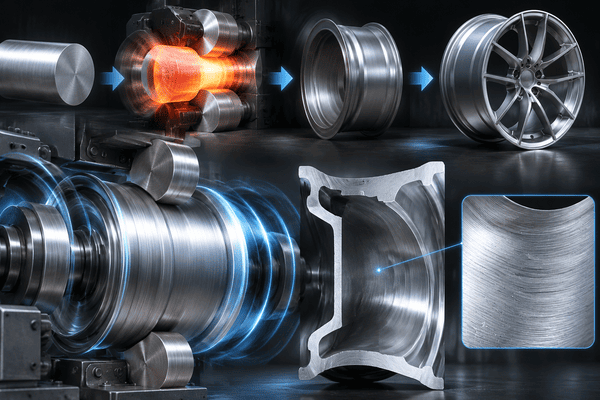
The practical consequence is a wheel that achieves lower unsprung weight without sacrificing the load-bearing capacity of the rim section — which is where impact stress concentrates.
Forging process comparison: what changes at the barrel
Standard monoblock forging shapes the entire wheel — center and barrel — from a single billet under press force. The grain structure is improved over casting throughout, but the barrel wall thickness must be conservative to meet load requirements.
V-forging applies additional rotary pressure to the barrel after the initial forge. The material is worked under compression while spinning, which:
- Elongates and aligns the grain structure along the barrel wall
- Allows the barrel wall to be thinned while maintaining or improving strength per unit of material
- Reduces total wheel weight without reducing the center section’s structural integrity
For a modification shop, this matters in two practical ways:
- Weight reduction is real and measurable. A V-forged wheel in a given size will typically be lighter than a conventionally forged wheel in the same size and alloy. Lower unsprung weight affects handling response7 — a point worth communicating to performance-oriented customers.
- The weight reduction comes from the barrel, not the center. This means the structural hub mounting area is not compromised to achieve the weight target.
What V-forged does not guarantee on its own
Process improvement does not substitute for correct fitment. A V-forged 6061-T6 wheel installed at the wrong offset will still cause caliper contact. The manufacturing quality of the wheel is one dimension of the decision; dimensional compatibility with the vehicle is a separate dimension that the wheel’s construction cannot resolve.
How do I verify 6061 v-forged wheels fitment before ordering?
The most common mistake in wheel orders is treating size as the only fitment variable. Diameter and width matching is necessary — but it leaves two other variables unverified, both of which cause real problems on installation day.
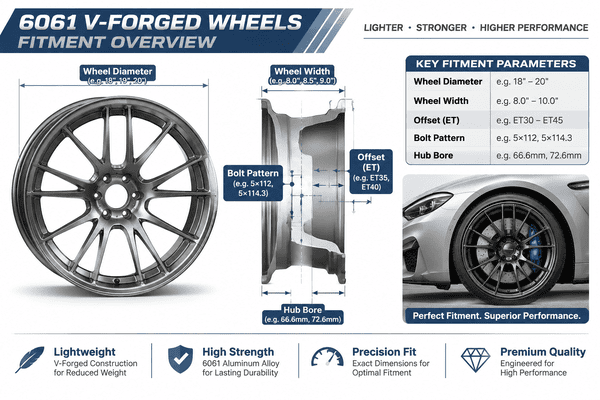
6061 v-forged wheels fitment requires a three-variable check: (1) diameter and width matched to the vehicle’s tire and arch clearance specifications, (2) offset (ET value) verified against the vehicle’s caliper clearance and desired stance, and (3) hub bore diameter confirmed against the vehicle’s center bore. All three must align before ordering.
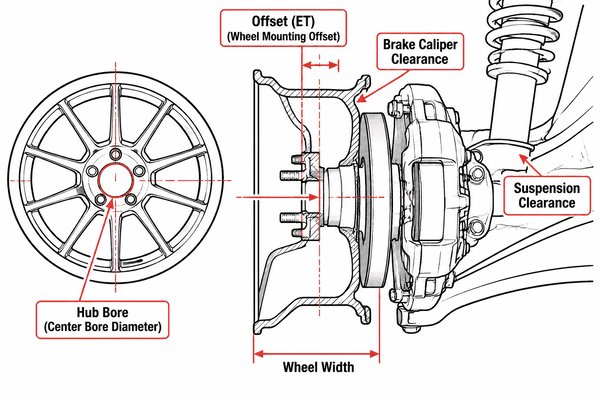
In orders we have processed, offset mismatches account for the majority of fitment problems that surface post-delivery. Hub bore issues come second, and they tend to appear at speed rather than on the lift.
Variable 1: Diameter and width
This is where most buyers start, and it is the most visible dimension. Match the wheel diameter to the vehicle’s tire sizing requirements. Width must suit the tire’s mounting width range and clear the inner suspension components.
Key checks:
- Confirm the tire’s minimum and maximum rim width from the tire manufacturer’s spec, not just the existing setup
- Check inner arch clearance — especially relevant on lowered vehicles or aggressive offsets
- Verify overall diameter against speedometer calibration if the customer is changing from stock tire sizing
Variable 2: Offset (ET value)
Offset is the distance in millimeters from the wheel’s mounting face to its centerline. Positive offset pushes the mounting face toward the outside of the wheel; negative offset moves it inward.
| Offset Type | Mounting Face Position | Common Application |
|---|---|---|
| Positive (e.g., ET45) | Toward outer face | Most modern passenger cars and crossovers |
| Zero (ET0) | At centerline | Trucks, some performance platforms |
| Negative (e.g., ET-10) | Toward inner face | Wide-body builds, certain off-road applications |
Why offset is the most consequential fitment variable:
- Too much positive offset can bring the inner barrel into contact with the caliper or suspension arm
- Too little positive offset (or negative) can push the wheel outside the arch, causing rubbing under compression or steering lock
A common question we get from shops is whether they can resolve an offset mismatch with wheel spacers. Spacers are a workable solution in some builds, but they introduce additional mounting variables and should not be the default fix for an ordering error. Get the offset right at the selection stage.
Variable 3: Hub bore diameter
Hub bore is the center hole diameter of the wheel. It must match or exceed the vehicle’s center bore diameter. When a wheel’s hub bore is larger than the vehicle’s center bore, hub-centric rings close the gap.
This variable is frequently under-checked on unfamiliar vehicle platforms. Here is why it matters:
- Lug-centric fitment (where the lug nuts carry all centering load) works at low speeds but creates vibration at highway speeds on many platforms
- Hub-centric fitment transfers centering load to the hub flange, reducing vibration risk
- The PCD (pitch circle diameter — e.g., 5×114.3) confirms the lug bolt pattern. It does not confirm center bore. Both must be checked separately.8
Practical note: Always record the vehicle’s center bore measurement alongside the PCD when specifying an order. Hub-centric rings are an inexpensive solution when bore sizes do not match exactly — but only if you know the mismatch exists before delivery.
Frequently Asked Questions
Does "forged" automatically mean 6061-T6 alloy?
No. "Forged" describes the manufacturing process — shaping under press force — not the alloy or its temper state. A wheel can be forged from several aluminum alloys. 6061-T6 is a common choice for performance wheels, but the T6 heat treatment must be confirmed in the supplier’s documentation separately.
Can I use the same offset as my OEM wheels when upgrading to 6061 v-forged wheels?
OEM offset is a useful starting reference, but it is not a guarantee of correct fitment for aftermarket wheels with different widths or barrel profiles. If you are changing wheel width as part of the upgrade, offset must be recalculated — wider wheels at the same offset will sit further inward than the original setup.
What is the minimum order quantity for custom 6061 v-forged wheels from Tree Wheels?
Our minimum order quantity is four wheels. This applies to one-piece, two-piece, and three-piece forged configurations. Production time for one-piece V-forged wheels runs 15 to 20 days from order confirmation.
How do I know if I need hub-centric rings for my fitment?
Compare the wheel’s center bore diameter to your vehicle’s hub flange diameter. If the wheel bore is larger than the hub, hub-centric rings of the correct size will close the gap and restore hub-centric load transfer. If the diameters match exactly, rings are not needed.
Are 6061 v-forged wheels suitable for daily-driven vehicles?
The alloy and process are used across both performance and daily-driven applications. Suitability depends on the specific wheel’s load rating relative to the vehicle’s weight, the offset’s compatibility with the vehicle platform, and correct installation torque. A wheel that meets DOT or TÜV load standards for the vehicle class is the appropriate benchmark9 — not a general category claim.
Conclusion
6061 v-forged wheels represent a well-established combination of alloy and manufacturing process — but the label is a starting point, not a complete fitment answer. The key takeaways from this article: confirm the T6 temper designation in writing, understand that V-forging improves barrel wall properties in ways that standard monoblock forging does not replicate, and verify all three fitment variables — size, offset, and hub bore — before placing an order.
Skipping any of these steps shifts the cost of the error downstream, onto the installer or the customer. That is a preventable outcome.
If you are mid-process on a fitment decision and need to verify specifications for a specific vehicle application, reach out to us at Tree Wheels. We work through fitment consultations at the order stage and can help you confirm the right dimensions before production begins.
-
"Custom Casting Wheels", https://treewheels.com/casting-wheels/. The Aluminum Association’s temper designation system, codified in ANSI H35.1, defines the T6 temper as solution heat-treated and then artificially aged, distinguishing it from T4 (naturally aged) and other T-series designations. Evidence role: definition; source type: institution. Supports: The T6 temper designation denotes solution heat treatment followed by artificial aging. ↩
-
"6061 aluminium alloy", https://en.wikipedia.org/wiki/6061_aluminium_alloy. The Aluminum Association and ASM International material data sheets list the typical tensile yield strength of 6061-T6 at approximately 276 MPa (40 ksi) and 6061-O at approximately 55 MPa (8 ksi), reflecting the substantial strengthening effect of the T6 heat treatment cycle. Evidence role: statistic; source type: institution. Supports: Yield strength values for 6061 aluminum in O and T6 temper states. Scope note: Published values represent typical or minimum guaranteed properties; actual batch properties may vary within specification tolerances ↩
-
"6061 aluminium alloy", https://en.wikipedia.org/wiki/6061_aluminium_alloy. Material property databases such as those maintained by ASM International and MatWeb report the typical tensile yield strength of 6061-T4 aluminum at approximately 145 MPa (21 ksi), intermediate between the annealed and fully aged T6 conditions. Evidence role: statistic; source type: institution. Supports: Yield strength of 6061-T4 aluminum alloy at approximately 145 MPa. Scope note: Values are typical rather than guaranteed minimums; specification sheets from individual suppliers may cite slightly different figures depending on the testing standard applied ↩
-
"What Are JWL, VIA, and TÜV Certifications for Wheels?", https://treewheels.com/what-are-jwl-via-and-tuv-certifications-for-wheels/. TÜV certification for automotive wheels typically references testing protocols aligned with standards such as SAE J2530, ISO 3006, or equivalent national standards, encompassing radial fatigue, cornering fatigue, and dynamic impact tests conducted by an accredited third-party laboratory. Evidence role: definition; source type: institution. Supports: TÜV wheel certification involves third-party testing against defined structural performance standards including radial fatigue, cornering fatigue, and impact tests. Scope note: TÜV certification confirms performance of tested samples under specified conditions; it does not constitute 100% production inspection of every wheel manufactured ↩
-
"IATF 16949", https://en.wikipedia.org/wiki/IATF_16949. IATF 16949, published by the International Automotive Task Force, specifies quality management system requirements for organizations in the automotive production and relevant service part supply chain; it is built upon ISO 9001 and adds automotive-specific requirements for defect prevention and reduction of variation, but does not itself certify the performance of individual products. Evidence role: definition; source type: institution. Supports: IATF 16949 is an international quality management system standard specific to automotive production and service part organizations. Scope note: IATF 16949 certification attests to the quality management system of the manufacturing organization, not to the mechanical properties or dimensional accuracy of any specific wheel produced ↩
-
"What Are the Cost Differences Between One-Piece and Multi- …", https://treewheels.com/what-are-the-cost-differences-between-one-piece-and-multi-piece-forged-wheels/. Manufacturing engineering literature describes flow-forming (also termed rotary forging or spin-forming) as a process in which a pre-formed wheel center is mounted on a mandrel and rollers apply radial pressure while the workpiece rotates, elongating the barrel wall and refining its grain structure without additional material. Evidence role: mechanism; source type: research. Supports: Flow-forming or rotary-forging applies compressive spinning to the barrel of a pre-forged wheel center, aligning grain structure and enabling thinner barrel walls. Scope note: The specific trade name ‘V-forged’ is a marketing designation; its precise process parameters may differ by manufacturer, and direct equivalence to standardized flow-forming definitions should be confirmed with the supplier ↩
-
"Influence of unsprung weight on vehicle ride quality – ADS", https://ui.adsabs.harvard.edu/abs/1988JSV…124..497H/abstract. Vehicle dynamics engineering literature establishes that unsprung mass — the mass of components not supported by the suspension spring, including wheels and tires — directly influences wheel hop frequency and the suspension’s ability to maintain tire contact with the road surface; reductions in unsprung mass generally improve transient handling response and ride quality. Evidence role: mechanism; source type: research. Supports: Reducing unsprung mass at the wheel improves suspension response and handling dynamics. Scope note: The magnitude of the handling benefit depends on the total vehicle mass, suspension geometry, and the absolute reduction achieved; perceptible differences may be modest in passenger car applications ↩
-
"Bolt circle", https://en.wikipedia.org/wiki/Bolt_circle. Pitch circle diameter (PCD) defines the diameter of the circle passing through the centers of the wheel’s bolt holes and determines lug pattern compatibility, while center bore (hub bore) refers to the diameter of the central aperture of the wheel; these are geometrically independent dimensions, and a wheel may match a vehicle’s PCD while having an incompatible center bore. Evidence role: definition; source type: encyclopedia. Supports: Pitch circle diameter and center bore are distinct wheel fitment dimensions that must be independently verified. ↩
-
"5.1.15 Wheels (393.205) – CSA – Department of Transportation", https://csa.fmcsa.dot.gov/safetyplanner/MyFiles/SubSections.aspx?ch=22&sec=64&sub=144. In the United States, the Department of Transportation’s National Highway Traffic Safety Administration (NHTSA) establishes vehicle safety standards under the Federal Motor Vehicle Safety Standards (FMVSS); aftermarket wheel manufacturers may reference DOT compliance in the context of these standards, though specific wheel load rating certification often follows industry standards such as SAE J2530 rather than a dedicated FMVSS wheel standard. Evidence role: definition; source type: government. Supports: DOT references a U.S. regulatory framework applicable to wheel performance standards. Scope note: DOT compliance claims for aftermarket wheels should be verified against the specific standard cited, as the term is sometimes used loosely in marketing materials ↩