
Most buyers ask the wrong first question. They ask about price. But price alone will not protect you from failed inspections, delayed shipments, or angry customers.
The right questions to ask a forged wheel manufacturer cover four areas: certifications, production capacity, customization options, and lead times. Getting clear answers to these four questions will tell you more about a supplier than any price quote ever will.
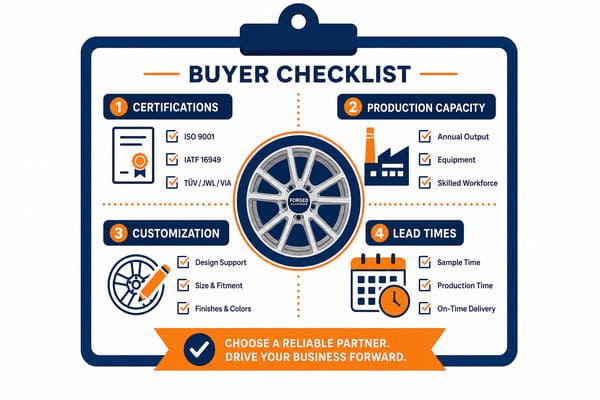
I have spoken with dozens of modification shop owners who came to us after a bad experience with another supplier. The pattern is almost always the same. They saved $30 per wheel upfront, then spent $200 per wheel dealing with the aftermath — failed inspections, replacements, and angry customers1. The real question is not "how cheap can I get this?" It is "how do I make sure I am choosing the right manufacturer from the start?" The four sections below will help you do exactly that.
What Certifications Should a Forged Wheel Manufacturer Have?
Skipping the certification check feels harmless until the wheels are sitting in a customs warehouse and your customer is waiting. One wrong decision at this step can cost you thousands before a single wheel reaches the road.
A forged wheel manufacturer should hold at minimum four certifications: ISO9001 for quality management2, DOT for road use in the United States3, TÜV for safety compliance in Europe and Australia4, and IATF16949 as the highest-level automotive quality system standard5. If a supplier cannot provide all four, treat that as a serious risk.
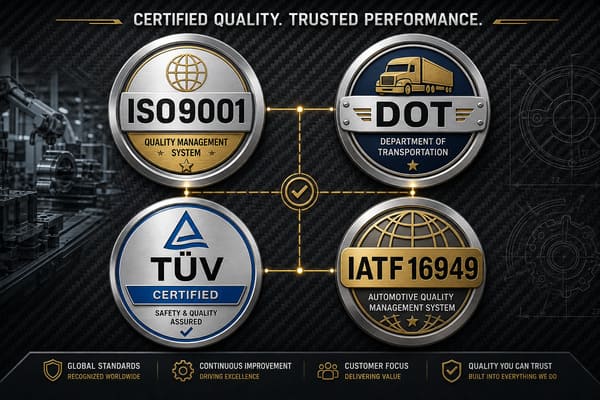
I remember a buyer from the U.S. who contacted us in a panic. He had placed an order with a cheaper supplier. When the wheels arrived at the port, customs held them because the products had no DOT certification6. He had 200 wheels sitting in a warehouse, a customer waiting, and no way to release the goods. That single decision — skipping the certification check — cost him over $8,000 in storage fees, re-shipping costs, and refunds.
Why Each Certification Matters
Each certification serves a different purpose, and each one protects you in a different market. The table below breaks this down clearly.
| Certification | What It Covers | Market It Protects |
|---|---|---|
| ISO9001 | Quality management systems | Global baseline standard |
| DOT | Road safety compliance | United States |
| TÜV | Structural and safety testing | Europe, Australia |
| IATF16949 | Automotive-grade quality systems | All major automotive markets |
At Tree Wheels, we hold all four certifications. We did not get them to display on a website. We got them because our clients sell into the U.S., Canada, Australia, the UK, and the Middle East, and every one of those markets will ask for proof. When you ask a supplier for their certifications, do not just accept a yes or no answer. Ask to see the actual documents. Check the expiry dates. Check that the certification covers the specific product type you are ordering. A certificate that covers steel parts does not automatically cover forged aluminum wheels. This one detail catches many buyers off guard.
How Do You Evaluate a Manufacturer’s Production Capacity for Forged Wheels?
A large factory floor and rows of machines can look very impressive during a visit. But impressive photos do not tell you whether your order will arrive on time. Capacity is not about size. It is about systems.
To evaluate a forged wheel manufacturer’s production capacity, ask three specific questions: What is the minimum order quantity? How many active SKUs can they run at the same time? Is surface finishing done in-house or sent to a third party7? These three answers will tell you whether their lead time promises are real.
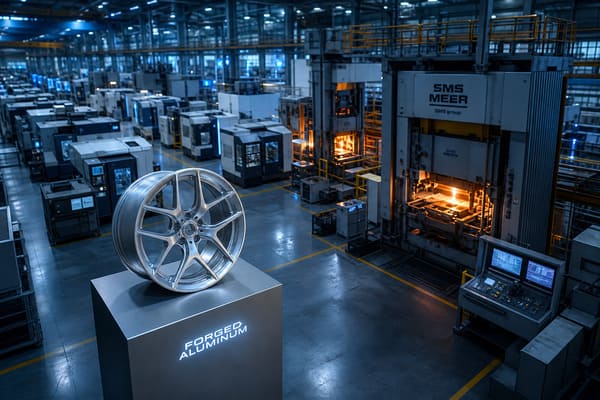
A buyer from Australia once sent me photos of a factory he had visited. Big floor space, rows of machines, very impressive. He placed an order for 120 wheels and was promised a 20-day lead time. The wheels arrived in 47 days. His customer had already cancelled. The factory looked capable, but it was running 11 other large orders at the same time and had no real scheduling system.
Breaking Down the Three Capacity Signals
Production capacity is a practical question, not a visual one. Here is how to read each signal correctly.
| Capacity Signal | What to Ask | What a Good Answer Looks Like |
|---|---|---|
| Minimum Order Quantity (MOQ) | What is your MOQ? | Low MOQ (such as 4 wheels) shows flexibility and real production control |
| Parallel SKU capacity | How many active orders do you run at once? | A clear number with a scheduling system behind it |
| Finishing process | Is surface treatment done in-house? | In-house finishing means fewer handoffs and tighter timeline control |
At Tree Wheels, our MOQ is just 4 wheels. This means we work with small modification shops and individual car owners, not only large distributors. Our standard lead times are 15–20 days for one-piece forged wheels, 20–25 days for two-piece, and 30–35 days for three-piece8. These numbers come from running this process for over 20 years. They are real production commitments, not sales estimates designed to win the order. When a supplier gives you a lead time, ask them to walk you through each production stage and the time each stage takes. If they cannot do that, the number they gave you is a guess.
What Customization Options Should a Forged Wheel Supplier Offer?
Many suppliers say they offer custom wheels. What they actually offer is a fixed catalog with a few color options. Real customization starts from nothing and builds to exactly what the client needs.
A proper forged wheel supplier should be able to customize size, spoke design, surface finish, and color — all from a single reference image or rough sketch. If a supplier can only modify existing molds, they are a catalog seller, not a true custom manufacturer.
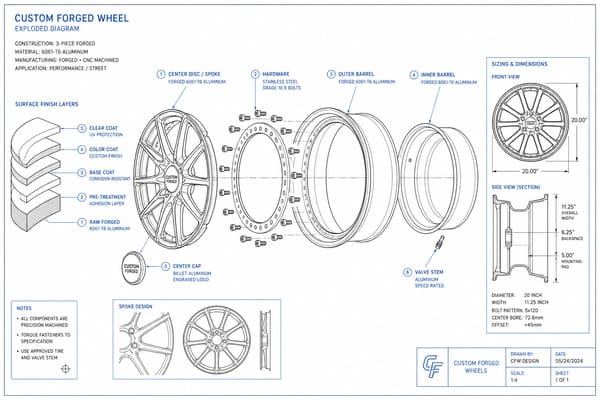
One of our clients runs a luxury car modification shop in Dubai. He came to us with a hand-drawn sketch on an A4 piece of paper — a wheel design he had been thinking about for months. No CAD file, no technical drawing, just a rough idea. Within 5 days, we sent him a full 3D rendering. Within 12 days, we had a physical sample ready for his approval. That is what real customization looks like.
The Full Range of Custom Options
Real customization covers every visible and structural element of the wheel. The table below shows what a capable supplier should be able to handle.
| Customization Area | What It Includes | What to Watch Out For |
|---|---|---|
| Size | Diameter, width, offset, PCD | Suppliers who only offer standard sizing |
| Spoke design | Custom spoke count, shape, and depth | Suppliers limited to existing mold designs |
| Surface finish | Polished, brushed, matte, gloss, two-tone, custom paint | Suppliers who only offer 2–3 finish options |
| Color | Full custom color matching from reference | Suppliers who only work from a fixed color chart |
| Design support | Sketch to 3D model to physical sample | Suppliers who require a completed CAD file to start |
At Tree Wheels, we offer all of the above. We start from client drawings, reference images, or even rough sketches, and we provide design sketches, 3D models, and physical samples before production begins. The surface treatments we offer include polished, brushed, matte, gloss, two-tone, and fully custom paint finishes. If a supplier cannot start from a sketch, they are not a true custom manufacturer. Ask them directly: "Can you start from a hand-drawn reference?" The answer will tell you everything.
What Should Buyers Know About Lead Times for Forged Wheels?
Lead times for forged wheels are not flexible in the way buyers sometimes hope. The process has real physical requirements at every stage, and no supplier can skip them without cutting corners.
Forged wheel lead times depend on the product type: 15–20 days for one-piece, 20–25 days for two-piece, and 30–35 days for three-piece. Any supplier quoting under 10 days for a custom forged wheel either has your exact spec already in stock or is giving you a number that is not based on the actual process.
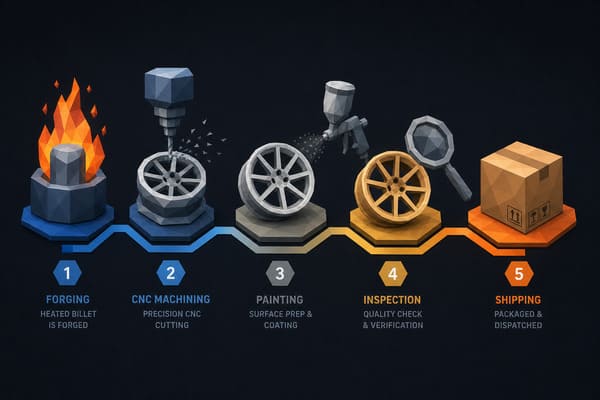
I tell every new buyer the same thing before they place their first order: forged wheels cannot be rushed9. The forging process alone involves heating the aluminum billet to over 400°C, pressing it under thousands of tons of force10, and then letting it cool under controlled conditions11. After that comes CNC machining, surface treatment, quality inspection, and packaging. Each step has a minimum time requirement that no supplier can compress without affecting the result.
What the Production Timeline Actually Looks Like
Understanding the stages helps you plan your order and spot unrealistic promises from suppliers.
| Production Stage | What Happens | Why It Cannot Be Skipped |
|---|---|---|
| Forging | Billet heated, pressed, and cooled | Cooling time is fixed by material science |
| CNC Machining | Wheel shaped to exact dimensions | Precision work that cannot be rushed |
| Surface Treatment | Finish applied and cured | Curing time depends on the finish type |
| Quality Inspection | Structural and visual checks | Required before any certified product ships |
| Packaging & Shipping | Foam inserts, corner guards, seven-layer cartons applied | Protects the wheel through transit |
At Tree Wheels, we give buyers a full production timeline on day one. We update them at each milestone. We also handle door-to-door shipping with foam inserts, corner guards, and seven-layer corrugated cartons12 — because a wheel that arrives damaged is the same as a wheel that never arrived. If a supplier cannot give you a stage-by-stage breakdown of their lead time, that lead time is not based on their actual process.
Conclusion
Ask the right questions from the start. Certifications, capacity, customization, and lead times matter far more than price alone. Tree Wheels delivers certified, fully custom forged wheels with transparent timelines and door-to-door shipping worldwide.
-
"The U.S. Automotive Industry Supply Chain – Boise State University", https://www.boisestate.edu/cobe/blog/2025/02/the-u-s-automotive-industry-supply-chain-challenges-and-transformations/. Research on supply chain quality failures in the automotive sector consistently finds that the total cost of poor quality—including inspection failures, rework, returns, and customer dissatisfaction—substantially exceeds the initial cost differential that motivated lower-cost sourcing decisions (Juran, J.M. & De Feo, J.A., ‘Juran’s Quality Handbook,’ 6th ed., McGraw-Hill, 2010). Evidence role: general_support; source type: research. Supports: Non-compliance with automotive component quality standards generates downstream costs substantially exceeding initial procurement savings. Scope note: The specific cost ratio cited in the article ($30 vs. $200 per wheel) is the manufacturer’s own illustrative example and is not validated by the cited general quality cost literature. ↩
-
"IATF 16949 – Wikipedia", https://en.wikipedia.org/wiki/IATF_16949. ISO 9001 is maintained by the International Organization for Standardization and specifies requirements for a quality management system that organizations can use to demonstrate the ability to consistently provide products meeting customer and regulatory requirements (ISO, iso.org/iso-9001-quality-management.html). Evidence role: definition; source type: institution. Supports: ISO 9001 is an internationally recognized quality management system standard published by the International Organization for Standardization. Scope note: The standard applies broadly across industries; its specific enforcement in the forged wheel sector depends on individual market regulations. ↩
-
"Interpretation ID: 86-1.39 – NHTSA", https://www.nhtsa.gov/interpretations/86-139. The U.S. Department of Transportation’s National Highway Traffic Safety Administration (NHTSA) administers Federal Motor Vehicle Safety Standards (FMVSS) that establish minimum performance requirements for motor vehicle equipment, including wheels intended for road use (NHTSA, nhtsa.gov/laws-regulations/fmvss). Evidence role: definition; source type: government. Supports: The U.S. Department of Transportation, through NHTSA, sets Federal Motor Vehicle Safety Standards that govern automotive component compliance for road use. Scope note: DOT marking requirements for wheels are self-certification based; buyers should confirm specific FMVSS applicability to imported forged wheels with a compliance specialist. ↩
-
"What Are JWL, VIA, and TÜV Certifications for Wheels? – Tree …", https://treewheels.com/what-are-jwl-via-and-tuv-certifications-for-wheels/. TÜV (Technischer Überwachungsverein) refers to a group of German technical inspection organizations that conduct safety and quality testing for automotive components; TÜV certification is widely accepted as evidence of compliance with European and Australian road safety standards, though it is issued by a private body rather than a government authority. Evidence role: definition; source type: institution. Supports: TÜV is a private technical inspection and certification organization whose testing services are widely accepted by European and Australian regulatory frameworks for automotive components. Scope note: TÜV acceptance may vary by jurisdiction; buyers should confirm specific national requirements with local regulatory authorities. ↩
-
"IATF 16949 – Wikipedia", https://en.wikipedia.org/wiki/IATF_16949. IATF 16949 is published by the International Automotive Task Force (IATF) and specifies quality management system requirements for automotive production and relevant service part organizations, incorporating and supplementing ISO 9001 with automotive-sector-specific requirements (IATF, iatfglobaloversight.org). Evidence role: definition; source type: institution. Supports: IATF 16949 is an automotive-specific quality management standard published by the International Automotive Task Force that builds on ISO 9001 with additional requirements for the automotive supply chain. Scope note: The characterization of IATF 16949 as the ‘highest-level’ standard is contextual; its relevance depends on the specific supply chain tier and customer requirements. ↩
-
"Importing a Motor Vehicle", https://www.cbp.gov/trade/basic-import-export/importing-car. U.S. Customs and Border Protection (CBP), acting in coordination with NHTSA, is authorized to detain or refuse entry to motor vehicle equipment that does not conform to applicable Federal Motor Vehicle Safety Standards; importers bear responsibility for ensuring compliance prior to shipment (CBP, ‘Importing Motor Vehicles and Motor Vehicle Equipment,’ cbp.gov). Evidence role: mechanism; source type: government. Supports: U.S. Customs and Border Protection enforces NHTSA safety standards at the border, and non-compliant motor vehicle equipment may be detained or refused entry. Scope note: Specific enforcement actions depend on CBP port-of-entry procedures and the nature of the shipment; the article’s anecdote cannot be independently verified. ↩
-
"Vertical integration, supply chain disruptions, and …", https://www.sciencedirect.com/science/article/abs/pii/S0890838925000897. Operations management literature identifies vertical integration of production stages as a mechanism for reducing coordination costs, minimizing transport-related delays between sub-processes, and enabling tighter quality oversight; outsourcing finishing operations introduces additional scheduling dependencies and inspection handoff points (Chase, R.B., Aquilano, N.J. & Jacobs, F.R., ‘Operations Management for Competitive Advantage,’ McGraw-Hill). Evidence role: general_support; source type: research. Supports: Vertical integration of manufacturing sub-processes, including surface treatment, reduces inter-firm handoffs, shortens total lead times, and enhances quality control visibility. Scope note: The benefit of in-house finishing is contextual and depends on facility scale, process capability, and order volume; the article’s assertion is directionally supported but not universally applicable. ↩
-
"How Long Does It Take to Manufacture Custom Forged Wheels?", https://treewheels.com/how-long-does-it-take-to-manufacture-custom-forged-wheels/. Multi-piece wheel construction requires additional manufacturing steps including separate forging or spinning of barrel components, precision machining of mating surfaces, and mechanical or adhesive assembly, each of which adds to total production time relative to a one-piece design (SAE International, Technical Paper on Wheel Design and Manufacturing Processes). Evidence role: general_support; source type: other. Supports: Multi-piece forged wheel construction involves additional assembly and machining steps that extend production timelines relative to single-piece designs. Scope note: The specific day ranges cited are the manufacturer’s own estimates; independent industry-wide benchmarks for these lead time windows were not located. ↩
-
"(PDF) Manufacturing Processes of Car Alloy Wheels", https://www.academia.edu/83937836/Manufacturing_Processes_of_Car_Alloy_Wheels. Each stage of forged component production—including die forging, heat treatment, precision CNC machining, and surface coating—is governed by physical constraints such as thermal diffusion rates, cutting tool feed limits, and coating cure kinetics that establish minimum cycle times independent of production scheduling pressure (Kalpakjian, S. & Schmid, S.R., ‘Manufacturing Engineering and Technology,’ Pearson). Evidence role: mechanism; source type: research. Supports: Discrete manufacturing stages in forged metal components, including forging, heat treatment, CNC machining, and surface finishing, each have minimum cycle times governed by physical and chemical process constraints. Scope note: The cited textbook addresses manufacturing principles broadly; direct empirical data specific to forged aluminum wheel cycle times was not identified. ↩
-
"Optimization of Hot Forging Process Parameters of Alloy CuZn40Pb2 …", https://pmc.ncbi.nlm.nih.gov/articles/PMC13084498/. Aluminum alloy forging is typically performed at temperatures ranging from approximately 350°C to 500°C depending on alloy composition, with press forces in the range of thousands of tonnes required to achieve plastic deformation and the refined grain structure associated with superior mechanical properties (ASM International, ‘Aluminum and Aluminum Alloys,’ ASM Handbook Vol. 2). Evidence role: mechanism; source type: research. Supports: Aluminum alloy forging is conducted at elevated temperatures and high press forces to achieve the desired microstructure and mechanical properties. Scope note: Exact temperature and force parameters vary significantly by alloy grade, billet size, and die geometry; the figures cited in the article are illustrative rather than universally applicable. ↩
-
"The Natural Aging Behavior of Open-Die-Forged 7050 …", https://digitalcommons.calpoly.edu/cgi/viewcontent.cgi?article=1177&context=matesp. Post-forging heat treatment of aluminum alloys, including solution heat treatment, quenching, and artificial aging (T6 temper), involves time-dependent diffusion processes that determine final mechanical properties such as yield strength and fatigue resistance; shortening these stages degrades material performance (Davis, J.R., ed., ‘Aluminum and Aluminum Alloys,’ ASM International, 1993). Evidence role: mechanism; source type: research. Supports: Post-forging heat treatment and controlled cooling of aluminum alloys are required to achieve target mechanical properties and cannot be arbitrarily shortened without compromising material performance. Scope note: Specific treatment durations depend on alloy composition and part geometry; the article’s general claim is supported directionally but not for a specific wheel alloy. ↩
-
"Casting Wheels – Tree Wheels – Coustom Forged Automotive …", https://treewheels.com/casting-wheels/. Multi-wall corrugated board construction is specified for heavy or high-value industrial components requiring elevated stacking strength and impact resistance during long-distance freight; the International Safe Transit Association (ISTA) and ASTM D4169 provide test protocols for evaluating packaging performance under simulated distribution conditions (ISTA, ista.org; ASTM D4169, Standard Practice for Performance Testing of Shipping Containers). Evidence role: general_support; source type: institution. Supports: Multi-wall corrugated packaging with higher flute counts provides greater compression strength and impact resistance for heavy or high-value components during international freight transit. Scope note: The specific claim that seven-layer cartons are the appropriate specification for forged wheels is not directly validated by the cited standards, which establish testing frameworks rather than prescriptive layer counts. ↩