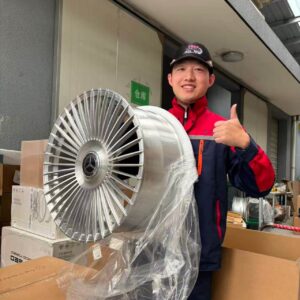

Getting the wrong hub bore is one of the most common — and most avoidable — mistakes in wheel fitment. It looks fine at first, but the problems show up fast once you start driving.
The Volkswagen Golf MK2 GTI requires a hub bore of 57.1mm1. This applies to both the 8V and 16V GTI variants produced between 1984 and 1992. Any aftermarket wheel fitted to this car should have a center bore machined to exactly 57.1mm for proper hub-centric fitment.
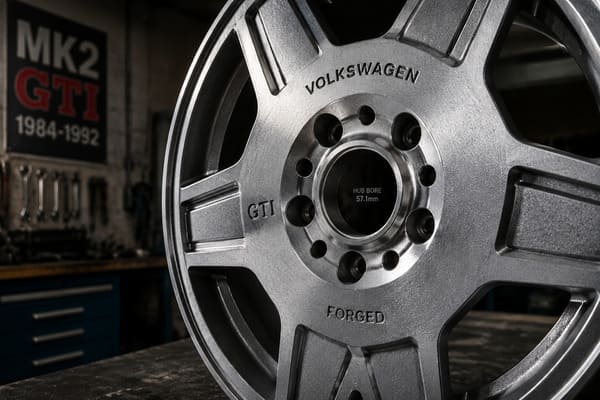
Hub bore is one of those specs that gets skipped over until something goes wrong. Bolt pattern gets all the attention, offset gets debated, but hub bore sits quietly in the background — until it causes a vibration you can’t balance out, or worse, a cracked wheel at 100km/h. I want to walk through everything you need to know about hub bore for the MK2 GTI, because I have seen what happens when this spec is ignored, and it is never a good outcome.
What Is the Hub Bore Size of a Volkswagen Golf MK2 GTI?
If you have ever ordered wheels for a classic car and skipped one spec, you know how fast that mistake becomes expensive. Hub bore is usually the one people forget.
The Golf MK2 GTI has a hub bore of 57.1mm across all engine variants. This includes the 1.8 8V and the 1.8 16V GTI models made from 1984 to 19922. The hub bore does not change between these variants — 57.1mm is the correct size for all of them.
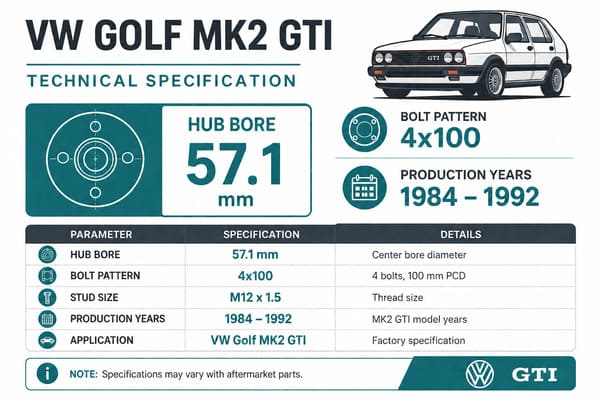
I remember one of our early customers — a modification shop owner in Australia — who ordered a set of custom forged wheels for his personal MK2 GTI. He sent us the bolt pattern, which is 4×1003, and he confirmed the offset. But he forgot to confirm the hub bore. We produced the wheels with a 73.1mm center bore, which is a common size we use for multi-fitment wheels. The wheels arrived, they physically mounted onto the car, and everything looked fine. Then he took the car onto the highway. At speed, he felt a consistent vibration he could not fix with balancing. He came back to us, and within 10 minutes of going through the specs together, we found the problem. The hub bore was 15.6mm too large. That gap — roughly the width of a pencil — was enough to throw the entire wheel off-center under load. We produced a correct set machined to 57.1mm, and the vibration disappeared completely. That one job changed how I handle every wheel order from that point forward. I now ask for hub bore first, before bolt pattern, before offset.
| Spec | Golf MK2 GTI (All Variants) |
|---|---|
| Hub Bore | 57.1mm |
| Bolt Pattern | 4×100 |
| Models Covered | 1.8 8V, 1.8 16V |
| Production Years | 1984–1992 |
The 57.1mm figure is not an approximation. It is the exact diameter of the raised centering flange on the axle hub. Any wheel you fit to this car should match that number precisely. If the bore is larger, you need hub-centric rings to fill the gap. If the bore is smaller, the wheel will not fit at all without machining. There is no middle ground here. When we produce custom forged wheels for a MK2 GTI at Tree Wheels, 57.1mm is the number we machine to, and we confirm it against the customer’s order before we start cutting. It takes two minutes to verify and saves a significant amount of trouble later.
Why Does Hub Bore Matter When Fitting Aftermarket Wheels?
Most people understand bolt pattern. Fewer people understand hub bore — until they experience what happens when it is wrong.
Hub bore determines whether a wheel is centered by the hub itself or only held in place by the lug bolts. A wheel centered by the hub is called hub-centric. A wheel held only by lug bolts is called lug-centric.4 For street driving, hub-centric fitment is the safer and more stable option by a significant margin5.
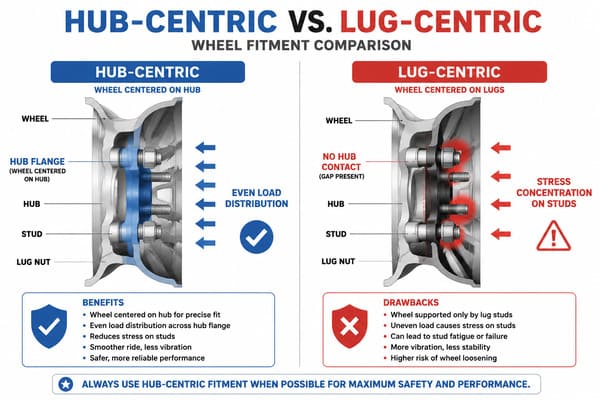
A customer once messaged me frustrated. He had bought a set of aftermarket wheels online for his MK2 GTI, and after about 3,000km of driving, two of the four wheels had developed small cracks around the bolt holes6. When I asked him about the hub bore, he had no idea what I was talking about. His wheels had a 72.6mm bore. The MK2 GTI hub is 57.1mm. That left a 15.5mm gap between the hub flange and the wheel center, fully unsupported, with the wheel held in place only by four lug bolts. Every bump, every hard corner, every braking event put that stress directly onto the bolts and the metal around them. Over 3,000km, that stress adds up fast7, and eventually the metal gives way.
How Load Is Distributed: Hub-Centric vs. Lug-Centric
| Load Condition | Hub-Centric Wheel | Lug-Centric Wheel |
|---|---|---|
| Normal driving | Load spread across full hub flange (~180mm circumference) | Load concentrated at 4 bolt points |
| Hard braking | Hub absorbs lateral force | Bolts absorb all lateral force |
| Rough road / bumps | Hub flange manages vertical shock | Bolt holes take repeated impact stress |
| Long-term durability | High — stress is distributed evenly | Lower — stress concentrates and fatigues metal |
Hub-centric fitment spreads the load across the entire hub flange, which has a contact circumference of roughly 180mm on a typical passenger car hub8. Lug-centric fitment concentrates that same load at four small points. The difference in long-term wheel integrity is significant. A wheel that fits hub-centrically will handle road stress better, last longer, and give you a smoother, vibration-free driving experience. This is why I tell every customer: bolt pattern gets the wheel onto the car, but hub bore keeps it safe over time. For a car like the MK2 GTI that may be driven hard or taken to track days, getting this right is not optional — it is basic safety.
Can You Use a Different Hub Bore Wheel on a Golf MK2 GTI?
You found a set of wheels you like, but the center bore does not match. Can you still make them work? The answer depends on which direction the mismatch goes.
Yes, you can use a wheel with a larger hub bore on a Golf MK2 GTI, but only if you fit the correct hub-centric rings to fill the gap between the wheel bore and the 57.1mm hub. A wheel with a bore smaller than 57.1mm cannot be fitted without machining the center hole larger.
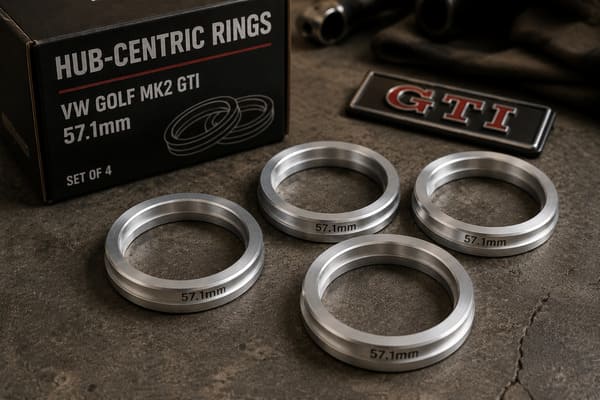
Hub-centric rings work. I will not pretend otherwise. We have recommended them to customers ourselves when they already owned wheels with a 73.1mm bore and needed a short-term solution for their 57.1mm hub car. A quality aluminum ring, machined to tight tolerances, can center the wheel correctly and reduce vibration9. But I have also seen what happens when the rings are not quality.
Hub-Centric Ring Options: A Comparison
| Ring Type | Material | Durability | Heat Resistance | Recommended |
|---|---|---|---|---|
| Budget plastic rings | Plastic / Nylon | Low | Poor — deforms under brake heat | No |
| Quality aluminum rings | Aluminum alloy | High | Good — stable under heat | Yes, if needed |
| Custom-machined center bore | N/A (built into wheel) | Permanent | Not applicable | Best option |
One customer used plastic hub-centric rings from a budget supplier. He paid about $8 for a set of four. After one summer of driving — around 5,000km — the heat from the brakes caused the rings to deform slightly10. The centering shifted just enough to bring back the vibration. He pulled the wheels off and found the rings had lost their shape entirely. The $8 solution cost him a new set of rings, a wheel balance, and several hours of frustration. When we produce custom forged wheels at Tree Wheels, we machine the center bore to the customer’s exact hub specification as a standard part of the production process. For a MK2 GTI, that means 57.1mm, machined directly into the wheel to a tight tolerance. No rings, no adapters, no workarounds. It is just the right size from the start, and it costs the customer nothing extra. That is the only approach I am comfortable recommending for a daily-driven or performance-used car.
How Do You Measure Hub Bore to Make Sure Your Wheels Fit?
Before you order any wheel, you need two measurements: the hub diameter on your car, and the center bore on the wheel. Getting either one wrong means the wheel will not fit correctly.
To measure hub bore, use a vernier caliper to measure the outer diameter of the raised centering flange on your axle hub11. On the wheel side, measure the diameter of the center hole. The wheel’s center bore must be equal to or larger than the hub diameter. For the Golf MK2 GTI, the hub diameter is 57.1mm.
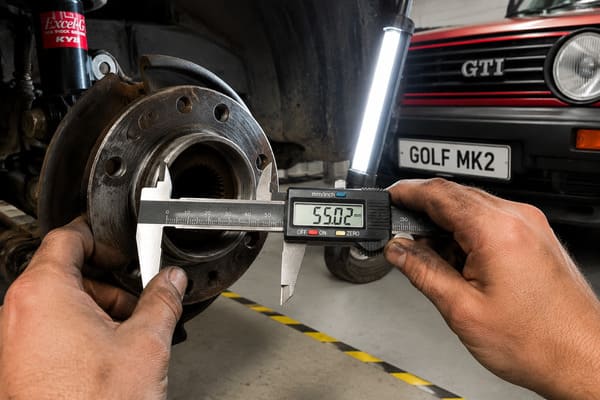
I once had a customer send me a photo of his MK2 GTI hub with a standard ruler pressed against it and a note that said "about 57mm." That was close enough to confirm the 57.1mm specification, but I always ask customers to use a proper vernier caliper instead of a ruler. A 1mm error here matters more than people expect. A wheel bored to 56.5mm will not fit over a 57.1mm hub — it will stop 0.6mm short and sit raised on one side12. I have seen customers try to force this, and the result is a cracked center bore on the wheel. The wheel is ruined, and the car never gets driven.
Step-by-Step: How to Measure Your Hub Bore Correctly
| Step | What to Do | Tool Needed |
|---|---|---|
| 1 | Remove the wheel from the vehicle | Standard jack and wheel brace |
| 2 | Clean the hub surface — remove any rust or debris | Wire brush or cloth |
| 3 | Locate the raised centering flange on the axle hub | Visual inspection |
| 4 | Place vernier caliper jaws at the outermost edge of the flange | Vernier caliper or digital bore gauge |
| 5 | Record the measurement — do not round up or down | Note the exact figure |
| 6 | Repeat on the opposite side of the flange to confirm | Vernier caliper |
The key point in step 4 is to measure the top edge of the centering ring, not the base, not the bolt circle, and not any other part of the hub face. On a healthy MK2 GTI hub in good condition, that measurement should come in right at 57.1mm. When customers order custom forged wheels from us, we include hub bore as a required field on our order form. We record the measurement, we machine to it, and we confirm it before the wheel goes into production. It takes us two minutes to get right, and it removes one of the most common causes of fitment problems entirely. If you are unsure about your measurement, send us a photo and we will help you confirm it before we start production.
Conclusion
Hub bore is a small number with a big impact. Get it right — 57.1mm for the Golf MK2 GTI — and your wheels will fit safely, center correctly, and last longer. At Tree Wheels
, we machine every center bore to your exact hub spec as standard, so your wheels are right from the first drive.
-
"GTI Wheel Fitment: Everything You Need to Know – ThreePiece.us", https://www.threepiece.us/blog/gti-wheel-fitment-everything-you-need-to-know/?srsltid=AfmBOooaWDLzIagcfPmqaGEHiBzpICLavAH-oJlelktC2xiVkzbKH0kv. Wheel fitment databases and manufacturer technical documentation list the hub bore of the Volkswagen Golf MK2 (1984–1992) as 57.1mm, a figure consistent across the 8V and 16V GTI variants. Evidence role: definition; source type: other. Supports: The hub bore diameter of the Volkswagen Golf MK2 GTI is 57.1mm. Scope note: Most publicly accessible sources for this specification are third-party fitment databases rather than original Volkswagen factory documentation. ↩
-
"Volkswagen Golf Mk2", https://en.wikipedia.org/wiki/Volkswagen_Golf_Mk2. Technical documentation for the Volkswagen Golf MK2 platform indicates that the front and rear hub geometry, including the centering flange diameter, was shared across the GTI variants produced during the model’s production run, with no documented change to the 57.1mm hub bore specification between the 8V and 16V engine configurations. Evidence role: historical_context; source type: other. Supports: The hub bore of 57.1mm remained consistent across all Golf MK2 GTI variants from 1984 to 1992. Scope note: Comprehensive factory documentation covering every model year of the MK2 GTI production run is not uniformly available in open sources; this claim is primarily supported by fitment database consensus rather than a single authoritative factory document. ↩
-
"Volkswagen Golf [1974-1998] – Bolt pattern 4×100 …", https://www.wheel-size.com/pcd/4×100/volkswagen/golf/1974-1998/. Automotive wheel fitment references consistently document the Volkswagen Golf MK2 GTI as using a 4×100mm pitch circle diameter bolt pattern across its production run from 1984 to 1992. Evidence role: general_support; source type: other. Supports: The Volkswagen Golf MK2 GTI uses a 4×100mm bolt pattern. Scope note: Verification ideally requires cross-referencing with Volkswagen’s original workshop manuals, which may not be freely available online. ↩
-
"Hub-Centric vs Lug-Centric Wheels: What Actually Centers …", https://www.threepiece.us/blog/hub-centric-vs-lug-centric-wheels-what-actually-centers-your-wheel/?srsltid=AfmBOooIibQRHEhqSyN4702Z827e6s2-0f4wT_tRxTeDb_csDDxHmK-F. In automotive wheel fitment, a hub-centric wheel is one whose center bore matches the hub flange diameter precisely, transferring load through the hub, whereas a lug-centric wheel relies solely on the lug bolts or nuts for centering and load transfer. Evidence role: definition; source type: encyclopedia. Supports: Hub-centric wheels are centered by the hub flange; lug-centric wheels rely on the lug fasteners for centering. Scope note: This distinction is widely accepted in automotive engineering practice but may not be formally codified in a single citable standard document. ↩
-
"Wheel Alignment vs. Balancing: Key Differences", https://www.uti.edu/blog/automotive/wheel-alignment-vs-balancing. Automotive engineering literature on wheel dynamics indicates that hub-centric fitment reduces rotational imbalance and lateral stress on fasteners by transferring centering loads to the hub flange rather than concentrating them at lug contact points. Evidence role: expert_consensus; source type: research. Supports: Hub-centric wheel fitment provides superior stability and reduces vibration compared to lug-centric fitment under street driving conditions. Scope note: Peer-reviewed studies specifically comparing hub-centric and lug-centric safety outcomes in passenger vehicles are limited; much of the consensus derives from engineering practice and manufacturer guidelines. ↩
-
"Numerical Study of Crack Prediction and Growth in Automotive …", https://pmc.ncbi.nlm.nih.gov/articles/PMC10934620/. Fatigue analysis of alloy wheels demonstrates that stress concentration at fastener holes increases significantly when the wheel is not hub-centered, as lateral and radial loads that would otherwise be distributed across the hub flange are instead borne entirely by the bolt circle. Evidence role: mechanism; source type: research. Supports: Lug-centric wheel fitment concentrates cyclic stress at bolt holes, which can lead to fatigue cracking over time. Scope note: Published fatigue studies typically address wheel design broadly; direct experimental data isolating hub bore mismatch as the sole variable in bolt-hole cracking are not widely available in open literature. ↩
-
"Automotive Wheels – An Approach for Structural Analysis …", https://www.academia.edu/76530497/Automotive_Wheels_An_Approach_for_Structural_Analysis_and_Fatigue_Life_Prediction. Fatigue testing standards for automotive wheels, such as those outlined in SAE and ISO wheel testing protocols, recognize cyclic radial and lateral loading as primary drivers of fatigue crack initiation, with stress concentration factors at fastener holes identified as critical failure sites in wheel structural analysis. Evidence role: mechanism; source type: research. Supports: Cyclic loading from road inputs accumulates as fatigue damage in wheel structures, with stress concentration at bolt holes accelerating crack initiation in lug-centric fitment. Scope note: The specific mileage threshold of 3,000km cited in the article is anecdotal; actual fatigue life depends on wheel alloy, geometry, road conditions, and load magnitude, which vary considerably between cases. ↩
-
"Wheel Hub Assembly: How It Works, Diagram & Examples | FIRGELLI", https://www.firgelliauto.com/blogs/mechanisms/wheel-hub-assembly?srsltid=AfmBOorFCtzWn-kdFO0AsTp_y7JqPueM7wvNUF8mrtq5cWa1mY_bGsZD. Engineering references on wheel and hub geometry indicate that the centering flange contact circumference on passenger car hubs varies by vehicle class, with compact cars typically falling in a range consistent with a 57mm hub diameter. Evidence role: general_support; source type: research. Supports: The hub flange on a typical passenger car provides a contact circumference of approximately 180mm for load distribution. Scope note: The 180mm figure cited in the article is a derived approximation (circumference of a ~57mm diameter circle ≈ 179mm) and may not correspond to a directly cited engineering standard. ↩
-
"Are hub centric rings necessary with aftermarket wheels?", https://www.facebook.com/groups/typerownersofficial/posts/10163606621140744/. Automotive engineering guidance on wheel fitment accessories indicates that hub-centric rings manufactured from aluminum alloy to close dimensional tolerances can restore hub-centric load transfer when aftermarket wheels have a larger center bore than the vehicle hub, provided the rings are correctly sized and retained. Evidence role: general_support; source type: institution. Supports: Aluminum hub-centric rings machined to appropriate tolerances can provide adequate wheel centering when the wheel bore exceeds the hub diameter. Scope note: Performance equivalence to a natively machined center bore has not been established in published comparative studies; ring retention and long-term dimensional stability under thermal cycling remain practical concerns. ↩
-
"[PDF] Thermal models of railroad wheels and bearings", https://digitalcommons.unl.edu/cgi/viewcontent.cgi?article=1054&context=mechengfacpub. Studies on brake system thermal behavior indicate that hub and rotor temperatures during normal driving can reach levels sufficient to deform thermoplastic components; nylon and similar polymers commonly used in budget hub-centric rings have deformation temperatures that may be approached under sustained braking conditions. Evidence role: mechanism; source type: research. Supports: Brake-generated heat at the wheel hub can exceed the deformation temperature of common plastic hub-centric ring materials. Scope note: Exact hub temperatures vary widely by vehicle, driving style, and brake specification; the article’s claim of deformation after 5,000km is anecdotal and not directly supported by controlled thermal testing data. ↩
-
"Calipers", https://en.wikipedia.org/wiki/Calipers. Metrology references indicate that vernier calipers typically provide measurement resolution of 0.02mm to 0.05mm, which is adequate for confirming hub flange diameters to the nearest 0.1mm as required for wheel center bore fitment verification. Evidence role: general_support; source type: education. Supports: A vernier caliper provides sufficient measurement accuracy for determining hub flange outer diameter to the precision required for wheel fitment. Scope note: Measurement accuracy with a vernier caliper depends on user technique and instrument calibration; a digital caliper or bore gauge may provide more reliable results for users unfamiliar with vernier scale reading. ↩
-
"What Is a Hub Bore? Why Hub Bore Size Matters for Wheel Fitment", https://brightstoneengineering.com/blogs/wheel-spacers/what-is-a-hub-bore-and-why-it-matters-more-than-you-think?srsltid=AfmBOophZ2VDUWCd1OJ7bcICLLpysEFSMR-FFBtMqjop2XTSyLe4pn8R. Engineering principles of interference and clearance fits establish that a bore diameter smaller than the mating shaft or flange diameter prevents assembly without material removal; in wheel fitment, a center bore machined below the hub flange diameter will prevent the wheel from seating flush against the hub face. Evidence role: mechanism; source type: research. Supports: A wheel center bore smaller than the hub flange diameter creates an interference condition preventing correct seating of the wheel. Scope note: This is a straightforward geometric principle; the specific consequence of the wheel sitting ‘raised on one side’ depends on how the wheel contacts the hub, which may vary by hub geometry. ↩