
Forged wheels are everywhere in the performance and luxury car space, but the phrase "forged wheels" tells buyers almost nothing about what they’re actually getting. When modification shop owners and car enthusiasts ask me what forged wheels are made of, they usually expect a simple one-line answer. The real answer is more useful — and more consequential — than they expect.
Forged wheels are made primarily from aluminum alloys, most commonly 6061-T6 or 7075-T6, shaped under extreme pressure to produce a dense, high-strength wheel structure. The alloy grade determines the wheel’s strength-to-weight ratio, fatigue resistance, and suitability for specific use cases — from daily street driving to competitive track use. Material grade alone does not guarantee performance; the heat treatment and forging process are equally critical.
Understanding which alloy suits which application — and how to verify a supplier’s material claims — separates smart procurement decisions from expensive mistakes. The sections below break down each key alloy, how the forging process affects material behavior, and what buyers at every level should actually be asking before placing an order.
Are all forged wheels made from the same aluminum alloy?
Most buyers assume a forged wheel is a forged wheel. This assumption costs modification shops credibility when a wheel fails under track stress that it was never rated for — even though the supplier labeled it "forged aluminum."
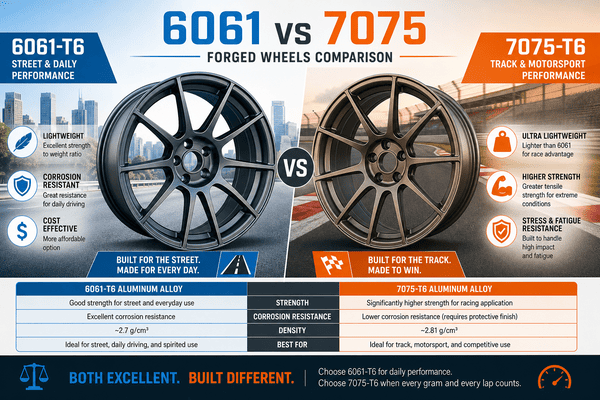
No. Forged wheels are made from different aluminum alloy grades, and the grade determines suitability for your driving scenario. 6061-T6 is the standard for street and daily-use performance wheels. 7075-T6 offers superior strength-to-weight for racing applications. These two alloys behave differently under load, fatigue, and impact — and they are not interchangeable.
The confusion runs deeper than most buyers realize. When I consult with modification shop owners evaluating new wheel suppliers, they often confuse three distinct categories of product: genuinely forged 6061-T6, genuinely forged 7075-T6, and cast wheels using A356 aluminum that are marketed with language designed to blur the line between casting and forging. Sorting out these three categories is where material evaluation actually begins.
6061-T6: The reliable workhorse for street and performance driving
6061-T6 is the most widely used alloy in forged wheel production1. The "T6" designation refers to the heat treatment process — solution heat-treated and then artificially aged — which gives the alloy its structural properties. Without the T6 treatment, 6061 aluminum would not deliver the strength levels buyers expect from a forged wheel.
Why modification shops specify 6061-T6:
- Balanced mechanical properties — sufficient yield strength for performance street driving, good corrosion resistance, and excellent machinability for complex spoke designs
- Cost-effective at scale — lower raw material cost than 7075, making it viable for both B2B and B2C pricing without sacrificing meaningful durability
- Wide application range — suitable for daily-driven performance cars, modified street vehicles, and most non-competitive driving scenarios
- Repair and finishing compatibility — easier to anodize, paint, and surface-treat compared to higher-alloy grades, which matters for shops offering custom aesthetics alongside performance upgrades
Where 6061-T6 has limits:
Buyers who plan sustained high-speed circuit driving, aggressive track days, or competitive motorsport should understand that 6061-T6 has lower tensile and yield strength compared to 7075. Under repeated high-load cycles — hard braking from track speed, aggressive cornering generating lateral load — fatigue accumulates faster. This does not make 6061-T6 a poor material. It makes it the wrong material for the wrong application if a buyer misrepresents their use case to their supplier or to themselves.
7075-T6: Racing-grade strength-to-weight ratio
7075-T6 aluminum is a zinc-magnesium alloy series with significantly higher yield strength than 60612. Racing teams and professional modification builders specify it when weight reduction and maximum load tolerance are both non-negotiable.
Key characteristics relevant to buyers:
| Property | 6061-T6 | 7075-T6 |
|---|---|---|
| Primary alloying element | Magnesium + Silicon | Zinc + Magnesium |
| General yield strength range | Lower | Higher |
| Corrosion resistance | Good | Lower (requires coating) |
| Typical application | Street / performance | Track / motorsport |
| Raw material cost | Lower | Higher |
| Surface treatment sensitivity | Easier | Requires care |
Important: I am not a metallurgist, and I do not cite specific mechanical property numbers without verified third-party test data attached to a specific production batch. Any supplier who quotes you exact tensile strength numbers without independent test documentation backing those figures is giving you marketing language, not engineering data.
Procurement implication: If a supplier quotes 7075-T6 at pricing that seems comparable to a 6061-T6 competitor, treat that as a procurement red flag. Material cost for 7075 is meaningfully higher. The price difference should be visible. When it isn’t, verifying the material claim through documentation becomes non-negotiable.
A356: Cast aluminum that gets mistaken for forged
A356 is a casting alloy — full stop. It is not a forging alloy, and wheels made from A356 are cast wheels3, regardless of how the product listing describes them.
I raise this here because when clients ask me what forged wheels are made of, the underlying question is often: "How do I know the supplier is telling the truth about the manufacturing process?" A356 appears in this conversation because it is the alloy used in premium cast wheels, which can look visually identical to forged wheels and be priced similarly to entry-level forged options.
Why this matters for buyers:
- Cast wheels have a different internal grain structure from forged wheels — voids can exist in cast material that do not exist in properly forged billet
- Failure modes differ: cast wheels tend toward brittle fracture under sudden impact, while properly forged wheels are more likely to deform plastically before complete failure4
- The distinction is process-based, not just alloy-based — a supplier must be able to document the manufacturing method, not just the material certificate
How does the forging process affect the material?
Knowing the alloy grade is only half the evaluation. The forging process itself transforms the raw aluminum into a finished wheel — and process quality determines whether the material’s potential is fully realized.
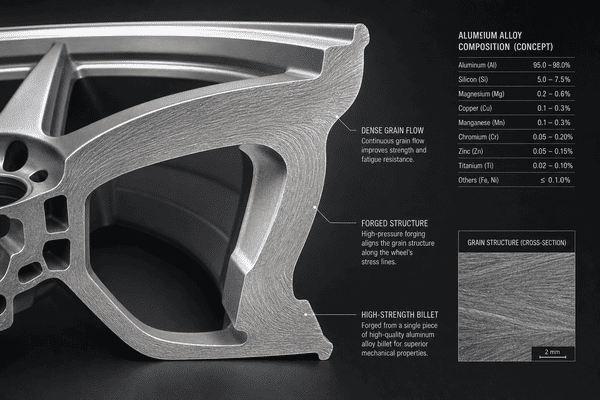
Forging applies controlled pressure to aluminum billet, compressing and shaping the material while aligning its grain structure directionally5. This directional grain alignment is the core mechanical advantage of forging over casting. A correctly forged wheel has superior fatigue resistance along its primary load paths because the grain follows the geometry of the part.

The forging process is not the same across all manufacturers, and material response to that process varies. Here is what buyers should understand about the relationship between material and process.
Heat treatment is inseparable from material grade
The T6 designation on both 6061-T6 and 7075-T6 is a heat treatment classification. Solution heat treatment followed by artificial aging changes the microstructure of the alloy, precipitating strengthening particles within the grain structure6. The mechanical properties buyers care about — yield strength, fatigue life — are largely the result of this treatment, not just the base alloy composition.
What this means practically:
- A wheel labeled 6061 without confirmed T6 treatment may significantly underperform compared to properly treated 6061-T6
- Heat treatment requires controlled furnace temperatures and precise timing; process shortcuts produce inconsistent results across a production batch
- Buyers cannot verify heat treatment compliance visually — this is a documentation and certification issue
Not every aluminum alloy can be forged effectively
Some alloys crack or deform unpredictably under forging pressure. The alloys used in forged wheel production — primarily 6061 and 7075 series — are selected partly because they respond well to the forging process. Suppliers who claim to forge exotic or non-standard alloys without providing detailed process documentation are making claims worth scrutinizing carefully.
Process documentation buyers should request
When evaluating a forged wheel supplier, the following documentation points are relevant:
- Material certificates — traceable to the billet source, confirming alloy grade
- Heat treatment records — confirming T6 processing on the specific production batch
- Third-party test certifications — DOT (for US market) and TÜV (for European standards) involve physical testing that provides independent material performance verification7
- Production method description — one-piece monoblock forging, two-piece, and three-piece constructions involve different process steps and different material considerations
At Tree Wheels, our production carries ISO9001, DOT, TÜV, and IATF16949 certifications8. I treat those certifications as a starting point for buyer confidence, not an endpoint. Buyers should always verify that a certificate is current, applies to the specific product being ordered, and was issued by an accredited body rather than self-certified.
Which forged wheel material is right for your use case?
This is the question I spend the most time on in client consultations. The material specification only makes sense in context of how and where the wheels will be used.
The wrong material for the wrong use case creates real risk — not generic "safety risk" language, but specific failure modes tied to how the wheel will actually be loaded.

Use the framework below to match material grade to application type before approaching a supplier.
Use-case framework for buyers
Street and daily performance driving:
6061-T6 forged wheels are the appropriate specification for modified street vehicles, performance daily drivers, and luxury car fitments. The alloy provides durability against road impacts, good corrosion resistance over time, and compatibility with the widest range of surface treatments and finishes.
Track days and competitive motorsport:
If wheels will experience sustained lateral and braking loads at circuit speeds, or if the vehicle is competing in any class where wheel failure has safety consequences, 7075-T6 is the specification to pursue. The higher material cost is justified by the fatigue life advantage under repeated high-load cycles. Modification shops recommending wheels for clients who track their cars should document this specification explicitly.
Show cars and aesthetic-first builds:
Many high-end aesthetic builds prioritize surface finish quality, spoke design complexity, and color accuracy over maximum strength specifications. 6061-T6 is typically specified here because its superior machinability allows more intricate designs, and its surface treatment compatibility supports high-quality anodizing and custom paint. Weight reduction is less relevant than visual impact.
Summary table:
| Use Case | Recommended Alloy | Key Reason |
|---|---|---|
| Daily performance street driving | 6061-T6 | Durability, corrosion resistance, cost |
| Competitive track / motorsport | 7075-T6 | Higher strength-to-weight, fatigue life |
| Show car / aesthetic build | 6061-T6 | Design flexibility, surface treatment compatibility |
| Luxury vehicle fitment | 6061-T6 | Balance of quality and finish |
Frequently Asked Questions
Is forged aluminum stronger than cast aluminum?
Properly forged aluminum wheels are generally stronger than cast aluminum wheels due to the directional grain alignment produced during the forging process9. This makes them more resistant to fatigue cracking under repeated load cycles. However, strength claims should always be supported by verified certification documentation from the specific supplier and production batch.
Can forged wheels be repaired after impact damage?
Minor cosmetic damage can sometimes be repaired by qualified wheel refurbishment specialists. Structural damage — cracks, significant bends, or impact deformation — should result in full wheel replacement regardless of alloy grade. A damaged structural component should be assessed by a qualified professional before the vehicle returns to use.
What certifications should I look for when buying forged wheels?
For the US market, DOT certification is relevant for road-legal use. TÜV certification covers European standards. ISO9001 and IATF16949 indicate quality management systems at the manufacturer level. Always request current certificates, confirm they apply to the specific product model being purchased, and verify the issuing body is accredited rather than self-certified.
How do I verify that a supplier’s wheels are actually forged and not cast?
Request the supplier’s material certificates, production process documentation, and third-party test certification. Ask specifically which manufacturing method — monoblock forging, two-piece, or three-piece — applies to the product. Price point can also be an indicator: genuine forged wheels at unusually low prices warrant closer documentation review.
Does wheel weight matter more than alloy grade?
Both matter, but they serve different purposes. Lower wheel weight reduces unsprung mass, improving handling response10. Higher alloy grade (e.g., 7075 vs. 6061) improves fatigue resistance under high-load conditions. For track use, both specifications are relevant. For street use, weight reduction through good design in 6061-T6 typically delivers the most practical benefit per dollar spent.
Conclusion
Forged wheels are made from aluminum alloys — but not all aluminum alloys are equal, and not all forging processes produce equivalent results. The primary distinction buyers need to make is between 6061-T6 for street and performance applications and 7075-T6 for racing and high-load track use. Neither grade delivers its potential without proper heat treatment and a documented forging process behind it.
When evaluating forged wheel suppliers, focus your questions on material certificates, heat treatment records, applicable certifications, and how the supplier’s product aligns with your actual use case. At Tree Wheels, we support clients through this evaluation with transparent documentation and design consultation from specification through delivery. If you are sourcing forged wheels for your modification shop or your own build, reach out directly — the right material conversation starts before the order, not after a failure.
-
"What Documentation Should Come with Premium Forged Wheels?", https://treewheels.com/what-documentation-should-come-with-premium-forged-wheels/. Industry and materials engineering literature consistently identifies 6061-T6 as a primary alloy for forged aluminum wheel applications due to its balance of mechanical properties, machinability, and cost. Evidence role: general_support; source type: research. Supports: 6061-T6 aluminum is a predominant alloy choice in forged automotive wheel production. Scope note: Sources may address aluminum alloy selection broadly rather than forged wheel production specifically; direct market-share data for wheel alloy usage is rarely published. ↩
-
"7075 aluminium alloy", https://en.wikipedia.org/wiki/7075_aluminium_alloy. Published mechanical property data for aluminum alloys indicate that 7075-T6 has a typical tensile yield strength approximately 70–80% greater than that of 6061-T6, reflecting the zinc-dominant alloying system of the 7075 series. Evidence role: statistic; source type: encyclopedia. Supports: 7075-T6 aluminum alloy exhibits substantially higher yield strength than 6061-T6. Scope note: Exact values vary by product form, temper lot, and testing standard; published ranges should be treated as representative rather than batch-specific guarantees. ↩
-
"Aluminium alloy", https://en.wikipedia.org/wiki/Aluminium_alloy. A356 is a hypoeutectic aluminum-silicon casting alloy standardized for sand, permanent mold, and die casting processes; it is not listed among wrought aluminum alloys suitable for forging in standard alloy designation systems such as those maintained by the Aluminum Association. Evidence role: definition; source type: encyclopedia. Supports: A356 is classified as an aluminum casting alloy and is not designated for wrought or forging applications. Scope note: Alloy classification systems distinguish casting from wrought alloys by designation series; the article’s broader point about marketing language obscuring process differences is not directly addressed by alloy classification alone. ↩
-
"Phase-Field Modeling of Coupled Brittle-Ductile Fracture in …", https://arxiv.org/html/2204.13994v1. Engineering studies on aluminum wheel failure modes report that the porosity and isotropic grain structure inherent in cast aluminum promote brittle crack propagation under sudden impact, while the refined, directionally aligned grain structure of forged aluminum supports greater plastic deformation before fracture. Evidence role: mechanism; source type: research. Supports: Cast aluminum wheels are more prone to brittle fracture under impact loading, whereas forged aluminum wheels tend to exhibit plastic deformation prior to failure. Scope note: Failure behavior is influenced by alloy grade, wall thickness, and impact geometry; these generalizations may not hold for all cast or forged wheel designs. ↩
-
"Forging", https://en.wikipedia.org/wiki/Forging. Metallurgical research on aluminum deformation processing demonstrates that compressive forging induces preferred grain orientation along the direction of material flow, which enhances fatigue crack resistance relative to the isotropic grain structure typical of cast aluminum. Evidence role: mechanism; source type: research. Supports: Forging aligns the grain structure of aluminum along the part geometry, improving fatigue resistance along primary load paths compared to cast material. Scope note: The magnitude of the fatigue improvement depends on forging parameters, alloy composition, and part geometry; general findings may not apply uniformly to all wheel designs. ↩
-
"Precipitation hardening", https://en.wikipedia.org/wiki/Precipitation_hardening. Precipitation hardening of aluminum alloys involves two stages: solution heat treatment, which dissolves alloying elements into a supersaturated solid solution, followed by controlled aging, during which fine precipitate particles form and impede dislocation movement, substantially increasing yield strength. Evidence role: mechanism; source type: encyclopedia. Supports: T6 heat treatment strengthens aluminum alloys through precipitation hardening, in which fine intermetallic particles form within the grain structure during artificial aging. ↩
-
"5.1.15 Wheels (393.205) – CSA – Department of Transportation", https://csa.fmcsa.dot.gov/safetyplanner/MyFiles/SubSections.aspx?ch=22&sec=64&sub=144. The U.S. Department of Transportation’s National Highway Traffic Safety Administration (NHTSA) establishes Federal Motor Vehicle Safety Standards applicable to wheel performance; DOT-marked wheels are required to meet these standards, which include structural and load testing criteria. Evidence role: general_support; source type: government. Supports: DOT certification for wheels sold in the US market involves compliance with federal motor vehicle safety standards, including physical performance testing. Scope note: DOT certification for wheels operates under a self-certification model in some categories; independent third-party testing requirements vary by product type and market segment. ↩
-
"IATF 16949", https://en.wikipedia.org/wiki/IATF_16949. IATF 16949, published by the International Automotive Task Force, specifies quality management system requirements for organizations in the automotive production and relevant service part supply chain; certification requires third-party audit by an IATF-recognized certification body and is widely required by original equipment manufacturers as a supplier qualification criterion. Evidence role: definition; source type: institution. Supports: IATF 16949 is an internationally recognized quality management system standard specific to automotive production and service part organizations. Scope note: IATF 16949 certification addresses quality management processes rather than the mechanical performance of specific products; its presence does not directly verify the material properties of individual wheel batches. ↩
-
"Forging", https://en.wikipedia.org/wiki/Forging. Materials engineering literature broadly supports the finding that forged aluminum parts outperform cast counterparts in tensile strength and fatigue life, attributable to the elimination of casting porosity and the development of a refined, directionally oriented grain structure during the forging process. Evidence role: expert_consensus; source type: research. Supports: Forged aluminum components generally exhibit higher strength and fatigue resistance than equivalent cast aluminum components. Scope note: Comparative performance depends on alloy grade, part geometry, and process quality; a well-engineered cast part may outperform a poorly forged one in specific loading scenarios. ↩
-
"Vehicle dynamics", https://en.wikipedia.org/wiki/Vehicle_dynamics. Vehicle dynamics literature establishes that unsprung mass — comprising wheels, tires, brakes, and associated components — directly affects suspension response frequency; lower unsprung mass allows faster wheel-to-road contact recovery over surface irregularities, improving ride quality and cornering stability. Evidence role: mechanism; source type: encyclopedia. Supports: Reducing unsprung mass improves vehicle handling by allowing the suspension to respond more quickly to road surface variations. Scope note: The practical handling benefit of wheel weight reduction varies with vehicle suspension design, spring rates, and driving conditions. ↩