
A customer walks into your shop and asks for the best wheels money can buy. You point them toward forged. They see the price and go quiet. That silence costs shops sales every day — not because forged wheels aren’t worth it, but because most buyers don’t understand what they’re actually paying for. This article gives you the language to explain it clearly.
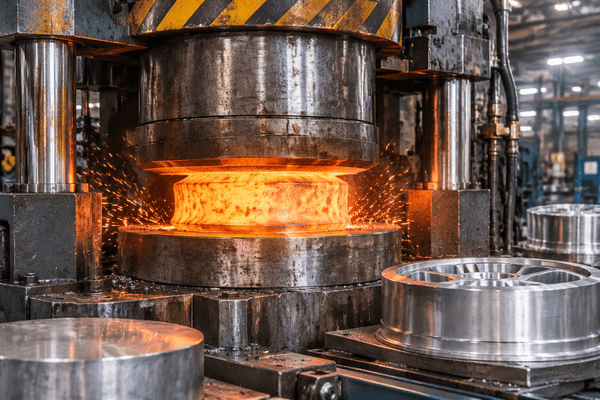
Forged wheels are aluminum wheels produced by compressing a solid billet of aluminum alloy under high pressure, aligning the metal’s grain structure for greater density, strength, and fatigue resistance. They are lighter than cast wheels of comparable strength, tolerate higher loads, and allow tighter machining tolerances — making them the recommended choice for high-performance, heavy vehicles, or demanding fitment applications.
Understanding what forged wheels are is only the starting point. The more useful question — the one modification shops actually need to answer — is when forged wheels are the right recommendation, and how you justify the price without losing the customer. The sections below break that down piece by piece.
Are forged wheels actually better than cast wheels?
Most buyers assume "forged" is simply a premium label — a marketing upgrade, like buying the name brand. That assumption is what creates price resistance in the first place. The real difference lies in the manufacturing process and what it does to the material at a structural level.
Forged wheels are not universally superior to cast wheels. They are structurally superior in specific conditions: high-load applications, track use, large diameter fitments, and scenarios where weight reduction directly affects performance or fuel efficiency. Cast wheels remain a cost-effective, reliable option for everyday driving on standard fitments.
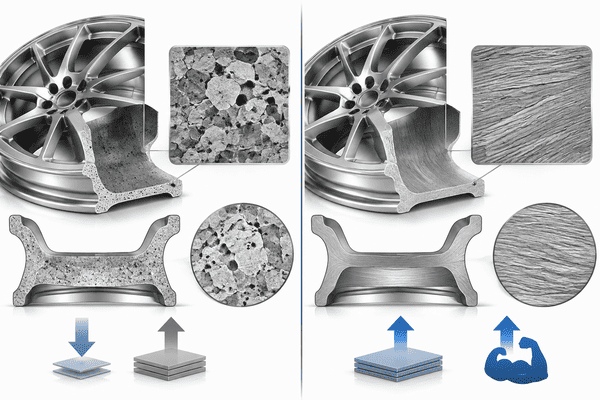
This distinction matters for how you sell. Positioning forged as "the better wheel" invites the customer to ask: better for what? Having a clear answer is what separates a confident recommendation from a shrug.
What actually happens during forging?
When a cast wheel is made, molten aluminum is poured into a mold and allowed to cool. The resulting grain structure is random — which is fine for most applications. When a forged wheel is made, a solid billet of aluminum is pressed under extreme pressure while it’s below melting point. That pressure forces the grain structure to align with the shape of the wheel.
The practical result of that process difference:
- Higher tensile strength — the aligned grain structure resists stress better than a random one
- Lower weight for equivalent strength — the denser material means less aluminum is needed to hit the same load tolerance
- Tighter machining tolerances — the uniform density allows more precise CNC finishing
- Better fatigue resistance — forged wheels handle repeated stress cycles more predictably over time
When does this actually matter?
This is where many product descriptions fail. They list technical advantages without mapping them to real use cases. Based on what we see in customer consultations at Tree Wheels, the clearest application scenarios for forged wheels are:
| Scenario | Why Forged Matters |
|---|---|
| Track or performance driving | Weight reduction improves handling response; higher load tolerance handles cornering forces |
| Large diameter fitments (20"–24"+) | Bigger wheels carry more rotational mass — forged keeps unsprung weight lower1 |
| Heavy vehicles (trucks, SUVs) | Higher load rating handles sustained weight without fatigue cracking |
| Luxury or prestige builds | Tight machining tolerances support complex finishes and custom designs |
| Fitment-sensitive applications | Dimensional consistency reduces vibration and runout issues |
Cast wheels are a reasonable choice for standard sedans on normal roads, daily drivers with modest performance needs, and budget-constrained builds where the vehicle won’t stress the wheel. If a customer fits that profile, saying so is better for your credibility than pushing forged at a price they don’t need to pay.
What are the different types of forged wheels — and which one fits your customer?
This is the question most articles skip entirely. "Forged wheel" is not a single product — it’s a manufacturing category that includes three distinct construction types. Shops that can’t explain the difference to customers are leaving money on the table or, worse, recommending the wrong wheel for the application.
The three types of forged wheels are: one-piece (monoblock), two-piece, and three-piece. Each has a different construction method, customization scope, use profile, and production timeline. One-piece wheels are the most structurally unified; two-piece wheels offer wider fitment flexibility; three-piece wheels allow the most customization and are common in high-end custom builds.
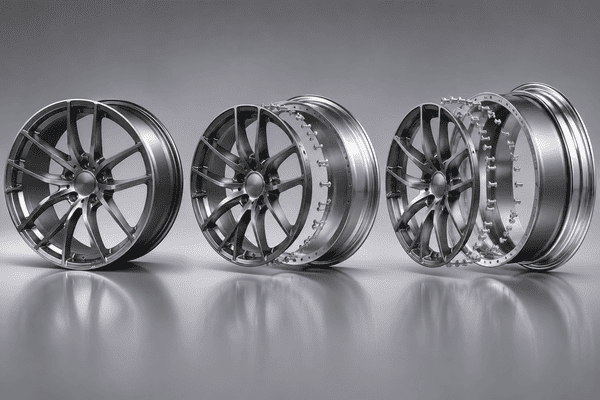
Knowing which type to recommend tells your customer far more about your expertise than quoting a tensile strength number. Here’s how to think about each one.
One-Piece Forged Wheels (Monoblock)
A one-piece forged wheel is machined from a single billet of aluminum. There are no joints, no fasteners, and no assembly seams. The structural integrity is continuous throughout the wheel.
Best for:
- Performance and track applications where rigidity matters most
- Customers who want a clean, minimalist aesthetic
- Standard fitments that don’t require unusual offsets or width combinations
Customization scope: Moderate. Size and design are set during the machining process. Surface finishes and colors can still be customized, but width and offset changes require a different forging profile.
Production timeline: 15–20 days from order confirmation, based on our factory’s standard production schedule.
Price tier: Typically the most accessible entry point into the forged wheel category.
Two-Piece Forged Wheels
A two-piece wheel combines a forged center (the face) with a forged or spun outer barrel. The two sections are joined — typically by welding or bolting — which allows the center and barrel to be produced in different proportions.
Best for:
- Customers who need specific width or offset combinations that a one-piece can’t accommodate
- Shops building fitments for lowered vehicles or wide-body conversions
- Builds where the center design needs to stand out against a clean barrel
Customization scope: Higher than monoblock. The center and barrel can be finished differently — for example, a polished lip with a matte center.
Production timeline: 20–25 days, reflecting the additional assembly step.
Price tier: Mid-range in the forged category.
Three-Piece Forged Wheels
A three-piece wheel consists of a forged center, an inner barrel, and an outer barrel — each produced separately and assembled with hardware. This construction offers the widest range of fitment and finish options of any wheel type.
Best for:
- High-end custom builds where every detail is specified
- Show cars or prestige vehicles where the wheel is a visual centerpiece
- Shops serving clients who want to rebuild or refinish a wheel later (three-piece wheels can be disassembled)
Customization scope: Maximum. Width, offset, barrel depth, center design, and finish can all be independently specified. Customers with precise fitment requirements — or clients who want to change the look down the road — often prefer three-piece for this flexibility.
Production timeline: 30–35 days, reflecting the more complex production and assembly process.
Price tier: The highest in the forged category, reflecting both material cost and build complexity.
Summary Comparison
| Type | Construction | Customization | Lead Time | Typical Use |
|---|---|---|---|---|
| One-Piece | Single billet | Moderate | 15–20 days | Performance, standard fitment |
| Two-Piece | Center + barrel | High | 20–25 days | Wide fitment, unique offsets |
| Three-Piece | Center + 2 barrels | Maximum | 30–35 days | Custom builds, prestige vehicles |
Why do forged wheels cost more — and how do you explain it without sounding like you’re upselling?
Price resistance is a knowledge problem. Customers who push back on forged wheel pricing aren’t being unreasonable — they’re filling the information gap with the assumption that they’re being charged for a brand name.
The price of a forged wheel reflects three specific cost drivers: the quality of the starting material (aerospace-grade billet aluminum), the longer and more controlled production process (forging, heat treatment, multi-stage CNC machining), and tighter quality inspection standards. These factors produce a structurally denser, more precisely dimensioned wheel — not just an aesthetically different one.
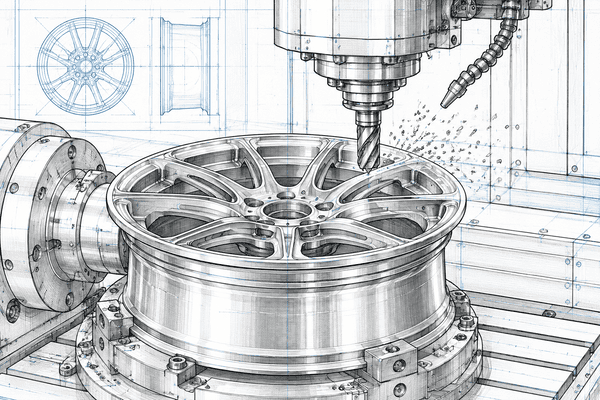
One sentence that shops can actually say to a customer: "With a forged wheel, you’re paying for the material to be denser and the dimensions to be more precise — that affects how the wheel handles load and how well it fits."
That’s it. You don’t need to explain grain structure or tensile modulus. You need to give the customer a reason they can understand and repeat.
What goes into the price, specifically?
Here’s a breakdown of what makes forged wheel production more resource-intensive than casting:
- Material cost: Forging starts with aerospace-grade billet aluminum — higher purity and tighter alloy specs than casting material2. More material is used at the start, because the billet is machined down, not poured to shape.
- Tooling and pressing: The forging press itself is high-capital equipment. The dies used to shape the billet are custom to each design profile.
- Heat treatment: Forged wheels go through a heat treatment process (typically T6 temper for aluminum) to optimize strength. This adds time and controlled oven cycles.
- Multi-stage CNC machining: Because forged blanks are more dimensionally precise, they can be machined to tighter tolerances. That precision takes more passes, more setup time, and more skilled operation.
- Quality inspection: At Tree Wheels, the production facility holds ISO9001, DOT, TÜV, and IATF16949 certifications. These aren’t marketing badges — they reflect documented inspection processes that buyers should verify against their own compliance requirements.
What does certification actually mean for buyers?
Certifications are documents, not guarantees. Buyers should request copies and verify them independently. Here’s a brief map of what each certification signals:
| Certification | What It Signals |
|---|---|
| ISO9001 | Quality management system standard — covers process control and documentation |
| DOT | U.S. Department of Transportation compliance — required for legal road use in the US |
| TÜV | German technical inspection — widely recognized for structural and safety testing |
| IATF16949 | Automotive-specific quality management — stricter than ISO9001 for production consistency |
Shops sourcing for the US market should confirm DOT compliance at minimum. Australian buyers may have different compliance expectations under the relevant ADR standards3 — confirm with a qualified assessor for your specific market.
What should a modification shop know before ordering forged wheels?
Customers often ask us about timelines only after they’ve committed to a build date — which is where most post-sale friction starts. Setting timeline expectations before the order is placed is one of the simplest ways to protect the shop’s relationship with the client.
Before ordering forged wheels, a modification shop should confirm: wheel type (one-piece, two-piece, or three-piece), diameter and width, bolt pattern, offset, center bore, and required surface finish. These specifications affect both production time and pricing. Lead times range from 15 days for one-piece to 35 days for three-piece — and that starts from order confirmation, not inquiry.
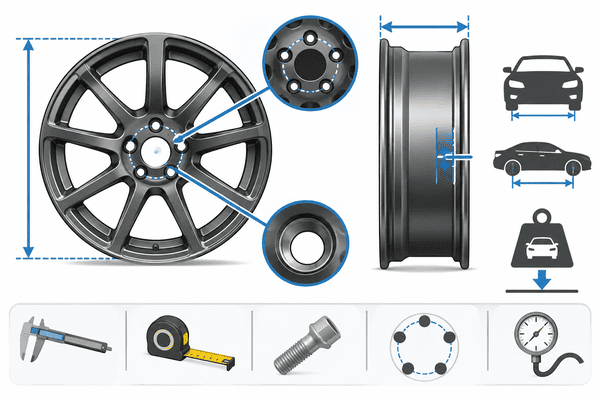
Incomplete specs create rework. Rework adds days or weeks to delivery. For shops working against a customer’s scheduled build or event deadline, that’s a relationship problem, not just a logistics one. Here’s what to have ready before requesting a quote.
Specifications checklist for shops
- Diameter: Confirm the target diameter in inches — 18", 19", 20", 22", etc.
- Width: Front and rear widths if staggered; confirm against fender clearance
- Bolt pattern: Number of bolts × PCD (e.g., 5×114.3, 5×120)
- Offset: ET value in millimeters — critical for clearance on lowered or wide-body vehicles
- Center bore: Hub bore diameter to match the vehicle’s hub
- Load rating: Especially important for trucks, SUVs, or performance builds where weight and cornering loads are elevated
- Finish and color: Bring a reference image or color sample — custom finishes are based on client drawings or confirmed references
- Delivery deadline: State the hard deadline upfront. Lead time starts from order confirmation, not the quote stage.
Frequently Asked Questions
Are forged wheels safe for daily driving?
Yes — forged wheels are safe for daily driving and, in many cases, more durable under sustained load than cast wheels. Their higher fatigue resistance makes them well-suited for high-mileage use. The choice between forged and cast for a daily driver typically comes down to budget and whether the performance advantages are relevant to how the vehicle is used.
Can forged wheels be repaired after curb damage?
One-piece forged wheels are more difficult to repair than cast wheels because the aluminum is denser — a repair that would be straightforward on a cast wheel may not be possible on a forged one without compromising structural integrity4. Three-piece wheels have an advantage here: damaged barrels can sometimes be replaced individually. Always consult a qualified wheel repair specialist before attempting repair on any damaged forged wheel.
What is the minimum order quantity for custom forged wheels?
At Tree Wheels, the minimum order is 4 wheels. This applies across one-piece, two-piece, and three-piece constructions. This low MOQ is intentional — it allows modification shops to trial a design or fulfill a single customer build without committing to large inventory.
How long does it take to receive custom forged wheels?
Production lead times at Tree Wheels are: 15–20 days for one-piece, 20–25 days for two-piece, and 30–35 days for three-piece. These timelines start from order confirmation and full specification sign-off — not from the initial inquiry. Shipping time via door-to-door delivery adds additional transit days depending on destination.
Do forged wheels require different maintenance than cast wheels?
Forged wheels don’t require a fundamentally different maintenance routine — regular cleaning, torque checks, and finish care apply to both types. However, the surface treatment on forged wheels (especially custom painted or polished finishes) may require specific cleaning products to avoid finish damage. Ask your supplier for care recommendations specific to the finish specified on your order.
Conclusion
Forged wheels are a specific solution for specific conditions — not a universal upgrade. They deliver real structural advantages in high-load, high-performance, or fitment-sensitive applications, and those advantages come from a more controlled, more material-intensive production process. The price premium reflects that process, not a brand markup.
For modification shops, the practical takeaway is this: know your construction types (one-piece, two-piece, three-piece), set timeline expectations before the order is placed, and give customers a clear one-sentence explanation of what they’re paying for. That’s the difference between a sale lost to price resistance and a customer who understands the value of forged wheels.
If you’re evaluating Tree Wheels as a supplier, the most useful first step is to bring your specs to the table — diameter, bolt pattern, offset, center bore, finish reference, and delivery deadline. A quote without those details doesn’t give you useful pricing, and it doesn’t give us what we need to confirm the build is achievable on your timeline.
-
"Unsprung mass", https://en.wikipedia.org/wiki/Unsprung_mass. Vehicle dynamics literature, including SAE technical papers and automotive engineering textbooks, establishes that unsprung mass — the mass of components not supported by the suspension spring, including wheels and tires — directly affects suspension response frequency and road-holding ability; reducing unsprung mass improves the suspension’s ability to follow road surface variations and reduces dynamic load variation at the tire contact patch. Evidence role: mechanism; source type: research. Supports: That reducing unsprung mass, including wheel mass, improves suspension response and vehicle handling dynamics.. Scope note: The magnitude of handling improvement from wheel mass reduction varies with vehicle type, suspension design, and driving conditions; the effect is more pronounced in performance and track applications than in typical road driving. ↩
-
"Aluminium alloy", https://en.wikipedia.org/wiki/Aluminium_alloy. Wrought aluminum alloys designated for forging applications — commonly from the 6xxx and 7xxx series, including 6061 and 7075 — are specified under standards such as ASTM B209 and AMS aerospace material specifications, and differ from casting alloys (3xx.x series) in composition, processing requirements, and achievable mechanical properties. Evidence role: definition; source type: encyclopedia. Supports: That wrought aluminum alloys used in forging, such as 6061-T6 or 7075-T6, have tighter compositional specifications and different mechanical property profiles than aluminum casting alloys.. Scope note: The term ‘aerospace-grade’ is a commercial descriptor rather than a formal standards designation; buyers should request the specific alloy designation and applicable material standard from the manufacturer. ↩
-
"Australian Design Rules", https://en.wikipedia.org/wiki/Australian_Design_Rules. The Australian Design Rules (ADRs), administered by the Australian Government Department of Infrastructure, Transport, Regional Development, Communications and the Arts, establish national standards for vehicle safety and emissions; modifications including aftermarket wheel fitments may be subject to ADR compliance requirements and state-based vehicle modification codes, which differ from US DOT standards. Evidence role: general_support; source type: government. Supports: That Australia has its own vehicle standards framework (Australian Design Rules) that governs wheel and vehicle modification compliance, which may differ from US DOT requirements.. Scope note: Specific ADR requirements applicable to aftermarket forged wheels depend on wheel size, vehicle type, and state jurisdiction; the article correctly advises consulting a qualified assessor rather than relying on general guidance. ↩
-
"Can Forged Wheels Be Repaired If Damaged?", https://treewheels.com/can-forged-wheels-be-repaired-if-damaged/. Materials engineering literature on aluminum alloy repair notes that welding heat-treated wrought aluminum alloys — including T6-tempered forgings — can locally anneal the heat-affected zone, reducing strength to levels below the original specification; industry guidance from wheel safety organizations and materials engineers generally advises against structural repair of damaged forged aluminum wheels for this reason. Evidence role: expert_consensus; source type: research. Supports: That welding or mechanical repair of forged aluminum wheels carries a risk of compromising the heat-treated grain structure and structural integrity that the forging process created.. Scope note: Repairability also depends on the nature and location of the damage; cosmetic repairs to non-structural surfaces may be feasible without compromising load-bearing integrity, and assessment by a qualified specialist is necessary for any specific case. ↩