
Buyers walk into conversations about forged wheels assuming the category is self-explanatory. It isn’t. One client came to me asking for "forged wheels" for his modified BMW M3 — and he had already been quoted by three suppliers. None of them had mentioned compression forging. When I asked whether he knew the difference, he paused. That pause is exactly why this article exists.
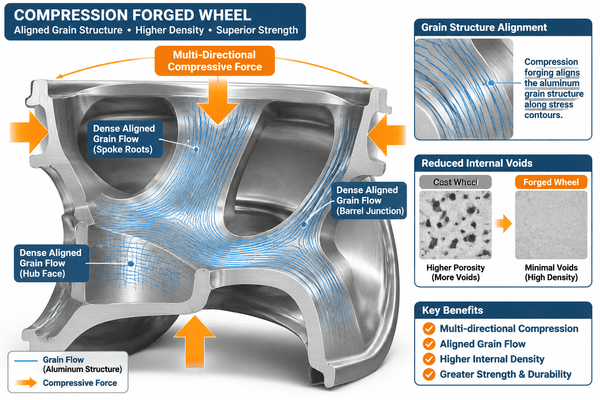
Compression forged wheels are a specific type of forged wheel produced by applying multi-directional compressive force to an aluminum billet during the forging process. This aligns the metal’s grain structure along the wheel’s natural stress contours, producing a part that is measurably denser, structurally stronger, and lighter than wheels made through standard forging methods. For buyers comparing suppliers, this process difference matters more than any surface finish or design spec.
Understanding what compression forging actually does to aluminum — and what it means for your specific vehicle — is the difference between buying a premium wheel and buying a wheel that only looks like one. The sections below break this down from the inside out.
How is compression forging different from standard forging?
Most buyers assume all forged wheels are created equal. They aren’t. The word "forged" describes a broad category of manufacturing, and within that category, the specific method used determines the final product’s structural quality.
Standard forging presses aluminum in a single direction. Compression forging applies force from multiple directions simultaneously, compacting the material more aggressively and more evenly. The result is a wheel with tighter grain structure and fewer internal voids — before any machining begins1.
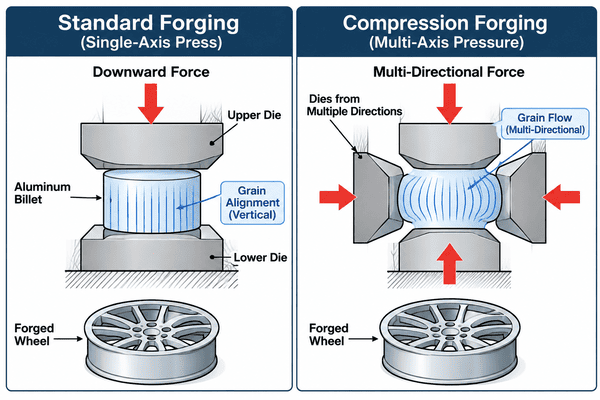
This distinction does not show up on a spec sheet unless you know to ask for it. Most supplier catalogs simply list "forged aluminum" without specifying the method. Here is what actually separates the two approaches.
The grain flow question
Aluminum is not uniform at the microscopic level. It has a grain structure — the directional alignment of its crystalline matrix. When aluminum is pressed, that grain either flows randomly or aligns along the part’s load paths, depending on how the force is applied.
Standard forging produces decent grain alignment. Compression forging is designed to push that alignment further by applying pressure across multiple axes during the same operation. The manufacturing process is intended to orient the grain along the wheel’s highest-stress zones: the spoke roots, the hub face, and the barrel junction.
Why does this matter for the buyer?
- Grain-aligned aluminum resists fatigue cracking more effectively under cyclic loading2 (which is exactly what your wheels experience every time you corner, brake, or hit a bump)
- Better grain alignment allows the design engineer to remove more material from low-stress areas — this is what enables the weight reduction without compromising load capacity
- The same structural result from a standard forging would require more material, meaning a heavier wheel
Weight and unsprung mass
This is where compression forging becomes a real-world performance conversation, not just a manufacturing one.
Unsprung mass refers to the weight of components not supported by the suspension — wheels, tires, and brake assemblies. Every gram you reduce from unsprung mass has a disproportionate effect on:
- Steering responsiveness
- Suspension reaction speed
- Road holding under dynamic load
A compression forged wheel — because of its denser, more consistent grain structure — can be machined more aggressively in areas where material is not structurally necessary. The result is a wheel that is lighter than a comparably sized standard forged wheel, often by a meaningful margin depending on design and diameter3.
I work with a manufacturing partner with over 20 years of forged wheel production experience. Their consistent observation is that compression forging allows for more confident material removal during CNC finishing — not because they cut more corners, but because the base material is more predictable.
A direct comparison
| Feature | Standard Forging | Compression Forging |
|---|---|---|
| Force direction | Single-axis | Multi-directional |
| Grain alignment | Partial | Optimized along stress contours |
| Internal voids | More likely | Significantly reduced |
| Weight for equivalent strength | Heavier | Lighter |
| Material predictability | Moderate | High |
| Typical application | General performance | High-performance, custom builds |
Who actually needs compression forged wheels?
Not every buyer needs compression forged wheels. Part of my job is making sure buyers are matched to the right product for their actual use case — not oversold on something they don’t need or undersold on something that won’t hold up.
The right question isn’t just "are these compression forged?" It’s "what are these wheels expected to do, on what vehicle, under what conditions?"
Here is a scenario-based decision framework I use with clients.
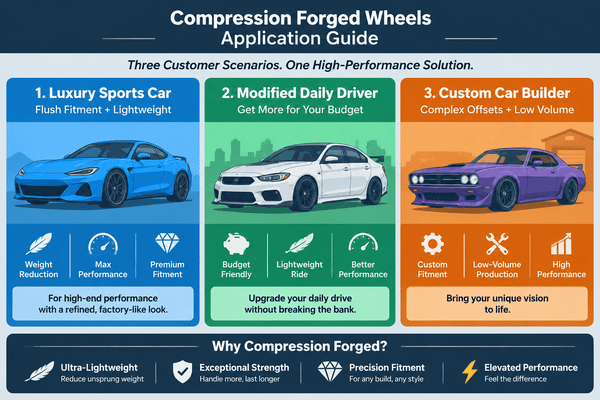
Scenario 1: Luxury sedan, flush fitment, lightweight aesthetics
A client with a Porsche 911 came to me wanting wide-body fitment and a minimal-spoke design. His priorities were visual aggression and low rotational weight. He drove on public roads with occasional track days.
Compression forged is the right answer here — and here’s why:
- Minimal-spoke designs require each spoke to carry more load. Compression forging provides the structural confidence to execute an aggressive design without over-engineering the spoke width.
- The reduced unsprung mass directly improves the driving feedback he was paying for — not just in lap times but in daily feel.
- A one-piece compression forged wheel in his fitment could be produced to his design and finished in 15–20 days through our production process.
Scenario 2: Modified daily driver, tight budget
A shop owner reached out about a customer’s Honda Civic build — a street car with modest power and a primary goal of visual upgrade. The customer’s budget was fixed and the wheel would see no track use.
Compression forged may be more than necessary here. A well-made standard forged wheel would likely meet the structural demands of this application. I told the shop owner exactly that. Overspending the budget on a process premium the application won’t use is not good sourcing advice.
The honest answer is: compression forging earns its cost when the application is pushing design limits, weight targets, or performance demands that standard forging can’t meet as efficiently.
Scenario 3: Custom car builder, low-volume, complex fitment
This is the client type where compression forging provides the clearest value. Custom builders often need unusual sizing, aggressive offsets, and designs that have never been manufactured before.
- Multi-directional compression allows the forging to begin closer to the finished shape, reducing the material waste and machining time for complex geometries4.
- The structural predictability of the base material makes custom spoke designs easier to validate.
- Our MOQ of 4 wheels means custom builders can order a single set without committing to a full production run.
How do you verify a supplier’s compression forging claims?
This is the question buyers should be asking but rarely do. "Compression forged" is a marketing-friendly term, and not every supplier uses it honestly. Some use it to describe standard die forging. Others use it correctly. Without visibility into the production line, how do you tell the difference?
There are three practical verification anchors.
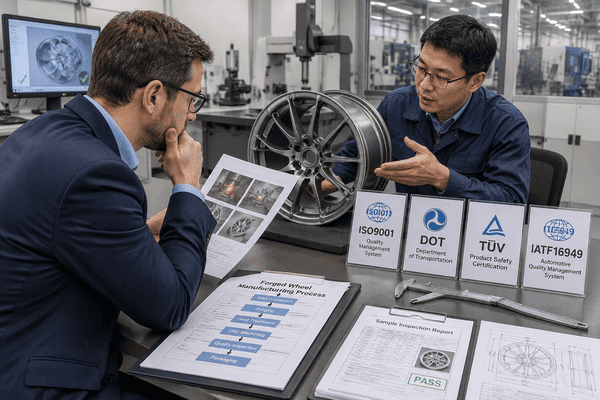
1. Ask for the forging process documentation
A legitimate compression forging operation will have documented process parameters: the press tonnage, the die configuration, the number of forging strikes, and the heat treatment sequence. You don’t need to be a metallurgist to evaluate this — you just need to see that it exists. If a supplier can’t produce process documentation, the manufacturing claim is unverifiable.
2. Check for certifications that imply process control
Certifications like IATF16949 are not awarded to companies that simply describe their process — they require documented quality management systems, controlled production records, and regular third-party auditing. A supplier holding IATF16949 has had their manufacturing process independently evaluated.
Tree Wheels’ manufacturing partner holds ISO9001, DOT, TÜV, and IATF16949 certifications. I recommend buyers treat these as minimum signals of process credibility — not as guarantees, but as documentation that the production environment has been externally assessed. Verify the certification documents directly; don’t accept a logo on a website as proof.
DOT certification specifically signals that the wheel has been tested against U.S. safety standards for road use. TÜV certification reflects evaluation against German technical safety benchmarks, which are widely recognized as stringent across global markets.
3. Request a sample before committing to a full order
No certification replaces physical evaluation. For buyers sourcing through Tree Wheels, we offer sample production before full order commitment. A sample lets you assess surface finish quality, dimensional accuracy, and overall manufacturing consistency before you scale the order.
This step is especially important for custom designs — a 3D model and a physical sample are different conversations.
Questions to ask any forging supplier
- What press tonnage is used in the compression forging stage?
- How many forging operations does the wheel go through before CNC machining?
- What alloy specification is used, and what is the temper designation?
- What heat treatment process follows forging?
- Can you provide the certification documents (not just the logo)?
Frequently Asked Questions
Is compression forging the same as flow forming?
No. Compression forging and flow forming are different processes applied at different stages. Compression forging shapes the aluminum billet under high pressure before machining. Flow forming is a post-forging or post-casting process that stretches the barrel of the wheel under heat and rotation to increase density in that specific zone. Some wheels combine both — but they are not interchangeable terms.
Are compression forged wheels only for high-performance vehicles?
Not exclusively. Compression forged wheels are appropriate for any application where lightweight construction, structural reliability, and design flexibility are priorities. Many luxury sedan owners and custom car builders choose them for aesthetic and handling benefits, not just outright performance. The right fit depends on your vehicle, your use case, and your design goals.
What sizes can compression forged wheels be made in?
At Tree Wheels, sizing is tailored to customer specifications. There is no fixed size catalog. We work from your vehicle’s fitment requirements — diameter, width, offset, and center bore — and produce wheels to those dimensions. This applies to one-piece, two-piece, and three-piece compression forged configurations.
How long does it take to produce compression forged wheels?
Production lead times at Tree Wheels depend on the wheel configuration. One-piece forged wheels take approximately 15–20 days. Two-piece wheels take 20–25 days. Three-piece wheels take 30–35 days. These timelines begin after design confirmation and deposit.
What is the minimum order quantity?
Our MOQ is 4 wheels — one complete set. This applies to both B2B clients like modification shops and individual buyers with custom fitment needs. We designed this threshold specifically so that custom builds and low-volume orders aren’t excluded from the production process.
Conclusion
Compression forged wheels are not simply a premium tier of forged wheels — they represent a specific manufacturing method with specific structural outcomes. The multi-directional compression process is designed to produce denser grain structure, reduced internal voids, and a lighter final part than standard forging methods can consistently achieve. For buyers making sourcing decisions, this distinction determines whether the wheel matches the structural demands of the application or simply looks like it does.
The right compression forged wheel comes down to three factors: your vehicle’s fitment requirements, your performance or aesthetic goals, and a supplier you can verify. Not every buyer needs compression forged wheels. But if your design pushes spoke geometry, your build demands low unsprung weight, or your use case involves dynamic stress beyond ordinary road driving — this is the process that justifies the investment.
If you’re ready to source, reach out to Tree Wheels with your vehicle make and model, the size and offset you’re targeting, and a description of your build goals or use case. That information is what allows us to match you to the right configuration, give you an accurate lead time, and move your project forward without wasted back-and-forth.
-
"The Natural Aging Behavior of Open-Die-Forged 7050 …", https://digitalcommons.calpoly.edu/cgi/viewcontent.cgi?article=1177&context=matesp. Metallurgical studies of aluminum forging processes indicate that hydrostatic compressive stress components during die forging close pre-existing porosity and suppress void nucleation, with more uniform stress distributions producing lower residual void fractions in the finished part. Evidence role: mechanism; source type: research. Supports: Higher and more uniformly distributed compressive stress during forging reduces internal porosity and void content in aluminum billets. Scope note: Void reduction efficiency depends on billet quality, alloy, temperature, and strain rate; the comparative advantage of multi-directional over single-axis forging is process- and geometry-specific. ↩
-
"Influence of the Grain-Flow Orientation after Hot Forging …", https://preserve.lehigh.edu/lehigh-scholarship/faculty-and-staff-publications/faculty-publications/influence-grain-flow. Materials science literature establishes that preferred crystallographic texture aligned with principal stress directions reduces fatigue crack initiation rates in aluminum alloys by limiting the number of favorably oriented slip systems available for crack propagation under cyclic stress. Evidence role: mechanism; source type: research. Supports: Grain alignment along principal stress directions improves fatigue crack resistance in aluminum alloys under cyclic loading. Scope note: Quantitative improvement in fatigue life varies substantially with alloy composition, temper, and loading geometry; general findings may not translate directly to specific wheel designs. ↩
-
"Casting Wheels vs. Forged Wheels: Which Offers Better …", https://treewheels.com/casting-wheels-vs-forged-wheels-which-offers-better-performance-for-your-vehicle/. Engineering analyses of aluminum wheel manufacturing indicate that improvements in forging process control, which reduce property scatter and internal defects, allow designers to reduce safety margins and remove additional material in non-critical regions, yielding measurable weight reductions relative to conventionally forged equivalents of the same diameter and load rating. Evidence role: general_support; source type: research. Supports: Advanced forging processes that improve material consistency enable greater material removal during finishing, producing lighter wheels than conventional forging for equivalent structural performance. Scope note: Published quantitative comparisons between compression forging and standard forging specifically for automotive wheels are limited in open literature; weight savings figures cited by manufacturers should be verified against independently tested specimens of equivalent design and load rating. ↩
-
"Near-Net Forging Technology Demonstration Program", https://ntrs.nasa.gov/citations/19970015005. Manufacturing engineering literature on precision and near-net-shape forging documents that multi-directional die configurations constrain material flow more completely than open or single-axis dies, yielding tighter dimensional tolerances and reduced machining stock in the as-forged condition. Evidence role: mechanism; source type: research. Supports: Multi-directional and precision forging processes produce parts closer to final geometry than conventional forging, reducing machining allowances and material waste. Scope note: Near-net-shape capability depends on die design, press capacity, and alloy behavior; the advantage over conventional forging is geometry-dependent and not uniform across all wheel designs. ↩