

We have been producing forged wheels for over 20 years. In that time, we have worked with customers from the USA, Australia, Dubai, and beyond. The same misconceptions come up again and again.
Most people walk into a forged wheel conversation with a fixed set of beliefs: they are too expensive, they take too long to make, and they are only for race cars. These beliefs are not based on direct experience. They come from retail pricing, one-sided online reviews, and second-hand stories from friends.
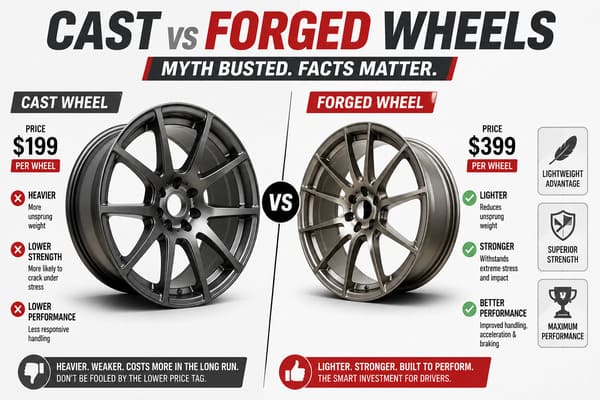
We want to break each of these misconceptions down, one by one. We have seen how these wrong ideas stop good customers from making a decision that would genuinely benefit them. So let us go through them together, clearly and honestly.
Are Forged Wheels Really Too Expensive for Most Drivers?
Many customers contact us and say "I probably can’t afford it" before they even ask for a price. That assumption is almost always wrong, and it costs them money in the long run.
The "too expensive" label on forged wheels comes from retail brand pricing, not factory direct pricing. When you buy directly from a manufacturer like us, the cost is significantly lower. Our minimum order is just 4 wheels, which means individual car owners and small shops can both place orders.
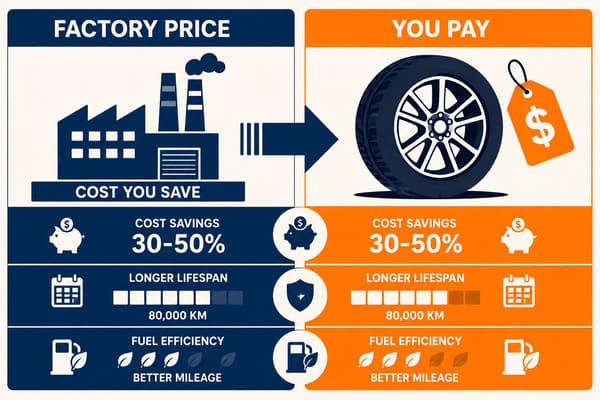
One shop owner from the USA contacted us and said his opening line was: "I assume I can’t afford your wheels." He was running cast wheels at around $800 a set. When we gave him our factory direct price for a custom forged set, he went quiet for a few seconds. Then he said: "I thought it would be at least three times more expensive."
Why the Price Perception Is Wrong
The price gap between cast and forged wheels is real, but it is much smaller than most people think, especially when you buy direct from a factory. More importantly, the comparison should not stop at the purchase price.
| Factor | Cast Wheels | Forged Wheels |
|---|---|---|
| Upfront Cost | Lower | Moderate |
| Lifespan | Standard | 30–50% longer |
| Weight | Heavier | 15–20% lighter |
| Fuel Savings Over Time | None | Yes, due to reduced unsprung mass |
| Repair vs. Replace | Replace sooner | Last longer before replacement |
| Long-Term Value | Lower | Higher |
When you factor in the longer lifespan of forged wheels, which is typically 30% to 50% longer than cast wheels1, and the fuel savings that come from reduced wheel weight2, the total cost over time often favors forged wheels. A customer who pays slightly more upfront but replaces their wheels far less often is actually spending less. The "too expensive" label is not wrong because forged wheels are cheap. It is wrong because the comparison is being made on the wrong terms.
Do Forged Wheels Actually Make a Difference in Performance?
Some customers think the performance difference between forged and cast wheels is mostly marketing. They believe it sounds good on paper but does not change how a car actually feels on the road.
Forged wheels are lighter than cast wheels of the same size, typically by 15% to 20%. This weight reduction directly lowers the unsprung mass of the vehicle3. Lower unsprung mass means faster acceleration response, shorter braking distances, and more precise handling4. These are measurable, physical changes.
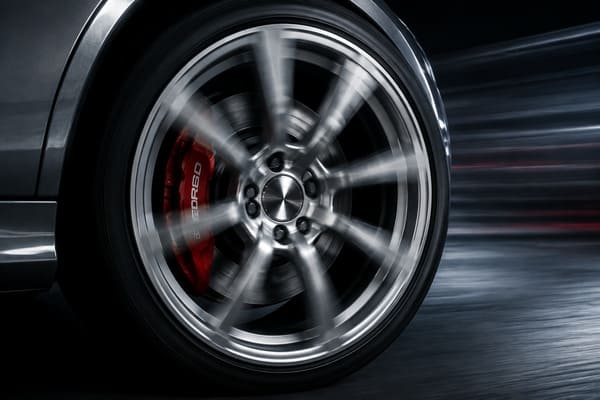
We had a customer in Australia who tracks his BMW M3 on weekends. After switching to our one-piece forged wheels, he sent us a message. He said his braking distance was noticeably shorter and that cornering felt completely different5. That is not a feeling. That is physics.
How the Weight Difference Changes Real Driving
The forging process compresses the grain structure of the aluminum alloy under high pressure. This makes the material denser and stronger6, which means less material is needed to achieve the same structural strength. Less material means less weight.
| Performance Area | Effect of Reduced Unsprung Mass |
|---|---|
| Acceleration | Wheels spin up faster, improving response time |
| Braking | Less rotational inertia means shorter stopping distances |
| Cornering | Suspension reacts more quickly to road changes |
| Tire Wear | More even contact with the road surface |
| Fuel Efficiency | Less energy needed to rotate lighter wheels |
For a daily driver, the difference may not be dramatic on day one. But after three months, the data shows up in tire wear patterns and fuel consumption records7. Forged wheels do not just look better. They change how the car behaves in ways that are real and repeatable.
Are Forged Wheels Only for Race Cars?
Forged wheels first became widely used in Formula 1 and Le Mans racing8. That history is real. But it is also old history, and it has nothing to do with what forged wheels are today.
Forged wheels moved from the racetrack to the street over the past two decades9. Today, they are used on luxury SUVs, daily commuter cars, and custom builds of all kinds. Any car owner who cares about driving quality and appearance can use forged wheels.

Our customers include a luxury car modification center in Dubai that fits forged wheels on Rolls-Royce and Bentley vehicles. We also work with SUV owners in Canada who want their vehicles to look sharper and feel more stable. And we work with younger enthusiasts in the UK who have limited budgets but want a genuinely custom set of wheels. None of these people are professional racing drivers.
Who Actually Buys Forged Wheels Today
The idea that forged wheels are only for race cars made sense in the 1980s10. It does not make sense now. The market has changed completely, but the old image has not caught up.
| Customer Type | Location | Reason for Choosing Forged Wheels |
|---|---|---|
| Luxury car modification center | Dubai | Premium appearance for high-end vehicles |
| SUV owner | Canada | Better stability and visual upgrade |
| Young car enthusiast | UK | Full customization on a controlled budget |
| Auto modification shop | USA | Offering clients a higher quality product |
| Track day enthusiast | Australia | Performance improvement for weekend use |
The common thread across all of these customers is not that they race cars. It is that they care about what their car looks and feels like. That is the real qualification for forged wheels. If you want a wheel that is built specifically for your car, in the size, style, and finish you choose, forged is the answer. Racing is just where the technology started.
Is the Production Time for Forged Wheels Really That Long?
One of the most common concerns we hear is about lead time. Customers see our production timelines and compare them to off-the-shelf wheels available online. The comparison is understandable, but it is not a fair one.
Our one-piece forged wheels take 15 to 20 days to produce. Two-piece wheels take 20 to 25 days. Three-piece wheels take 30 to 35 days. This time includes design confirmation, 3D modeling, and full customization. Every wheel is built specifically for the customer who ordered it.
Here is a question we like to ask customers who are concerned about lead time: if you go to a tailor for a custom suit, do you compare the wait time to buying a shirt off the rack at a supermarket? The answer is no, because they are not the same thing. One is made for you. The other is made for anyone.
What Happens During the Production Window
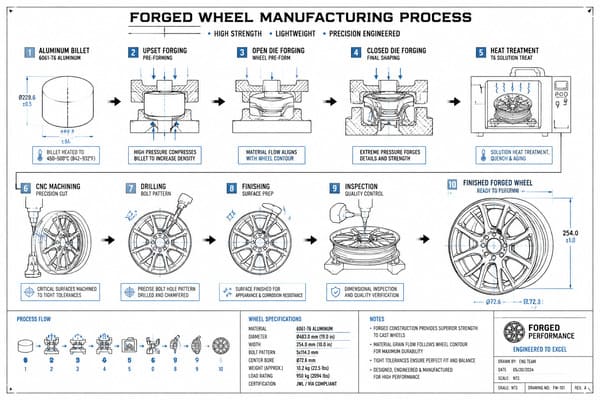
The production time for forged wheels is not waiting. It is working. Before a single piece of aluminum is pressed, we go through a full confirmation process with the customer.
| Stage | What Happens |
|---|---|
| Design Confirmation | We provide sketches based on customer requirements |
| 3D Modeling | A digital model is built and approved before production starts |
| Forging | Aluminum billet is pressed under high pressure to form the wheel |
| Machining | CNC machining shapes the final dimensions precisely11 |
| Surface Treatment | Custom finish is applied based on the agreed specification |
| Quality Inspection | Each wheel is checked against the confirmed design |
| Packaging & Shipping | Foam protection, corner guards, and seven-layer corrugated cartons |
Every step in that process exists to make sure the wheel you receive matches exactly what you agreed on. A customer once told us: "I waited 20 days, but the moment I received them, I knew it was worth it." That waiting time is not a delay. It is the definition of custom manufacturing. You cannot rush a process that is being done specifically for you and expect the same result.
Conclusion
Forged wheels are not too expensive, not only for race cars, and not slow to produce without reason. The misconceptions come from outdated information and unfair comparisons. At Tree Wheels, we build every wheel with 20+ years of forging expertise, full customization, and a minimum order of just 4 wheels — made for you, not the masses.
-
"(PDF) Design and fatigue analysis of an aluminium alloy …", https://www.academia.edu/95480152/Design_and_fatigue_analysis_of_an_aluminium_alloy_aerodynamic_wheel. Research on aluminum wheel fatigue life, such as studies conducted under SAE or ISO standards, provides comparative data on the cyclic load endurance of forged versus cast wheel structures; specific percentage claims vary by alloy and geometry and should be referenced to a controlled test protocol. Evidence role: statistic; source type: research. Supports: The fatigue life and durability advantage of forged aluminum wheels over cast aluminum wheels. Scope note: Lifespan advantage is geometry- and alloy-dependent; a single percentage range may not apply universally across all wheel designs. ↩
-
"[PDF] Rotating Inertia Impact on Propulsion and Regenerative Braking for …", https://vtechworks.lib.vt.edu/server/api/core/bitstreams/42728a07-b0a2-49e8-8968-311179eb0f5c/content. Research on vehicle energy consumption indicates that reducing rotational inertia at the wheel has a proportionally greater effect on fuel economy than equivalent reductions in sprung mass, owing to the energy required to accelerate rotating components; reported fuel savings depend heavily on driving cycle and vehicle type. Evidence role: mechanism; source type: research. Supports: The effect of wheel mass reduction on vehicle fuel consumption through decreased rotational inertia and unsprung mass. Scope note: Fuel savings from wheel mass reduction are modest in absolute terms and highly dependent on drive cycle; aggressive driving conditions amplify the effect while highway cruising minimizes it. ↩
-
"How Much Weight Can Forged Wheels Save?", https://treewheels.com/how-much-weight-can-forged-wheels-save/. Engineering literature on aluminum wheel manufacturing documents that the higher density achieved through die forging allows thinner cross-sections, resulting in measurable mass reductions compared to gravity or low-pressure cast equivalents; reported ranges differ by design and size. Evidence role: statistic; source type: research. Supports: The typical weight difference between forged and cast aluminum wheels of equivalent dimensions. Scope note: Weight savings vary significantly by wheel diameter, width, and spoke design; a universal 15–20% figure is an approximation that may not hold for all configurations. ↩
-
"Accelerating and braking", https://dynref.engr.illinois.edu/ava.html. Vehicle dynamics literature, including studies published by SAE International, establishes that unsprung mass directly affects tire contact force variation, suspension response frequency, and rotational inertia, with lower unsprung mass correlating with improved handling and braking metrics under controlled conditions. Evidence role: mechanism; source type: research. Supports: The relationship between reduced unsprung mass and improvements in vehicle acceleration, braking, and handling dynamics. Scope note: The magnitude of improvement is vehicle- and road-condition-dependent; effects are more pronounced at higher speeds and on uneven surfaces than in normal urban driving. ↩
-
"Optimization of aluminum alloy wheel design based on improved …", https://ui.adsabs.harvard.edu/abs/2025ERExp…7d55b4K/abstract. Controlled vehicle dynamics studies examining the effect of unsprung mass variation on stopping distance and lateral response provide a mechanistic basis for performance changes attributed to wheel substitution; individual subjective reports are consistent with predicted directional effects but do not substitute for standardized testing. Evidence role: general_support; source type: research. Supports: That changes in wheel mass produce measurable differences in braking and cornering performance under real driving conditions. Scope note: Anecdotal driver reports are subject to expectation bias; controlled tests with instrumented vehicles are needed to quantify the specific braking and handling improvements attributable to wheel mass alone. ↩
-
"Intrinsic and Extrinsic Effects of Microstructure on Properties in Cast …", https://pmc.ncbi.nlm.nih.gov/articles/PMC7254244/. Materials science references, including ASM International handbooks and Wikipedia’s entry on forging, describe how compressive deformation during hot or cold forging refines grain boundaries and eliminates porosity, increasing yield strength and fatigue resistance in aluminum alloys. Evidence role: mechanism; source type: encyclopedia. Supports: The metallurgical mechanism by which forging refines grain structure in aluminum alloys, improving strength and density relative to cast counterparts. Scope note: The degree of improvement depends on alloy composition, forging temperature, and die design; the general mechanism is well established, but specific performance outcomes vary. ↩
-
"USTMA Tire Wear Rate Calculations for U.S. and California", https://calsafer.dtsc.ca.gov/documentitem/index/?guid=c006401a-3494-450a-9cca-e6d889f5f266. Vehicle dynamics and tire mechanics literature supports the principle that lower unsprung mass reduces wheel hop and improves tire contact patch consistency, which is theoretically associated with more even wear; longitudinal empirical comparisons specific to forged versus cast wheels in identical vehicle configurations are limited in the public literature. Evidence role: general_support; source type: research. Supports: That reduced wheel mass and improved wheel rigidity contribute to more even tire contact and measurable differences in wear rate and fuel use over extended use. Scope note: Published longitudinal data comparing tire wear specifically between forged and cast wheels on identical vehicles under matched conditions is scarce; the claim rests primarily on engineering inference rather than direct experimental proof. ↩
-
"Alloy wheel", https://en.wikipedia.org/wiki/Alloy_wheel. Historical accounts of motorsport technology development note that lightweight forged aluminum components, including wheels, were adopted in top-tier racing series during the mid-to-late twentieth century as teams sought mass reductions; the specific timeline of widespread adoption varies by source and series. Evidence role: historical_context; source type: encyclopedia. Supports: The historical adoption of forged aluminum wheels in elite motorsport categories such as Formula 1 and endurance racing. Scope note: Detailed manufacturer-level records of when forged wheels became standard in specific series are not uniformly documented in public encyclopedic sources. ↩
-
"How Has Wheel Design Evolved Over the Past Decade?", https://treewheels.com/how-has-wheel-design-evolved-over-the-past-decade/. Automotive industry market research and trade association reports on the global wheel market document the expansion of forged wheel availability into luxury, performance, and aftermarket segments; the pace and scale of this transition are tracked differently across regional markets. Evidence role: historical_context; source type: institution. Supports: The broader commercial adoption of forged aluminum wheels beyond motorsport applications into the consumer and luxury automotive aftermarket. Scope note: Publicly available granular market data specifically segmenting forged wheel adoption timelines by application type is limited; industry reports are often proprietary. ↩
-
"American Racing: Classic, Custom, Performance and Vintage …", https://www.americanracing.com/?srsltid=AfmBOoqrt229XZ-BIYjp1qQi8At8Sjv0K7KSfrWcDFThGL98CHkPaeWA. Historical accounts of the automotive aftermarket wheel industry indicate that cast aluminum alloy wheels became widely available to consumers during the 1970s and 1980s, while forged variants remained associated with high-cost performance and racing applications during that period due to their manufacturing complexity and cost. Evidence role: historical_context; source type: encyclopedia. Supports: That forged aluminum wheels were primarily a motorsport technology in the 1980s before broader consumer market availability. Scope note: The boundary between racing-exclusive and consumer-available forged wheels was not uniformly drawn across all markets simultaneously; adoption timelines differed between Japan, Europe, and North America. ↩
-
"What Is the Complete Manufacturing Process for a Premium …", https://treewheels.com/what-is-the-complete-manufacturing-process-for-a-premium-forged-wheel/. Manufacturing engineering references describe CNC machining as a standard finishing operation in forged component production, enabling tight dimensional tolerances that forging alone cannot achieve due to die wear and material springback; wheel manufacturing typically requires adherence to runout and balance specifications governed by standards such as those published by TÜV or JWBA. Evidence role: definition; source type: education. Supports: The use of CNC machining as a precision finishing step in forged aluminum wheel manufacturing. Scope note: Specific tolerance values and machining protocols vary by manufacturer and target market regulatory requirements. ↩