
Every week, buyers contact us having already decided they want "chromatic wheels" — but when we ask what finish they actually mean, the conversation stalls. The term shows up everywhere in product listings and forums, yet no two sellers seem to define it the same way. That gap between label and specification causes real problems at the order stage.
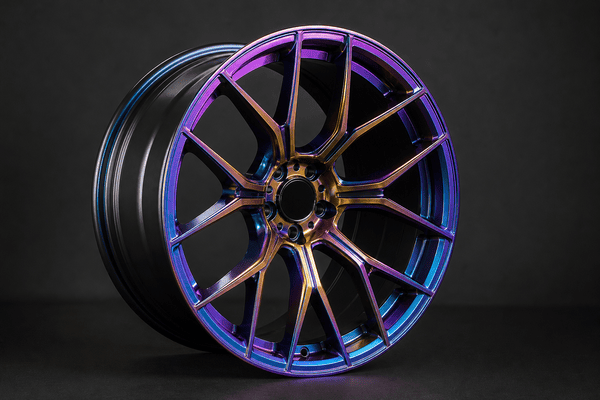
"Chromatic wheels" is not a standardized technical term. In wheel customization, it broadly describes wheels with color-rich, multi-tone, or iridescent surface finishes — such as holographic, color-shifting, or prismatic coatings. Because no industry body regulates the term, different suppliers use it differently. Buyers must look past the label and identify the specific finish type, application method, and substrate before placing an order.
Understanding that "chromatic" describes a finish direction rather than a fixed product SKU changes how you shop for wheels entirely. The sections below break down what the term typically covers, what variables actually matter when you’re buying, and what information you need to bring to a supplier before a single wheel goes into production.
What Does "Chromatic" Actually Mean in the Wheel Industry?
Most buyers assume "chromatic" maps to a specific product they can order off a shelf. It doesn’t — and that assumption is where most purchasing confusion starts.
When customers contact Tree Wheels asking about chromatic wheels, the first question we ask back is: "Can you show us a reference image?" That question cuts through the label immediately, because "chromatic" can describe half a dozen different finish effects depending on who’s selling.

What "Chromatic" Typically Refers To
In practice, the term is used as an umbrella for finishes that produce color variation, tone shifts, or multi-spectral effects across the wheel surface. These effects are achieved through different coating and surface treatment processes. Common examples include:
- Holographic finishes — produce rainbow-like spectral patterns that shift with viewing angle and light source
- Color-shifting (flip-flop) coatings — change apparent hue depending on the angle of observation; often use interference pigments or thin-film technology
- Prismatic or pearl finishes — embed metallic or mica-based particles that refract light differently across the surface
- Iridescent anodizing (rare on steel, more common on aluminum) — an electrochemical process that creates oxide-layer interference colors
None of these are interchangeable. Each has a different production process, a different cost point, and a different durability profile. A buyer who asks for "chromatic wheels" without specifying which effect they want is essentially asking a painter for "a colorful painting" — technically accurate, practically useless.
Why the Term Isn’t Standardized
Unlike a specification such as TÜV certification or a wheel offset measurement, "chromatic" carries no regulatory definition in the automotive parts industry. It originated in marketing copy — most likely borrowed from optics terminology, where "chromatic" simply means "relating to color." Suppliers adopted it because it sounds premium and visually descriptive. The result is a term that means something slightly different in every catalog it appears in.
This isn’t necessarily dishonest on the supplier’s part. It’s a genuine vocabulary gap in the aftermarket wheel space. But it does mean the buyer’s job is to translate the marketing label back into a technical specification before the order process begins.
What This Means for Buyers
| What You See in a Listing | What You Actually Need to Ask |
|---|---|
| "Chromatic wheel" | What finish type? (holographic, color-shift, pearl, prismatic?) |
| "Color-shifting effect" | What pigment or coating technology produces this? |
| "Multi-tone finish" | How many color stages? What are the base and shift colors? |
| "Iridescent coating" | Is this anodizing, PVD, powder coat, or paint-based? |
| "Custom chromatic option" | What color references do you accept? (RAL, Pantone, image?) |
The table above captures what our consultation process usually surfaces within the first few minutes of a customer inquiry. The label is the starting point, not the specification.
What Are the Real Buying Variables for Chromatic Wheels?
Once buyers understand that "chromatic" is a finish direction, the next mistake is treating all chromatic finishes as equivalent. They’re not. Three variables determine whether a chromatic wheel works for your application.
The right finish for a show car sitting under controlled lighting is not the right finish for a daily driver in a salt-belt climate. Getting this wrong costs money — either in premature finish degradation or in a wheel that simply doesn’t look the way the buyer expected.
Variable 1: Finish Durability
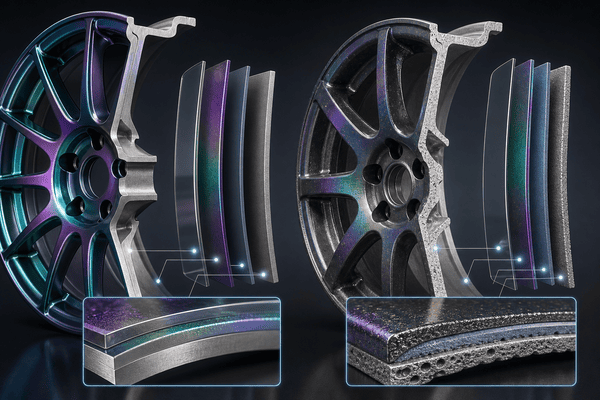
Durability is the variable buyers most often underestimate. Marketing copy rarely breaks down what a chromatic finish can and cannot withstand. Here is what actually matters:
- UV resistance — Color-shifting and holographic pigments can fade or lose their shift effect under prolonged UV exposure1. This varies significantly by coating type. Buyers should ask for specific UV resistance data from their supplier and treat unverified claims with caution.
- Chemical resistance — Wheel cleaners, brake dust, and road salts each stress the coating differently. Some chromatic finishes are applied over a clear coat that provides additional protection; others are not.
- Mechanical resistance — Curb rash, stone chips, and car wash brushes will eventually damage any finish. Harder surface treatments (such as PVD) generally outperform standard paint-based chromatic coatings on this metric, though at higher cost2.
- Climate suitability — Buyers in coastal or high-humidity environments should specifically ask about moisture resistance. This is not a general claim we make for all finishes — it requires verification for each specific treatment type.
Important: No chromatic finish is maintenance-free. Any specific durability figures quoted by a supplier should be verified against their production process and, where possible, tested on sample pieces before a full order is placed.
Variable 2: Customization Range
Not every supplier can produce every chromatic effect. The range of achievable finishes depends on their coating equipment, in-house capability, and supplier relationships for specialty pigments.
When evaluating suppliers, ask:
- What finish types do you produce in-house? (vs. outsourcing to a third-party coater)
- What color reference formats do you accept? (RAL codes, Pantone, physical samples, image references)
- Can you produce a sample before the full order? A reputable supplier should offer sample production so you can verify the finish effect before committing.
- What is the color consistency across a set of four wheels? Multi-tone finishes are harder to batch-match than single-color finishes.
At Tree Wheels, customers can submit color references — images, physical samples, or standard color codes — and we produce 3D models and sample wheels before full production begins. That step exists specifically because chromatic finishes are difficult to communicate in text alone.
Variable 3: Substrate Compatibility
The wheel material affects how a finish bonds, how long it lasts, and what processes are even possible.
| Substrate | Finish Compatibility Notes |
|---|---|
| Forged aluminum alloy | Dense grain structure provides an excellent base for PVD, anodizing, and high-adhesion paint systems. Finishes tend to bond more reliably than on cast alloys. |
| Cast aluminum alloy | More porous surface; some high-end chromatic processes may not adhere as durably. Surface preparation quality becomes more critical. |
| Flow-formed aluminum | Intermediate properties; compatibility depends on alloy grade and surface prep. Verify with supplier. |
This is not a claim that forged wheels always produce better finishes — it’s a structural observation about why substrate matters when specifying a chromatic treatment. A qualified coating specialist or the supplier’s technical team should confirm compatibility for any specific combination.
How Do You Actually Specify a Chromatic Wheel Order?
The most practical section of this article is also the one most often missing from marketing-driven content. Knowing what chromatic means is only useful if you can translate that knowledge into a supplier conversation.
Buyers who skip the specification step — assuming "chromatic" is enough detail — are the ones who end up with mismatched finishes, unexpected lead times, or wheels that look different from the reference image they had in mind.
The Specification Checklist
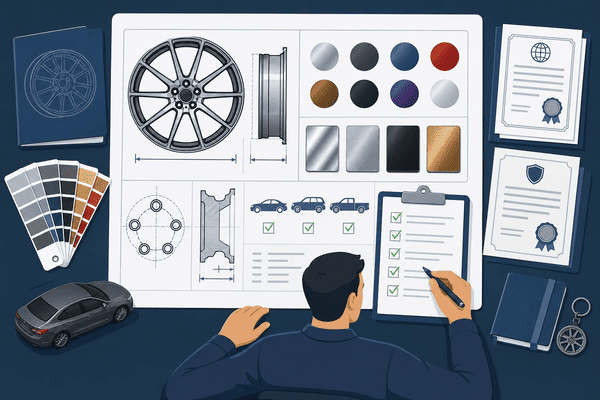
Before contacting any supplier about chromatic wheels, you should have clear answers — or at least clear questions — on the following:
1. Wheel substrate and construction
- One-piece forged, two-piece, or three-piece?
- Alloy specification?
- Size: diameter, width, offset, bolt pattern, center bore?
2. Finish type
- What visual effect are you targeting? (Holographic, color-shift, pearl, prismatic?)
- Do you have a reference image, physical sample, or color code?
- Is the effect expected across the full face, the spokes only, or split across sections of the wheel?
3. Durability requirements
- Primary use: show car, daily driver, track use?
- Climate: standard, coastal, cold-weather salt exposure?
- Washing method: hand wash, automated car wash, pressure washer?
4. Production and verification
- Is sample production available before full order?
- What is the approval process for color matching?
- What certifications apply to the wheel construction? (DOT, TÜV, ISO9001, IATF16949 — verify documents directly with the supplier)
5. Commercial terms
- What is the MOQ for your finish option?
- What is the lead time?
- What does the warranty cover for the finish specifically?
Why Samples Matter More Than Descriptions
Color-shifting and holographic finishes are nearly impossible to accurately communicate through text descriptions or even standard photography. The finish effect changes with lighting conditions, camera settings, and viewing angle. A physical sample wheel — or at minimum, a sample panel in the target finish — is the only reliable way to confirm the effect before a full four-wheel order goes into production.
This is not a sales pitch. It’s a practical observation based on the consultations we’ve handled. Buyers who skip this step and rely on catalog images are taking a real risk with a high-value purchase.
Frequently Asked Questions
Are chromatic wheels legal for road use?
Road legality depends on the wheel’s structural certification (DOT in the US, TÜV in Europe, for example) and local regulations — not the finish type3. A chromatic finish applied to a DOT-certified forged wheel does not affect the certification, but buyers should verify that the specific wheel they’re ordering carries the required documentation for their region.
Do chromatic finishes require special maintenance?
Most chromatic finishes require gentler maintenance than standard painted or machined wheels — particularly avoiding abrasive cleaners, automated car wash brushes, and harsh chemical wheel cleaners. The specific care requirements depend on the coating type. Ask your supplier for written care instructions before ordering, and treat generic claims of "easy maintenance" with skepticism.
Can I get a chromatic finish on any wheel size or design?
In principle, yes — chromatic finishes can be applied to most aluminum alloy wheel geometries. In practice, complex spoke designs or recessed areas may produce uneven finish effects with certain coating methods. Confirm with your supplier whether your target design is compatible with the specific finish process you want, and request a rendered 3D model before production if possible.
How long does a chromatic finish last?
This depends entirely on the coating type, application quality, substrate preparation, and real-world use conditions. No honest supplier can give a universal answer. Some PVD-based finishes are marketed as lasting the life of the wheel under normal use; paint-based chromatic coatings may require touch-up or re-finishing sooner, particularly under harsh conditions4. Ask for specific durability data and, where possible, test a sample before committing to a full order.
What’s the difference between chromatic and chrome wheels?
These are not the same thing. Chrome wheels use an electroplating process to deposit a thin layer of chromium metal over the wheel surface, producing a highly reflective mirror finish5. Chromatic wheels use color-rich coatings — often paint, powder, or PVD-based — to produce multi-tone or iridescent color effects. Chrome is a single-tone metallic mirror; chromatic describes color variation and tone-shifting effects.
Conclusion
Chromatic wheels describe a category of color-rich, multi-tone, or iridescent wheel finishes — not a single standardized product. The term covers holographic, color-shifting, prismatic, and similar effects, each produced by different processes with different durability profiles. For any buyer, the real work starts after recognizing the label: identifying the specific finish type, matching it to the right substrate, and building a proper specification before contacting a supplier. At Tree Wheels, we work with car enthusiasts, modification shops, and luxury vehicle owners to turn finish ideas into fully specified, sample-verified forged wheel orders. If you’re ready to move from "I want chromatic wheels" to a complete brief, contact our team and let’s start with a reference image.
-
"Effects of UV radiation on natural and synthetic materials – PMC", https://pmc.ncbi.nlm.nih.gov/articles/PMC10088630/. Photodegradation of organic and interference-based pigments under UV exposure is a documented phenomenon in coatings science, with UV-induced changes to pigment microstructure or binder systems capable of reducing goniochromatic effects. Evidence role: mechanism; source type: research. Supports: That UV radiation can degrade the optical properties of effect pigments and interference-based coatings, reducing color-shift performance over time. Scope note: Published UV degradation studies address coating systems generally; the rate and extent of degradation for specific chromatic wheel coatings depends on formulation details not available in general literature ↩
-
"PVD vs. DLC Coatings: Key Differences & Performance …", https://www.upa.com/feeds/blog/pvd-vs-dlc-coating. Physical vapor deposition (PVD) coatings are documented in the surface engineering literature as producing hard, wear-resistant films with hardness values substantially exceeding those of conventional organic paint systems. Evidence role: general_support; source type: research. Supports: That PVD coatings typically exhibit higher hardness and wear resistance than conventional paint-based surface treatments. Scope note: Published comparisons address PVD coatings in general industrial contexts; direct comparative data for decorative automotive wheel applications specifically may require supplier testing documentation ↩
-
"What Documentation Should Come with Premium Forged Wheels?", https://treewheels.com/what-documentation-should-come-with-premium-forged-wheels/. The U.S. Department of Transportation, through the National Highway Traffic Safety Administration (NHTSA), establishes Federal Motor Vehicle Safety Standards (FMVSS) that govern wheel performance requirements for road-use vehicles in the United States. Evidence role: definition; source type: government. Supports: That the US Department of Transportation (DOT) administers vehicle safety standards applicable to wheels sold for road use in the United States. Scope note: DOT marking requirements and the specific standards applicable to aftermarket wheels involve nuances not fully addressed by citing the regulatory body alone; buyers should consult NHTSA documentation directly ↩
-
"PVD for Decorative Applications: A Review – PMC – NIH", https://pmc.ncbi.nlm.nih.gov/articles/PMC10381906/. PVD coatings are reported in the surface engineering literature to exhibit high hardness, strong adhesion, and resistance to corrosion and wear, properties that contribute to extended service life relative to conventional paint systems in comparable exposure conditions. Evidence role: general_support; source type: research. Supports: That PVD coatings demonstrate superior durability and service life compared to organic paint-based coatings in demanding surface applications. Scope note: Published PVD durability data typically addresses industrial or tooling applications; direct comparative longevity data for decorative automotive wheel finishes under real-world conditions is limited in the open literature ↩
-
"Chrome plating", https://en.wikipedia.org/wiki/Chrome_plating. Decorative chrome plating is an electroplating process in which chromium is deposited from a chromic acid or trivalent chromium electrolyte bath onto a substrate, producing a thin, hard, highly reflective metallic layer; the process and its properties are described in standard electrochemistry and surface finishing references. Evidence role: definition; source type: encyclopedia. Supports: That decorative chrome plating involves electrochemical deposition of a thin chromium layer that produces a highly reflective surface. Scope note: General electroplating references describe the process for industrial applications broadly; automotive wheel-specific chrome plating may involve additional substrate layers (copper, nickel) not detailed in encyclopedic sources ↩