
If you’ve been researching 3-piece wheels, you’ve probably already seen the anatomy breakdown — center disc, inner barrel, outer barrel, bolted together. That description is accurate. It’s also almost useless for making a buying decision. The real question behind "what are 3-piece wheels?" is whether they’re the right choice for your build, your budget, and your timeline.
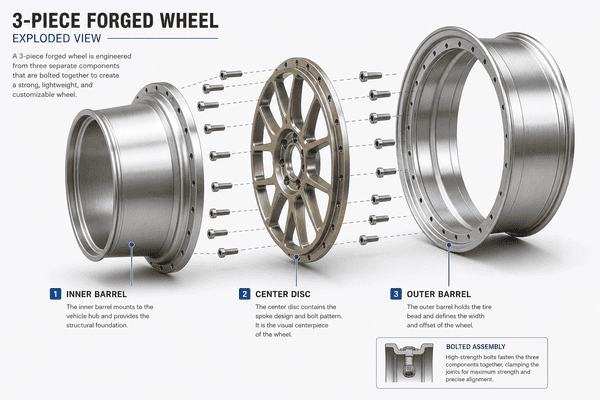
3-piece wheels are a wheel construction type made from three separate forged components — a center disc, an inner barrel, and an outer barrel — bolted together with hardware and sealed. This modular design allows each section to be configured, sized, and finished independently, giving buyers a level of customization depth that one-piece forged or cast wheels simply can’t match. They are best suited for custom builds where fitment, aesthetics, or repairability are priorities.
Understanding what 3-piece wheels are is only the first step. The more useful question is when they make sense — and when they don’t. The sections below break that down honestly, including what the construction actually enables, what it costs in time and money, and what I’ve heard from buyers who’ve made both the right and wrong call.
How Are 3-Piece Wheels Actually Built?
Most buyers arrive with a rough picture of the construction already. Where that picture usually breaks down is in understanding why the three-part design exists.
The three-component structure isn’t an engineering complexity for its own sake. It exists because it decouples the variables that determine fitment. The center disc controls offset and load transfer. The inner and outer barrels control width and depth. When these are separate, each can be specified and manufactured independently.
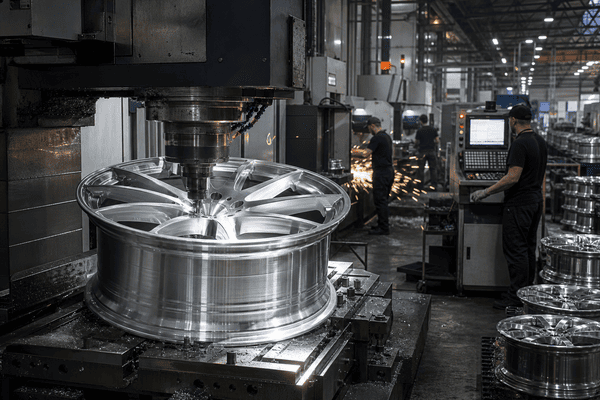
In a one-piece forged wheel, every dimension is locked at the time of forging. If your customer wants a 10.5-inch wide wheel with an aggressive negative offset for a wide-body fitment, a monoblock can be machined to that spec — but only if you order it that way from the start, and only if the forging blank is large enough to accommodate it1. There’s less room to adapt once the billet is cut.
With a 3-piece design, the barrels can be widened or narrowed by specifying different barrel depths. The center disc can be shared across multiple width configurations. This is why 3-piece wheels dominate in the custom and luxury fitment space.
What the Three Components Do
- Center disc (face/spider): The structural and aesthetic centerpiece. This is what you see from the front. It carries the bolt pattern, offset, and hub bore. On a forged 3-piece, this section is typically forged aluminum — the same process used in aerospace and motorsport applications2.
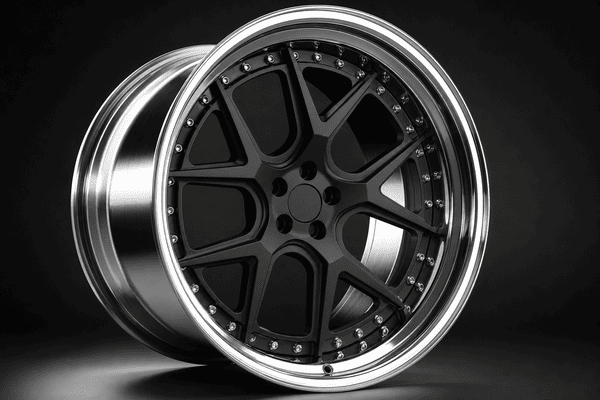
- Outer barrel: The visible rim lip on the street-facing side. On a deep-lip build, this is where the visual drama lives. It can be polished, painted, or powdercoated independently.
- Inner barrel: The inboard section, less visible but equally important for fitment clearance against suspension and brake components.
How the Hardware Works
The three sections are joined with circumferential bolts — typically stainless steel — and sealed with an O-ring or silicone to prevent air loss. The quality of this hardware matters. In conversations with shop owners, I’ve heard complaints about cheaper 3-piece wheels where the hardware corrodes or the seal fails over time3. This is one area where build quality differences between suppliers become tangible, not just theoretical.
Assembly vs. Forged 3-Piece
It’s worth distinguishing between a true forged 3-piece and a lower-cost cast-center 3-piece assembly. Some wheels in this category use a cast center disc bolted to spun or rolled barrels. Others use fully forged components throughout. The forged version typically carries more verifiable certifications — look for DOT, TÜV, and ISO9001 as baseline documentation to request from any supplier4.
What Does the 3-Piece Construction Actually Enable?
This is the question most buyers are actually trying to answer when they search for 3-piece wheels.
The modular design unlocks four practical advantages: sizing flexibility, finish independence, repairability, and fitment precision. Each matters differently depending on whether you’re a shop owner building for clients or an individual putting together a personal project.
These aren’t marketing claims — they’re the specific reasons buyers come to us asking for 3-piece configurations over one-piece alternatives. Understanding each one helps you decide whether the premium is justified for your application.
Sizing Flexibility
One-piece wheels are manufactured to a fixed width and offset. If your target fitment doesn’t match a standard size, you’re either compromising or ordering a full custom monoblock run, which has its own tooling and minimum order implications.
With a 3-piece, width is adjusted by varying barrel depth. This means:
- A shop serving multiple vehicle platforms can work with a smaller set of center disc toolings and vary the barrels per fitment
- Width adjustments in the 1–2 inch range can often be achieved without a full redesign5
- Stepped-lip configurations (inner and outer barrel at different depths) are far easier to execute
Finish Independence
Each of the three sections can receive a different surface treatment. This opens up finish combinations that aren’t possible on a monoblock:
| Section | Common finish options |
|---|---|
| Center disc | Painted, powdercoated, brushed, anodized |
| Outer barrel | Polished, chrome, brushed, painted |
| Inner barrel | Painted, powdercoated (often matches center) |
For luxury builds and show cars, this is significant. A matte black center with a mirror-polished outer lip is a combination that requires a 3-piece construction to execute properly6.
Repairability
This is a practical advantage that gets overlooked in the aesthetics conversation. If a one-piece wheel sustains curb rash on the outer lip or a barrel crack from pothole impact, the entire wheel typically needs replacement. On a 3-piece, the damaged barrel can often be replaced independently7.
I’ve had shop owners tell me this single factor justified the cost premium for their clients — not because they expected damage, but because it reduced the long-term risk of owning a set of expensive wheels on a daily-driven luxury vehicle.
Fitment Precision
Custom offset is where 3-piece wheels give professional fitment technicians the most control. Offset can be specified to the millimeter8, and the independent barrel design means that width and offset can be optimized simultaneously without the constraints of a single-piece forging blank.
When Are 3-Piece Wheels the Right Choice — and When Aren’t They?
This is the section most buyers actually need. 3-piece wheels are not universally superior. They cost more, take longer to produce, and carry more assembly variables than a monoblock.
The honest answer to "should I choose 3-piece?" depends on your use case.
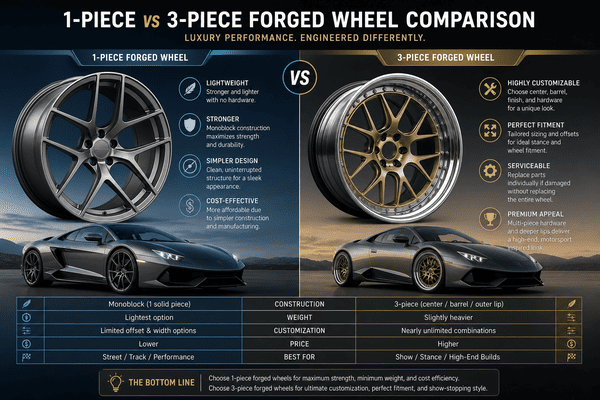
In my experience working with modification shops and individual buyers, the decision usually comes down to a few clear factors: how deep the customization requirements go, how important repairability is, and whether the lead time and minimum order fit the project timeline.
Use Case Comparison
| Use case | 3-piece justified? | Why |
|---|---|---|
| Show car / luxury build | Yes | Maximum finish customization, deep lips, precise fitment |
| Wide-body street build | Yes | Non-standard widths and offsets are easier to achieve |
| Daily driver (standard fitment) | Often no | A one-piece forged wheel is lighter, faster to produce, lower cost9 |
| Track / motorsport | Depends | Weight is critical on track; a well-designed monoblock may be preferable |
| Replacement wheel (one damaged wheel) | No | Matching an existing set post-damage is difficult; repair is more practical |
What 3-Piece Wheels Cost in Time and Money
Buyers should go in with realistic expectations.
Production timelines for 3-piece forged wheels typically run 30–35 days10 from order confirmation to shipping-ready. This is longer than the 15–20 days for a one-piece forged wheel. The assembly, hardware fitment, sealing, and multi-stage finishing add process steps that can’t be compressed.
MOQ at Tree Wheels is 4 wheels. For an individual buyer, this aligns with a standard full set. For a shop owner ordering for a single client, it works cleanly. Where it creates friction is for shops trying to order a single replacement wheel or a test sample — that’s a conversation worth having upfront rather than after a quote is submitted.
Price premium is real. A 3-piece forged wheel will cost more than a comparable one-piece forged wheel of the same size and finish. The premium reflects additional materials (hardware, O-rings, three separate forged or machined components), more complex finishing operations, and longer production time. For a buyer who needs the customization depth, it’s justified. For a buyer who just wants a quality upgrade from cast wheels, a monoblock forged wheel may deliver more value per dollar.
The Risk Is Different Depending on Who’s Buying
For shop owners and modification specialists, the primary risk is reputational. An incorrect fitment, a finish that doesn’t match expectations, or a hardware quality issue reflects on your shop, not just the supplier. This is why I always recommend getting detailed confirmation on offset, hub bore, and finish spec before production begins — and why certifications (ISO9001, DOT, TÜV, IATF16949) should be verified as actual documents, not just claimed on a spec sheet11.
For individual enthusiasts, the primary risk is financial. Misunderstanding what "custom" means in terms of lead time and non-refundable production costs can create a frustrating experience even when the wheels themselves are excellent. Going in with clear expectations about the 30–35 day window and the 4-wheel minimum avoids most of that friction.
Frequently Asked Questions
Are 3-piece wheels stronger than 1-piece wheels?
Not necessarily. Strength depends on the alloy, forging process, and engineering of each specific wheel — not the number of pieces. One-piece forged wheels are structurally seamless and often preferred in motorsport for that reason12. Three-piece wheels trade some structural simplicity for customization flexibility. Always verify certifications like DOT and TÜV for any wheel you’re evaluating.
Can 3-piece wheels be repaired if the barrel is damaged?
In many cases, yes. One of the practical advantages of 3-piece construction is that individual sections — particularly the outer barrel — can be replaced without scrapping the entire wheel. This depends on whether replacement barrels are available from the original manufacturer, so it’s worth asking your supplier about spare parts availability before ordering.
How long does it take to produce a custom 3-piece forged wheel?
At Tree Wheels, production time for 3-piece forged wheels is typically 30–35 days from order confirmation. This is longer than one-piece wheels (15–20 days) due to the additional assembly, hardware fitting, and multi-stage finishing involved. Factor this into your project timeline before committing to a delivery date with your client.
What’s the minimum order quantity for 3-piece forged wheels?
Our MOQ is 4 wheels, which corresponds to a standard full set for most vehicles. This applies to both B2B shop orders and direct individual purchases. If you’re a shop owner evaluating 3-piece wheels for the first time, we can discuss sample options — but the standard production run starts at 4.
Do 3-piece wheels require special maintenance?
The hardware — typically stainless steel perimeter bolts — should be inspected periodically, especially on vehicles driven in environments with road salt or humidity. The barrel seals should be checked if you notice slow air loss that isn’t attributable to the tire or valve. Beyond these specific checks, 3-piece wheels require similar care to any quality alloy wheel: regular cleaning, avoiding harsh chemical cleaners on polished finishes, and prompt attention to any impact damage.
Conclusion
3-piece wheels are not the right choice for every application — but for buyers who need deep customization, precise non-standard fitment, or the repairability advantage on a high-value build, they’re difficult to match. The construction enables width, offset, and finish combinations that one-piece forged wheels simply can’t replicate. That capability comes with a real cost in price and lead time (30–35 days, starting at 4 wheels), and buyers who go in understanding that make better decisions and have better experiences.
At Tree Wheels, our experience working with modification shops and individual enthusiasts across the US, Canada, Australia, the UK, and the UAE has shaped how we talk about 3-piece forged wheels — honestly, with the trade-offs included. If you’re evaluating 3-piece wheels for an upcoming build or client project, reach out to our team for a consultation and quote. Bring your fitment specs, your finish reference, and your timeline — we’ll tell you straightforwardly whether 3-piece is the right call.
-
"How a Forged Wheel Blank Becomes a Finished Wheel", https://astforgedwheels.com/how-a-forged-wheel-blank-becomes-a-finished-wheel-the-manufacturing-journey/. In monoblock forged wheel production, the forging blank must contain sufficient material volume to allow CNC machining of the target geometry; extreme width or offset specifications may require larger or custom forging blanks, increasing material cost and potentially requiring dedicated tooling not needed for standard configurations. Evidence role: mechanism; source type: research. Supports: That the final geometry of a one-piece forged wheel is constrained by the dimensions of the initial forging blank, limiting the range of width and offset combinations achievable through CNC machining alone. Scope note: Modern flow-forming and forging techniques have expanded the range of achievable geometries in one-piece wheels; the constraint described is real but its practical significance varies by manufacturer capability. ↩
-
"U.S. FORGING INDUSTRY", https://science.osti.gov/-/media/sbir/pdf/Market-Research/AMO—Forging-Industry-August-2022-Public.pdf. Forged aluminum components are widely used across aerospace, motorsport, and automotive applications due to the process’s ability to align grain structure and improve mechanical properties relative to casting; the underlying forging methodology is consistent across these industries, though specific alloy grades and tolerances vary by application. Evidence role: mechanism; source type: research. Supports: That aluminum forging processes used in wheel manufacturing share fundamental characteristics with those employed in aerospace and motorsport component production. Scope note: Sources may describe forging processes generally without directly comparing wheel-grade and aerospace-grade aluminum forgings, making the equivalence claim contextual rather than directly proven. ↩
-
"3pc Rim PSA: Check your rim bolts", http://forums.pelicanparts.com/911-930-turbo-super-charging-forum/499915-3pc-rim-psa-check-your-rim-bolts.html. Galvanic corrosion can occur at interfaces between aluminum barrel components and steel fasteners in the presence of electrolytes such as road salt solutions; elastomeric seals used in multi-piece wheel assemblies are also subject to degradation from ozone exposure, thermal cycling, and chemical contact, which can compromise air retention over time. Evidence role: mechanism; source type: research. Supports: That galvanic corrosion between dissimilar metals and seal material degradation are recognized failure mechanisms in bolted multi-piece assemblies exposed to road salt, moisture, and temperature cycling. Scope note: The severity of these failure modes depends heavily on material selection, surface treatment quality, and operating environment; the claim as stated reflects anecdotal shop experience rather than systematic failure rate data. ↩
-
"Interpretation ID: 86-1.39", https://www.nhtsa.gov/interpretations/86-139. The U.S. Department of Transportation establishes Federal Motor Vehicle Safety Standards (FMVSS) governing wheel performance requirements; TÜV certification is issued by German technical inspection associations and is recognized across European markets; ISO9001 is a quality management system standard published by the International Organization for Standardization and does not itself certify product safety. Evidence role: definition; source type: government. Supports: That DOT certification reflects compliance with U.S. Federal Motor Vehicle Safety Standards applicable to wheels, while TÜV and ISO9001 represent European technical inspection and quality management standards respectively. Scope note: ISO9001 certifies a manufacturer’s quality management processes rather than the safety of any specific product, so grouping it with DOT and TÜV as equivalent safety documentation may overstate its role. ↩
-
"KP | 3-Pieces Forged Wheels", https://treewheels.com/3-pieces-forged-wheels/. The separation of barrel and center disc components in 3-piece wheel construction allows width to be adjusted by specifying different barrel depths, enabling a single center disc design to serve multiple width configurations; the practical range of this adjustment is bounded by structural requirements at the barrel-to-disc interface and the hub-to-flange geometry. Evidence role: general_support; source type: other. Supports: That the modular barrel design of 3-piece wheels allows width to be varied across a range of specifications by changing barrel depth while retaining the same center disc, reducing tooling requirements for width variants. Scope note: The 1–2 inch figure cited is a general approximation; actual adjustability limits depend on specific wheel design parameters and manufacturer tooling, and are not defined by a universal industry standard. ↩
-
"What Are the Cost Differences Between One-Piece and Multi- …", https://treewheels.com/what-are-the-cost-differences-between-one-piece-and-multi-piece-forged-wheels/. On one-piece forged wheels, achieving distinct finishes on the face and barrel lip requires masking, sequential finishing operations, and careful quality control to prevent finish contamination at transition zones; the physical separation of components in 3-piece construction allows each section to be finished independently before assembly, reducing process complexity and improving finish consistency at the interface. Evidence role: mechanism; source type: other. Supports: That achieving independent surface finishes on structurally separate wheel sections is more reliably executed on 3-piece wheels than on monoblock designs, where masking and selective finishing introduce process complexity and quality control challenges. Scope note: The claim that the combination ‘requires’ 3-piece construction is an overstatement; skilled finishing operations can achieve similar results on monoblock wheels, though with greater process complexity and potentially higher rejection rates. ↩
-
"1910.177 – Servicing multi-piece and single piece rim …", http://www.osha.gov/laws-regs/regulations/standardnumber/1910/1910.177. The bolted assembly of 3-piece wheels permits disassembly and component-level replacement; structural restoration following barrel replacement depends on the availability of dimensionally compatible replacement barrels from the original manufacturer, correct hardware torque specification, and re-sealing of the barrel-to-disc interface to restore air retention. Evidence role: general_support; source type: other. Supports: That the bolted modular construction of 3-piece wheels allows individual barrel sections to be disassembled and replaced, provided compatible replacement components are available from the original manufacturer. Scope note: Repairability in practice is contingent on the original manufacturer’s ability to supply matching replacement barrels; for discontinued designs or suppliers who have ceased production, component availability may be limited, reducing the practical repairability advantage. ↩
-
"Wheel sizing", https://en.wikipedia.org/wiki/Wheel_sizing. CNC machining of forged aluminum components routinely achieves dimensional tolerances in the range of ±0.1 mm or better for critical interfaces; in wheel manufacturing, this precision enables offset to be specified and held within tight tolerances, though the practical significance of sub-millimeter offset variation depends on vehicle suspension geometry and tire clearance requirements. Evidence role: mechanism; source type: research. Supports: That CNC machining of forged aluminum wheel components can achieve dimensional tolerances consistent with millimeter-level offset specification. Scope note: Achievable tolerance depends on the specific machining equipment, quality control processes, and inspection methods employed by a given manufacturer; the claim of millimeter-level precision should be verified against a supplier’s documented manufacturing tolerances. ↩
-
"What Are the Cost Differences Between One-Piece and Multi- …", https://treewheels.com/what-are-the-cost-differences-between-one-piece-and-multi-piece-forged-wheels/. Three-piece wheel assemblies incorporate stainless steel perimeter fasteners, barrel lip flanges, and sealing materials not present in monoblock designs; these additional components contribute to total assembly weight, with the magnitude depending on wheel diameter, hardware count, and barrel material specification. Evidence role: mechanism; source type: research. Supports: That 3-piece wheel assemblies carry additional mass relative to monoblock wheels of equivalent dimensions due to the inclusion of perimeter hardware, barrel flanges, and sealing components. Scope note: Precise weight differentials vary significantly by wheel size, design, and manufacturer; no universal figure can be cited without reference to specific comparative product data. ↩
-
"How Long Does It Take to Manufacture Custom Forged …", https://treewheels.com/how-long-does-it-take-to-manufacture-custom-forged-wheels/. Custom forged wheel production involves multiple sequential stages including forging or flow-forming, CNC machining, surface finishing, component assembly, hardware torquing, and leak testing; the cumulative duration of these steps typically extends lead times beyond those of standard cast wheel production. Evidence role: general_support; source type: other. Supports: That multi-component custom forged wheel production involves sequential manufacturing stages — forging, machining, finishing, assembly, and quality inspection — that collectively require several weeks to complete. Scope note: Specific lead time figures vary by manufacturer, order volume, and finishing complexity; the 30–35 day figure cited reflects one supplier’s stated timeline and may not represent a universal industry standard. ↩
-
"IATF 16949", https://en.wikipedia.org/wiki/IATF_16949. IATF16949 is a quality management system standard developed by the International Automotive Task Force and aligned with ISO9001; it specifies additional requirements specific to automotive production and service part suppliers, including defect prevention, reduction of variation, and waste reduction, but like ISO9001 it certifies management processes rather than the safety performance of individual products. Evidence role: definition; source type: institution. Supports: That IATF16949 is an automotive-sector quality management system standard published by the International Automotive Task Force, specifying requirements for quality management systems in automotive production and service part organizations. Scope note: IATF16949 certification indicates a supplier’s quality management system meets automotive industry requirements but does not directly certify that any specific wheel product meets safety or performance standards equivalent to DOT or TÜV product-level certifications. ↩
-
"Formula One regulations", https://en.wikipedia.org/wiki/Formula_One_regulations. One-piece forged wheel construction eliminates the bolted interfaces present in multi-piece designs, reducing the number of potential failure initiation sites under cyclic loading; this structural continuity is a recognized factor in motorsport wheel selection, where weight minimization and structural integrity under extreme conditions are primary engineering criteria. Evidence role: expert_consensus; source type: research. Supports: That one-piece forged wheels are favored in motorsport contexts due to the absence of mechanical joints, which eliminates potential failure points under high-load dynamic conditions. Scope note: Motorsport wheel selection is also governed by series-specific regulations and tire compatibility requirements; the structural argument alone does not fully explain wheel choice across all racing disciplines. ↩