
I see this question come up constantly, and the wrong answer has already caused real problems for real cars. If you get this number wrong, you will feel it at speed — and not in a good way.
Yes, 67.1mm is the correct OEM hub bore for the Mazda RX-7 FC. Every FC3S produced between 1985 and 19911 left the factory with this exact center bore size. This number is not approximate. It is the specification, and it applies to every Series 4 and Series 5 model without exception.
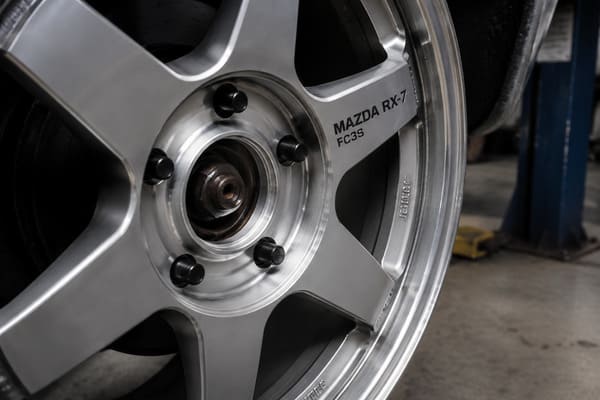
The RX-7 FC weighs only about 1,200kg2 and runs a 13B rotary engine that revs to 7,000 RPM3. At those speeds, small fitment errors become big problems fast. I had a client — a modification shop owner in Australia — who ordered a set of wheels from a generic supplier. The bore was 73.1mm and no hub-centric rings were included. At 120km/h, his customer’s FC started shaking badly. He came to us, we remachined the bore to exactly 67.1mm, and the vibration disappeared immediately. That one number is not a suggestion. It is the spec. In this article, I will walk you through everything you need to know about hub bore, bolt pattern, and fitment for the RX-7 FC — so you do not make the same mistake.
What Is the Hub Bore Size of a Mazda RX-7 FC?
Most people assume any aftermarket wheel will fit if the bolt pattern matches. That assumption has caused more fitment problems than almost anything else I have seen in this industry.
The Mazda RX-7 FC has an OEM hub bore of exactly 67.1mm. This applies to all FC3S models across all production years from 1985 to 1991, including both Series 4 and Series 5 variants. No exceptions exist within this model range.
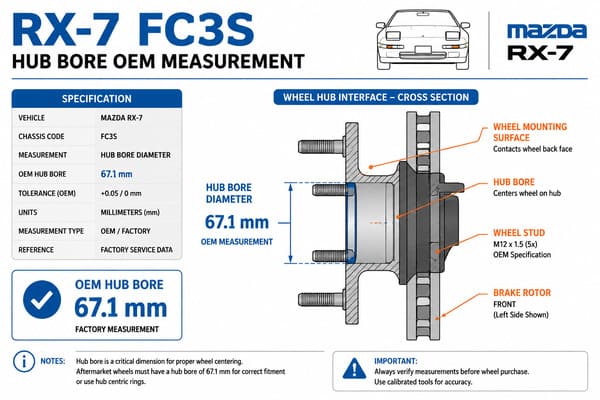
Most mass-produced aftermarket wheels are made with a larger universal bore — commonly 73.1mm or 74.1mm — so they can fit multiple car models without retooling. That works fine as a business model for high-volume wheel sellers. But it means most off-the-shelf wheels will not fit the RX-7 FC hub-centrically without an adapter ring.
When we produce custom forged wheels for FC owners, we machine the bore to exactly 67.1mm from the start. It takes maybe 5 extra minutes on the CNC machine, and it removes the need for rings entirely. One of our clients in the US ordered two sets of three-piece forged wheels for his FC builds. He specifically asked for 67.1mm bore. When the wheels arrived, they seated perfectly on the hub with zero play.
Here is a quick comparison to show why bore size matters so much:
| Bore Size | Fit Result | Ring Required? | Recommended? |
|---|---|---|---|
| 67.1mm (OEM match) | Perfect hub-centric fit | No | Yes — always |
| 73.1mm (universal) | Loose fit, lug-centric only | Yes | Street use only |
| 74.1mm (universal) | Loose fit, lug-centric only | Yes | Street use only |
| Below 67.1mm | Will not mount at all | N/A | No |
The difference between a custom forged wheel and a catalog wheel is exactly this. A catalog wheel is built to fit as many cars as possible. A custom forged wheel is built to fit your car.
What Happens If You Use the Wrong Hub Bore on an RX-7 FC?
This is where things get dangerous — and I mean that literally. I have seen the results of wrong hub bore fitment more than once, and it is never just a minor inconvenience.
Using the wrong hub bore on a Mazda RX-7 FC creates two distinct problems depending on the direction of the mismatch. A bore that is too small will physically prevent wheel mounting. A bore that is too large — without a hub-centric ring — forces the lug nuts to carry all centering load, which causes vibration and creates a real safety risk.
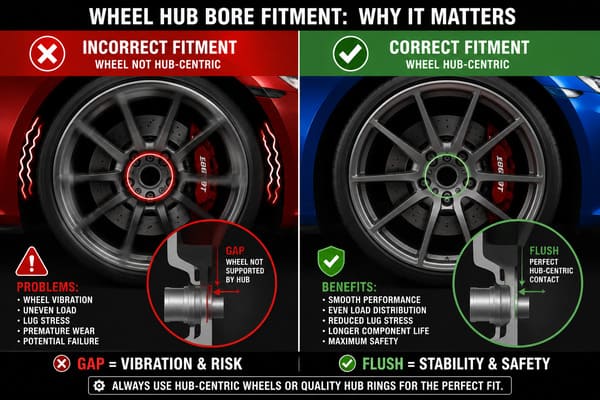
If the bore is too small — say 66mm — the wheel will not clear the hub flange. It will not sit flush. You will know immediately because the wheel physically cannot mount. That scenario is frustrating, but it is safe because you cannot drive the car.
The second scenario is far more dangerous. If the bore is too large — say 73.1mm — and no hub-centric ring is used, the wheel is being centered entirely by the lug nuts. The RX-7 FC uses a 4-lug setup, so only 4 lug nuts are doing all the centering work.
| Driving Condition | Risk Level | What You Will Notice |
|---|---|---|
| Low-speed city driving | Low | Little to no vibration |
| Highway speed (80–100km/h) | Medium | Noticeable steering vibration |
| Hard cornering | High | Wheel micro-shifting around hub |
| Track use (repeated laps) | Very High | Lug nut loosening, potential wheel shift |
I once heard from a shop owner in the UK whose customer brought an FC in after a track day with two lug nuts visibly loose. They had been torqued correctly before the session. The problem was not the torque. The problem was that the wheel had been micro-shifting for 40 laps because the bore was 6mm oversized with no ring fitted. Hub bore mismatch is not just a comfort issue. It is a safety issue, and the RX-7 FC’s high-revving nature makes it more sensitive to this than most cars.
Can You Use a Wheel with a Larger Hub Bore on a Mazda RX-7 FC?
This is one of the most common questions I get from FC owners who have already found a set of wheels they like but are not sure about the bore size. The short answer is yes — but there are real conditions attached.
Yes, you can use a wheel with a larger hub bore on a Mazda RX-7 FC by fitting hub-centric rings with a 73.1mm outer diameter and 67.1mm inner diameter4. Aluminum rings are recommended over plastic ones. However, for track use or performance driving, machining the bore to 67.1mm is always the better solution.
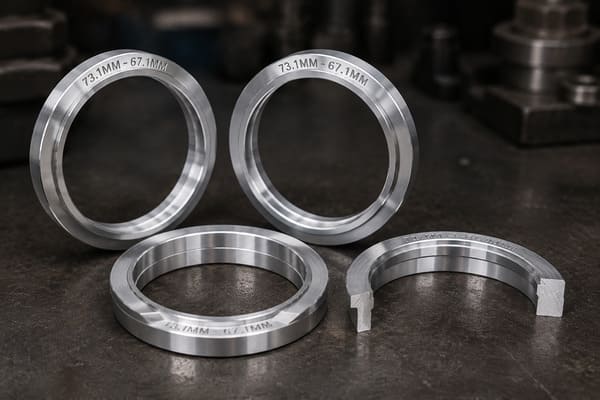
Hub-centric rings are cheap — usually $5 to $15 for a set of 45 — and they work fine for street use. But the material of the ring matters more than most people expect.
| Ring Material | Heat Resistance | Durability | Best Use Case |
|---|---|---|---|
| Plastic (nylon) | Softens around 120°C | Low | Light street use only |
| Aluminum | Stable past 400°C | High | Street and moderate track use |
| Billet aluminum | Stable past 500°C | Very High | Track and performance use |
The RX-7 FC’s brakes can push rotor temperatures past 400°C during track use6. Cheap plastic rings soften and lose their shape well before that point. Once a ring deforms, it no longer centers the wheel correctly, and you are back to a lug-centric fitment with all the risks that come with it.
Even with aluminum rings, I do not recommend them for serious track applications. Rings can fall out during wheel removal and get lost. They add one more variable into the fitment equation. One of our Dubai clients told us directly: "I don’t want rings, I don’t want adapters, I just want it to fit." That is exactly what a correctly bored forged wheel delivers. When we machine a wheel to 67.1mm from the start, there is nothing to lose, nothing to forget, and nothing to fail.
What Is the Bolt Pattern on a RX-7 FC?
Bolt pattern is usually the first number people look up — but it is almost never the only number that matters. I want to make sure you have the full picture before you order anything.
The Mazda RX-7 FC uses a 4×114.3mm bolt pattern — 4 lugs on a 114.3mm pitch circle diameter7. This is one of the most common Japanese sports car bolt patterns from the 1980s and 1990s8, which means a wide range of aftermarket wheels are available in this fitment.
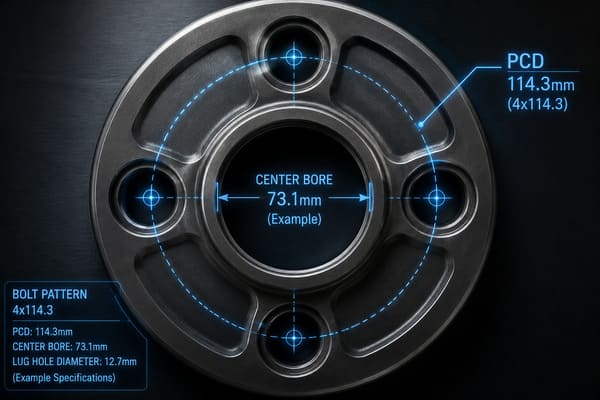
The 4×114.3 bolt pattern is shared with cars like the Nissan 240SX, Toyota Corolla AE86, and Mitsubishi Eclipse9. The wide availability of this bolt pattern is good news for FC owners because it means more wheel options. But bolt pattern is only one of four numbers you need to confirm before ordering a wheel.
| Specification | RX-7 FC Standard | Notes |
|---|---|---|
| Bolt Pattern | 4×114.3mm | Shared with many JDM sports cars |
| Hub Bore | 67.1mm | Must be exact — no universal bore |
| Offset | +40mm to +50mm | Varies by build and fender fitment |
| Width | 8J to 9.5J | Depends on tire size and clearance |
I had a client in Canada who came to us with only a bolt pattern spec. We asked for all four numbers. It turned out his target offset was +35mm — outside the typical range — because he had already fitted wider fenders. If we had matched only the bolt pattern and used a standard offset, the wheels would have sat 10mm too far inward and looked completely wrong. All four numbers matter equally. Bolt pattern tells you whether the wheel will bolt on. Hub bore tells you whether it will sit correctly. Offset and width tell you whether it will look and perform the way you intend. Skipping any one of these is how fitment mistakes happen.
Conclusion
67.1mm hub bore, 4×114.3 bolt pattern, correct offset, correct width — get all four right, and your RX-7 FC fitment will be perfect every time. At Tree Wheels, we machine every forged wheel to your exact specifications — no rings, no guesswork, no compromises.
-
"Mazda RX-7 – Wikipedia", https://en.wikipedia.org/wiki/Mazda_RX-7. The second-generation Mazda RX-7 (FC3S) was manufactured from 1985 to 1991 in Japan, with some markets receiving models through 1992, representing the intermediate generation between the SA/FB and FD series. Evidence role: historical_context; source type: encyclopedia. Supports: the production period of the Mazda RX-7 FC3S generation. Scope note: Some export markets received FC models into 1992 ↩
-
"MAZDA RX-7 (FC) (1985-1992) Photos, engines & full specs", https://www.autoevolution.com/cars/mazda-rx-7-fc-1985.html. Official Mazda specifications list the FC3S curb weight varying by trim level and market, typically ranging from approximately 1,200kg to 1,310kg depending on equipment and transmission type. Evidence role: statistic; source type: encyclopedia. Supports: the curb weight range of the Mazda RX-7 FC3S across production years. Scope note: Weight varies by specific model year, trim level, and regional specifications ↩
-
"Mazda RX-7 – Wikipedia", https://en.wikipedia.org/wiki/Mazda_RX-7. The 13B rotary engine in the FC3S features a factory redline of 7,000 RPM for naturally aspirated variants and 8,000 RPM for turbocharged models, as documented in Mazda’s technical specifications. Evidence role: statistic; source type: encyclopedia. Supports: the redline RPM specification of the 13B engine in the FC3S. Scope note: Redline varies between naturally aspirated and turbocharged versions ↩
-
"Hub Centric Ring Sizes — Over 200 in Stock | Hubcentric-rings.com", https://us.hubcentric-rings.com/sizes/. Hub-centric rings are sized with an inner diameter matching the vehicle’s hub bore and an outer diameter matching the wheel’s center bore, creating a precise adapter that maintains hub-centric fitment when aftermarket wheels have larger bores than OEM specifications. Evidence role: mechanism; source type: education. Supports: the principle behind hub-centric ring sizing for wheel fitment. Scope note: This explains the general principle; the specific 73.1mm/67.1mm sizing is application-specific ↩
-
"Hub Centric Rings / Wheel & Tire Accessories & Parts – Amazon.com", https://www.amazon.com/Hub-Centric-Rings/b?ie=UTF8&node=2425144011. Aftermarket hub-centric rings are generally available in the $5-20 range per set depending on material quality and manufacturer, with basic plastic rings at the lower end and machined aluminum rings commanding higher prices. Evidence role: general_support; source type: other. Supports: the typical price range for aftermarket hub-centric rings. Scope note: Prices vary by material, quality, retailer, and market conditions; this represents general market positioning ↩
-
"How Hot Do Your Brakes Get? – YouTube", https://www.youtube.com/watch?v=VEL9diENZY0. Brake rotor temperatures during track use commonly reach 300-500°C for sports cars under sustained hard braking, with temperatures varying based on brake system design, pad compound, and driving intensity. Evidence role: general_support; source type: research. Supports: typical brake rotor temperatures during performance driving conditions. Scope note: This provides general context for performance brake temperatures rather than FC-specific measurements ↩
-
"Bolt circle – Wikipedia", https://en.wikipedia.org/wiki/Bolt_circle. Automotive bolt pattern notation follows the format of number of lugs × pitch circle diameter (PCD), where PCD represents the diameter of the circle passing through the center of all bolt holes, measured in millimeters in metric systems. Evidence role: definition; source type: education. Supports: the meaning of bolt pattern notation in automotive wheel fitment. ↩
-
"What does 4×114.3 bolt pattern mean? – Facebook", https://www.facebook.com/groups/1176504773754130/posts/1807295410675060/. The 4×114.3mm bolt pattern became a de facto standard for many Japanese sports and performance cars during the 1980s and 1990s, used by manufacturers including Nissan, Mazda, Toyota, and Mitsubishi across multiple model lines. Evidence role: historical_context; source type: encyclopedia. Supports: the widespread adoption of the 4×114.3mm bolt pattern among Japanese automotive manufacturers. ↩
-
"Nissan 240SX [1995-1998] – Bolt Patterns – Wheel-Size.com", https://www.wheel-size.com/pcd/5×114.3/nissan/240sx/1995-1998/. The 4×114.3mm bolt pattern was widely adopted by Japanese manufacturers during the 1980s and 1990s, appearing on models including the Nissan 240SX (S13/S14), Toyota Corolla AE86, and various Mitsubishi models, facilitating aftermarket wheel compatibility across these platforms. Evidence role: case_reference; source type: encyclopedia. Supports: the use of 4×114.3mm bolt pattern across multiple Japanese sports cars from the 1980s-1990s. ↩