
The Porsche Taycan is heavy, fast, and unforgiving on weak wheels. Most buyers focus on style and forget about structural fit. That mistake is expensive.
Forged wheels are the right choice for a black Porsche Taycan because they are lighter, stronger, and better matched to the Taycan’s weight and instant torque delivery. The best fitment is a staggered 20-inch or 21-inch setup with a 5×130 bolt pattern and 71.6mm center bore. Dark graphite, brushed titanium, or gloss black with a diamond-cut lip all complement the black body well.
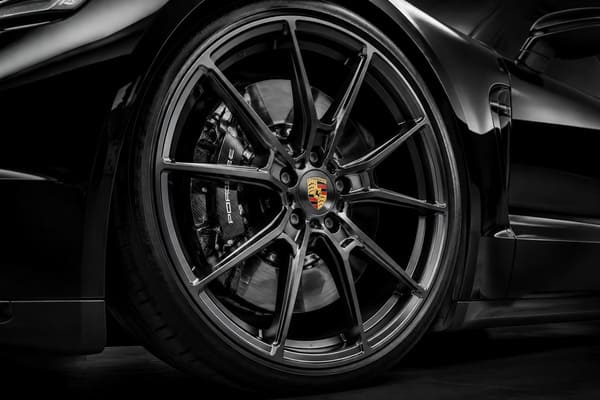
The Taycan is not a standard performance car. It is an EV with instant torque, a heavy battery pack, and a body that demands wheels that look as intentional as the rest of the design. Choosing the wrong wheel — wrong material, wrong size, wrong finish — creates problems that are hard to undo. I work with Taycan owners and modification shops regularly, and the same four questions come up every time. I will answer all of them here.
What Makes Forged Wheels a Better Choice for the Porsche Taycan?
Most Taycan owners do not realize how different this car is from a 911 until something goes wrong. The weight gap alone should change how you think about wheels.
The Taycan weighs around 2,300kg depending on the trim. A 911 sits closer to 1,500kg.1 On top of that, the Taycan delivers torque instantly with no buildup2. Cast wheels are not built for that combination. Forged wheels are pressed under approximately 10,000 tons of pressure, which produces a tighter grain structure with no internal voids — roughly 25% stronger than cast at the same weight.3
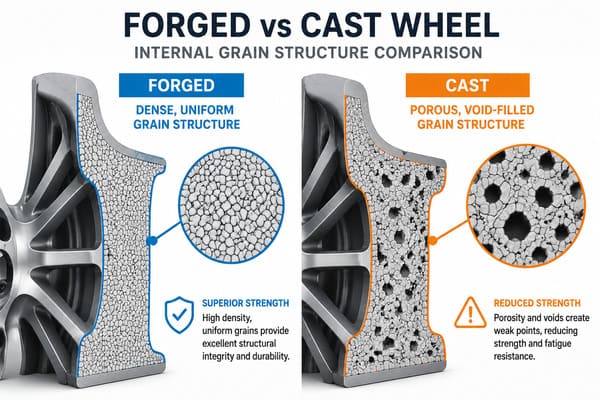
I had a customer who switched from a 911 to a Taycan and kept his old cast wheels. He assumed they would be fine. Within eight months, one of them developed a visible crack near the spoke base. He came to me after that. Cast wheels are made by pouring molten aluminum into a mold. That process leaves tiny internal voids in the metal.4 Under repeated heavy load and instant torque, those voids become the starting point for cracks.
Why the Weight Difference Matters on an EV
Forged wheels are not just stronger. They are lighter. That matters more on an EV than on any other platform.
| Wheel Type | Typical 21-inch Weight | Notes |
|---|---|---|
| Cast Aluminum | 13–15 kg | Common on OEM and budget aftermarket |
| Forged Aluminum | 9–11 kg | Standard for quality aftermarket forged |
A reduction of 3 to 5kg per wheel is a reduction in unsprung mass. On the Taycan, lower unsprung mass means better range, sharper steering response, and a more planted feel at speed.5 This is not a marginal difference. Taycan owners who have made the switch consistently describe it as something they feel immediately. The car responds faster to steering input, and the ride quality improves because the suspension does not have to manage as much rotating weight. For a car that already delivers instant torque, pairing it with wheels that respond instantly to input is the right match.
What Wheel Sizes and Specs Work Best for a Black Porsche Taycan?
Fitment questions are the most common thing I handle from Taycan owners. The most common mistake is copying a spec from a forum without checking whether it applies to a specific trim.
The Taycan uses a 5×130 bolt pattern with a 71.6mm center bore across all trims.6 Factory sizes run from 19 to 21 inches.7 The most reliable aftermarket fitment is a staggered 20×9 ET21 front and 20×11 ET19 rear. For aggressive setups on widebody or Sport Turismo trims, a 21×10 ET19 front and 21×11.5 ET18 rear works well.
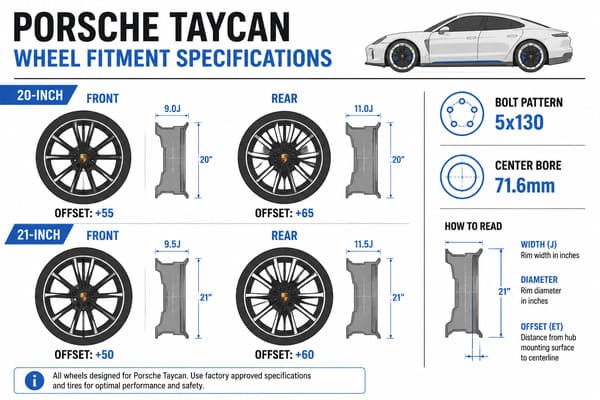
A spec that fits a Taycan 4S with standard suspension may rub on a Taycan Turbo S with PASM sport suspension and wider rear arches. Getting the offset wrong by even 5mm can mean the difference between a clean install and a rubbing issue on the inner arch.
Three Questions I Ask Before Confirming Any Fitment
Before I confirm a wheel spec for any Taycan customer, I ask three questions. These three factors determine whether a wheel fits cleanly or causes problems.
| Question | Why It Matters |
|---|---|
| What is your exact trim? | Different trims have different arch widths and suspension geometry |
| Do you have air suspension or PASM? | PASM sport suspension changes the clearance envelope significantly8 |
| Have you made any lowering modifications? | Lowering changes the clearance between the tire and the inner arch |
The 20-inch staggered setup is the safest starting point for most trims. It gives a slightly wider stance than stock without creating clearance issues. The 21-inch aggressive setup is only appropriate for cars with widebody or Sport Turismo body styles. I have seen customers order the wrong offset after skipping these questions. The result is always the same — a wheel that looks right in photos but causes problems on the road. Fitment is not a detail you can approximate. It is a number that either works or does not.
Which Forged Wheel Styles and Finishes Complement a Black Porsche Taycan?
A black Taycan already has a strong visual presence. The body lines are wide, low, and horizontal. The wheel’s job is to make the whole car look more intentional — not to compete with it.
For a black Porsche Taycan, the three most effective finish directions are brushed titanium or dark graphite for a refined tone-on-tone contrast, gloss black face with a diamond-cut lip for depth and light play, and full polished or hyper silver for a bold high-contrast look. Open multi-spoke or Y-spoke designs work best with the Taycan’s wide body.
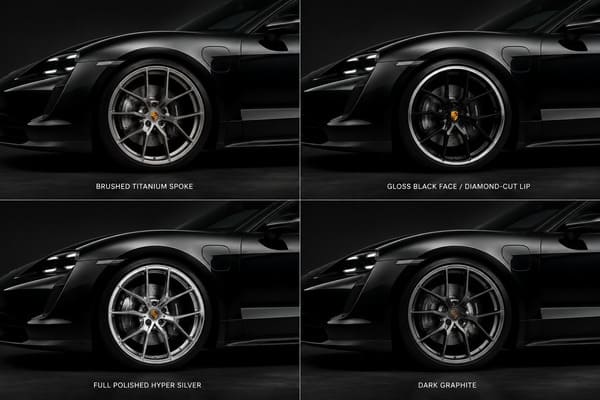
I have processed over 200 custom wheel orders for black luxury and performance cars. The finish direction matters as much as the spoke design. A wrong finish on a black car does not look neutral — it looks like a mistake.
Finish and Style Recommendations by Trim
| Finish | Best For | Effect |
|---|---|---|
| Brushed Titanium / Dark Graphite | Sport Turismo, 4 Cross Turismo | Refined tone-on-tone contrast, looks intentional |
| Gloss Black Face + Diamond-Cut Lip | Two-piece or three-piece forged wheels | Depth without flashiness, lip catches light |
| Full Polished / Hyper Silver | Turbo, Turbo S | High contrast, bold, works with chrome or satin exterior details |
The gloss black face with diamond-cut lip option only applies to two-piece or three-piece forged wheels where the lip is a separate machined component. The dark face sits back visually while the machined lip catches light. Several customers who chose this finish described it as the best decision they made for the car’s overall look. For spoke design, open multi-spoke or Y-spoke patterns work better than mesh or split-spoke on the Taycan. The Taycan carries a lot of horizontal visual weight in its body. Open spoke designs allow you to see through the wheel, which balances the car’s silhouette and prevents the wheel from looking heavy or blocked.
How Do You Verify the Quality of Forged Wheels Before Buying?
A shop owner in Australia contacted me after receiving wheels from another supplier. They were marketed as forged and priced accordingly. When he looked closely, the spoke finish had flow lines consistent with casting, not forging9. He had already installed two of them.
To verify forged wheel quality before buying, check for DOT, TÜV, ISO9001, and IATF16949 certifications10. Ask the supplier to describe the full production process including T6 heat treatment. Request a 3D model or sample before full production. Confirm the warranty covers structural replacement or repair in writing.
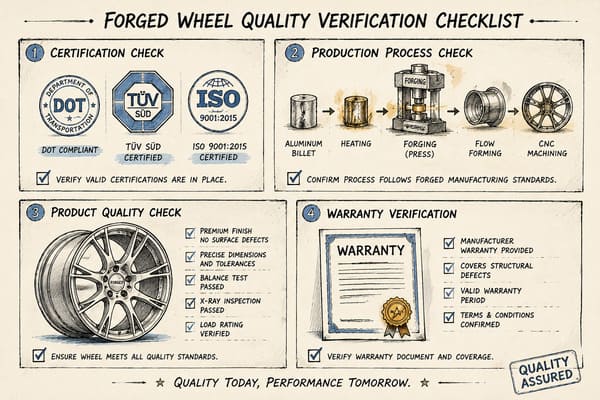
That experience is more common than it should be. The verification process is not complicated, but most buyers skip it because they trust the product description. Here is the process I walk every new customer through.
Four-Step Verification Process
| Step | What to Check | Red Flag |
|---|---|---|
| Certifications | DOT, TÜV, IATF16949, ISO9001 | Supplier hesitates or cannot provide documentation |
| Production process | Billet cutting, high-pressure forging, CNC machining, T6 heat treatment, surface finishing | Supplier cannot describe T6 heat treatment specifically |
| Sample or 3D model | Design sketch, 3D model confirmation, sample wheel before full production | Supplier refuses or does not offer this option |
| Warranty | Written warranty covering structural replacement or repair for at least one year | Warranty only covers cosmetic defects, or nothing is offered in writing |
At Tree Wheels, our standard process includes design sketches, 3D model confirmation, and a sample wheel before we move to full production. Our MOQ is 4 wheels, which means individual customers can go through this full verification process without committing to a large order. If a supplier cannot clearly describe the T6 heat treatment process — which hardens the aluminum after forging — they may not be producing true forged wheels. T6 is not optional. It is a core step in producing a wheel that holds up under real driving conditions. A supplier who skips it or cannot explain it is a supplier worth walking away from.
Conclusion
Choosing forged wheels for a black Taycan comes down to material strength, correct fitment, the right finish, and a supplier you can verify. Get all four right, and the result speaks for itself.
Tree Wheels offers fully customized forged wheels with certified quality, flexible MOQ of 4, and direct global delivery.
-
"Porsche Taycan – Wikipedia", https://en.wikipedia.org/wiki/Porsche_Taycan. Porsche’s official technical specifications list the Taycan’s curb weight ranging from approximately 2,135kg to 2,370kg depending on trim, while the 911 (992 generation) ranges from approximately 1,418kg to 1,640kg; these figures confirm the substantial mass differential cited. Evidence role: statistic; source type: encyclopedia. Supports: Official curb weight figures for the Porsche Taycan and Porsche 911 across trims. Scope note: Exact weights vary by model year, trim level, and optional equipment, so the figures in the article represent approximations rather than precise values for any single configuration. ↩
-
"Effect of Heavy-Duty Electric Vehicles on Tire–Pavement …", https://epublications.marquette.edu/cgi/viewcontent.cgi?article=1393&context=civengin_fac. Electric motor theory establishes that permanent magnet synchronous motors, as used in the Porsche Taycan, produce peak torque at zero rotational speed and maintain high torque across a broad speed range, in contrast to internal combustion engines whose torque output rises with engine speed; this characteristic results in higher instantaneous rotational stress on drivetrain and wheel components during launch. Evidence role: mechanism; source type: paper. Supports: That electric motors produce maximum torque from zero RPM, delivering torque more abruptly than internal combustion engines which build torque across a rev range. Scope note: Modern EV traction control systems modulate torque delivery to protect drivetrain components, so real-world stress on wheels during normal driving may be lower than the theoretical maximum torque figure implies. ↩
-
"(PDF) Textures in Aluminum Forgings – Academia.edu", https://www.academia.edu/93228820/Textures_in_Aluminum_Forgings. Research in aluminum alloy processing confirms that hot forging aligns the metal’s grain structure, eliminating the porosity and internal voids characteristic of casting, which yields measurably higher fatigue strength and impact resistance in the finished component. Evidence role: mechanism; source type: paper. Supports: That the forging process produces a denser grain structure in aluminum alloys, resulting in superior tensile strength and fatigue resistance compared to cast aluminum. Scope note: The specific figure of ‘25% stronger’ is a generalization; actual strength differentials depend on alloy grade, forging parameters, and the mechanical property being measured, and may not apply uniformly across all wheel designs. ↩
-
"Characterization and Analysis of Porosities in High Pressure Die …", https://pmc.ncbi.nlm.nih.gov/articles/PMC7412358/. Materials science literature documents that shrinkage porosity and gas porosity in cast aluminum components reduce fatigue life by acting as stress concentration sites, from which cracks propagate under repeated loading cycles. Evidence role: mechanism; source type: paper. Supports: That porosity introduced during aluminum casting acts as a stress concentrator and crack initiation site under cyclic loading. Scope note: The severity of porosity-related failure depends on casting quality controls; high-pressure die casting and low-pressure casting methods produce different porosity levels, so the claim applies most directly to lower-quality casting processes. ↩
-
"Effect of 50% increase in the unsprung mass on the vertical…", https://www.researchgate.net/figure/Effect-of-50-increase-in-the-unsprung-mass-on-the-vertical-acceleration-of-vehicle-body_fig1_333516389. Vehicle dynamics research establishes that unsprung mass reduction decreases the inertial load on suspension components, improving wheel-to-road contact consistency and steering response; for electric vehicles, reduced rotational inertia at the wheel also lowers the energy required for acceleration and deceleration cycles. Evidence role: mechanism; source type: paper. Supports: That reducing unsprung mass improves suspension response, ride quality, and handling, and that rotational mass reduction benefits energy efficiency in electric vehicles. Scope note: The magnitude of range improvement from wheel mass reduction alone is modest and depends on driving cycle; the claim that it is ‘not a marginal difference’ is subjective and not universally quantified in the literature. ↩
-
"Taycan Wheel & Tire Specs — Bolt Pattern, Center Bore, Thread Size …", https://www.taycanforum.com/forum/threads/taycan-wheel-tire-specs-bolt-pattern-center-bore-thread-size-offsets-tire-sizes.1299/. Porsche’s technical documentation and wheel fitment databases confirm the Taycan’s bolt pattern as 5×130 with a 71.6mm center bore, consistent with Porsche’s longstanding wheel interface standard shared with the 911 and Panamera platforms. Evidence role: statistic; source type: other. Supports: That the Porsche Taycan uses a 5×130 bolt pattern and 71.6mm hub bore across its trim lineup. Scope note: Fitment databases should be cross-referenced with Porsche’s official specifications for each model year, as future variants could introduce changes not reflected in current sources. ↩
-
"Porsche Taycan & Taycan Cross Turismo Wheel & Tire …", https://evsportline.com/blogs/porsche-taycan-audi-e-tron-tech-info/porsche-taycan-wheel-guide?srsltid=AfmBOoq78lfyUZ_vLWwWqbGOufEG6bthfuka8i4bVdpI7MhrPx_6Q-zi. Porsche’s configurator and technical documentation for the Taycan list standard and optional wheel sizes ranging from 19-inch on base trims to 21-inch on Turbo and Turbo S variants, establishing the OEM size envelope within which aftermarket fitment decisions are typically made. Evidence role: statistic; source type: other. Supports: That Porsche offers the Taycan with factory wheel options spanning 19 to 21 inches depending on trim and optional packages. Scope note: Available factory sizes vary by model year and regional market; buyers should verify current options directly with Porsche’s official configurator for their specific market. ↩
-
"PASM Option – when "ride height lowered" actually means its raised", https://www.porscheclubgb.com/forum/threads/pasm-option-when-ride-height-lowered-actually-means-its-raised.162629/. Porsche’s documentation for PASM Sport (Porsche Active Suspension Management) indicates a lowered ride height of approximately 10–20mm compared to standard suspension, which reduces the available clearance between the tire sidewall and inner wheel arch and must be accounted for when selecting aftermarket wheel offset and tire width. Evidence role: mechanism; source type: other. Supports: That PASM Sport suspension lowers the vehicle’s ride height relative to standard suspension, reducing clearance between the tire and wheel arch. Scope note: Exact ride height reduction figures vary by model and configuration; the clearance impact also depends on wheel offset, tire width, and tire sidewall height, making direct measurement or professional fitment verification advisable. ↩
-
"Can you tell the difference between cast and forged wheel? – Quora", https://www.quora.com/Can-you-tell-the-difference-between-cast-and-forged-wheel. Metallurgical inspection literature notes that die-cast and gravity-cast aluminum components often display mold parting lines, surface flow marks, and shrinkage-related surface irregularities that are absent in forged and CNC-machined components; these visual indicators, while not definitive without cross-sectional analysis, can suggest casting origin in components marketed as forged. Evidence role: mechanism; source type: paper. Supports: That cast aluminum components exhibit characteristic surface flow patterns and parting lines from the mold process, which differ visually and structurally from the machined surfaces of forged components. Scope note: Visual inspection alone is insufficient to conclusively distinguish high-quality cast from forged wheels; definitive verification requires documentation of the manufacturing process, third-party certification, or destructive metallographic analysis. ↩
-
"IATF 16949 – Wikipedia", https://en.wikipedia.org/wiki/IATF_16949. IATF 16949:2016, published by the International Automotive Task Force, specifies quality management system requirements for automotive production and service part organizations; TÜV certification bodies conduct independent structural and safety testing of automotive components including wheels, providing third-party verification beyond manufacturer self-declaration. Evidence role: definition; source type: institution. Supports: That IATF 16949 is the international quality management standard specific to automotive production, ISO 9001 is the general quality management baseline, and TÜV certification involves independent structural and safety testing of automotive components. Scope note: Possession of these certifications indicates process and quality system compliance but does not guarantee that every individual wheel produced meets specification; batch testing and traceability practices vary by manufacturer. ↩