
Choosing the wrong wheel size is not just a cosmetic mistake. It can quietly damage your car over months and create safety risks you won’t notice until it’s too late.
The optimal wheel size for your vehicle depends on five key specifications: diameter, width, bolt pattern, offset (ET value), and center bore (CB value). Each number matches a physical dimension on your car. Getting all five right is the only way to ensure safe and proper fitment.
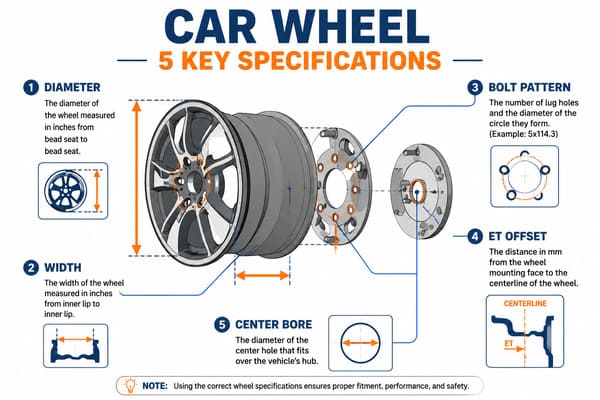
Every week, we receive inquiries from customers who think wheel sizing is just about picking a diameter. It’s not. The five numbers on a wheel spec sheet each control a different part of how the wheel sits on your car. Miss one, and the problems may not show up immediately. They show up three months later, or six months later, when you’re already on the highway.
What Happens If You Put the Wrong Size Wheels on Your Car?
Most people think a wrong-size wheel is a problem you’ll notice right away. In reality, some of the most serious consequences don’t appear until months later, and by then, the damage is already done.
Wrong wheel size can cause inaccurate speedometer readings, uneven tire wear, and compromised safety systems. These issues often develop slowly and are easy to misdiagnose, which makes them more dangerous than problems that appear immediately after installation.
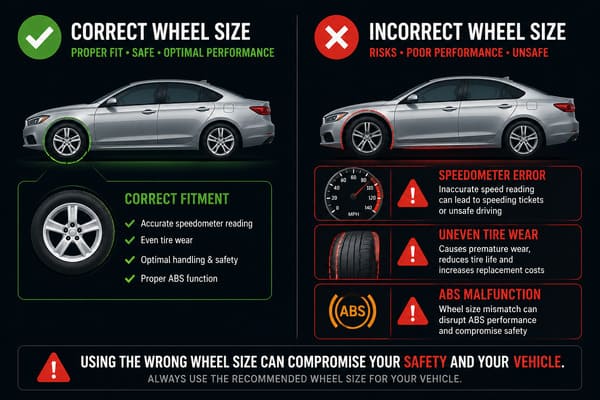
Last year, a customer contacted me after buying a set of 20-inch wheels from another supplier. He installed them and drove normally for about three months. Then he noticed something odd: his odometer was reading roughly 3 kilometers short for every 100 kilometers driven1. He assumed it was a dashboard fault and took the car to a dealership. The technician told him the real cause. The larger wheel diameter had changed the tire’s rolling circumference, but the car’s ECU was still calculating speed and distance using the factory data. This wasn’t just an odometer issue. His speed warning system had also lost accuracy. He thought he was driving at 120 km/h on the highway. He wasn’t.2
Beyond the ECU issue, incorrect diameter directly affects how your tires wear. We have seen a set of tires develop clear single-side wear in under 8,000 kilometers because the wheel diameter was out of spec3. The tire was being asked to sit at an angle it was never designed for.
Why Diameter Changes Cause System-Level Problems
The problem with changing wheel diameter is that your car was built around a specific rolling circumference. That number feeds into multiple systems at once.
| System Affected | What Goes Wrong |
|---|---|
| Speedometer | Reads lower than actual speed |
| Odometer | Records fewer kilometers than driven |
| Speed Warning | Triggers at wrong actual speed |
| ABS / Traction Control | Miscalculates wheel rotation data |
| Tire Wear Pattern | Uneven load distribution on tread |
Each of these systems assumes the factory rolling circumference is unchanged. When you increase wheel diameter without adjusting tire profile to compensate, every one of these systems starts working with bad data. The car does not alert you. It just quietly operates outside its designed parameters. Choosing the wrong diameter is not a style problem. It is a slow, invisible safety problem that compounds over time.
How Do Bolt Pattern and Offset Affect Wheel Fitment?
Many customers know they need a specific bolt count. Far fewer understand why the offset number matters just as much, and what happens when it’s even slightly off.
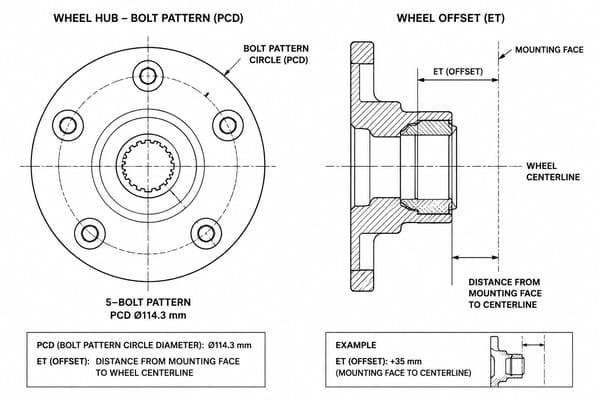
Bolt pattern determines whether the wheel physically mounts to your hub4. Offset (ET value) controls how far the wheel sits inward or outward from the suspension. A bolt pattern mismatch means the wheel won’t fit at all. An incorrect ET value means the wheel fits but creates clearance and handling problems.
We receive around 200 inquiries per month. Nearly half of those customers provide incomplete specifications. They know the diameter they want. They know the bolt count. But the ET value field is either blank or filled with "not sure, please advise." One case stands out clearly. A customer from Australia was ordering wheels for a Nissan GT-R. The factory ET value on that car is +305. He wanted a more aggressive, outward stance, so he estimated ET20 and sent that to us. Before we processed the order, we recalculated the suspension clearance using his car’s actual geometry. At ET20, the outer edge of the wheel would extend approximately 8 millimeters beyond the wheel arch lip. Under hard cornering at speed, the tire sidewall would contact the inner arch liner directly. We recommended ET25. He accepted the change. The result still looked aggressive and outward, but it stayed within a safe clearance range.
Understanding ET Value in Practical Terms
ET value is measured in millimeters. It describes the distance between the wheel’s mounting face and its centerline.
| ET Value | Wheel Position | Common Risk |
|---|---|---|
| High positive (e.g. ET45) | Sits deeper into the arch | May contact suspension components |
| Low positive (e.g. ET25) | Sits closer to flush | More outward stance, less inner clearance |
| Zero (ET0) | Centerline = mounting face | Neutral position, car-specific fit needed |
| Negative (e.g. ET-10) | Extends outward past arch | High risk of arch contact and legal issues |
Every 5-millimeter change in ET value moves the wheel’s outer edge by 5 millimeters6. That sounds small. But under full suspension compression, 5 millimeters is the difference between clearance and contact. This is why we always verify ET value before production, not after.
Does Wheel Width Really Impact Your Car’s Performance and Safety?
Wider wheels look more aggressive. That’s a fact. But width is not just a visual choice. It is a structural one, and getting it wrong creates problems that are very hard to diagnose.
Wheel width must match the tire width within the manufacturer’s recommended range. If the wheel is too wide for the tire, the tread deforms and loses flat contact with the road. This causes uneven pressure distribution, unpredictable handling, and steering pull that four-wheel alignment cannot fix.
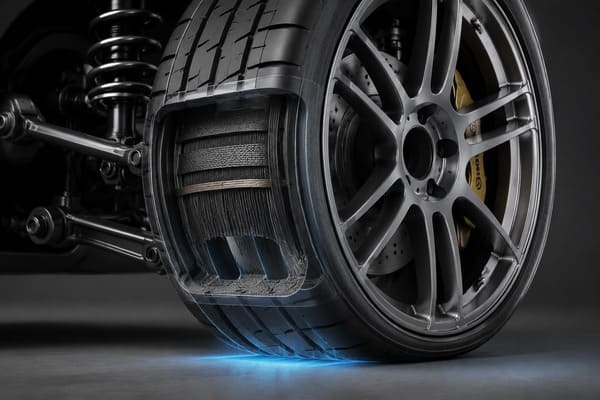
I work closely with a modification shop owner who runs a Honda Civic as his showroom display car. He fitted it with 9.5-inch wide wheels and a 245-width tire. The visual result was strong. The wheel arch was filled, and the stance looked planted. But he told me directly that the car developed a persistent steering pull at highway speeds. He had the alignment checked multiple times by different technicians. Each time it was adjusted, the pull came back within weeks. A more experienced technician eventually identified the actual cause. The tire was being stretched over a wheel that was too wide. The tread center was bowing outward slightly, changing the contact patch from a flat surface to a gentle arc. The car was no longer putting even pressure across the tread. It was loading the center more than the edges, and that imbalance was pulling the steering.
The tire manufacturer’s recommended wheel width for a 245 tire is 8.5 to 9 inches7. He was running 9.5 inches. That 0.5-inch difference caused months of unresolved handling complaints.
Recommended Wheel Width Ranges for Common Tire Widths
| Tire Width (mm) | Recommended Wheel Width (inches) | Risk if Too Wide |
|---|---|---|
| 205 | 5.5 – 7.0 | Tread center crowning, edge wear |
| 225 | 6.5 – 8.0 | Uneven contact patch, handling pull |
| 245 | 8.5 – 9.0 | Center bow, alignment instability |
| 265 | 9.0 – 10.0 | Sidewall stress, tread distortion |
| 285 | 10.0 – 11.0 | High risk of sidewall damage |
Wheel width is not a number you push to the maximum because it looks better. It is a number that must stay within the range the tire was designed for. Outside that range, the tire cannot do its job correctly, and no amount of alignment adjustment will fix that8.
How Do You Read and Understand Wheel Size Specifications?
Most customers can read a wheel diameter. Very few can accurately read all five specifications their car requires. That gap causes more production errors than any other single issue we deal with.
A complete wheel specification includes five values: diameter, width, bolt pattern, offset (ET value), and center bore (CB value). All five must match your vehicle’s requirements exactly. Missing or incorrect values, especially CB and ET, can cause vibration, bearing damage, and unsafe wheel seating even when the wheel appears to be installed correctly.
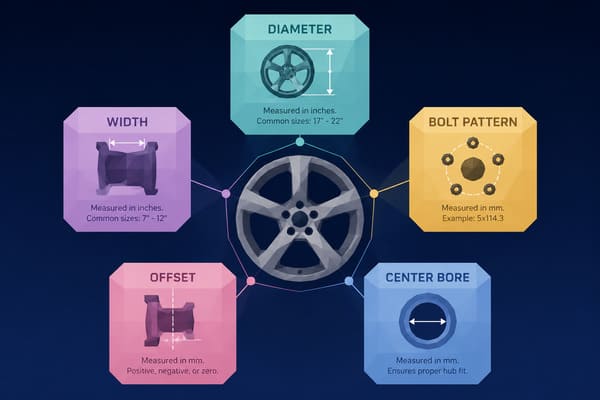
We added a specification form to our website to make ordering easier. We found that over 70% of new customers skipped or filled in the ET and CB fields incorrectly. One case from a customer in Dubai showed exactly why those two fields matter. He was ordering wheels for a Bentley Continental GT. He filled in the diameter and bolt pattern correctly. But he entered 73.1 mm for the center bore. That is the CB value for a Toyota Camry. The Bentley Continental GT uses a 57.1 mm center bore9. If we had gone straight to production without checking, the wheels would have been installed with the center bore floating around the hub. The wheel would have been held in place by the bolts alone, with no hub centering. At highway speeds, that creates a periodic vibration. Over time, it places off-center load on the wheel bearings, which are not designed to handle that kind of stress.
After that case, we created a simple illustrated reference card and now send it to every new customer. We call the five values the "five identities" of a wheel.
The Five Wheel Specifications You Must Know
| Specification | What It Means | Where to Find It |
|---|---|---|
| Diameter | Wheel size in inches (e.g. 20") | Tire sidewall, owner’s manual |
| Width | Wheel width in inches (e.g. 9.0") | Owner’s manual, current wheel stamp |
| Bolt Pattern | Number of bolts × bolt circle diameter (e.g. 5×114.3) | Owner’s manual, hub measurement |
| ET Value (Offset) | Distance in mm from mounting face to centerline | Stamped on current wheel, dealer spec sheet |
| Center Bore (CB) | Hub center hole diameter in mm | Stamped on current wheel, manufacturer data |
Each of these five numbers corresponds to a physical dimension on your vehicle. The diameter matches the brake caliper and arch clearance. The width matches the tire’s designed mounting range. The bolt pattern matches the hub stud layout. The ET value matches the suspension geometry. The CB value matches the hub flange diameter. Every single one must be correct. There is no such thing as "close enough" when it comes to wheel fitment.
Conclusion
Wheel sizing comes down to five numbers. Get all five right, and your wheels will fit safely and perform as designed. Get one wrong, and the consequences build quietly over time. At Tree Wheels, we verify every specification before production starts, so you get wheels that fit right the first time.
-
"Does rim size effect how quickly your odometer increases? : r/cars", https://www.reddit.com/r/cars/comments/qa082y/does_rim_size_effect_how_quickly_your_odometer/. Vehicle speed sensors count wheel rotations and multiply by the factory-programmed rolling circumference to derive speed and distance; a larger rolling circumference causes the system to undercount rotations per unit distance, producing a proportionally lower speedometer and odometer reading. Evidence role: mechanism; source type: education. Supports: That vehicle speedometers and odometers calculate speed and distance from wheel rotation pulses calibrated to a factory rolling circumference, so changes in tire/wheel diameter introduce proportional measurement error. Scope note: Most technical sources address this in the context of tire size changes rather than wheel diameter changes specifically; the magnitude of error depends on the combined tire-and-wheel rolling circumference, not wheel diameter alone. ↩
-
"CURVE SPEED WARNING APPLICATION", https://www.transportation.gov/sites/dot.gov/files/2020-03/V2I%20Curve%20Speed%20Warning%20Benefits%20Analysis_0.pdf. Regulatory frameworks for vehicle speed warning devices, such as those referenced in UN ECE Regulation No. 39 on speedometer equipment, require that speed indication systems be calibrated to the vehicle’s standard tire dimensions; systems sharing the same wheel speed sensor input will exhibit proportionally equivalent errors when tire rolling circumference deviates from the calibrated value. Evidence role: mechanism; source type: government. Supports: That vehicle speed warning and limiting systems derive their speed reference from the same wheel rotation sensors used by the speedometer, and are therefore subject to the same calibration errors when rolling circumference changes. Scope note: Some modern vehicles use GPS-assisted speed correction that may partially compensate for rolling circumference changes; the degree of error in speed warning systems depends on vehicle architecture and whether independent speed references are used. ↩
-
"What causes irregular tire wear pattern?", https://www.facebook.com/groups/359036095791844/posts/1289078036120974/. Tire industry standards bodies note that mounting a tire on a wheel outside its recommended dimensional range distorts the tread contact patch geometry, redistributing contact pressure unevenly and accelerating localized wear. Evidence role: mechanism; source type: institution. Supports: That improper wheel-to-tire dimensional matching alters load distribution across the tread contact patch, leading to accelerated or uneven wear patterns. Scope note: The 8,000 km figure cited in the article is a single anecdotal case; wear rate depends on driving conditions, vehicle weight, and the degree of dimensional mismatch. ↩
-
"Bolt circle", https://en.wikipedia.org/wiki/Bolt_circle. Bolt pattern, or pitch circle diameter (PCD), defines the diameter of the imaginary circle passing through the center of each wheel stud; because stud positions are fixed on the hub, a wheel with a non-matching PCD will either fail to engage the studs or seat at an angle, preventing proper torque transfer and flush contact between the wheel and hub face. Evidence role: definition; source type: education. Supports: That wheel bolt pattern, expressed as the number of studs multiplied by the pitch circle diameter (PCD), must match the vehicle hub geometry precisely for the wheel to seat flush and for fasteners to engage correctly. ↩
-
"Wheel size and offsets and tire size", https://www.gtrlife.com/threads/wheel-size-and-offsets-and-tire-size.309092/. Nissan GT-R (R35) factory wheel specifications, including offset values, are documented in manufacturer technical data sheets and widely reproduced in automotive specification databases for fitment verification purposes. Evidence role: general_support; source type: other. Supports: The factory wheel offset specification for the Nissan GT-R (R35). Scope note: Factory offset values can vary by model year and trim level; readers should verify against the specific year and variant of their vehicle. ↩
-
"Wheel Offset Explained: Pick the Right ET", https://curvaconcepts.com/resources/offset-optimization/. Wheel offset (ET, from the German Einpresstiefe) is defined as the perpendicular distance in millimeters between the wheel’s hub-mounting face and its geometric centerline; because this is a direct linear measurement, each millimeter of offset change corresponds to exactly one millimeter of lateral displacement of the entire wheel assembly relative to the hub flange. Evidence role: definition; source type: education. Supports: That wheel offset (ET) is defined as the distance in millimeters from the wheel’s mounting face to its geometric centerline, and that a change in ET directly and proportionally shifts the wheel’s lateral position relative to the hub. ↩
-
"Tire & Rim Fit Chart", https://www.wtb.com/pages/tire-rim-fit-chart?srsltid=AfmBOopW7hm-F-JzvJQqGXY600joFKyi7qJdIaNcxTA9WdOPK2UPBqe5. The European Tyre and Rim Technical Organisation (ETRTO) and the Tire and Rim Association (TRA) publish standardized tables specifying recommended and permissible rim widths for each tire section width; for a 245 mm section width tire, these tables define the range within which the tread contact patch maintains its designed geometry. Evidence role: general_support; source type: institution. Supports: That standardized tire-to-rim width compatibility tables, such as those published by ETRTO or TRA, specify recommended and permissible rim width ranges for each tire section width. Scope note: Exact recommended ranges may vary slightly between ETRTO and TRA standards and between individual tire manufacturers’ specifications for specific product lines. ↩
-
"What’s the relationship between tyre dimensions and contact patch?", https://www.facebook.com/groups/1939836749567520/posts/3150696315148218/. Wheel alignment procedures adjust camber, caster, and toe angles to optimize the wheel assembly’s orientation relative to the road surface and vehicle centerline; however, these adjustments operate on the wheel-hub geometry and cannot modify the tire’s cross-sectional shape or tread contact pressure distribution, which are determined by the relationship between tire section width and rim width. Evidence role: expert_consensus; source type: research. Supports: That wheel alignment adjusts the angular orientation of the wheel assembly but cannot alter the tire’s internal cross-sectional geometry, meaning contact patch distortions caused by rim-width mismatch persist regardless of alignment settings. Scope note: In some cases, alignment adjustments may partially mask symptoms of contact patch distortion by compensating for resultant steering pull, but the ↩
-
"Bentley Continental GT – Specs of rims, tires, PCD, offset …", https://www.wheel-size.com/size/bentley/continental-gt/. Hub center bore dimensions for production vehicles, including the Bentley Continental GT, are documented in manufacturer technical specifications and reproduced in automotive wheel fitment databases used by aftermarket suppliers for compatibility verification. Evidence role: general_support; source type: other. Supports: The hub center bore diameter specification for the Bentley Continental GT. Scope note: Center bore specifications may vary across Continental GT generations and model years; the value cited should be verified against the specific production year of the vehicle in question. ↩