
Choosing between forged wheels and cast wheels trips up even experienced buyers — not because the products are complicated, but because most comparisons start with the wrong question. If you’re asking "which is better?", you’re already on the wrong track. The real question is: what does your car actually do?
Forged wheels and cast wheels are both legitimate, well-established products — they serve different use cases. Forged wheels suit high-stress performance applications where weight reduction and structural strength matter most. Cast wheels are a reliable, cost-effective choice for standard road use and visual upgrades. Choosing correctly means identifying your actual use case first, then matching the product to it.
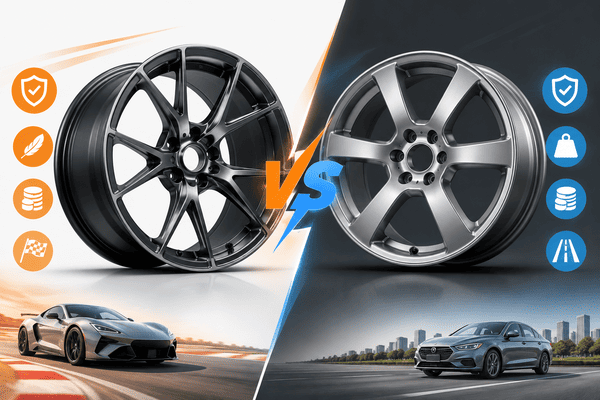
That distinction sounds simple. In practice, though, the way wheel categories get marketed makes it genuinely confusing — "forged" often reads as a premium tier label rather than a manufacturing process with specific functional consequences. The sections below walk through what that process difference actually means for your decision, and which use case points clearly in which direction.
What Actually Makes Forged Wheels Different From Cast Wheels?
Most buyers come in assuming the difference is about price point or brand prestige. That framing leads to bad decisions in both directions — overspending when it isn’t necessary, or cutting costs where the use case demands more. The real difference starts at the manufacturing step, and it has direct functional consequences.
The distinction is in how the aluminum is shaped. Cast wheels are made by pouring molten aluminum into a mold and letting it solidify. Forged wheels are made by pressing solid aluminum billets under extreme pressure. That pressure changes the internal grain structure of the metal — aligning the grain and eliminating voids1. The result is a denser, stronger material from the same base alloy.
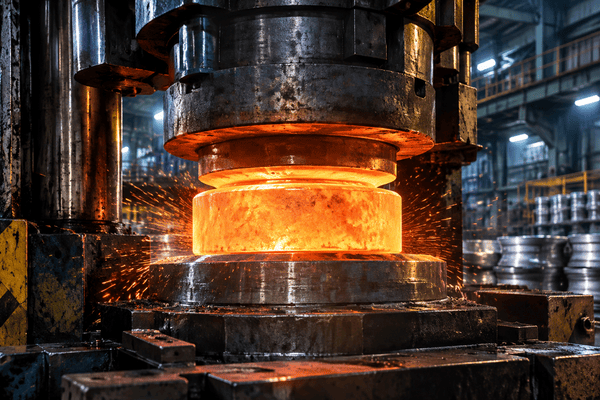
Why does grain structure matter to a buyer? Because it’s the reason forged wheels can be machined thinner and lighter while maintaining — or exceeding — the load tolerance of a heavier cast wheel2. You’re not just paying for a label. You’re paying for a fundamentally different material profile in the finished product.
A One-Paragraph Version for Your Customers
When I’m explaining this to shop owners who need to relay it to their clients, I use this framing: think of cast aluminum like poured concrete — strong enough for most jobs, but with internal air pockets and inconsistencies you can’t see3. Forged aluminum is closer to a rolled steel beam — the material has been compressed and aligned, so the strength is more uniform and more predictable under stress.
That’s the extent of the metallurgy lesson needed here. What matters next is whether your use case actually requires that difference.
Does the Manufacturing Process Matter for Every Buyer?
No — and that’s the point most comparison articles miss. The structural advantage of forging only becomes meaningful under conditions that stress the wheel significantly:
- High-speed cornering loads, as experienced on track or aggressive mountain driving
- Repeated impact stress, such as curb strikes or rough road surfaces at performance speeds
- High vehicle weight combined with performance brake and suspension upgrades
- Motorsport or modified builds where unsprung weight reduction measurably affects handling
For a daily commuter running standard road conditions, those stress levels don’t materialize in normal use. The structural margin built into a quality cast wheel is sufficient. Paying a premium for forged in that context is like spec’ing structural steel for a garden shed — technically superior, practically unnecessary.
Which Use Cases Actually Require Forged Wheels?
When customers come to us with a specific performance build, the first question we ask is: what does this vehicle do under load? The answer usually tells us within the first two minutes whether forged is the right call.
Forged wheels are the correct choice when the vehicle is used for track days, time attack, or any application where cornering loads, braking stress, and weight reduction directly affect performance and safety. They are also appropriate for heavily modified street builds where wheel integrity under non-standard loads is a genuine engineering concern.

The use cases that reliably point toward forged:
Track and Performance Driving
This is the clearest case. Reducing unsprung weight — the mass not supported by the suspension — has a measurable effect on handling response, braking efficiency, and acceleration4. Forged wheels, being structurally denser, can be machined to lower mass without compromising load ratings. For track applications, that matters.
Shops advising track customers should also consider: a cast wheel failure at speed is a serious safety event5. The margin for error is smaller at track loads. The cost difference between forged and cast becomes a different kind of calculation when that context is on the table.
High-Output Modified Builds
A customer running significant power upgrades — upgraded brakes, coilovers, wide-body kit, sticky tires — is asking their wheels to operate at stress levels the original vehicle wasn’t designed for. In these builds, the wheel is no longer a passive component. It’s part of the performance system.
Custom forged wheels also offer deeper fitment flexibility in these scenarios6:
| Customization Factor | Why It Matters for Modified Builds |
|---|---|
| Offset and backspacing | Fitment clearance for wide-body kits or larger brakes |
| Diameter and width | Matching tire setups not available in standard sizes |
| Center bore machining | Precise hub fitment for aftermarket suspension |
| Finish and barrel design | Aesthetic cohesion for show-quality or luxury builds |
Cast wheels have limited customization availability at non-standard sizes and offsets. Forged blanks can be machined to specification — which is a practical advantage for shops building custom vehicles, not just a marketing point.
Motorsport and Competition Applications
Sanctioned motorsport events in many categories specify or strongly recommend forged construction for safety compliance7. Buyers in this segment already know this. The article isn’t for them specifically — but modification shop owners advising clients entering amateur motorsport should be aware that wheel category is sometimes a regulatory issue, not just a preference.
When Are Cast Wheels the Right Answer?
Here’s where most "forged vs cast" articles quietly lose credibility: they treat cast as the consolation prize. That’s not accurate, and it’s not useful to the reader trying to make an honest product recommendation.
Cast wheels are the correct choice for street-driven vehicles used in standard road conditions, including luxury daily drivers, SUV visual upgrades, and commuter builds where the priority is appearance, ride quality, and cost efficiency. A quality cast wheel from a certified manufacturer handles normal road loads with a substantial safety margin.

A large portion of wheel upgrade inquiries I receive fall into this profile: the customer owns a well-specified luxury SUV, wants a visual refresh — maybe a more aggressive fitment or a specific finish — and asks whether cast wheels are "good enough." In most of those cases, the honest answer is yes. Here’s why:
Normal Road Loads Are Well Within Cast Wheel Tolerances
Quality cast wheels from manufacturers holding recognized certifications (DOT, TÜV) are designed and tested for road use8. The safety margins built into certified cast wheels account for the impact and load conditions typical of street driving9. A buyer who treats their vehicle as a daily driver — even an enthusiast daily driver — is not operating in conditions that exhaust those margins.
Cost Efficiency Allows Budget Allocation Elsewhere
For a shop advising a customer on a total build budget, recommending forged when cast is sufficient means that budget premium didn’t go toward better tires, upgraded suspension, or brake components that would actually improve the driving experience. Good product consulting means knowing when to hold the line on cost — not defaulting to the premium SKU.
Visual Upgrade Goals Don’t Require Forged
A buyer who wants 20-inch gloss-black multi-spoke wheels because they look good on their car doesn’t need forged. Full stop. The appearance outcome is achievable with cast. Recommending otherwise to a buyer in this category is overselling, and experienced shop operators know their repeat business depends on not doing that.
Where Cast Logic Breaks Down
That said, there’s a recognizable point where the daily-driver justification stops holding:
- The vehicle has been significantly modified for performance and no longer represents stock load conditions
- The customer explicitly mentions track use, even occasional
- The tire and suspension setup is performance-spec, creating lateral loads higher than street-normal
- The vehicle is a heavyweight performance model (think high-output sport SUV or performance sedan with aggressive compound tires from factory)
These are signals to revisit the forged recommendation — not because cast is dangerous in these scenarios by default, but because the use case has shifted into territory where the structural margin starts to matter.
How Do You Actually Make the Decision?
Working through real inquiries, a reliable decision framework emerges. It’s not a pros/cons list — it’s a sequence of questions.
Start with use case, not product category. Ask: what does this vehicle do under load? From the answer, the correct wheel category usually identifies itself.
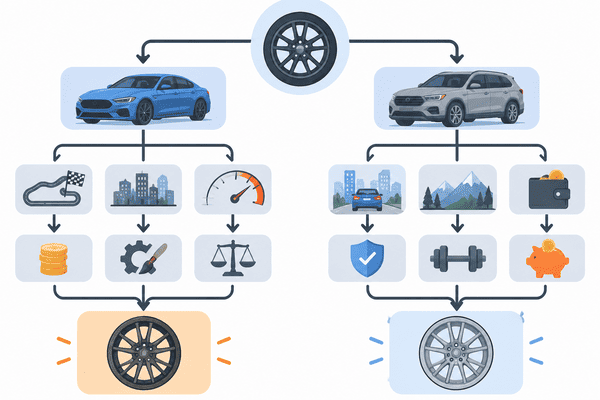
Here’s the question sequence I’ve found useful:
Step 1: What is the primary use of the vehicle?
- Daily street driving → cast wheels are likely sufficient
- Track, racing, or performance driving → forged is the correct direction
- Mixed use (street and occasional track) → forged is the safer call
Step 2: Has the vehicle been significantly modified?
- Stock or lightly modified → cast wheels remain appropriate
- Heavily modified (power, suspension, brakes, wide tires) → forged offers better fitment flexibility and appropriate structural margin
Step 3: What is the buyer’s priority?
- Visual upgrade, cost efficiency → cast
- Weight reduction, handling precision, structural confidence at limits → forged
Step 4: Does the application require customization beyond standard sizes?
- Standard fitment available → cast is accessible and practical
- Non-standard offset, diameter, or custom finish required → forged blanks offer more depth of customization
This four-step sequence handles the majority of real buyer inquiries without requiring technical expertise the buyer doesn’t have.
Frequently Asked Questions
Are forged wheels always more expensive than cast wheels?
Yes, forged wheels carry a higher unit cost — the manufacturing process is more material- and labor-intensive. However, the cost gap varies by manufacturer, order quantity, and customization level. For B2B buyers placing repeat orders, per-unit cost can be negotiated. The right comparison isn’t forged vs cast price — it’s correct product vs incorrect product for the application.
Can cast wheels be used on a track car safely?
This depends on the vehicle, the track, and the specific wheel’s load rating. Many casual track-day participants run cast wheels without incident. However, for sustained high-load track use or competition driving, forged wheels provide a meaningfully higher structural margin. Consult a qualified performance vehicle specialist before making this decision.
Do forged wheels actually improve handling, or is that just marketing?
Reduced unsprung weight can improve suspension response, steering feedback, and braking efficiency — this is a recognized principle in vehicle dynamics10. Whether that improvement is perceptible depends on the vehicle, the weight delta, and the driver. On a street-driven daily driver, the difference is unlikely to be noticeable. On a track build, it can be meaningful.
What certifications should I look for when buying wheels?
For road use in major markets, look for DOT (United States), TÜV (Europe/Australia), and ISO9001 or IATF16949 quality management certifications. These indicate the product has been tested against recognized load and impact standards11. Always verify certification documentation directly — don’t rely solely on marketing claims.
How do I evaluate a wheel supplier’s actual manufacturing capability?
Ask for certification documentation, request samples before placing volume orders, and confirm lead times in writing. Suppliers with genuine production capability will offer 3D models and design previews before production. MOQ flexibility is also a signal — suppliers with actual manufacturing relationships can accommodate smaller initial orders, which matters when evaluating a new product line.
Conclusion
The forged-vs-cast decision isn’t about which wheel is better — it’s about which wheel is right for the specific vehicle and use case in front of you. Forged wheels deliver meaningful structural and customization advantages for performance builds, track applications, and heavily modified vehicles. Cast wheels are a legitimate, well-certified choice for street-driven vehicles, visual upgrades, and cost-conscious builds where performance loads stay within standard parameters.
Getting this right protects your reputation as a shop owner or advisor. It also protects the end customer from spending money they don’t need to spend — or from cutting corners in a situation where they shouldn’t.
If you’re working through a specific build inquiry and want to talk through the right wheel category for your customer’s application, I’m happy to help. At Tree Wheels, we work with modification shops and individual enthusiasts across the US, Canada, Australia, and the Middle East — and our first conversation is always about use case, not product pitch. Contact us to discuss your next build.
-
"Comparison of Mechanical and Corrosion Properties Between …", https://pmc.ncbi.nlm.nih.gov/articles/PMC12842727/. Research in materials science confirms that hot and cold forging of aluminum alloys produces a refined, directionally aligned grain structure with fewer internal discontinuities compared to casting, resulting in improved tensile strength and fatigue resistance. Evidence role: mechanism; source type: research. Supports: That the forging process aligns grain structure in aluminum alloys, reducing internal voids and increasing density relative to cast aluminum. Scope note: Specific mechanical property improvements vary by alloy composition, forging temperature, and die design; general findings may not apply uniformly to all wheel-grade aluminum alloys. ↩
-
"Review of Magnesium Wheel Types and Methods of Their …", https://pmc.ncbi.nlm.nih.gov/articles/PMC10856444/. Engineering literature on aluminum alloy components indicates that forged parts typically exhibit higher fatigue strength and yield strength per unit mass than cast counterparts, enabling weight reduction without proportional loss of load-bearing capacity. Evidence role: general_support; source type: research. Supports: That forged aluminum components can achieve equivalent or higher structural performance at reduced mass compared to cast equivalents due to superior material density and grain alignment. Scope note: Published comparisons often address aerospace or structural components broadly; direct wheel-specific load rating comparisons between forged and cast products are less commonly available in open literature. ↩
-
"Characterization and Analysis of Porosities in High Pressure …", https://pmc.ncbi.nlm.nih.gov/articles/PMC7412358/. Metallurgical studies of aluminum casting processes document the formation of gas porosity and shrinkage cavities during solidification; these internal discontinuities reduce fatigue life and tensile strength compared to wrought aluminum of equivalent alloy composition. Evidence role: mechanism; source type: research. Supports: That cast aluminum components are susceptible to internal porosity and shrinkage defects that reduce mechanical performance relative to wrought or forged aluminum. Scope note: Modern low-pressure and counter-pressure casting techniques, as well as post-casting treatments such as hot isostatic pressing, can substantially reduce porosity; the degree of internal defects varies significantly by casting method and quality control. ↩
-
"Signature redacted", https://dspace.mit.edu/bitstream/handle/1721.1/116487/14051765-MIT.pdf?sequence=1&isAllowed=y. Vehicle dynamics literature establishes that unsprung mass — components not isolated by the suspension system — directly influences wheel contact force variation, suspension response frequency, and transient handling behavior; reductions in unsprung mass are associated with improved road-holding and braking performance. Evidence role: mechanism; source type: research. Supports: That reducing unsprung mass improves suspension response, braking performance, and acceleration in wheeled vehicles. Scope note: The perceptible magnitude of improvement depends on the total vehicle mass, suspension design, and the absolute weight delta achieved; benefits may be negligible on heavy vehicles with small wheel mass reductions. ↩
-
"Tire-Related Factors in the Pre-Crash Phase", https://crashstats.nhtsa.dot.gov/Api/Public/Publication/811617. National Highway Traffic Safety Administration (NHTSA) investigations and recall records document incidents in which wheel fracture or separation contributed to loss of vehicle control, underscoring the safety-critical nature of wheel structural integrity at operating speeds. Evidence role: general_support; source type: government. Supports: That wheel structural failure during vehicle operation poses significant safety risks including loss of vehicle control. Scope note: NHTSA records cover a broad range of wheel types and failure modes; the relative failure rate of cast versus forged wheels under track conditions is not directly addressed in publicly available government safety data. ↩
-
"What Is Wheel Concavity and How Does It Affect …", https://treewheels.com/what-is-wheel-concavity-and-how-does-it-affect-wheel-appearance/. Forged aluminum blanks, having uniform material density and no internal porosity, are well-suited to extensive CNC machining operations that alter offset, center bore, and spoke geometry; cast wheels are dimensionally constrained by mold tooling, making non-standard specifications more costly or impractical to produce. Evidence role: mechanism; source type: research. Supports: That forged aluminum blanks are more amenable to post-forge CNC machining for custom dimensions than cast wheels, which are constrained by mold geometry. Scope note: Flow-formed and rotary-forged cast hybrid wheels have expanded the customization range available in cast products; the customization advantage of forged blanks is most pronounced for highly non-standard specifications rather than modest offset variations. ↩
-
"Formula One regulations", https://en.wikipedia.org/wiki/Formula_One_regulations. Motorsport governing bodies such as the FIA publish technical regulations for competition vehicles that include wheel material and construction specifications; the extent to which forged construction is mandated varies by competition category and class. Evidence role: general_support; source type: institution. Supports: That certain motorsport regulatory bodies include wheel construction specifications that may favor or require forged wheels in particular competition classes. Scope note: Specific requirements differ substantially across sanctioning bodies, competition levels, and vehicle classes; the article’s broad claim should be verified against the relevant rulebook for any specific competition. ↩
-
"Interpretation ID: 86-1.39", https://www.nhtsa.gov/interpretations/86-139. The U.S. Department of Transportation’s Federal Motor Vehicle Safety Standards (FMVSS) establish minimum performance requirements for wheels used on road vehicles; DOT-marked wheels are certified by the manufacturer to meet these standards, which include dynamic cornering fatigue and radial fatigue tests. Evidence role: definition; source type: government. Supports: That DOT certification for wheels involves compliance with federal motor vehicle safety standards governing load, impact, and fatigue performance. Scope note: DOT certification for wheels is largely self-certified by manufacturers rather than independently tested by a government agency, which limits the assurance it provides compared to third-party certification schemes such as TÜV. ↩
-
"What Testing Standards Do Quality Forged Wheels Meet?", https://treewheels.com/what-testing-standards-do-quality-forged-wheels-meet/. Standards such as SAE J2530 (North America) and the Japanese JWL standard specify dynamic cornering fatigue, radial fatigue, and impact test requirements for passenger car wheels; wheels certified to these standards have demonstrated compliance with defined safety margins under simulated road-use loading conditions. Evidence role: general_support; source type: institution. Supports: That industry testing standards for road wheels specify minimum safety margins for impact resistance and fatigue life under conditions representative of street driving. Scope note: These standards define minimum performance thresholds for normal road use and do not address the elevated loads associated with track driving or heavily modified vehicles; compliance with road-use standards does not imply adequacy for performance applications. ↩
-
"Vehicle dynamics", https://en.wikipedia.org/wiki/Vehicle_dynamics. Standard vehicle dynamics textbooks, including Milliken and Milliken’s Race Car Vehicle Dynamics, treat unsprung mass as a fundamental parameter influencing wheel contact patch behavior, suspension natural frequency, and transient response; reducing unsprung mass is a widely accepted method for improving dynamic performance. Evidence role: expert_consensus; source type: education. Supports: That the relationship between unsprung mass and vehicle handling performance is an established principle in automotive engineering and vehicle dynamics. Scope note: The practical significance of unsprung mass reduction is context-dependent and interacts with suspension geometry, spring and damper tuning, and overall vehicle mass; textbook principles describe tendencies rather than guaranteed outcomes for specific vehicles. ↩
-
"IATF 16949", https://en.wikipedia.org/wiki/IATF_16949. ISO 9001 specifies requirements for a quality management system and IATF 16949 extends these requirements for automotive production and service part organizations; both standards govern manufacturing process controls and documentation rather than certifying that individual products meet specific load or impact performance thresholds. Evidence role: definition; source type: institution. Supports: What ISO 9001 and IATF 16949 certifications actually cover, specifically that they address quality management processes rather than product-level load and impact performance. Scope note: The article’s implication that these certifications confirm product-level safety testing is inaccurate; product performance testing for wheels is governed by separate standards such as SAE J2530 or JWL, which should be distinguished from quality management system certifications. ↩