
Buyers ask this question every week. It sounds like a straightforward yes-or-no question about a finishing process — but the framing itself is the problem. Worrying about whether powder coating weakens forged wheels focuses attention on the wrong variable and leaves the real risks completely unexamined.
Powder coating does not inherently weaken forged wheels. A wheel’s structural integrity is determined by its alloy specification, forging process, and heat treatment — all of which happen before the coating stage. However, poor process control during powder coating, specifically incorrect cure temperatures applied to certain aluminum alloys, can affect material temper. The question worth asking is not whether a supplier powder coats, but how.
That reframe matters enormously for anyone evaluating a supplier or choosing a finish for an expensive custom wheel. The difference between a supplier who understands their coating process and one who doesn’t is not visible in a product photo or a certification list. It lives in the details of their production workflow — and those details are worth asking about directly.
Is powder coating a structural treatment or a surface treatment?
Buyers who worry about coating and strength are often working from a mental model that treats the wheel as a single, uniform object. If you do something to its surface, you change the whole thing. That concern is understandable, but it conflates two separate engineering stages.
Powder coating is a surface-only treatment applied after the wheel’s structural properties have already been established. The forging process, alloy selection, and post-forge heat treatment determine strength. By the time a wheel reaches the coating stage, its mechanical properties are fixed — unless the coating process itself introduces enough thermal stress to interfere with those properties.
What actually determines a forged wheel’s strength?
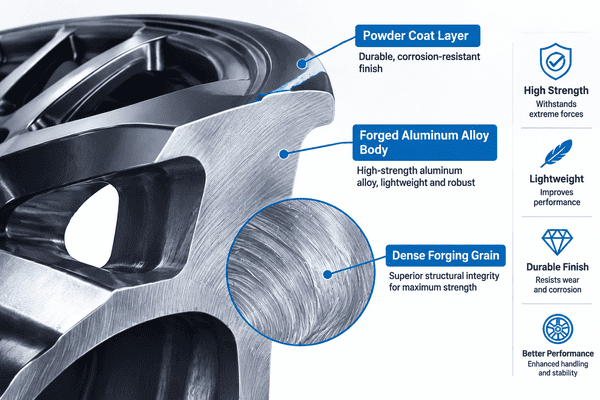
A forged wheel’s strength comes from three things, all of which happen before any surface finish is applied:
- Alloy specification — The aluminum alloy grade (commonly 6061 or 7075) defines the material’s baseline mechanical properties1.
- Forging process — Applying high pressure to aluminum billet aligns the grain structure and produces a denser, stronger part than casting2.
- Heat treatment (temper) — Post-forge heat treatment, such as T6 tempering, further increases yield strength and hardness3.
When a customer asks me whether powder coating will weaken their wheel, I find myself redirecting the question almost immediately. The wheel’s strength is established well before it reaches the coating line. What matters is whether the coating process is controlled carefully enough not to undo what the heat treatment achieved.
Why buyers conflate coating and strength
Part of this confusion comes from legitimate concerns about other wheel types. Cast wheels — which are more porous and less dense than forged wheels — are more vulnerable to surface treatments that apply heat or chemical stress4. Buyers who have researched cast wheel limitations sometimes carry those concerns into forged wheel purchasing decisions where they don’t apply in the same way.
It is also worth noting that the "does powder coating weaken wheels?" question often surfaces after a buyer has seen a cracked or failed wheel on a forum and is trying to attribute a cause. In most cases, coating is not the failure mechanism. But the concern is real enough that it deserves a thorough answer — not a dismissal.
Where does real risk actually live in the coating process?
The real risk in powder coating forged wheels is narrow but specific. It comes down to cure temperature, cure duration, and the alloy spec being coated. A supplier who understands these three variables and controls them consistently eliminates the risk. A supplier who doesn’t is the actual problem — not the coating process itself.
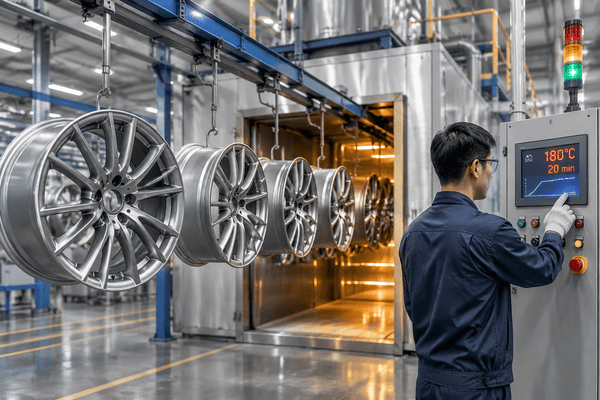
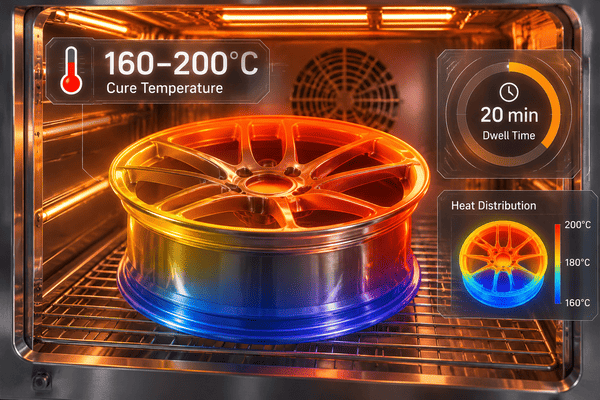
Powder coating requires curing at temperatures typically in the range of 160–200°C5. For most automotive powder coat applications, this is unremarkable. But for high-strength aluminum alloys that have been heat-treated to a specific temper, prolonged exposure near the upper end of that range introduces a consideration worth examining6.
Alloy temper and cure temperature: what to watch
Aluminum alloys like 6061-T6 achieve their mechanical properties through a precipitation hardening process. The T6 designation indicates the alloy has been solution heat-treated and then artificially aged to maximize yield strength7. According to material standards and manufacturer data for these alloys, prolonged exposure to elevated temperatures — particularly sustained exposure above 177°C — can begin to over-age the material, gradually reducing yield strength.
This does not mean powder coating 6061-T6 wheels is dangerous. It means the cure profile matters. Key variables include:
| Variable | Why It Matters |
|---|---|
| Peak cure temperature | Must stay within the alloy’s safe thermal range |
| Time at peak temperature | Prolonged soak increases risk of temper degradation |
| Oven calibration accuracy | An uncalibrated oven that runs hot creates invisible risk |
| Alloy grade knowledge | Supplier must know what alloy they are coating to set an appropriate profile |
In our production workflow at Tree Wheels, the alloy spec is confirmed before any coating parameters are set. This is not an exotic precaution — it is basic process discipline. But it is a step that varies meaningfully between suppliers.
What buyers should ask before approving a coating process
Rather than asking a supplier "does your powder coating weaken wheels?", ask two more specific questions:
-
"What is your standard cure temperature and dwell time?" — A supplier who can answer this precisely is operating with documented process control. A supplier who gives a vague answer is not.
-
"What alloy are these wheels made from, and have you coated this alloy spec before?" — This surfaces whether the supplier understands the relationship between their coating process and the material they are coating.
These questions will not make you a metallurgist. But they will tell you quickly whether a supplier is thinking carefully about the process or applying a generic workflow to every wheel they coat.
Does pre-treatment affect wheel strength?
Pre-treatment before powder coating is frequently misunderstood. Some buyers assume that if pre-treatment goes wrong, it creates a structural risk. In practice, pre-treatment failure produces a different kind of problem entirely.
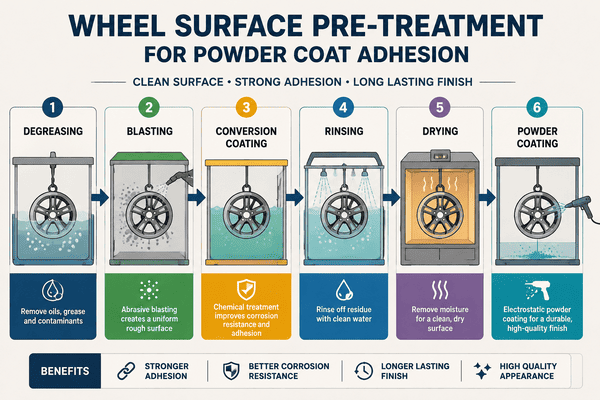
Poor pre-treatment — insufficient degreasing, skipped phosphating, or inadequate conversion coating — causes the powder coat to lose adhesion over time. This means peeling, bubbling, and cosmetic degradation. It does not cause wheels to crack or fail structurally. These are two distinct failure modes, and confusing them leads buyers to ask the wrong diagnostic questions.
Why pre-treatment still matters for buyers
Even though pre-treatment is not a structural concern, it is still a legitimate quality concern — especially for buyers investing in custom forged wheels. A powder coat that starts peeling within twelve months is a poor outcome regardless of whether the wheel underneath is structurally intact.
Good pre-treatment typically involves:
- Degreasing — Removing oils, machining residue, and contaminants from the wheel surface
- Etching or blasting — Creating surface texture to improve mechanical adhesion
- Conversion coating or phosphating — Adding a chemical bonding layer between aluminum and powder
- Rinsing and drying — Ensuring no chemical residue interferes with adhesion
A supplier who can describe their pre-treatment sequence in detail is demonstrating the kind of process awareness that correlates with consistent quality. At Tree Wheels, we treat pre-treatment documentation the same way we treat cure profile documentation — it is part of the approval record for a finished wheel.
How should buyers evaluate a supplier’s coating process?
By this point, the original question — does powder coating weaken forged wheels — has been replaced by a more useful one: how do I know whether a supplier is controlling their coating process well enough to protect the wheels they are finishing?
This is the right frame for both B2B buyers sourcing custom wheels for a modification shop and individual buyers choosing a finish for a high-value vehicle.
A practical supplier evaluation checklist
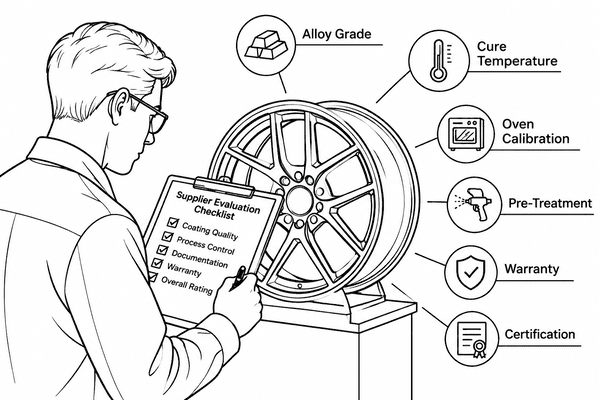
Use these questions when evaluating any supplier who powder coats forged wheels:
On alloy and process knowledge:
- What alloy grade are these wheels manufactured from?
- What is your documented cure temperature and dwell time for this alloy?
- How is your curing oven calibrated, and how frequently?
On pre-treatment:
- What pre-treatment sequence do you follow before powder application?
- Do you use a conversion coating or phosphating step?
On quality documentation:
- Do you have ISO 9001 or IATF 16949 certification8? (These indicate documented quality management systems, though buyers should verify certificates independently.)
- What is your warranty coverage for coating defects?
A supplier confident in their process will answer these questions without hesitation. Gaps in the answers are informative. At Tree Wheels, customers ask us variations of these questions regularly — and we welcome them, because the questions themselves signal that a buyer is thinking carefully about quality rather than just price.
It is also worth noting that certifications like DOT, TÜV, and IATF 16949 are relevant reference points during supplier evaluation, but no certification replaces direct process inquiry for application-specific decisions. Treat certifications as a starting point, not a complete answer.
Frequently Asked Questions
Will powder coating affect the balance of a forged wheel?
Powder coat adds a small, uniform layer of material to the wheel surface — typically 60–80 microns thick9. When applied evenly, this addition is negligible for balancing purposes. However, uneven coating thickness, particularly around hub faces or valve stem areas, can introduce minor imbalance that requires correction at the balancing stage. Ask your supplier about coating thickness tolerances.
Can powder-coated forged wheels be repaired if the coating chips or peels?
Yes. Powder-coated surfaces can be stripped and recoated without affecting the underlying forged aluminum structure, provided the wheel has not sustained mechanical damage. This is a repair process best handled by a qualified wheel refinisher. Attempting to spot-repair powder coat without proper equipment typically produces poor cosmetic results.
Is powder coating suitable for all custom forged wheel designs?
Powder coating works well on most forged wheel designs, including complex spoke geometries and deep-dish profiles. However, very tight internal recesses may present coverage challenges. For wheels with intricate design features, ask your supplier whether they have experience coating similar profiles and request a sample finish or reference photos.
How does powder coating compare to anodizing for forged aluminum wheels?
Anodizing penetrates the aluminum surface to create an oxide layer, while powder coating sits on top of it10. Both are surface treatments that do not affect structural integrity when properly applied. The choice between them typically involves aesthetic preference, durability requirements, and color range — not strength considerations. Consult a qualified finishing specialist for application-specific guidance.
What is a reasonable warranty expectation for powder-coated forged wheels?
A supplier confident in their process and pre-treatment quality should offer at least a one-year warranty covering coating defects such as peeling, bubbling, or adhesion failure under normal use conditions. At Tree Wheels, our one-year warranty covers both repair and replacement where applicable. Review warranty terms carefully and confirm what failure modes are included.
Conclusion
Powder coating does not inherently weaken forged wheels. The strength of a forged wheel is established by its alloy, forging process, and heat treatment — well before coating begins. The real variable is process control: a supplier who understands their alloy spec, documents their cure profile, and executes proper pre-treatment eliminates the risk that coating could affect temper or adhesion. The question buyers should bring to a supplier conversation is not whether powder coating weakens wheels, but whether the supplier controls their coating process precisely enough to protect the material properties they started with. If you are sourcing custom forged wheels and want to understand how we approach coating quality in production, contact Tree Wheels directly — we are happy to walk through our process in detail.
-
"7075 aluminium alloy", https://en.wikipedia.org/wiki/7075_aluminium_alloy. Aluminum alloys 6061 and 7075 are widely used in structural and automotive forging applications; 6061 offers good corrosion resistance and weldability, while 7075 provides higher strength-to-weight ratio, making both relevant to forged wheel manufacturing. Evidence role: general_support; source type: research. Supports: That 6061 and 7075 aluminum alloys are among the most commonly specified grades for forged automotive wheel applications. Scope note: Alloy selection varies by manufacturer and application; some wheel producers use proprietary or alternative alloy grades, and the article’s claim of commonality is directionally accurate but not exhaustive. ↩
-
"Comparison of Mechanical and Corrosion Properties Between …", https://pmc.ncbi.nlm.nih.gov/articles/PMC12842727/. The forging process reorients the grain structure of aluminum alloys along the contours of the part, producing improved tensile strength, fatigue resistance, and impact toughness relative to cast equivalents of the same alloy composition. Evidence role: mechanism; source type: encyclopedia. Supports: That the forging process aligns grain structure in aluminum alloys, resulting in higher density and improved mechanical properties compared to casting. Scope note: General metallurgical references describe this mechanism for aluminum alloys broadly; specific quantitative comparisons depend on alloy grade, forging method, and casting technique used as the baseline. ↩
-
"MATERIALS DATA HANDBOOK Aluminum Alloy 2014", https://ntrs.nasa.gov/api/citations/19720023885/downloads/19720023885.pdf. Per aluminum alloy temper designation standards, the T6 condition denotes solution heat treatment followed by artificial aging, a precipitation hardening sequence that maximizes yield strength and hardness for alloys such as 6061 and 7075. Evidence role: definition; source type: institution. Supports: That the T6 temper designation indicates solution heat treatment followed by artificial aging, and that this process increases yield strength and hardness in aluminum alloys. Scope note: Specific mechanical property values vary by alloy grade and product form; the general mechanism applies broadly to heat-treatable aluminum alloys. ↩
-
"A Review on Porosity Formation in Aluminum-Based Alloys", https://pmc.ncbi.nlm.nih.gov/articles/PMC10004325/. Aluminum casting processes are susceptible to porosity defects arising from gas entrapment and solidification shrinkage, resulting in lower density and reduced fatigue resistance compared to forged aluminum parts of equivalent alloy composition. Evidence role: mechanism; source type: encyclopedia. Supports: That cast aluminum components exhibit greater porosity and lower density compared to forged equivalents due to differences in solidification and deformation processing. Scope note: The degree of porosity in cast parts depends heavily on casting method (e.g., gravity die casting versus low-pressure casting) and process control; the comparison is directionally valid but not uniformly applicable across all casting techniques. ↩
-
"How Are Two-Tone and Multi-Color Finishes Created on Forged …", https://treewheels.com/how-are-two-tone-and-multi-color-finishes-created-on-forged-wheels/. Industry process guidelines for thermosetting powder coatings specify cure temperatures generally ranging from 160°C to 200°C depending on powder chemistry, substrate mass, and required film properties. Evidence role: general_support; source type: institution. Supports: That thermosetting powder coatings used in automotive and industrial applications typically require oven cure temperatures in the range of approximately 160–200°C. Scope note: Cure temperature ranges vary by powder formulation and manufacturer specification; the stated range represents a common window for polyester and epoxy-polyester systems but is not universal across all powder coat chemistries. ↩
-
"Elevated Temperature Effects on the Mechanical …", https://digitalcommons.calpoly.edu/cgi/viewcontent.cgi?httpsredir=1&article=1132&context=matesp. Research on precipitation-hardened aluminum alloys demonstrates that sustained thermal exposure above the artificial aging temperature accelerates precipitate coarsening, a process known as over-aging, which progressively reduces yield strength from the peak T6 condition. Evidence role: mechanism; source type: research. Supports: That prolonged thermal exposure of 6061-T6 aluminum at elevated temperatures causes over-aging, which reduces yield strength by coarsening precipitate particles. Scope note: The precise temperature threshold and duration at which meaningful strength loss occurs depend on alloy composition and initial temper; the article’s reference to 177°C is directionally consistent with published data but should be verified against specific alloy datasheets. ↩
-
"Temper Designations for Aluminium", https://www.rightonblackburns.co.uk/products/metals/aluminium-alloys/aluminium-alloy-temper-designations. Under the aluminum alloy temper designation system standardized by the Aluminum Association, the T6 temper denotes solution heat treatment followed by artificial aging, a sequence that produces near-peak yield strength through controlled precipitation hardening. Evidence role: definition; source type: institution. Supports: That the T6 temper designation for aluminum alloys is formally defined as solution heat treatment followed by artificial aging, producing near-maximum yield strength. ↩
-
"IATF 16949", https://en.wikipedia.org/wiki/IATF_16949. ISO 9001 specifies requirements for a quality management system applicable across industries, while IATF 16949 extends these requirements specifically to automotive production and service part organizations, both mandating documented process controls and internal audit mechanisms. Evidence role: definition; source type: institution. Supports: That ISO 9001 and IATF 16949 are internationally recognized quality management system standards requiring documented processes, process control, and continual improvement. Scope note: Certification indicates that a quality management system meets the standard’s requirements at the time of audit; it does not guarantee the quality of any specific product or process outcome. ↩
-
"How Does Anodizing Change Both the Appearance and …", https://treewheels.com/how-does-anodizing-change-both-the-appearance-and-durability-of-wheels/. Powder coating specifications for automotive and industrial applications commonly target dry film thicknesses in the range of 60–80 microns, though actual thickness varies with powder type, application method, and substrate geometry. Evidence role: statistic; source type: institution. Supports: That powder coat applied to automotive components typically achieves a dry film thickness in the range of 60–80 microns. Scope note: Coating thickness specifications vary by application, powder chemistry, and customer requirement; the stated range is representative of common practice but not a universal standard. ↩
-
"Anodizing", https://en.wikipedia.org/wiki/Anodizing. Anodizing is an electrochemical oxidation process that converts the aluminum surface into a porous aluminum oxide layer integral to the substrate, providing corrosion and wear resistance; this differs fundamentally from powder coating, which deposits a polymer film on the surface without chemically altering the substrate. Evidence role: definition; source type: encyclopedia. Supports: That anodizing is an electrochemical process that converts the aluminum surface into an integral aluminum oxide layer, in contrast to powder coating which forms an external polymer film on the substrate. ↩