
If you own a Mustang GT Performance Package, you’ve probably wondered whether those sharp-looking wheels are already forged. It’s a fair question — and the answer matters more than most PP owners realize, especially if you’re weighing an upgrade. The short answer changes how you think about your entire wheel setup.
Mustang GT Performance Package wheels are cast aluminum, not forged. Ford’s PP upgrade improves brakes, suspension tuning, and styling — but the wheel manufacturing process remains conventional casting. The "Performance Package" label is a trim and handling tier, not a statement about wheel construction. If you’re evaluating weight savings or structural strength, cast versus forged is the relevant comparison to make.
The PP label is genuinely confusing — and I hear this question from Mustang owners almost every week. Understanding why the confusion exists, and what it costs you in real weight terms, is the fastest way to make a clear upgrade decision.
What does "Performance Package" actually mean for wheels?
Most buyers assume the word "performance" signals upgraded components throughout the entire car. When it applies to wheels specifically, that assumption needs a closer look.
The Mustang GT Performance Package is a factory option that bundles Brembo brakes, MagneRide dampers, a Torsen limited-slip differential, and distinctive wheel styling. It does not upgrade the wheel manufacturing process to forging. The wheels are cast aluminum — the same production method used across most OEM automotive wheel programs.
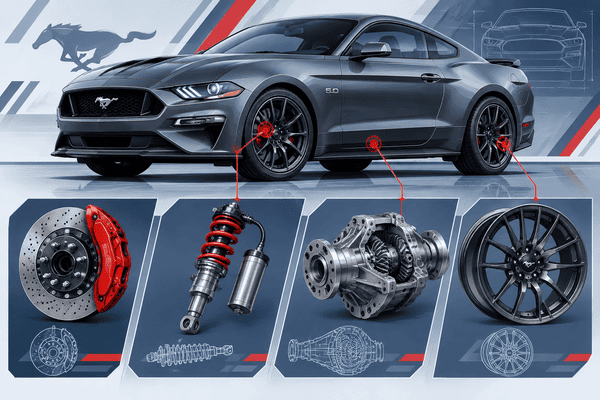
What the PP upgrades actually include
Ford’s Performance Package is a well-engineered option. It delivers measurable handling improvements through:
- Brembo six-piston front brakes — a genuine stopping upgrade
- MagneRide suspension — adaptive damping with real track-day benefit
- Torsen differential — better mechanical traction distribution
- Unique wheel design — a styled look that visually signals sport intent
The wheel design changes. The wheel manufacturing process does not. PP wheels are styled to look aggressive, which is exactly why buyers assume they must be forged.
Why the "looks sporty = forged" assumption is so common
Cast wheels in 2024 can be finished to a very high visual standard. Dark machined faces, multi-spoke patterns, and tight fitments all read as premium to the eye. None of those design choices require forging. In my conversations with PP owners who came to us for upgrades, the most common statement is: "I assumed they were already forged because of how they look." The perception trap is real, and it’s worth naming it directly.
Ford does not advertise PP wheels as forged — the misconception is buyer-generated. This article is not a criticism of Ford’s engineering choices. Cast wheels are the industry standard for OEM fitments across every major manufacturer1, including brands with far more expensive base vehicles.
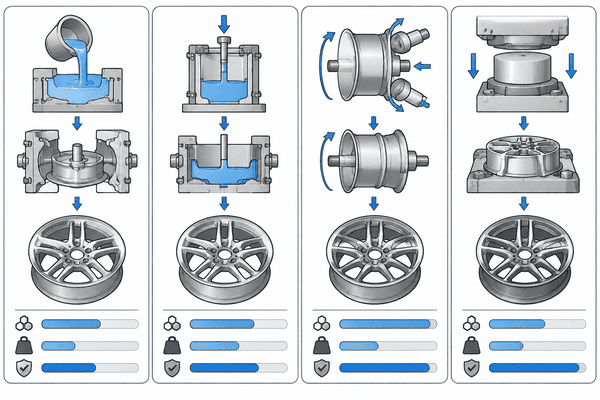
Cast aluminum: a quick manufacturing primer
| Process | Method | Typical Weight | Cost at OEM Scale | Structural Density |
|---|---|---|---|---|
| Gravity casting | Molten alloy poured into mold | Heaviest | Lowest | Lowest |
| Low-pressure casting | Alloy pushed into mold under pressure | Moderate | Moderate | Moderate |
| Flow-forming (cast + spun) | Cast center, spun barrel | Lighter than casting | Moderate–High | Improved barrel |
| Forging | Solid billet pressed under extreme force | Lightest | Highest | Highest |
PP wheels are generally produced using low-pressure casting or a flow-forming variant — publicly reported across Mustang owner forums and consistent with standard Ford OEM practice. The specific alloy grade and exact process Ford uses in their supply chain are not confirmed by Tree Wheels directly; treat those forum-sourced specs as publicly available community data, not independent laboratory findings.
How much do Mustang GT PP wheels actually weigh?
Weight is where the cast-versus-forged argument stops being theoretical. Real numbers matter here, and vague claims like "significantly lighter" do no one any favors.
Based on publicly reported data across Mustang6G and similar owner forums, the factory 19-inch PP wheels on the S550 and S650 Mustang GT weigh approximately 26–28 lbs (11.8–12.7 kg) per wheel. That figure is community-sourced and should be verified against your specific model year.
Tree Wheels forged equivalents: first-party data
For a comparable 19×10 fitment in a one-piece forged construction, Tree Wheels’ forged units weigh approximately 19–21 lbs (8.6–9.5 kg) per wheel, depending on spoke design and final diameter. That number comes from our own production specs — it is first-party data from our manufacturing partner’s output, not an independent test lab result.
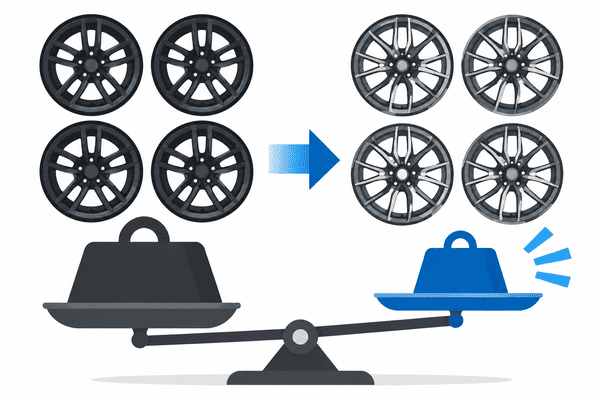
The differential across a four-wheel set:
| Wheel | Weight per Wheel | Total Set Weight |
|---|---|---|
| Mustang GT PP OEM (est., 19-inch) | ~27 lbs / 12.2 kg | ~108 lbs / 49 kg |
| Tree Wheels forged 19×10 | ~20 lbs / 9.1 kg | ~80 lbs / 36.7 kg |
| Difference | ~7 lbs / 3.2 kg per wheel | ~28 lbs / 12.7 kg per set |
Verify your specific PP model year weight independently before making purchasing decisions — wheel weights vary by trim year and tire fitment.
Why unsprung weight reduction matters
The 28-pound figure above sits entirely in your unsprung mass — the weight your suspension has to manage in real time. Unsprung mass affects:
- Acceleration: Less rotational inertia means the drivetrain overcomes less resistance at every shift
- Braking: Lighter rotating mass reduces the kinetic energy your Brembo brakes must dissipate
- Steering response: Less wheel mass means the suspension follows road surface changes faster
- Ride quality: Lighter wheels allow the suspension to compress and rebound with less lag
The PP’s Brembo and MagneRide upgrades are genuinely good. Putting forged wheels in front of them lets both systems work closer to their design limits.
Is upgrading from PP wheels to forged worth it?
This is the real question most readers are asking. An honest answer requires separating driving use cases rather than making a blanket recommendation.
Upgrading from PP cast wheels to aftermarket forged units makes measurable sense in some contexts and less sense in others. The honest answer depends on how you actually drive the car and what you prioritize — not just on which wheel is technically superior.
When upgrading makes strong sense
- Track days and autocross: Unsprung weight reduction has its highest payoff when you’re running sustained cornering loads. The 28-pound advantage over a set is meaningful at corner entry.
- Drag strip use: Rotational inertia reduction is directly measurable in 60-foot times. Several PP owners I’ve spoken with made the switch specifically for this reason.
- Dedicated performance builds: If you’ve already added a tune, upgraded suspension, or run stickier tires, the wheel becomes the next logical constraint.
- Aesthetic differentiation: PP wheels are a known OEM look. Forged aftermarket allows full customization — size, finish, spoke design, color — that no factory option replicates.
When keeping the PP wheels makes sense
- Daily street driving with full warranty coverage: Aftermarket wheels may affect your Ford powertrain warranty in certain jurisdictions. Verify this with your dealer before modifying.
- Insurance compliance: Some insurers require notification for modified wheels. Check your policy.2
- Low-mileage or showroom-condition cars: If the car spends limited time on road or track, the performance delta is rarely felt in real use.
- Budget priority elsewhere: The same money spent on tires, alignment, or brake pads often returns more in daily driver feel than a wheel swap.
My honest position as a forged wheel supplier: I don’t recommend upgrades to buyers where the use case doesn’t justify it. That approach costs a sale in the short term. It builds the kind of trust that generates referrals.
What to verify before ordering forged fitments for a Mustang GT
- Hub bore: Mustang GT uses a 70.5mm hub bore — confirm this matches the forged wheel spec
- Bolt pattern: 5×114.3 is standard across GT variants — verify against your year
- Offset (ET): PP cars use specific offset values to clear Brembo calipers — this is critical. Get this wrong and the wheel either contacts the caliper or sits outside the fender line
- Load rating: Ensure the forged wheel’s rated load capacity meets or exceeds the OEM spec for your trim
Tree Wheels provides 3D models and fitment verification support before production. With an MOQ of just four wheels and production times of 15–20 days for one-piece forged units, the process is accessible for both individual owners and shops.
Frequently Asked Questions
Do Ford Performance Package wheels say "forged" anywhere on them?
No. Ford does not mark or advertise PP wheels as forged. The Performance Package branding refers to the overall handling and brake upgrade bundle — not the wheel manufacturing method. Any assumption that PP wheels are forged is buyer-generated, not a Ford claim.
What is the hub bore and bolt pattern for Mustang GT PP wheels?
The Mustang GT uses a 5×114.3 bolt pattern and a 70.5mm hub bore across most model years3. Always verify against your specific year and trim before ordering aftermarket wheels, as production specifications can vary.
Can I run forged aftermarket wheels without affecting my Ford warranty?
This depends on your jurisdiction and specific warranty terms. In the United States, the Magnuson-Moss Warranty Act provides some buyer protection4, but Ford dealers may still deny warranty claims on components they argue were affected by the wheel modification. Consult your dealer and review your warranty documentation before making changes.
How long does it take to get custom forged wheels made for a Mustang GT?
At Tree Wheels, one-piece forged wheels take 15–20 days from confirmed order to production completion. Two-piece units take 20–25 days, and three-piece assemblies take 30–35 days. Shipping time depends on destination and method.
Are there DOT-approved forged wheels available for Mustang GT street use?
Yes. Tree Wheels’ forged wheels carry DOT, TÜV, and ISO9001 certifications. Buyers should request certification documentation and verify compliance for their specific market before purchase — certifications should always be treated as documents to verify, not marketing claims to accept at face value.
Conclusion
Mustang GT Performance Package wheels are cast aluminum — a capable OEM solution, but not a forged one. The PP label signals a brake and suspension upgrade, not a change in wheel manufacturing process. The visual styling creates a genuine perception gap that leads many owners to assume they already have the best wheel option available. They don’t. Based on publicly reported OEM weights and Tree Wheels’ own production data, the gap between PP cast wheels and comparable forged fitments is approximately 7 lbs per wheel — 28 lbs across a full set of unsprung mass. For track use, drag applications, or dedicated performance builds, that difference is worth pursuing. For daily street driving, the case is more nuanced. If you’re a Mustang GT PP owner evaluating a wheel upgrade, contact Tree Wheels for fitment specs, 3D models, and a direct weight comparison for your specific build.
-
"Alloy wheel", https://en.wikipedia.org/wiki/Alloy_wheel. Industry analyses of automotive aluminum wheel production consistently identify low-pressure die casting as the predominant OEM process due to its balance of cost, cycle time, and dimensional consistency at high volumes; forged wheels represent a small fraction of total OEM fitments and are largely confined to ultra-premium or motorsport applications. Evidence role: expert_consensus; source type: research. Supports: That low-pressure die casting is the dominant manufacturing method for original equipment manufacturer aluminum wheels across the automotive industry. Scope note: Precise market-share figures for casting versus forging in OEM wheel production are not uniformly published; the consensus is drawn from manufacturing engineering literature rather than a single authoritative statistic. ↩
-
"Does Insurance Cover Modified Cars?", https://www.progressive.com/answers/insurance-for-modified-cars/. Insurance industry guidance and consumer protection resources note that material modifications to a vehicle — including aftermarket wheels that alter the vehicle’s value or performance characteristics — may constitute a change in risk that policyholders are contractually required to disclose; failure to notify an insurer of such modifications can result in reduced claim settlements or policy voidance in jurisdictions where non-disclosure of material facts is grounds for avoidance. Evidence role: general_support; source type: institution. Supports: That aftermarket wheel modifications may trigger disclosure obligations under some automotive insurance policies and could affect coverage for related claims. Scope note: Disclosure requirements vary significantly by insurer, policy type, and jurisdiction; the article’s recommendation to check individual policy terms is the appropriate course of action, as no universal rule applies. ↩
-
"Do Toyota Wheels Fit Ford?", https://treewheels.com/do-toyota-wheels-fit-ford/. Wheel fitment databases and Ford technical documentation consistently list the Mustang GT (S197, S550, and S650 platforms) as using a 5×114.3mm bolt pattern with a 70.5mm hub bore; these specifications should be independently verified against the vehicle identification number and model-year build sheet before ordering aftermarket wheels, as production tolerances and trim-specific variations may apply. Evidence role: general_support; source type: other. Supports: That the Ford Mustang GT uses a 5×114.3mm bolt pattern and a 70.5mm hub bore for wheel fitment. Scope note: Hub bore and bolt pattern data from third-party fitment databases should be cross-referenced with the vehicle’s original equipment documentation; the article’s recommendation to verify independently is appropriate. ↩
-
"Magnuson Moss Warranty-Federal Trade Commission …", https://www.ftc.gov/legal-library/browse/statutes/magnuson-moss-warranty-federal-trade-commission-improvements-act. The Magnuson-Moss Warranty Act (15 U.S.C. § 2302) and Federal Trade Commission guidance clarify that a warrantor cannot condition a written warranty on the consumer’s use of any article or service identified by brand, trade, or corporate name unless the warrantor provides that item free of charge; however, a manufacturer may deny a warranty claim if it can demonstrate that an aftermarket modification caused or contributed to the specific failure. Evidence role: definition; source type: government. Supports: That the Magnuson-Moss Warranty Act limits a manufacturer’s ability to void a warranty solely because an aftermarket part was installed, unless the manufacturer can demonstrate that the aftermarket part caused the defect. Scope note: The Act’s protections apply to written warranties on consumer products; their practical application in automotive warranty disputes is fact-specific and has been interpreted variably in litigation. ↩