
Forged wheels carry a reputation for being lighter than cast alternatives — and buyers ask me about this constantly. The problem is that the answer they expect ("yes, always") sets them up for disappointment. Understanding what actually drives forged wheel weight can save you from spending premium money on the wrong fitment.
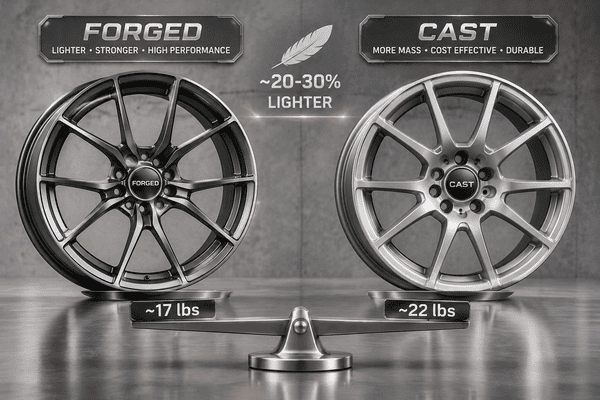
Forged wheels can be lighter than comparable cast wheels of the same size and load rating, because the forging process produces denser, stronger material — meaning manufacturers can achieve equivalent structural integrity with less of it. But "lighter" is conditional: actual weight depends on size, design, offset, and wall thickness. A large-diameter forged wheel in a staggered fitment can still outweigh a smaller cast wheel. The real question is not whether forged wheels are lighter, but whether they will be lighter in your specific configuration.
That distinction matters more than most buyers realize. In the inquiries we handle at Tree Wheels, weight is almost always the opening question — but it rarely turns out to be the most important one. The sections below walk through the mechanism, the conditions, and the smarter questions to ask before you order.
Why Are Forged Wheels Potentially Lighter Than Cast Wheels?
Most buyers arrive at this question because they’ve heard the claim repeated online. But very few explanations actually break down why the weight difference exists — or when it disappears.
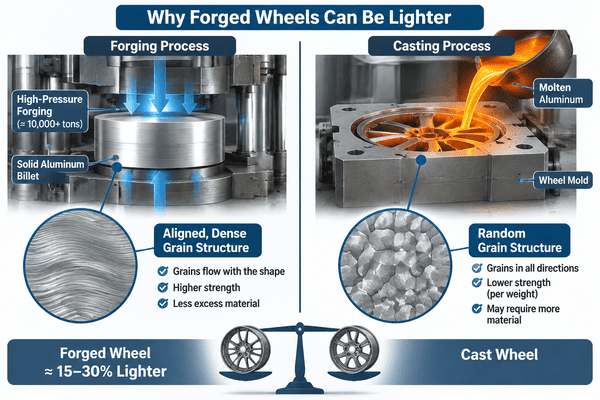
The weight advantage in forged wheels comes from material efficiency, not magic. The forging process compresses aluminum under high pressure, increasing grain density and alignment. This produces a structurally stronger billet. Because the material is stronger per unit, engineers can remove more of it — reducing wall thickness and spoke volume while maintaining the required load rating. That is where the weight savings originates.
Understanding this mechanism helps you spot when the weight claim is valid and when it is not.
The Forging Process Creates Structural Efficiency, Not Automatic Lightness
Cast wheels are formed by pouring molten aluminum into a mold. The resulting grain structure is more random, which reduces tensile strength compared to forged1. To compensate for that lower strength, cast wheel designs typically need more material — thicker spokes, heavier flanges — to hit the same load rating.
Forged wheels start from a solid billet of aluminum. The compression process aligns the grain structure, increasing the material’s strength-to-weight ratio. This is the technical foundation behind the weight claim.
But here is what that actually means in practice:
- The weight reduction is an option available to the designer — not an automatic outcome
- A manufacturer could theoretically produce a heavier forged wheel by choosing a thicker, more conservative design
- The actual weight of any specific forged wheel depends on the design brief, the intended load rating, the diameter, the width, and the offset
At Tree Wheels, we produce one-piece, two-piece, and three-piece forged wheels with fully custom specifications. When a buyer sends us a reference design and asks for a weight estimate, the answer always starts with size and structure — not just "it’s forged."
How Wheel Construction Type Affects Weight
| Wheel Type | Construction | Relative Weight | Notes |
|---|---|---|---|
| Cast (gravity) | Molten pour into mold | Heavier | Lower tooling cost; less design flexibility |
| Flow-formed | Cast center + rolled barrel | Mid-range | Better than full cast; not as light as forged |
| One-piece forged | Single billet machined | Light | Most design flexibility; shorter lead time |
| Two-piece forged | Forged center + spun barrel | Very light | Center and barrel optimized separately |
| Three-piece forged | Forged center + two barrel halves | Variable | Maximum fitment flexibility; heavier hardware |
Two-piece forged wheels in particular can achieve impressive weight savings because the center and the barrel are each optimized independently2. Three-piece wheels introduce bolted hardware that adds back some weight — but that construction offers fitment flexibility that often matters more than grams.
Does a Lighter Forged Wheel Actually Make a Performance Difference?
This is where buyer expectations most often diverge from reality. I have spoken with customers who expected an immediate, dramatic difference in how their car felt after switching to forged wheels. Some felt it. Others were surprised they did not. The gap usually comes down to how much weight actually changed — and where that weight sits.
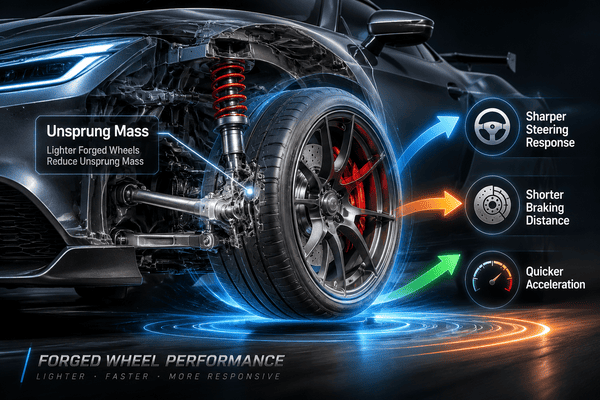
Weight reduction in wheels affects what engineers call unsprung mass — the components not supported by the suspension3. Lower unsprung mass can improve steering response, acceleration, and braking feel because the suspension and drivetrain are managing less rotating inertia. Whether you notice this depends on how much weight you actually removed and what your baseline was.
What Is Unsprung Mass and Why Does It Matter?
Sprung mass is everything the suspension supports — your chassis, engine, interior. Unsprung mass is everything below the suspension: hubs, brakes, and your wheels and tires.
Reducing unsprung mass is disproportionately beneficial compared to reducing weight elsewhere on the vehicle4. Lighter wheels mean:
- The suspension can follow road surface changes more quickly5
- The drivetrain spins up faster under acceleration6
- Braking forces are applied with less rotational inertia to overcome
These benefits are real — but they scale with the weight difference. If you are moving from a 22 lbs cast wheel to a 20 lbs forged wheel of the same diameter, the improvement is present but subtle. If you are moving from a 28 lbs chrome cast wheel to a 19 lbs forged monoblock, you will likely notice it.
When Will You Notice the Difference?
Customers who report clearly feeling the difference tend to share a few common factors:
- Track or spirited road use. Frequent direction changes amplify the benefit of lower rotational inertia.
- Significant weight reduction. Upgrades where the forged wheel is at least 20–25% lighter than the outgoing wheel produce more noticeable results (illustrative threshold — actual perception varies by vehicle and driver).
- Vehicles already tuned for response. Sports cars and modified platforms are more sensitive to unsprung mass changes than heavy SUVs or trucks.
- Tire size held constant. Buyers who upgrade to a larger forged wheel at the same time sometimes find tire weight offsets the wheel savings entirely.
For daily drivers making a cosmetic or quality upgrade, the weight benefit is a bonus — not the lead reason to choose forged.
Are Forged Wheels Always Lighter Than Your Stock Wheels?
This is the question beneath the question. Most buyers are not comparing forged to aftermarket cast — they are comparing forged to whatever came on their car from the factory.
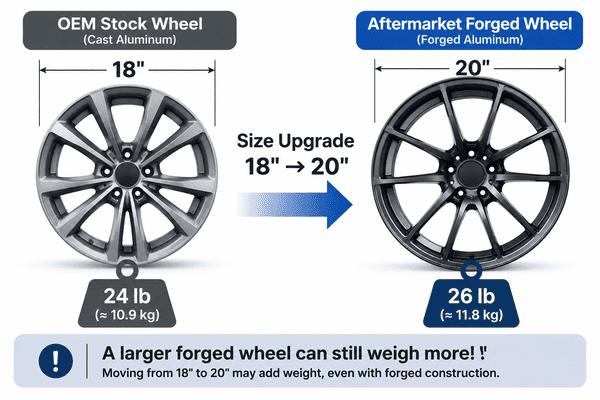
Not necessarily. Stock OEM wheels are designed to a cost and weight target, and many modern OEM cast wheels are already well-optimized7. A forged aftermarket wheel in a larger diameter than stock — which most fitment upgrades involve — may weigh more than the original wheel despite being forged. The comparison only makes sense when diameter, width, and load requirements are held equal.
The Size Upgrade Problem
In the inquiries we handle, a common scenario looks like this: a buyer has 18-inch OEM cast wheels weighing around 22 lbs each. They want to upgrade to 20-inch forged wheels. They ask whether the forged wheels will be lighter.
The answer depends entirely on the final design. A well-engineered 20-inch forged wheel might come in around 24–26 lbs (illustrative range — actual weight depends on width, design, and offset). That is heavier than the original wheel. It is also likely lighter than a comparable 20-inch cast aftermarket wheel would be.
The relevant comparison shifts when you size up:
- Forged vs. cast at the new size — forged wins on weight
- Forged new size vs. cast original size — the size change can negate the weight advantage
This is not a reason to avoid forged wheels. It is a reason to set the right expectation and to understand what you are actually optimizing for.
The Right Way to Frame the Comparison
When a customer comes to us asking about weight, I find it useful to ask three questions in return:
- What are you currently running? (size, brand, OEM or aftermarket)
- What size are you targeting? (the diameter and width you want to upgrade to)
- What is your primary goal? (performance, aesthetics, fitment, or all three)
These answers shape whether weight is a meaningful variable in their specific decision — or whether the real purchase drivers are elsewhere.
What Should You Actually Prioritize When Buying Forged Wheels?
Weight is a legitimate benefit of forged construction. But buyers who over-index on it often miss the fuller picture of why forged wheels justify their price.
The stronger reasons to choose forged wheels are structural integrity, customization flexibility, and surface quality — not weight alone. Forged construction produces a denser, more fatigue-resistant wheel that handles stress cycles better over time. It also enables tighter manufacturing tolerances and a wider range of custom finishes than cast production allows.
The Full Case for Forged
Here is how I typically frame the value of forged wheels for a buyer evaluating options:
- Structural strength. Forged aluminum handles impact and cyclic stress more reliably than cast8. For modified vehicles, track use, or aggressive fitments, this matters more than weight.
- Custom fitment precision. Forged wheels can be machined to exact offset, bore, and width specifications. Cast wheels are constrained by mold tooling.
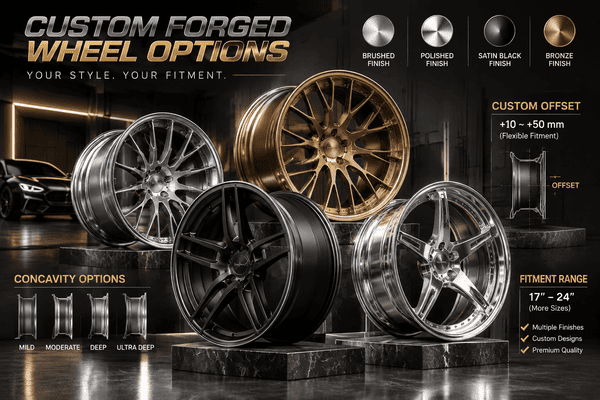
- Design freedom. Spoke patterns, face depths, concavity, and barrel widths are all adjustable in forged production. This is why luxury and performance builders prefer forged.
- Finish quality. The dense, smooth surface of forged aluminum takes paint, polish, and powder coating better than the porous surface common in gravity cast wheels9.
- Weight — conditionally. When size and load rating are held constant, expect a lighter result than cast. Don’t expect it automatically when you’re also upsizing.
Certifications and Quality Verification
At Tree Wheels, our forged wheels are manufactured under ISO 9001, IATF 16949, DOT, and TÜV certifications10. I always recommend buyers ask any supplier to provide documentation for these — not just mention them. Certifications cover manufacturing process controls and product testing standards that are directly relevant to structural safety.
For application-specific questions — particularly around load rating, offset, and fitment for modified or performance builds — I recommend working with a qualified shop or technician who can evaluate your specific vehicle configuration.
Frequently Asked Questions
How much lighter are forged wheels compared to cast wheels?
There is no universal figure — weight depends on diameter, width, design, and wall thickness. When size and load rating are held equal, forged wheels are often meaningfully lighter than cast equivalents, but the gap varies by manufacturer and model. Request weight specifications for the exact configuration you are comparing.
Will forged wheels improve my car’s acceleration or handling?
They can, through the reduction of unsprung mass. The effect is most noticeable on performance vehicles, in track environments, or when the weight reduction is significant relative to the baseline. For daily drivers doing a moderate upgrade, the improvement is real but may be subtle.
Are two-piece or three-piece forged wheels lighter than one-piece?
Two-piece forged wheels often achieve the best weight-to-strength ratio because the center and barrel are each optimized independently. Three-piece wheels introduce bolted hardware that adds some weight back, but their primary advantage is fitment flexibility — not minimum weight.
Can I get a weight estimate before ordering custom forged wheels?
Yes. At Tree Wheels, we provide design sketches and 3D models before production. Weight can be estimated based on the final design spec. Share your target size, offset, and design reference, and we can work through the expected weight range with you.
Is a lighter forged wheel always a better forged wheel?
No. Minimum weight is not the goal — appropriate weight for the load rating, fitment, and use case is. A wheel engineered too thin for its application is a safety risk. Always verify that the wheel’s rated load capacity matches your vehicle’s requirements.
Conclusion
Forged wheels are lighter than comparable cast wheels when the comparison is made fairly — same size, same load rating. That weight advantage is real, and it comes from the structural efficiency that the forging process makes possible. But it is conditional, not guaranteed, and it shrinks or disappears when you upsize or change the design significantly.
The smarter question is not "are forged wheels lighter?" but "will these specific forged wheels, in my chosen size and fitment, deliver the outcome I want?" Weight is one variable in that answer — structural strength, custom fitment, finish quality, and long-term durability are others.
If you are evaluating forged wheels for your vehicle or your shop’s customers, I am happy to work through the specifics with you. At Tree Wheels, we handle inquiries from individual enthusiasts and B2B buyers alike — with a minimum order of just four wheels and full customization available from design through delivery. Contact Tree Wheels to share your vehicle details and target fitment, and we will give you an honest answer about what to expect.
-
"The Effects of Casting Porosity on the Tensile Behavior of Investment …", https://ui.adsabs.harvard.edu/abs/2015JMEP…24.2917S/abstract. Gravity casting produces aluminum components with dendritic grain structures and residual porosity that reduce tensile and fatigue strength relative to wrought or forged counterparts; this is documented in standard materials references such as the ASM Handbook, Vol. 2, ‘Properties and Selection: Nonferrous Alloys and Special-Purpose Materials.’ Evidence role: mechanism; source type: research. Supports: That gravity cast aluminum exhibits a more random grain structure and lower tensile strength than forged aluminum due to solidification conditions. Scope note: Quantitative strength differences vary significantly by alloy composition and heat treatment, so general references may not reflect the specific alloys used in aftermarket wheel manufacturing. ↩
-
"KP | Monoblock Forged Wheels", https://treewheels.com/monoblock-forged-wheels/. Multi-piece wheel construction enables independent material selection and thickness optimization for the center disc and barrel sections, which can reduce overall mass compared to one-piece designs where geometry constraints limit material removal; this principle is discussed in automotive engineering literature on wheel design and lightweighting strategies. Evidence role: mechanism; source type: research. Supports: That two-piece wheel construction allows the center and barrel to be independently designed and material-optimized, potentially achieving lower overall weight than a one-piece design constrained by unified geometry. Scope note: Actual weight outcomes depend on design intent; some two-piece wheels prioritize fitment flexibility over minimum weight, and hardware (bolts, seals) adds mass not present in one-piece designs. ↩
-
"Unsprung mass", https://en.wikipedia.org/wiki/Unsprung_mass. Unsprung mass is defined in vehicle dynamics as the mass of components not supported by the suspension system, including wheels, tires, brake rotors, and hubs; reductions in unsprung mass are associated with improved suspension response and handling, as described in standard automotive engineering references (see, e.g., Milliken & Milliken, ‘Race Car Vehicle Dynamics,’ SAE International, 1995). Evidence role: definition; source type: encyclopedia. Supports: That unsprung mass comprises vehicle components not isolated from road inputs by the suspension, including wheels, tires, hubs, and brakes. ↩
-
"Unsprung mass", https://en.wikipedia.org/wiki/Unsprung_mass. Vehicle dynamics literature generally holds that unsprung mass reductions improve wheel-to-road contact fidelity and suspension response more significantly than equivalent sprung mass reductions, because unsprung components must be accelerated by road inputs independently of the suspension; this principle is discussed in Gillespie, ‘Fundamentals of Vehicle Dynamics,’ SAE International, 1992. Evidence role: expert_consensus; source type: research. Supports: That reductions in unsprung mass yield proportionally greater improvements in vehicle dynamics than equivalent reductions in sprung mass. Scope note: The magnitude of the benefit is vehicle- and context-dependent; some studies suggest the practical difference is modest for road vehicles at normal speeds. ↩
-
"Unsprung mass", https://en.wikipedia.org/wiki/Unsprung_mass. Reduced unsprung mass lowers the wheel-hop natural frequency and decreases the inertial resistance of the wheel assembly to vertical road inputs, thereby improving tire contact patch consistency; this mechanism is described in vehicle dynamics texts including Dixon, ‘Tires, Suspension and Handling,’ SAE International, 1996. Evidence role: mechanism; source type: research. Supports: That lower unsprung mass reduces the natural frequency of wheel hop and improves the suspension’s ability to maintain tire contact with irregular road surfaces. Scope note: The perceptible handling benefit depends on road surface characteristics, vehicle speed, and suspension tuning, and may be negligible in typical passenger car use. ↩
-
"73 Dynamics of Rotational Motion: Rotational Inertia", https://openbooks.lib.msu.edu/collegephysics1/chapter/dynamics-of-rotational-motion-rotational-inertia-2/. The rotational inertia of a wheel is proportional to its mass and the square of its radius; reducing wheel mass therefore decreases the angular momentum that the drivetrain must overcome during acceleration, an effect sometimes quantified as an ‘equivalent mass penalty’ of approximately 1.5–2× the wheel’s actual mass for linear acceleration calculations (see Heisler, ‘Advanced Vehicle Technology,’ Butterworth-Heinemann, 2002, or equivalent automotive engineering references). Evidence role: mechanism; source type: research. Supports: That wheel mass contributes to rotational inertia, and reducing wheel mass decreases the torque required to accelerate the wheel assembly, improving drivetrain response. Scope note: The practical acceleration benefit of wheel mass reduction depends on total vehicle mass, drivetrain characteristics, and the magnitude of the weight change; for heavy passenger vehicles, the effect may be imperceptible in normal driving. ↩
-
"Multi-Objective Optimization of The Low-Pressure Casting of Large …", https://pmc.ncbi.nlm.nih.gov/articles/PMC10532954/. Original equipment wheel suppliers operate under strict mass and cost targets set by vehicle manufacturers, and modern low-pressure die casting and counter-pressure casting processes allow OEM cast wheels to achieve competitive strength-to-weight ratios; this context is relevant when comparing aftermarket forged wheels to factory fitments (see SAE technical literature on automotive wheel design and lightweighting). Evidence role: general_support; source type: research. Supports: That OEM wheel manufacturers apply engineering optimization to minimize weight within cost, tooling, and load-rating constraints, resulting in cast wheels that are not necessarily heavy by design. Scope note: OEM optimization priorities include cost, repairability, and manufacturing volume, which may result in design conservatism not present in premium aftermarket forged wheels. ↩
-
"Thermo-Mechanical Fatigue of Cast 319 Aluminum Alloys", https://fcp.mechse.illinois.edu/files/2014/07/Sehitoglu-presentation.pdf. Forged aluminum alloys generally demonstrate higher fatigue endurance limits and impact energy absorption than cast equivalents of similar composition, attributable to the elimination of casting porosity and the development of a fibrous grain structure during deformation processing; comparative data are available in ASM Handbook, Vol. 19, ‘Fatigue and Fracture.’ Evidence role: general_support; source type: research. Supports: That forged aluminum exhibits higher fatigue strength and impact toughness than cast aluminum due to reduced porosity and aligned grain structure. Scope note: Fatigue performance is strongly influenced by alloy selection, heat treatment, and surface condition; the advantage of forging over casting is not uniform across all alloy systems or loading conditions. ↩
-
"What Wheel Options Enhance a White Fiat 500 Abarth?", https://treewheels.com/what-wheel-options-enhance-a-white-fiat-500-abarth/. Subsurface porosity in gravity cast aluminum components can cause outgassing during curing of paint or powder coat, leading to surface defects such as pinholes and blistering; forged aluminum’s reduced porosity mitigates these issues, as discussed in finishing industry literature and aluminum processing references (see, e.g., Wernick, Pinner & Sheasby, ‘The Surface Treatment and Finishing of Aluminium and Its Alloys,’ ASM International). Evidence role: mechanism; source type: research. Supports: That gravity cast aluminum surfaces exhibit porosity that can compromise coating adhesion and surface finish quality, while forged aluminum’s denser surface is more amenable to high-quality finishing. Scope note: Modern low-pressure and die casting processes can produce surfaces with lower porosity than traditional gravity casting, narrowing but not eliminating this finishing advantage. ↩
-
"IATF 16949", https://en.wikipedia.org/wiki/IATF_16949. IATF 16949 is an automotive-specific quality management system standard developed by the International Automotive Task Force, specifying requirements for design, development, production, and service of automotive-related products; ISO 9001 provides the underlying quality management framework; TÜV certification involves independent structural testing by accredited German inspection organizations; DOT markings indicate compliance with applicable U.S. Federal Motor Vehicle Safety Standards administered by the National Highway Traffic Safety Administration (NHTSA). Evidence role: definition; source type: institution. Supports: That IATF 16949 is an automotive-sector quality management standard, ISO 9001 is a general quality management framework, DOT denotes compliance with U.S. Federal Motor Vehicle Safety Standards, and TÜV certification involves independent structural and safety testing by German technical inspection bodies. Scope note: Certification scope and testing protocols differ across these bodies; the presence of a certification mark does not guarantee suitability for all vehicle applications or load conditions. ↩