
Most buyers asking about custom wheels and rims land on the wrong question. They assume the price gap reflects a brand premium — that they are paying extra for a logo or a finish. That framing leads to frustration, because it frames a structural manufacturing difference as a cosmetic upgrade.
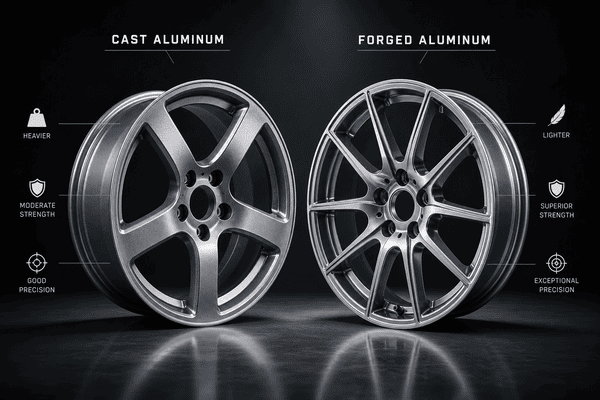
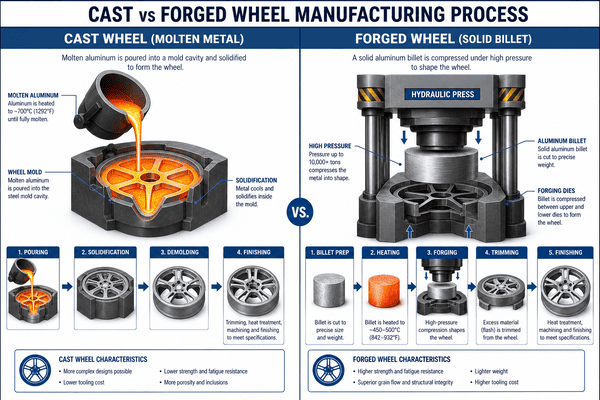
Custom wheels and rims are worth the money when the buyer understands what they are actually comparing. Forged wheels and cast wheels are not price tiers of the same product — they are two different manufacturing outcomes. A forged wheel is produced by compressing solid aluminum under high pressure, while a cast wheel is made by pouring liquid metal into a mold1. The resulting difference in weight, strength, and dimensional precision is material, not cosmetic. Whether that difference justifies the price depends entirely on how and where you drive.
Before unpacking the value question, it helps to understand the categories involved. Most buyers conflate "custom" with "expensive cast wheel." That conflation is where the confusion starts — and where the money gets spent wrong.
Are You Comparing the Right Two Products?
Buyers often arrive at a wheel purchase thinking they are choosing between budget and premium within the same product family. That assumption shapes how they evaluate price — and it is usually wrong.
The most important distinction in the custom wheels and rims market is not brand or finish — it is manufacturing process. Forged wheels and cast wheels behave differently because the metal itself is structured differently during production. Treating them as equivalent products at different price points leads to a misaligned purchase decision before any other variable enters the picture.
Once this distinction is clear, the rest of the value conversation becomes much more straightforward. The question shifts from "is it worth it?" to "which product fits my situation?"
How Forging and Casting Produce Different Metal Structures
Casting involves pouring molten aluminum into a mold and letting it cool. The process is cost-efficient and suitable for producing consistent shapes at scale. However, as the metal cools inside the mold, microscopic air pockets and inconsistencies can form within the material2. This is a natural result of the process, not a defect in any one manufacturer’s execution.
Forging works differently. A solid billet of aluminum — essentially a dense, compressed block — is pressed under extreme force into the required shape. This compression aligns the metal’s internal grain structure along the lines of stress the wheel will actually experience in use3. The result is a denser, more uniform piece of metal.
To put this in plain terms: imagine the difference between pressing clay tightly into a shape versus pouring liquid clay into a mold and letting it set. The pressed version tends to be denser and more consistent throughout.
What This Means at the Wheel Level
| Property | Cast Wheel | Forged Wheel |
|---|---|---|
| Production method | Poured liquid metal | Compressed solid billet |
| Internal grain structure | Irregular, with possible micro-voids | Aligned, denser |
| Typical weight | Heavier for equivalent size | Lighter for equivalent size |
| Dimensional tolerance | Wider tolerance range | Tighter tolerance |
| Unit cost | Lower | Higher |
This table is not a quality ranking — it is a description of trade-offs. Cast wheels serve a large portion of the market competently4. The question is whether the forged wheel’s specific characteristics matter for your application.
Does Lighter Weight Actually Matter for Street Driving?
Weight is often the first spec buyers cite when justifying a forged wheel purchase. But weight savings can sound like a marketing number with no practical meaning — especially if you have never felt the difference on the road.
Wheel weight falls into a category engineers call unsprung mass — the parts of your car not supported by the suspension5. Reducing unsprung mass has a proportionally larger effect on handling response than reducing weight elsewhere on the vehicle6. As a general mechanical principle, lighter wheels allow the suspension to react more quickly to road surface changes, which affects steering feel, braking distance, and ride quality.

This is not a brand claim or a lab result — it is standard mechanical physics that applies regardless of which manufacturer’s wheels you are comparing. Understanding it helps buyers decide whether weight savings are relevant to their specific driving situation.
When the Weight Difference Is Noticeable
Buyers who have driven the same vehicle with stock cast wheels and then switched to a lighter forged set often describe a sharpening of feel rather than a dramatic performance change. Steering becomes slightly more responsive. The car feels a little more planted under hard braking. These are incremental changes, not transformations.
The degree to which you will notice them depends on several factors:
- Vehicle type. Sports cars and performance sedans transmit road feedback more directly than SUVs or heavy trucks. The perceptible difference will be smaller on a larger, heavier vehicle.
- Driving style. A driver who pushes through corners or brakes late will notice unsprung mass changes more than someone driving conservatively on open roads.
- Existing wheel weight. If you are replacing a very heavy cast wheel, the delta is larger. If your current wheels are already relatively light, the perceptible gain shrinks.
- Tire compound. Tires carry significant unsprung mass of their own. Pairing a forged wheel with a heavy tire reduces the benefit the wheel delivers on its own.
For track use or spirited driving on winding roads, the mechanical case for lighter wheels is real and well-established. For pure city commuting on flat roads, the perceptible return is smaller — though the aesthetic and fitment advantages of custom forged wheels may still justify the investment depending on the buyer’s priorities.
What Buyers Typically Say When They Hold Both
I have seen buyers pick up a forged sample and a cast wheel of similar size side by side, and the weight difference is immediately physical. It registers before any explanation. That reaction is not performance theater — it reflects a genuine difference in material density. Whether that density difference translates into a driving experience you value is the honest question to ask yourself before purchasing.
Is Custom Fitment a Luxury Feature or a Practical Necessity?
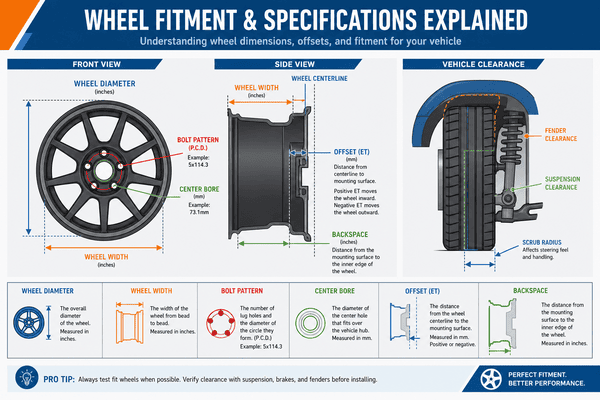
Custom fitment — specifying the exact diameter, width, offset, and bolt pattern for your vehicle — is sometimes presented as an upgrade tier. In practice, it is closer to a risk management decision.
When wheels are not specified correctly for a vehicle’s suspension geometry, the mismatch creates problems that show up after installation: uneven tire wear, rubbing against suspension components, altered steering behavior, and in some cases, a need to reorder entirely. Custom fitment means specifying wheels to match your vehicle’s actual requirements, not selecting from a catalog of near-matches and hoping the gap is small enough to ignore.
One pattern we see regularly in the ordering process is buyers who have already purchased once. They come to a custom forged wheel supplier not for the first time, but after a previous order that did not fit correctly. The reorder scenario is common enough that it shapes how we approach the first specification conversation with every new buyer.
The Fitment Variables That Matter
Custom wheel fitment involves several interdependent measurements:
- Diameter and width. These affect tire sizing options and overall clearance inside the wheel arch.
- Offset (ET value). This is the distance between the wheel’s mounting face and its centerline. A wrong offset pushes the wheel too far inward (risking suspension contact) or too far outward (risking arch rubbing or altered handling geometry)7.
- Bolt pattern (PCD). The number of bolts and their spacing must match the vehicle’s hub exactly.
- Center bore. The hole at the wheel’s center must match or be adaptable to the hub diameter.
- Backspace. Related to offset — affects how the wheel sits relative to the brake caliper and suspension components.
A catalog wheel is designed to fit a range of vehicles within acceptable tolerances. A custom-specified wheel is built to the exact measurements of your car. For a stock vehicle on factory suspension, the difference may be marginal. For a vehicle with modified suspension, spacers, or non-standard geometry, catalog fitment becomes a genuine risk.
The Cost of Getting Fitment Wrong
Reordering wheels is expensive — not just in additional unit cost, but in shipping, waiting time, and potentially in labor costs if the installer has already completed work. Buyers who have been through this scenario consistently report that the upfront cost of precise custom specification felt worthwhile in retrospect. The reorder cost almost always exceeds the customization premium.
How Do You Know Which Situation You Are In?
The "worth it" question does not have a universal answer. It has a user-specific answer based on how and where you drive, and what you have already spent money on.
The value of custom forged wheels depends on the gap between your current driving situation and the specific advantages forged wheels offer: reduced unsprung weight, tighter dimensional tolerance, and precise fitment. A buyer modifying a track car or a luxury vehicle with specific suspension geometry has more to gain from these properties than a buyer doing standard street driving with stock suspension on a mass-market car.

Rather than making a universal verdict, consider where you sit across three honest self-assessment questions.
Three Questions to Self-Identify Your Use Case
1. Has your vehicle been modified beyond stock suspension?
If yes, catalog-fit cast wheels carry a real fitment risk. Custom specification becomes practically necessary, not a luxury choice. The question is then which manufacturing process best fits your performance requirement.
2. Do you drive in ways where steering feel and braking response matter to you?
If you track your car, drive on mountain roads, or prioritize dynamic driving experience, the unsprung mass argument applies to your situation. If your primary context is urban commuting and highway cruising, the performance delta is real but smaller in day-to-day perception.
3. How long do you intend to keep the vehicle in its current configuration?
Custom forged wheels are a longer-horizon purchase. If you are planning to sell the car within twelve months or change the build significantly, the per-use value equation changes. Buyers who keep a build stable for several years extract more value from a higher-quality wheel that maintains structural integrity and finish over that period.
Frequently Asked Questions
What is the difference between custom wheels and aftermarket wheels?
Aftermarket wheels are produced in standardized sizes to fit a range of vehicles — they are not built specifically for your car. Custom wheels are manufactured to your exact size, offset, and design specifications. The distinction matters most when your vehicle has modified suspension or non-standard geometry that standard catalog sizing cannot reliably accommodate.
Do forged wheels actually last longer than cast wheels?
As a general mechanical principle, the denser grain structure produced by the forging process makes the material more resistant to fatigue under repeated stress cycles8. This is not a brand-specific claim — it reflects the physics of compressed versus cast metal. That said, wheel lifespan also depends on maintenance, driving conditions, and installation quality. Neither type is immune to damage from road hazards.
Is a one-piece forged wheel better than a two-piece or three-piece?
Each construction has practical trade-offs. A one-piece forged wheel is a single machined unit — simpler structurally and generally more rigid9. A two-piece or three-piece wheel allows the rim width and barrel depth to be customized independently of the face, which is valuable for aggressive fitment on modified vehicles. The right choice depends on your fitment requirements and design preferences, not a universal quality ranking.
How do I get the correct offset specification for my car?
Your vehicle’s factory offset is listed in the owner’s manual or on the door jamb sticker10. For a modified vehicle, have a qualified installer or alignment technician measure your actual suspension geometry before specifying a custom wheel. The cost of that measurement is small relative to the cost of ordering to the wrong specification.
Are custom forged wheels street-legal?
In most markets, forged wheels from certified manufacturers carry approvals such as DOT (USA) or TÜV (Germany/Europe) that confirm compliance with road-use standards11. Buyers should verify that the specific wheel they are purchasing carries the certification relevant to their country. Certification documents should be requested from the supplier and cross-checked — they are not automatically implied by price point or brand name.
Conclusion
Custom wheels and rims are worth the money when the buyer is asking the right question. The real evaluation is not cast versus forged as a price tier — it is whether the manufacturing difference produces properties that matter for your specific vehicle, driving style, and fitment situation. Forged wheels are lighter, structurally denser, and manufacturable to tighter dimensional tolerances than cast equivalents. Those properties translate to real advantages for modified vehicles, performance-oriented driving, and any situation where catalog fitment carries risk. For standard street use on a stock vehicle, the calculus is more personal. Start by understanding what you are actually comparing — the rest of the decision follows from there.
If you are currently evaluating custom forged wheels for your vehicle or your shop’s inventory, reach out to Tree Wheels directly. We work through exact fitment specifications with every buyer before production begins, and we offer design sketches and 3D models before you commit to an order.
-
"Forging", https://en.wikipedia.org/wiki/Forging. Forging is a manufacturing process in which metal is shaped by applying compressive forces, typically resulting in improved mechanical properties compared to casting, where molten metal is poured into a mold and allowed to solidify; the difference in grain structure between the two processes is well documented in materials engineering literature. Evidence role: definition; source type: encyclopedia. Supports: The mechanical distinction between forging and casting as manufacturing processes, including the role of compression in aligning grain structure. Scope note: General metallurgical sources describe the process distinction but may not address wheel-specific applications directly ↩
-
"A Review on Porosity Formation in Aluminum-Based Alloys", https://pmc.ncbi.nlm.nih.gov/articles/PMC10004325/. Porosity in cast aluminum alloys, arising from hydrogen gas entrapment and solidification shrinkage, is a well-documented phenomenon in materials science literature and is considered an inherent limitation of the casting process rather than a manufacturing defect attributable to any single producer. Evidence role: mechanism; source type: research. Supports: That porosity and micro-voids are a known, inherent characteristic of aluminum casting due to gas entrapment and shrinkage during solidification. Scope note: Research on casting porosity typically addresses industrial or aerospace applications; direct studies on automotive wheel casting may be less prevalent in open literature ↩
-
"Review of the Effects of Micro structure on Fatigue in …", https://ntrs.nasa.gov/api/citations/19840014667/downloads/19840014667.pdf. The forging process induces directional grain flow within aluminum alloys, aligning the microstructure along anticipated load paths and thereby improving fatigue life and tensile strength; this mechanism is described in standard materials engineering references as a primary advantage of forging over casting. Evidence role: mechanism; source type: research. Supports: That the forging process produces directional grain flow aligned with anticipated stress paths, which improves fatigue resistance and tensile strength relative to cast equivalents. ↩
-
"How to Start an Industry for Manufacturing Alloy Wheels?", https://treewheels.com/how-to-start-an-industry-for-manufacturing-alloy-wheels/. Industry market analyses of the global automotive wheel sector consistently indicate that cast aluminum wheels account for the dominant share of production volume, owing to lower per-unit manufacturing costs and suitability for high-volume original equipment manufacturer supply chains. Evidence role: statistic; source type: institution. Supports: That cast aluminum wheels constitute the majority of the automotive wheel market by volume. Scope note: Specific market share figures vary by report, year, and geographic region; the article’s claim is qualitative rather than quantitative, and a precise statistic may not be available from a single neutral source ↩
-
"Unsprung mass", https://en.wikipedia.org/wiki/Unsprung_mass. Unsprung mass refers to the mass of vehicle components not supported by the suspension system, including wheels, tires, and brake assemblies; vehicle dynamics engineering literature consistently identifies reductions in unsprung mass as having a proportionally greater effect on handling and ride quality than equivalent reductions in sprung mass. Evidence role: definition; source type: encyclopedia. Supports: The definition of unsprung mass as vehicle components not supported by the suspension, and its established role in vehicle dynamics including handling response and ride quality. ↩
-
"Unsprung mass", https://en.wikipedia.org/wiki/Unsprung_mass. Vehicle dynamics research supports the principle that unsprung mass reduction yields disproportionate improvements in wheel-to-road contact fidelity and suspension response speed, as the suspension system must accelerate and decelerate unsprung components with each road surface variation. Evidence role: expert_consensus; source type: research. Supports: That reductions in unsprung mass produce proportionally greater improvements in suspension response and handling than equivalent reductions in sprung mass. Scope note: The magnitude of the effect varies by vehicle type, suspension design, and driving conditions; general engineering consensus may not translate uniformly across all vehicle categories ↩
-
"Scrub radius", https://en.wikipedia.org/wiki/Scrub_radius. Automotive engineering literature establishes that wheel offset determines the scrub radius of the steering geometry; significant deviations from the vehicle manufacturer’s specified offset alter steering feel, can induce torque steer, and may cause physical interference between the wheel and suspension or bodywork components. Evidence role: mechanism; source type: research. Supports: That wheel offset directly affects scrub radius and suspension geometry, and that deviations from the manufacturer-specified offset can cause interference with suspension components and alter steering behavior. Scope note: The severity of consequences depends on the magnitude of offset deviation and the specific suspension design; minor deviations on some vehicles may fall within acceptable tolerance ranges ↩
-
"Data-driven fatigue analysis of selected aluminum alloys …", https://dr.lib.iastate.edu/handle/20.500.12876/108149. Materials testing literature documents that forged aluminum alloys generally exhibit higher fatigue strength than cast equivalents of similar composition, a difference attributed to the elimination of casting porosity and the development of a refined, directional grain structure during the forging process. Evidence role: mechanism; source type: research. Supports: That forged aluminum alloys exhibit superior fatigue resistance compared to cast equivalents, attributable to refined grain structure and reduced porosity. Scope note: Fatigue performance comparisons depend on alloy composition, heat treatment, and surface finish; results from general materials studies may not map precisely to specific wheel alloys ↩
-
"How Long Does It Take to Manufacture Custom Forged …", https://treewheels.com/how-long-does-it-take-to-manufacture-custom-forged-wheels/. Engineering analyses of wheel construction types note that monoblock (one-piece) wheels eliminate the bolted or welded joints required in two- and three-piece assemblies, reducing the number of potential failure initiation sites and simplifying structural load paths, though multi-piece designs offer greater customization flexibility in rim width and barrel depth. Evidence role: general_support; source type: research. Supports: That one-piece wheel construction eliminates the mechanical joints present in multi-piece designs, resulting in a structurally simpler assembly with fewer potential failure points. Scope note: Direct comparative rigidity studies specific to forged automotive wheels are not widely available in open academic literature; this claim is supported by general structural engineering principles rather than wheel-specific empirical data ↩
-
"Tire Safety Ratings and Awareness | TireWise", https://www.nhtsa.gov/vehicle-safety/tires. Under NHTSA regulations, vehicle manufacturers in the United States are required to affix a tire and loading information placard to the vehicle, typically located on the driver’s door jamb, which includes recommended tire size and inflation data; wheel offset specifications may additionally appear in the owner’s manual, though placard requirements do not mandate offset disclosure specifically. Evidence role: general_support; source type: government. Supports: That vehicle manufacturers are required to provide tire and wheel specification information in accessible locations including the vehicle placard. Scope note: Regulatory requirements mandate tire size and pressure information on the placard but do not universally require offset specification; offset data availability varies by manufacturer and market ↩
-
"Interpretation ID: 86-1.39", https://www.nhtsa.gov/interpretations/86-139. In the United States, wheel compliance for road use is governed by Federal Motor Vehicle Safety Standards administered by the National Highway Traffic Safety Administration (NHTSA); in Germany and across much of Europe, TÜV certification serves as a recognized conformity assessment for aftermarket wheel approval. Evidence role: general_support; source type: government. Supports: That DOT certification in the United States and TÜV approval in Germany represent official regulatory standards governing the road use of aftermarket wheels. Scope note: Certification requirements vary by jurisdiction; the article’s framing of TÜV as a pan-European standard is a simplification, as individual EU member states may have differing requirements ↩