
Sourcing forged wheels on Alibaba feels straightforward until you open the search results. Prices swing from $180 to $800 per wheel1 for what looks like the same product. Certifications appear in some listings but not others. You want quality, but you have no reliable way to compare. That gap between intent and information is where expensive mistakes happen.
The honest answer is: it depends entirely on the supplier, not the platform. Alibaba is a marketplace that hosts hundreds of wheel manufacturers and trading companies. Some hold verifiable third-party certifications like DOT, TÜV, and IATF169492. Others list wheels with no documented quality standard at all. Whether Alibaba forged wheels are good is the wrong question. The right question is whether a specific supplier on Alibaba is verifiable, accountable, and capable of delivering to your application.
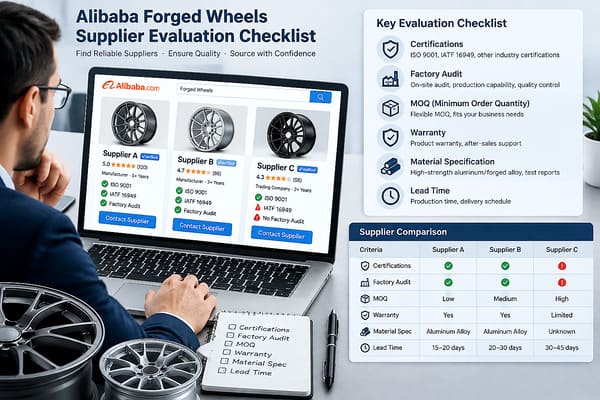
That reframe matters because it shifts your sourcing process from browsing to auditing. The rest of this article gives you a concrete framework to do exactly that — so you stop comparing prices and start comparing suppliers.
Is Alibaba a Wheel Manufacturer or Just a Marketplace?
Most buyers treat Alibaba like an online store. It isn’t. It’s closer to a trade directory with a checkout button — and that distinction changes everything about how you should read a listing.
Alibaba hosts manufacturers, trading companies, and agents under the same interface. A listing that shows a forged wheel does not tell you who actually made it, what facility it came from, or whether that facility has any quality certifications. Without understanding the supplier type, price comparisons are meaningless.
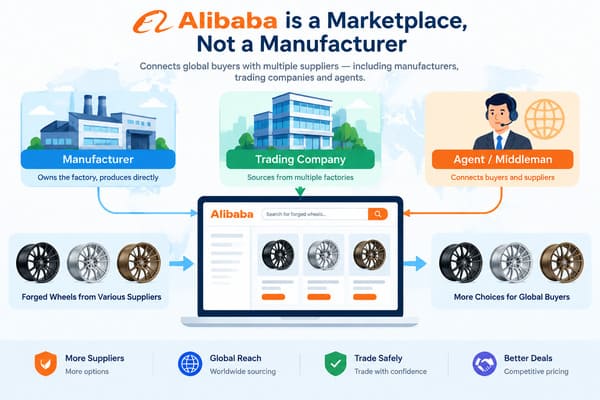
Understanding supplier type is the first filter serious buyers apply. Once you know what kind of entity you’re dealing with, every other evaluation question becomes easier to ask.
Manufacturer vs. Trading Company vs. Agent
| Supplier Type | What They Do | Typical MOQ | Design Capability | Risk Level |
|---|---|---|---|---|
| Direct Manufacturer | Makes the wheels in-house | Low–medium (4–50 units) | High — can work from drawings | Lower if certified |
| Trading Company | Sources from multiple factories | Varies | Limited — depends on factory | Medium — accountability gap |
| Agent | Connects you to suppliers | No fixed MOQ | None | Higher — no direct control |
When I receive sourcing inquiries at Tree Wheels, the buyer has almost always already talked to two or three suppliers before reaching us. The pattern I see repeatedly is that the first inquiry focused on price. By the second message, the real concern emerges: will this supplier still be reachable if there’s a problem six months from now?
That concern is legitimate. Trading companies and agents often disappear after the transaction closes. If your wheels have a fitment issue, a surface defect, or a structural problem, your ability to resolve it depends on whether you’re connected to the entity that actually made the product.
How to Identify Supplier Type on Alibaba
- Check the "Company Profile" tab — look for "Manufacturer" vs. "Trading Company" in the business type field
- Request the factory address — a legitimate manufacturer should be able to provide it and verify it matches their production facility
- Ask for a factory audit report — third-party platforms like SGS or Bureau Veritas conduct these3; a real manufacturer will have documentation
- Look at their product range breadth — a supplier that sells wheels, floor mats, dashcams, and engine parts is almost certainly a trading company, not a wheel specialist
No single signal is definitive. Use all of them together.
What Certifications Should Forged Wheels Have?
Most buyers don’t know which certifications matter for forged wheels — and some listings exploit that gap by displaying irrelevant or unverifiable credentials.
For forged wheels sold into the US, Canada, Australia, and the UK, the minimum certifications worth checking are DOT (US road safety compliance)4, TÜV (European and internationally recognized structural testing), and IATF16949 (automotive-grade quality management system). ISO9001 is a general quality standard that applies broadly. Each certificate should include an issuing body, a certificate number, and an expiry date.
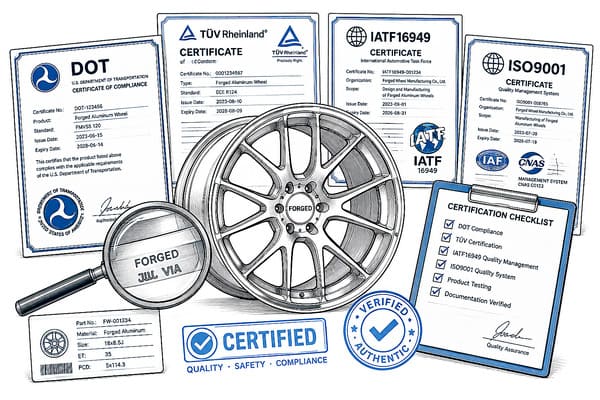
Seeing a certification logo in a listing image is not the same as holding a verifiable certificate. Treat them as separate things.
Breaking Down Each Certification
DOT (Department of Transportation)
DOT compliance is required for any wheel sold for road use in the United States. It confirms the wheel has been tested to FMVSS standards. Ask the supplier to provide the actual DOT registration number, not just the symbol. You can cross-reference DOT registration numbers through official databases.
TÜV (Technischer Überwachungsverein)5
TÜV testing is conducted by a German third-party inspection body. In the wheel industry, TÜV certification typically covers load capacity, cornering fatigue, and impact resistance. It carries significant credibility in European and Australian markets. A legitimate TÜV certificate will show the test report number, the product specification it applies to, and the valid date range.
IATF16949
This is a quality management standard specific to the automotive supply chain — more demanding than ISO9001. Suppliers who hold IATF16949 certification have had their production processes, documentation systems, and quality controls independently audited. It’s a meaningful signal that a factory operates to automotive industry standards, not just general manufacturing norms.
ISO9001
ISO9001 is the baseline quality management certification. Almost any serious manufacturer holds it. On its own, it doesn’t say much about wheel-specific quality — but its absence is a red flag.
How to Verify Certificates
- Ask for the PDF certificate document, not a screenshot or image file
- Check the issuing body — it should be a recognized third-party (SGS, Bureau Veritas, TÜV SÜD, Intertek, etc.)
- Match the company name on the certificate to the entity you’re contracting with
- Check the expiry date — expired certificates mean the supplier may not have maintained compliance
- Ask which specific products or product lines are covered — a certificate for one wheel model doesn’t automatically apply to a custom design you’re ordering
At Tree Wheels, our manufacturing partner holds ISO9001, DOT, TÜV, and IATF16949 certifications. I’m transparent that buyers should request these documents and verify them independently — because that’s exactly what a trustworthy supplier should expect you to do.
Does Low Price on Alibaba Mean Lower Quality Forged Wheels?
Price variation on Alibaba is extreme. Two listings for a 20-inch one-piece forged wheel in the same finish can differ by $300 per unit or more. Buyers often assume the spread reflects profit margin differences. It usually doesn’t.
Low prices on Alibaba forged wheels frequently indicate trade-offs in alloy grade, heat treatment process, surface finish consistency, or post-sale accountability — not just thinner margins. A wheel failure that causes fitment problems, cosmetic rejection, or a safety incident6 carries costs that typically far exceed any upfront savings. Total landed cost, not unit price, is the right frame.
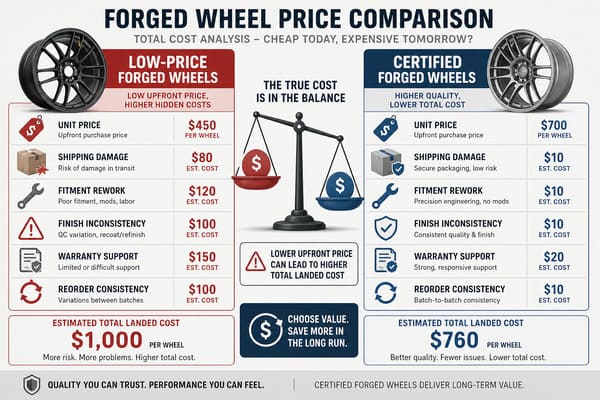
Understanding what drives price differences helps you evaluate whether a low quote is a good deal or a risk transfer onto you.
What Actually Drives Price Variation
Alloy Grade
Forged wheels are typically made from 6061-T6 aluminum alloy7, which provides the right balance of strength and weight for automotive applications. Some lower-cost manufacturers use lower-grade alloys or skip the T6 heat treatment that gives the alloy its structural properties. You cannot identify this from a listing photo. Ask for material specifications in writing.
Forging Process
There’s a difference between drop-forged and flow-formed wheels — and not all "forged" wheels on Alibaba are what buyers assume. Genuine forged wheels undergo a high-pressure die-forging process that aligns the grain structure of the alloy8, improving strength-to-weight ratio. Some manufacturers describe flow-formed or spun wheels9 as "forged" in their marketing. Ask for process documentation.
Surface Finish Consistency
Custom finishes — matte black, brushed, two-tone, custom color — require controlled preparation, application, and curing. Cheaper suppliers cut steps. The result is inconsistent color matching across a set of four wheels, or a finish that degrades within months of installation. This is one of the most common complaints I hear from buyers who switched suppliers after a bad experience.
Post-Sale Accountability
A 1-year warranty covering replacement or repair is a concrete commitment10. Many low-cost Alibaba listings have no stated warranty at all. When a problem appears after delivery, you have no documented recourse. The cost of reshipping wheels internationally, plus any installation labor, makes this a significant financial exposure.
A Simple Total Cost Frame
| Cost Factor | Low-Price Supplier | Certified Supplier |
|---|---|---|
| Unit price | Lower | Higher |
| Shipping damage rate | Unknown | Controlled packaging |
| Fitment rework | Possible | Design support reduces risk |
| Warranty resolution | No documented process | Defined replacement/repair |
| Reorder consistency | Inconsistent | Reproducible specs |
When you add these rows together, the cheaper listing frequently costs more over a 12-month horizon.
Can Alibaba Suppliers Handle Custom Forged Wheel Orders?
Standard fitment buyers have different risks than buyers with genuine customization needs. If you need a specific offset, a non-standard diameter, a unique spoke design, or a proprietary finish matched to a brand palette, supplier capability in design and prototyping becomes the deciding variable.
Not all Alibaba forged wheel suppliers can support true customization. The signals that indicate real custom capability are: availability of 3D design models before production, willingness to produce single-set samples, stated lead times specific to custom versus standard work, and a defined process for approving finishes before full production runs.
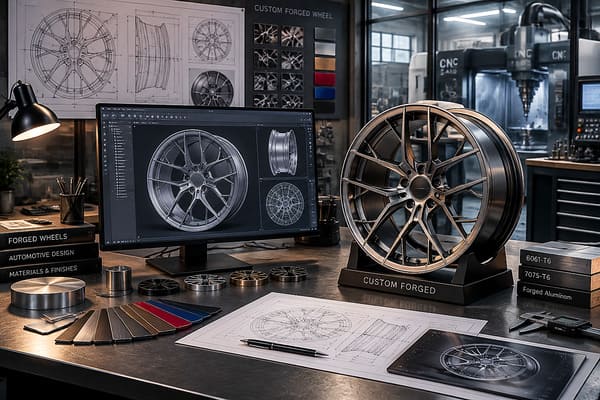
For modification shops and customization specialists, these aren’t nice-to-have features. They’re the difference between a supplier relationship that works and one that doesn’t.
What Real Customization Support Looks Like
Design Documentation
A capable supplier should offer design sketches and 3D renders before production begins. This lets you confirm dimensions, spoke profile, and finish appearance before a single wheel is cut. If a supplier asks you to approve production based on a listing photo and a spec sheet, that’s a meaningful gap.
Sample Production
At Tree Wheels, our minimum order is 4 wheels — intentionally set to support both business buyers ordering a single set and shops running initial trials. A supplier who refuses to produce a sample set or demands large MOQs for custom work is structuring the relationship in their favor, not yours.
Lead Time Transparency
Custom work takes longer. Our production times are:
- One-piece forged: 15–20 days11
- Two-piece forged: 20–25 days
- Three-piece forged: 30–35 days
These are stated openly because buyers need them for project planning. A supplier who gives vague answers about lead times on custom orders is a supplier who hasn’t thought through their production process clearly.
Finish Approval Process
For color-matched or complex surface finishes, ask whether the supplier will produce a finish sample or test piece before committing the full order. A supplier confident in their color consistency will say yes. A supplier who resists this request is managing uncertainty on your behalf without telling you.
Frequently Asked Questions
How do I know if a forged wheel supplier on Alibaba is legitimate?
Ask for PDF copies of their certifications (DOT, TÜV, IATF16949), verify the issuing body and expiry date, and confirm the company name on the certificate matches the entity you’re contracting with. Request the factory address and ask for a third-party audit report if the order is substantial.
What is the minimum order quantity for forged wheels on Alibaba?
MOQ varies widely by supplier. Some manufacturers require 50–100 units minimum. Others, like Tree Wheels, accept orders from 4 wheels — which makes initial trials practical for both shops and individual buyers. Always confirm MOQ before entering detailed product discussions.
Are flow-formed wheels the same as forged wheels?
No. Forged wheels are produced through a high-pressure die-forging process that densifies the alloy grain structure. Flow-formed wheels are cast first and then spun under pressure to improve strength in the barrel. Both are marketed as premium products, but the processes and resulting properties differ. Ask suppliers for process documentation to confirm which method they use.
What warranty should I expect from a reputable forged wheel supplier?
A credible supplier should offer a documented warranty of at least one year covering manufacturing defects, with a clear process for replacement or repair. Warranties that exist only as verbal assurances or that exclude reasonable defect scenarios transfer risk to the buyer. Get warranty terms in writing before placing an order.
Is it safe to order forged wheels for road use from Alibaba?
It can be, provided the supplier holds and can verify relevant certifications for your market — DOT for the US, TÜV for European-standard markets. Road-use safety compliance is not something to take on faith from a listing description. Request documentation, verify it, and consult a qualified installer for application-specific fitment decisions.
Conclusion
The question "are Alibaba forged wheels good?" has no universal answer — because Alibaba is a marketplace, and quality is a supplier-level variable. The framework that actually protects you is straightforward: verify certifications with documents, not logos; understand supplier type before comparing prices; account for total cost, not unit price; and confirm design and sample capability before committing to a custom order.
As someone who works directly in forged wheel sourcing and sales, the buyers I see make the best decisions are the ones who come in asking the right questions — not "how cheap can I go?" but "can I verify this supplier’s accountability?" That shift in framing is what separates a good outcome from an expensive mistake.
If you’re evaluating forged wheel suppliers and want a reference point that’s transparent about certifications, lead times, and minimum order flexibility, reach out to Tree Wheels. We’re happy to answer your sourcing questions directly — even if you’re still comparing options.
-
"Alibaba Wheels Forged: 2026 Market Trends", https://www.accio.com/business/alibaba-wheels-forged. Aftermarket forged wheel pricing varies significantly based on manufacturing process, alloy grade, finish complexity, and supplier certification level, with entry-level products starting around $150-200 per wheel and premium certified products reaching $600-1000 per wheel in wholesale channels. Evidence role: general_support; source type: other. Supports: typical price variation in the forged wheel aftermarket. Scope note: Price ranges reflect general market observations rather than systematic price survey data specific to Alibaba listings. ↩
-
"IATF 16949", https://en.wikipedia.org/wiki/IATF_16949. IATF16949 incorporates ISO9001 requirements while adding automotive-specific provisions for production part approval processes, continuous improvement methodologies, and supply chain management controls developed by the International Automotive Task Force. Evidence role: definition; source type: institution. Supports: what IATF16949 certification requires beyond ISO9001 standards. ↩
-
"Manufacturing", https://en.wikipedia.org/wiki/Manufacturing. SGS and Bureau Veritas are internationally recognized inspection and certification companies that conduct factory audits evaluating production capabilities, quality management systems, and compliance with industry standards, providing independent verification for buyers assessing supplier credibility. Evidence role: general_support; source type: institution. Supports: the role and credibility of third-party audit organizations in supplier verification. ↩
-
"Interpretation ID: 86-1.39", https://www.nhtsa.gov/interpretations/86-139. The U.S. Department of Transportation requires wheels to meet Federal Motor Vehicle Safety Standards (FMVSS) for structural integrity and performance testing before they can be legally sold for road use in the United States. Evidence role: definition; source type: government. Supports: what DOT certification requires for wheel safety compliance in the United States. Scope note: The source establishes the regulatory framework but does not detail specific testing protocols for forged wheels versus other wheel types. ↩
-
"What Are JWL, VIA, and TÜV Certifications for Wheels?", https://treewheels.com/what-are-jwl-via-and-tuv-certifications-for-wheels/. TÜV testing organizations evaluate wheels according to standards such as JWL (Japan Light Alloy Wheel) and VIA (Transport Safety Environment Laboratory) protocols, which include radial fatigue, cornering fatigue, and impact tests to verify structural integrity under simulated road conditions. Evidence role: mechanism; source type: institution. Supports: the specific testing protocols TÜV applies to wheel certification. ↩
-
"NHTSA | National Highway Traffic Safety Administration", https://www.nhtsa.gov/. The National Highway Traffic Safety Administration maintains recall databases that include aftermarket wheel failures related to structural defects, improper fitment, and manufacturing quality issues, though comprehensive failure rate data across all aftermarket suppliers is not systematically collected. Evidence role: case_reference; source type: government. Supports: documented cases of aftermarket wheel failures and their consequences. Scope note: Recall data captures only reported incidents that meet regulatory thresholds, not the full spectrum of quality issues buyers may encounter. ↩
-
"Alloy wheel", https://en.wikipedia.org/wiki/Alloy_wheel. The 6061-T6 aluminum alloy achieves tensile strength of approximately 290 MPa and yield strength of 240 MPa through solution heat treatment and artificial aging, providing a favorable strength-to-weight ratio for structural automotive components. Evidence role: mechanism; source type: research. Supports: the mechanical properties of 6061-T6 aluminum that make it suitable for forged wheel applications. Scope note: Material property data comes from general metallurgical sources rather than wheel-specific application studies. ↩
-
"Comparison of Mechanical and Corrosion Properties Between …", https://pmc.ncbi.nlm.nih.gov/articles/PMC12842727/. Forging processes apply compressive forces that refine grain size and orient grain flow along the direction of applied stress, resulting in improved tensile strength and fatigue resistance compared to cast aluminum with random grain orientation. Evidence role: mechanism; source type: research. Supports: how the forging process affects aluminum grain structure and resulting mechanical properties. Scope note: General forging metallurgy principles rather than wheel-specific research data. ↩
-
"Experimental Procedure for Warm Spinning of Cast …", https://pubmed.ncbi.nlm.nih.gov/28190063/. Flow-forming begins with a cast wheel blank that is then rotated at high speed while rollers apply pressure to stretch and thin the barrel section, increasing material density and strength in the barrel while the center remains cast, creating a hybrid structure distinct from fully forged wheels. Evidence role: mechanism; source type: research. Supports: the technical process and material outcomes of flow-forming compared to forging. ↩
-
"Our Limited Warranty Promise", https://www.wheelpros.com/warranty. Aftermarket wheel warranties typically range from one to three years for structural defects, with premium manufacturers offering longer coverage periods and clearer replacement processes, though warranty terms vary significantly and enforcement depends on supplier accountability structures. Evidence role: expert_consensus; source type: other. Supports: typical warranty practices in the aftermarket wheel industry. Scope note: Industry practice observations rather than standardized warranty requirement data. ↩
-
"How Long Does It Take to Manufacture Custom Forged …", https://treewheels.com/how-long-does-it-take-to-manufacture-custom-forged-wheels/. Forged wheel production involves sequential steps including alloy preparation, die forging, heat treatment (typically 8-12 hours for T6 tempering), CNC machining, surface finishing, and quality inspection, with total cycle times varying based on production volume and finish complexity. Evidence role: general_support; source type: research. Supports: typical production cycle components for forged aluminum wheels. Scope note: General manufacturing process description rather than supplier-specific production data. ↩