
Forged wheels carry a reputation for being the strongest wheels money can buy — and that reputation creates a problem. When customers ask whether forged wheels bend, they’re often hoping for a simple "no." But that expectation has caused more than a few painful surprises, and in my experience working with modification shops and individual buyers, it’s one of the most common misconceptions I run into.
Forged wheels can bend. Under severe impact — a hard curb strike, a deep pothole at speed, an overloaded track run — any aluminum wheel will deform, including a forged one. The difference is not whether a forged wheel bends, but how it fails when it does. Forged wheels tend to deform locally and predictably rather than crack or shatter. That behavior distinction is what makes them worth the premium — not an exemption from physics.
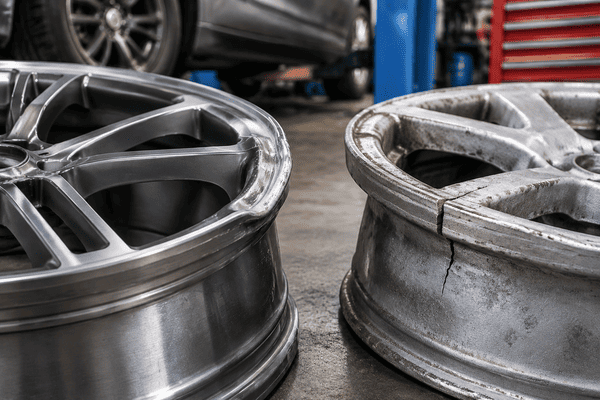
That answer is the starting point, not the ending point. The more useful question for any buyer is: under what conditions do forged wheels bend, and what does that mean for how I select and use them? The sections below break that down clearly, so you can make a purchase decision based on reality rather than marketing language.
Why do buyers assume forged wheels won’t bend?
The "forged is unbreakable" myth doesn’t come from nowhere. It comes from incomplete comparisons — and it sets buyers up for disappointment.
Forged aluminum wheels genuinely are stronger than cast aluminum wheels. They have a denser grain structure, higher tensile strength, and better capacity to absorb impact energy before failing. But "stronger than cast" is not the same as "immune to damage," and that gap in understanding is where the problem lives.
Based on what I’ve seen from customers — both modification shops and individual enthusiasts — the expectation tends to follow a simple chain of logic: forged = premium = stronger = won’t bend. Each link in that chain is partially true, but the conclusion is wrong.
The cast versus forged confusion
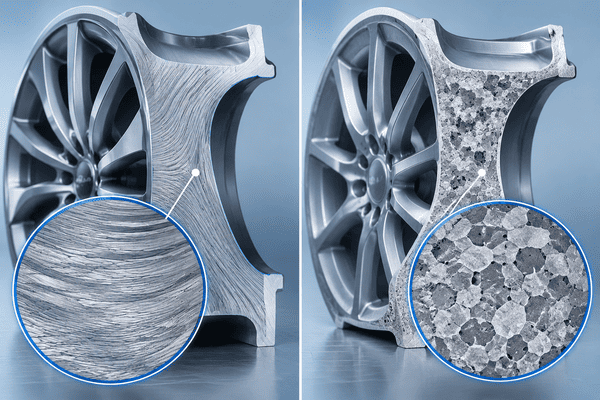
Cast wheels are made by pouring molten aluminum into a mold. The process is cost-effective and produces consistent shapes, but the resulting grain structure is less uniform. Cast aluminum is comparatively brittle. When it absorbs a hard impact beyond its limit, it’s more likely to crack or fracture — sometimes suddenly and structurally.1
Forged wheels are shaped under extreme pressure while the aluminum is in a solid state. That process aligns the grain structure and produces denser, tougher material.2 When a forged wheel reaches its impact limit, it typically bends or deforms rather than fracturing. The wheel may be ruined, but the failure mode is slower and more predictable.
The key distinction: Cast wheels tend to fail by cracking. Forged wheels tend to fail by bending. Both can fail. The difference matters for safety — but neither is indestructible.
Why this matters for buyers
If you understand this distinction before you buy, a bent forged wheel after a hard impact is not a product defect — it’s physics working as intended. The wheel absorbed the energy and deformed, rather than shattering in a way that could cause sudden loss of vehicle control.
If you don’t understand this distinction, that same bent wheel feels like a $1,500 failure. We’ve had customers contact us after a curb strike, convinced they received a defective product, because they expected "forged" to mean "unbendable." That frustration is real — but it comes from a marketing gap, not a manufacturing flaw.
| Property | Cast Aluminum Wheel | Forged Aluminum Wheel |
|---|---|---|
| Manufacturing process | Molten aluminum poured into mold | Solid aluminum shaped under high pressure |
| Grain structure | Less uniform, more porous | Dense, aligned grain structure |
| Typical failure mode | Cracking or fracturing | Bending or local deformation |
| Impact energy absorption | Lower | Higher |
| Weight (comparable size) | Heavier | Lighter |
| Cost | Lower | Higher |
What conditions actually cause forged wheels to bend?
Knowing that forged wheels can bend is useful. Knowing when they bend gives buyers the information they need to match a wheel spec to their actual use case.
Most forged wheel damage is preventable — not because the driver is reckless, but because the wheel was not specified correctly for how the vehicle is actually used.
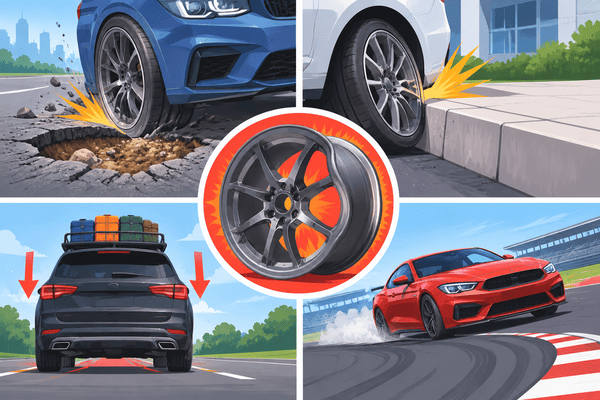
In our experience working with modification shops across the US, Australia, and the Middle East, bending incidents almost always trace back to one or more of the following conditions:
High-speed impacts with road hazards
A pothole or road debris at highway speed delivers a concentrated, high-energy impact to a small section of the wheel rim. Even a forged wheel rated for normal street use has a threshold. Hitting a deep pothole at 60 mph generates forces well beyond what most passenger vehicle wheels — cast or forged — are designed to absorb without deformation.3
Overloading beyond rated capacity
Every wheel carries a load rating, expressed in kilograms or pounds per wheel.4 Running a vehicle over that rated load — whether from cargo, passengers, or aftermarket suspension that changes load distribution — compresses the safety margin. Under sustained overload, even a correctly installed forged wheel can deform over time, particularly at the spoke-to-rim junction.
Aggressive track use with street-spec wheels
Track driving introduces lateral G-forces, repeated hard braking, and curb impacts that most street wheels are not rated for.5 A forged wheel specified for street use is not automatically suitable for track use. Wheel manufacturers produce track-spec variants with different geometry and load ratings for a reason. Using a street-spec forged wheel on a track is a use-condition mismatch, not a product shortcoming.
Incorrect size, offset, or fitment
A wheel fitted with the wrong offset places stress on the spoke and flange in ways the wheel was not engineered to handle.6 Over time — or under a single hard impact — this misalignment concentrates force in the wrong place. This is one of the more common sources of premature wheel damage that I’ve seen in customer inquiries, and it is entirely avoidable with correct fitment verification before installation.
| Cause | Preventable? | How to address it |
|---|---|---|
| High-speed pothole impact | Partially | Choose wheels rated for the road conditions; adjust driving |
| Overloading beyond rated spec | Yes | Verify load rating against vehicle and use requirements |
| Track use with street-spec wheels | Yes | Select track-rated wheels for circuit applications |
| Incorrect offset or fitment | Yes | Confirm fitment specs with a qualified technician before purchase |
| Severe collision or debris impact | No | Inspect and replace after any significant impact event |
How should buyers evaluate forged wheels for impact resistance?
The right evaluation process focuses on verified specs and use-case matching — not on marketing claims about strength.
A well-specified forged wheel from a qualified manufacturer will carry documented load ratings, dimensional certifications, and compliance with recognized international standards. These documents exist precisely so buyers can compare wheels on objective grounds rather than brand language.
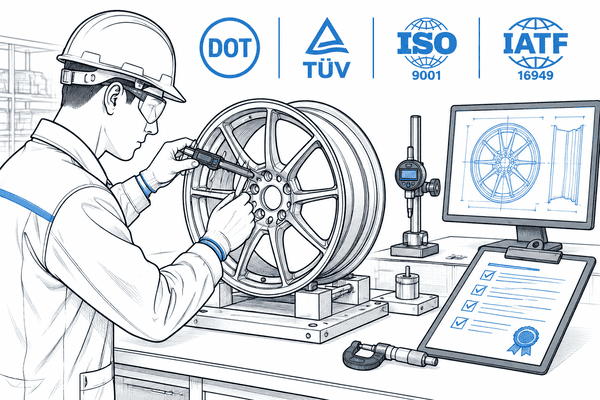
When evaluating any forged wheel supplier, I’d recommend asking for and verifying the following:
Certifications to look for
- DOT (Department of Transportation): Required for road-legal use in the United States. Confirms the wheel has been tested to federal safety standards.
- TÜV (Technischer Überwachungsverein): A German certification body widely respected in European and global markets. TÜV wheel certification includes structural load and fatigue testing.
- ISO 9001 / IATF 16949: Quality management system certifications that speak to manufacturing process consistency, not individual product performance. Relevant for evaluating a supplier’s overall production reliability.
Important note: Treat certifications as documents to verify, not marketing claims to accept at face value. Ask suppliers for the actual certification documents and check the issuing body’s registry where possible.
Specs to match against your use case
- Load rating per wheel: Confirm it covers your vehicle’s actual wheel load, including any payload or towing considerations.
- Offset and fitment: Have a qualified technician verify that the offset is correct for your specific vehicle make, model, and suspension setup.
- Intended use designation: Some manufacturers specify wheels as street, sport, or track. Match the designation to your actual driving conditions.
- Material and construction type: One-piece forged (monoblock), two-piece, and three-piece forged wheels have different structural profiles and are suited to different applications.
Questions worth asking your supplier
- What load rating is documented for this wheel?
- Which certifications apply, and can you provide the documentation?
- Is this wheel spec’d for street, sport, or track use?
- What is the production lead time, and what warranty coverage applies?
At Tree Wheels, our forged wheels carry ISO 9001, DOT, TÜV, and IATF 16949 certifications — and we provide documentation on request. Our 1-year warranty covers repair or replacement, though it’s worth noting that physical impact damage is a use-condition issue, not a manufacturing defect. Any reputable supplier should be transparent about that distinction.
Frequently Asked Questions
Can a bent forged wheel be repaired?
In some cases, yes — a minor bend in a forged wheel can be straightened by a qualified wheel repair specialist. However, the structural integrity after repair is a judgment call that requires professional inspection. For safety-critical applications, replacement is generally the safer choice. Always have a bent wheel evaluated by a qualified technician before reuse.
Are forged wheels worth the cost if they can still bend?
Yes — the value of a forged wheel is not that it never bends. It’s that when it does fail, it fails more safely than a cast wheel, and it performs better across normal driving conditions. Lower weight, higher strength-to-weight ratio, and a more controlled failure mode justify the premium for most performance and modification applications.7
How do I know if my forged wheel is bent?
Common signs include vibration through the steering wheel at certain speeds, uneven tire wear, pulling to one side, or a visible deformation on the rim face or flange. If you suspect a bent wheel, have it inspected on a wheel balancing machine or by a qualified technician before continuing to drive on it.
Does wheel weight affect bending resistance?
Not in a simple linear way. Lighter forged wheels achieve their weight reduction through material efficiency enabled by the denser forged structure — not by removing structural integrity. However, an underspecified wheel (wrong size or load rating for the vehicle) will be more vulnerable to bending regardless of weight. Correct specification matters more than weight alone.
What is the difference between a one-piece and two-piece forged wheel in terms of bend resistance?
A one-piece (monoblock) forged wheel is machined from a single forged billet, which gives it a continuous structural profile with no joints.8 Two-piece and three-piece wheels join a forged center to rim sections, introducing joint points that require careful engineering. Both configurations can be engineered to high performance standards — the choice depends on the design flexibility, weight targets, and application requirements rather than a simple "stronger vs. weaker" comparison.
Conclusion
Forged wheels can bend — and understanding that is not a reason to avoid them. It’s the reason to buy them thoughtfully. The real advantage of a forged wheel over a cast alternative is not an immunity to damage. It’s a denser material structure, a better failure mode under impact, and a higher performance baseline across normal driving conditions. Selecting forged wheels based on those genuine strengths — and matching the wheel spec to your actual use case — is what separates a good purchase from a disappointing one.
If you’re evaluating forged wheels for a modification project, a customer build, or your own vehicle, I’d encourage you to ask for documented certifications, verify load ratings against your specific fitment, and consult a qualified technician on offset and size before you commit. At Tree Wheels, we work with modification shops and individual buyers across the US, Australia, the UK, Canada, and the Middle East — and we’re happy to walk through the specs with you before you place an order. Reach out with your vehicle details and use case, and we’ll help you find the right fit.
-
"Wheel Failure Investigation Program: Phase I", https://rosap.ntl.bts.gov/view/dot/54652/dot_54652_DS1.pdf. Cast aluminum alloys generally exhibit lower elongation-to-failure and reduced impact toughness relative to wrought alloys due to microstructural porosity and less uniform grain distribution, making fracture a more common failure mode under sudden loading; see relevant materials engineering literature on aluminum casting defects and mechanical properties. Evidence role: mechanism; source type: research. Supports: That cast aluminum alloys exhibit lower ductility and are more prone to brittle fracture under impact loading compared to wrought or forged aluminum.. Scope note: Failure mode depends significantly on alloy composition, heat treatment, and casting quality; the characterization applies broadly but not universally to all cast aluminum wheel products. ↩
-
"Influence of the Grain-Flow Orientation after Hot Forging …", https://preserve.lehigh.edu/lehigh-scholarship/faculty-and-staff-publications/faculty-publications/influence-grain-flow. The forging of aluminum alloys under compressive force produces a refined, directionally aligned grain structure that improves tensile strength and fatigue resistance compared to cast counterparts; see, e.g., ASM International, ‘Aluminum and Aluminum Alloys’ (ASM Specialty Handbook, 1993), or equivalent metallurgical reference. Evidence role: mechanism; source type: research. Supports: That the forging process mechanically aligns aluminum grain structure, resulting in improved density and mechanical toughness relative to cast aluminum.. Scope note: General metallurgical references describe the mechanism for aluminum alloys broadly; specific performance outcomes vary by alloy grade and forging parameters. ↩
-
"critical parameters in determining the effects of potholes on …", https://www.academia.edu/104262522/CRITICAL_PARAMETERS_IN_DETERMINING_THE_EFFECTS_OF_POTHOLES_ON_MOTOR_VEHICLE_STRUCTURES. Dynamic impact loads from road surface discontinuities such as potholes can exceed static wheel load ratings by a factor of several times depending on vehicle speed and pothole geometry; engineering analyses of road-induced wheel loads support this characterization, though specific multipliers vary by study and conditions. Evidence role: mechanism; source type: research. Supports: That pothole impacts at highway speeds generate dynamic loads significantly exceeding the static load ratings of standard passenger vehicle wheels.. Scope note: Quantitative force values depend on vehicle mass, suspension design, pothole geometry, and speed; no single universal figure applies across all passenger vehicles. ↩
-
"TP-110T-03 November 1, 2012", https://www.nhtsa.gov/sites/nhtsa.dot.gov/files/tp-110t-03_nov_01_2012_final.pdf. Wheel load ratings are defined under standards such as SAE J2530 (passenger car and light truck wheels) and ISO 3006, which specify test procedures and load capacity designations for road wheels; these standards establish the basis for the per-wheel load figures cited by manufacturers. Evidence role: definition; source type: institution. Supports: That automotive wheels are assigned load ratings under recognized industry or regulatory standards.. Scope note: Specific rating methodologies differ between standards bodies and regional markets; not all aftermarket wheel manufacturers certify to the same standard. ↩
-
"Test", https://en.wikipedia.org/wiki/Test. Motorsport applications subject wheels to sustained lateral accelerations and repeated high-load braking cycles that differ substantially from the load cases used in standard street wheel certification testing; wheel manufacturers and motorsport engineering literature distinguish track-rated from street-rated products on this basis. Evidence role: general_support; source type: research. Supports: That motorsport and track driving conditions impose wheel loads, particularly in cornering and repeated braking, that exceed the design envelope of standard street-rated wheels.. Scope note: The specific load differential between street and track conditions varies by vehicle type, circuit, and driving style; no single universal threshold separates street-safe from track-unsafe wheel specifications. ↩
-
"Bicycle Wheel Spoke Patterns and Spoke Fatigue 1", https://people.duke.edu/~hpgavin/papers/HPGavin-Wheel-Paper.pdf. Wheel offset determines the lateral position of the wheel’s mounting face relative to its centerline, directly affecting the bending moment arm acting on the spoke and hub interface under cornering and braking loads; engineering analyses of wheel fitment confirm that offset deviations from design specification increase stress at these junctions. Evidence role: mechanism; source type: research. Supports: That deviations from the designed wheel offset alter the bending moment applied to the wheel’s spoke and flange sections, concentrating stress beyond design intent.. Scope note: The magnitude of additional stress depends on the degree of offset deviation and the vehicle’s suspension geometry; minor offset variations within manufacturer tolerances may not produce meaningful structural risk. ↩
-
"Casting Wheels vs. Forged Wheels: Which Offers Better Performance for …", https://treewheels.com/casting-wheels-vs-forged-wheels-which-offers-better-performance-for-your-vehicle/. The superior specific strength of forged aluminum alloys relative to cast equivalents allows wheel designers to reduce material cross-sections while maintaining load capacity, resulting in lower wheel mass for equivalent structural performance; this relationship is documented in automotive lightweight design literature and materials engineering references. Evidence role: general_support; source type: research. Supports: That forged aluminum wheels achieve a higher strength-to-weight ratio than cast aluminum wheels of comparable size.. Scope note: Weight savings realized in practice depend on wheel design and size; not all forged wheels are lighter than all cast wheels of the same diameter, as design geometry also influences final mass. ↩
-
"What Are the Cost Differences Between One-Piece and Multi- …", https://treewheels.com/what-are-the-cost-differences-between-one-piece-and-multi-piece-forged-wheels/. In structural engineering, elimination of mechanical joints in load-bearing components removes potential stress concentration sites and fatigue initiation points; monoblock wheel construction applies this principle by machining the entire wheel geometry from a single forged blank, as described in automotive wheel design literature. Evidence role: mechanism; source type: research. Supports: That single-piece forged wheel construction eliminates mechanical joints, providing a continuous load path and avoiding joint-related stress concentrations.. Scope note: The practical structural difference between a well-engineered multi-piece wheel and a monoblock design depends on joint design quality; the claim of inherent superiority is directionally supported but not absolute. ↩