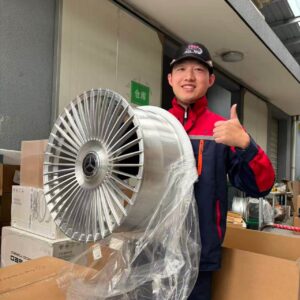

If you’re researching Rocket Forged Wheels Titanium White, you’ve probably already noticed the price sits higher than a standard white-finish wheel. That gap raises a fair question: are you paying for a color, or for something more? The answer changes what you should expect — and what you should verify before buying.
Rocket Forged Wheels Titanium White refers to a specific surface treatment finish applied to forged aluminum wheels — not a standard paint or powder coat color. The "Titanium White" designation describes a coating process that is typically harder, more chemically resistant, and more durable than conventional white finishes. Buyers should verify the exact process type (such as PVD or a titanium-based treatment) directly with Rocket’s specifications before purchase.
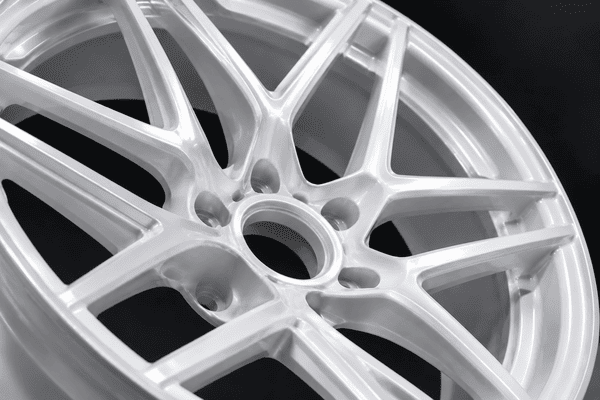
Understanding what that coating process actually involves — and how it interacts with a forged substrate — is what separates a confident purchase from an expensive surprise. The sections below break down each layer of that decision.
Is Titanium White a Paint Color or a Coating Process?
Most buyers searching "Rocket Forged Wheels Titanium White" are mentally filing it alongside other color options: gloss white, matte white, satin white. That assumption creates the first major decision risk.
Titanium White is not positioned as a standard paint color. Based on available product information, it appears to refer to a surface treatment that incorporates a titanium-based or similarly advanced coating — one that behaves more like an industrial finish than a decorative one. The exact process should be confirmed against Rocket’s current product specifications.
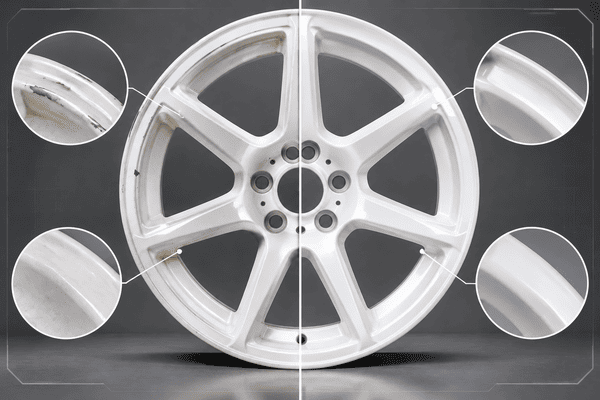
This distinction matters more than it might initially seem. Surface treatment processes and conventional paint systems differ in fundamental ways — from how they bond to the metal substrate to how they respond to heat, chemicals, and long-term UV exposure. Here’s why that affects your buying decision directly.
How Surface Treatments Differ From Paint and Powder Coat
Standard white finishes on wheels fall into three broad categories:
- Liquid paint: Applied in layers, cured at moderate temperatures. Relatively flexible, easy to custom-match, but more vulnerable to chipping, UV yellowing, and chemical attack from road salts and brake cleaners1.
- Powder coat: Electrostatically applied dry powder, then oven-cured. Harder than liquid paint, better impact resistance. Still susceptible to UV fade over time and can chip at impact edges.
- Advanced surface treatments (e.g., PVD, titanium-based coatings): Applied through physical or chemical deposition processes at high temperatures or under vacuum. The result is a finish that bonds at a molecular level to the substrate rather than sitting on top of it2.
The third category — where Titanium White reportedly sits — produces coatings with substantially higher hardness ratings (often measured on the Vickers or Rockwell scale), better chemical resistance, and longer service life under daily driving conditions.
What "Titanium" Signals in a Coating Name
The word "titanium" in a finish name is sometimes used loosely in the aftermarket wheel market, so it’s worth unpacking. In legitimate application, a titanium-based coating or treatment typically refers to one of the following:
| Coating Type | Process | Key Properties |
|---|---|---|
| PVD (Physical Vapor Deposition) | Vacuum chamber deposition | Extreme hardness, thin film, UV stable3 |
| Titanium Nitride (TiN) | Chemical vapor or PVD variant | Gold-to-white tones, very high hardness4 |
| Titanium-reinforced powder coat | Specialty powder formulation | Harder than standard powder, more impact resistant |
| Anodizing with titanium pigment | Electrochemical process | Primarily used on aluminum, corrosion resistant |
Which of these applies to Rocket’s Titanium White specifically requires verification from their official product documentation. I’d recommend asking Rocket directly for the coating process name, hardness rating, and chemical resistance data before committing to a purchase.
How Does Titanium White Perform Compared to Standard White Finishes?
This is where most buyers focus once they understand the coating isn’t just paint. The real question becomes: does the durability premium justify the price difference for my use case?
The short answer, based on how comparable surface treatments perform in the broader market, is that Titanium White-class finishes outperform standard white paints and powder coats on three specific durability axes — but only one of those axes matters for every buyer.
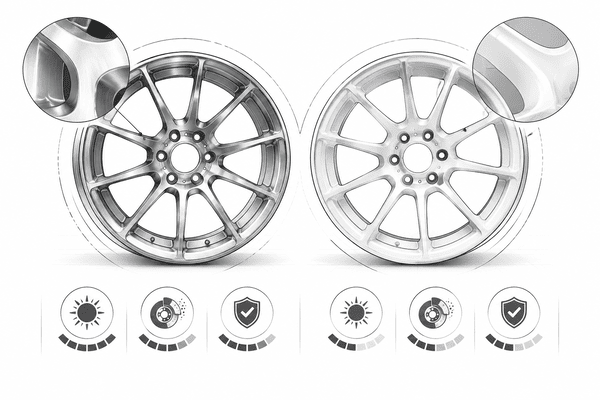
Those three axes are UV resistance, brake dust and chemical resistance, and chip resistance. The weight of each depends on how and where you drive.
UV Resistance and Yellowing
White wheels are uniquely vulnerable to UV-induced yellowing. Conventional white paint and powder coat contain organic pigments or binders that degrade under sustained UV exposure, shifting from bright white toward cream or yellow within one to three years of daily outdoor use.
Advanced surface treatments with titanium-based processes are inorganic at the coating level. They don’t contain the UV-sensitive compounds that cause yellowing5. From what we see buyers report in the forged wheel market, this is often the first visible point of difference between a premium surface treatment and a standard finish — usually apparent by the second summer of use.
Brake Dust and Chemical Resistance
Brake dust is mildly corrosive. Over time, the iron particles in brake dust embed into porous or soft finishes and oxidize, leaving stains that are nearly impossible to remove without abrasives6. Titanium-class coatings are significantly denser and harder, which reduces the ability of contaminants to embed in the surface.
This translates to easier cleaning and longer appearance retention — a practical advantage for daily drivers who aren’t detailing their wheels weekly.
Chip Resistance
Impact chipping is a different failure mode from UV or chemical attack. Hard coatings can be more brittle than flexible paint systems, which means a very sharp impact (curb strike, flying gravel) may crack rather than dent the finish7. This is a trade-off rather than a straight advantage — buyers in high-chip-risk environments (gravel roads, construction zones) should weigh this specifically.
Who Is Rocket Forged Wheels Titanium White Actually For?
Not every buyer benefits equally from a Titanium White-class finish. The decision fits best when two conditions are both true: the wheel will see regular real-world use, and the buyer understands they’re purchasing a fixed industrial finish rather than a flexible color option.
Framing this across two practical axes helps clarify the fit.

Daily Driver vs. Show or Display Build
| Use Case | Titanium White Value | Key Consideration |
|---|---|---|
| Daily driver, urban/suburban | High — UV, chemical, and chip resistance pay off quickly | Verify hardness doesn’t sacrifice too much impact flexibility |
| Track or performance use | Medium — durability matters, but finish isn’t the primary spec | Wheel weight and structural rating are the priority variables |
| Show car or trailer queen | Low to medium — durability premium is underutilized | Appearance retention matters less when exposure is controlled |
| Display build or garage queen | Low — standard paint would serve equally well at lower cost | No sustained UV or chemical exposure to justify premium |
For a daily driver in a climate with strong sun, road salt, or heavy brake use, the Titanium White process earns its cost difference within the first one to two years. For a show build that lives in a garage, you’re paying for durability you’ll never use.
Budget Alignment: Paying for Process, Not Appearance
This is the single point buyers most frequently misunderstand. A buyer who wants "white wheels that look clean" can achieve that result with a quality powder coat at a lower price point. A buyer who wants "white wheels that stay looking clean through three years of daily driving with minimal maintenance" is buying something meaningfully different — and that’s where Titanium White-class finishes are positioned.
If your expectation is custom color matching to an OEM panel color or the ability to easily refinish in a few years, an advanced surface treatment may not be the right fit. These processes are harder to touch up locally and typically require professional reprocessing if the finish is damaged. That’s not a flaw — it’s a characteristic of the process — but it needs to match your usage plan.
What Does "Forged" Add to the Titanium White Finish?
This compound advantage is the one I find buyers most consistently overlook. The substrate — the metal the coating is applied to — directly affects how well any surface treatment performs.
Forged aluminum wheels are produced by compressing aluminum billets under extreme pressure, which refines the grain structure of the metal into a denser, more uniform matrix8. Cast wheels are formed by pouring molten aluminum into molds, which produces a coarser, more porous grain structure9.
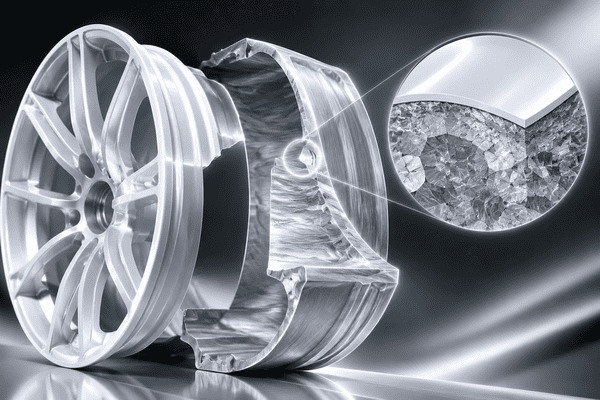
That difference in grain structure has a direct effect on surface treatment adhesion and performance.
How Substrate Density Affects Coating Performance
- Adhesion strength: Advanced coatings bond to the substrate surface at a microscopic level. A denser, more uniform grain structure provides more consistent bonding sites. A porous cast surface introduces microscopic voids where the coating can fail to adhere completely.
- Thermal stability: Forged aluminum handles heat cycling (brake heat, ambient temperature swings) with less dimensional change than cast aluminum10. Coatings on surfaces that expand and contract more uniformly experience less stress fracturing over time.
- Pre-treatment quality: The chemical pre-treatment steps before coating application (cleaning, etching, priming) work more predictably on the consistent surface of a forged wheel. Inconsistencies in a cast surface can create weak points in the pre-treatment stage.
In practical terms: the Titanium White finish on a forged wheel performs differently — and typically better — than the same finish applied to a cast wheel. The coating process gets more out of the substrate. Buyers evaluating white-finish wheels across different construction types should factor this in when comparing price points.
Frequently Asked Questions
Can Titanium White be custom-matched to a specific paint code?
Generally, no. Advanced surface treatments like those in the Titanium White category are fixed industrial finishes. They don’t offer the color-matching flexibility of liquid paint systems. If you need a specific OEM color match, a standard paint or powder coat process is the more appropriate path.
Is Titanium White the same as chrome or polished?
No. Chrome and polished finishes are distinct processes with very different visual and performance characteristics. Chrome is electroplated; polished is a mechanical surface process. Titanium White is a coating treatment producing a white or near-white finish — not a metallic mirror effect.
How do I verify what coating process Rocket actually uses for Titanium White?
Request the technical product sheet directly from Rocket Forged Wheels or their authorized distributor. Ask specifically for the coating process name, hardness rating (Vickers or equivalent), and chemical resistance data. Any reputable manufacturer will have this documentation available.
How do I clean and maintain a Titanium White finish?
Avoid abrasive cleaners, wire brushes, or acidic wheel cleaners, which can damage even hard surface treatments. pH-neutral wheel cleaners and soft brushes are the standard recommendation. For specific maintenance protocols, follow Rocket’s published care instructions for this finish.
Is Titanium White available on all Rocket Forged Wheels models?
Finish availability varies by wheel model and configuration. Confirm with Rocket or their distributor which specific models offer Titanium White as a finish option, as not all designs may be compatible with the coating process.
Conclusion
Rocket Forged Wheels Titanium White is a surface treatment finish, not a standard paint color — and that distinction is the most important thing to understand before purchasing. Advanced coating processes in this category deliver meaningfully better UV resistance, chemical resistance, and long-term appearance retention compared to conventional white paints and powder coats. That durability premium is most justified for daily drivers; it’s less relevant for show builds or controlled-use vehicles. The forged aluminum substrate compounds the advantage by providing better adhesion and thermal stability than cast alternatives — a factor buyers frequently underweight when comparing wheel options.
Before purchasing, verify the exact coating process, hardness specification, and maintenance requirements directly with Rocket. If you’re exploring forged wheel options more broadly and want to understand how surface treatments are specified from the manufacturing side, feel free to reach out to the team at Tree Wheels — we’re happy to walk through what to look for.
-
"Development of Car Coating Materials over the Past Decade for Paint …", https://pmc.ncbi.nlm.nih.gov/articles/PMC12694507/. Research on polymer coating degradation documents that organic binders in liquid paint systems undergo photochemical breakdown under sustained UV exposure, resulting in chalking, yellowing, and reduced adhesion to metal substrates. Evidence role: mechanism; source type: research. Supports: UV-induced degradation of organic binders and pigments in liquid paint systems, leading to yellowing and reduced chemical resistance over time. Scope note: Most published studies address automotive body paint rather than wheel-specific applications; performance under wheel-specific stressors such as brake heat and road salt may differ. ↩
-
"How PVD works – The Singh Center for Nanotechnology Wiki", https://wiki.nano.upenn.edu/wiki/index.php?title=How_PVD_works. Physical vapor deposition produces coatings through condensation of vaporized material onto a substrate, resulting in adhesion governed by atomic and intermolecular forces rather than the mechanical keying mechanisms characteristic of paint and powder coat systems. Evidence role: mechanism; source type: research. Supports: The PVD process deposits material atom by atom onto a substrate surface, creating adhesion through atomic-scale bonding rather than mechanical interlocking as in paint systems. Scope note: Adhesion strength in PVD coatings is also influenced by substrate preparation and process parameters; the claim of universally superior bonding requires qualification by specific process conditions. ↩
-
"Physical vapor deposition", https://en.wikipedia.org/wiki/Physical_vapor_deposition. Physical vapor deposition is defined in materials science references as a vacuum-based thin-film deposition process producing coatings with high hardness, low thickness in the range of one to ten micrometers, and UV stability attributable to the inorganic nature of the deposited material. Evidence role: definition; source type: encyclopedia. Supports: PVD coatings are thin-film deposits produced under vacuum conditions, characterized by high hardness, strong substrate adhesion, and resistance to UV degradation due to their inorganic composition. Scope note: PVD encompasses a range of sub-processes including sputtering and evaporation; hardness and UV stability values vary by deposited material and process parameters rather than being uniform across all PVD coatings. ↩
-
"Tin", https://en.wikipedia.org/wiki/Tin. Titanium nitride is documented in materials science literature as exhibiting Vickers hardness in the range of 1800–2100 HV and a characteristic gold coloration, with optical properties varying according to nitrogen content and deposition parameters. Evidence role: definition; source type: encyclopedia. Supports: Titanium nitride coatings are characterized by high Vickers hardness values and a distinctive gold coloration, with color shifting toward lighter tones depending on stoichiometry and deposition conditions. Scope note: Color appearance in commercial wheel applications may differ from laboratory specimens due to topcoat layers or proprietary process modifications. ↩
-
"Influence of Deposition Time on Titanium Nitride (TiN) Thin Film …", https://pmc.ncbi.nlm.nih.gov/articles/PMC10342551/. Photochemical degradation of coatings is primarily attributed to UV absorption by organic chromophores and polymer chain scission in binder systems; inorganic ceramic and metallic coatings deposited by PVD processes do not contain these UV-sensitive molecular structures and therefore exhibit substantially greater resistance to UV-induced color change. Evidence role: mechanism; source type: research. Supports: Inorganic coatings such as PVD-deposited titanium compounds lack the organic chromophores and polymer binders susceptible to UV-induced photodegradation, conferring inherent UV stability. ↩
-
"Review of Health Effects of Automotive Brake and Tyre Wear Particles – PMC", https://pmc.ncbi.nlm.nih.gov/articles/PMC12030913/. Studies on brake wear particle composition confirm that ferrous metallic particles constitute a significant fraction of brake dust; these particles are susceptible to oxidation upon contact with moisture, and their embedment in soft coating matrices has been associated with persistent surface discoloration. Evidence role: mechanism; source type: research. Supports: Brake dust contains ferrous particles that, when deposited on wheel surfaces, undergo oxidation and can penetrate porous or soft coatings, producing iron oxide staining resistant to non-abrasive cleaning. Scope note: Published research focuses primarily on brake dust as an air quality and health concern; direct studies on its staining effect on specific wheel coating types are limited. ↩
-
"(PDF) Tribological analysis of fracture conditions in thin surface coatings …", https://www.academia.edu/20642902/Tribological_analysis_of_fracture_conditions_in_thin_surface_coatings_by_3D_FEM_modelling_and_stress_simulations. Tribological literature on hard thin-film coatings notes an inverse relationship between coating hardness and fracture toughness; coatings with high Vickers hardness values are prone to brittle fracture under concentrated impact stress, in contrast to polymeric paint systems that deform plastically. Evidence role: mechanism; source type: research. Supports: High-hardness thin-film coatings exhibit reduced fracture toughness relative to polymeric paint systems, making them susceptible to cracking under localized impact loads. Scope note: Fracture behavior depends heavily on coating thickness, substrate compliance, and impact geometry; generalized brittleness claims may not apply uniformly across all titanium-based coating formulations. ↩
-
"Comparison of Mechanical and Corrosion Properties Between …", https://pmc.ncbi.nlm.nih.gov/articles/PMC12842727/. Metallurgical engineering sources document that hot and cold forging of aluminum alloys induces grain refinement and eliminates the porosity and dendritic segregation characteristic of cast microstructures, resulting in improved mechanical properties including tensile strength and fatigue resistance. Evidence role: mechanism; source type: education. Supports: The forging process subjects aluminum billets to compressive forces that refine and align the grain structure, producing a denser and more mechanically uniform microstructure than casting. ↩
-
"Casting Wheels vs. Forged Wheels: Which Offers Better Performance for …", https://treewheels.com/casting-wheels-vs-forged-wheels-which-offers-better-performance-for-your-vehicle/. Materials science literature on aluminum casting identifies solidification-induced porosity and dendritic grain coarsening as inherent microstructural characteristics of cast aluminum, which reduce surface uniformity and mechanical performance relative to wrought or forged equivalents. Evidence role: general_support; source type: research. Supports: Cast aluminum components exhibit microstructural porosity and coarser grain structures arising from solidification shrinkage and dendritic growth, in contrast to the refined grain structure of forged aluminum. ↩
-
"How Are Two-Tone and Multi-Color Finishes Created on Forged …", https://treewheels.com/how-are-two-tone-and-multi-color-finishes-created-on-forged-wheels/. Engineering studies on aluminum alloy thermal fatigue indicate that microstructural homogeneity, as achieved through forging, reduces stress concentration during thermal cycling and improves dimensional stability relative to cast alloys with inherent porosity and grain heterogeneity. Evidence role: mechanism; source type: research. Supports: The refined, uniform grain structure of forged aluminum provides more consistent thermal expansion behavior and greater resistance to thermal fatigue cracking compared to the heterogeneous microstructure of cast aluminum. Scope note: Thermal expansion coefficients for aluminum alloys are primarily composition-dependent rather than process-dependent; the dimensional stability advantage of forging is more attributable to reduced porosity and crack initiation sites than to differences in bulk thermal expansion. ↩