
Most Hellcat owners asking this question are already looking in the wrong place. They compare photos, check the finish, and scroll price listings — but replica wheels are engineered specifically to pass those tests. If appearance and price can’t separate real forged wheels from replicas, what actually can?
Genuine forged wheels differ from replicas at the production level, not the cosmetic level. To tell them apart on a Hellcat, you check four things: measured weight against published specs, visible surface grain from the forging process, load ratings matched to the Hellcat’s output, and certification numbers that trace back to a real manufacturer. No single check is enough — use all four.

Looks alone will not protect you or your client. Replicas have closed the visual gap almost entirely. The difference that matters is structural — and that difference is measurable if you know where to look. Each section below walks through one layer of that evaluation.
Does a replica wheel actually look different from a forged one?
Modification shop owners field this question constantly. A client walks in with a set of wheels they bought online, confident they got a deal on forged. The finish looks clean. The design matches. Nothing looks "off" — so how do you tell?
No, a replica wheel does not reliably look different from a genuine forged wheel. Replica manufacturers reverse-engineer popular designs and match surface finishes with high accuracy. Visual inspection alone cannot distinguish the two. Any evaluation method that starts and ends with appearance will produce false confidence in both directions.

This is the uncomfortable starting point, and most articles skip it entirely. They lead with visual tells — look for sharper spoke edges, check the machining lines, examine the logo font. Replica producers read those same articles. They optimize against exactly those cues. Appearance-based evaluation is a losing game, and it’s worth stating that clearly before going further.
Why the visual gap has nearly closed
The economics of replica production have changed. CNC finishing equipment that once required significant capital investment is now widely accessible1. Low-volume cast producers can apply the same surface treatments — brushed finishes, two-tone machining, anodized lips — that premium forged manufacturers use.
When I talk to customers who’ve been burned by replicas, the consistent complaint is: "It looked exactly right." That’s not a buyer failure. That’s the product of a supply chain that has spent years perfecting cosmetic mimicry.
What replicas cannot fake:
- The internal grain structure created by forging under pressure2
- Weight reduction that comes from genuine aluminum densification
- Load ratings derived from actual structural testing
- Certification numbers tied to traceable production records
These are the four areas worth your attention. Visual inspection is a starting point for obvious fakes — chipped paint, uneven machining, visible porosity near the spoke base — but it cannot confirm authenticity. It can only flag the worst offenders.
Does weight help identify genuine forged wheels on a Hellcat?
Weight is one of the most overlooked checkpoints. Buyers focus on fitment specs — bolt pattern, offset, center bore — and forget that forged and cast wheels at the same diameter and width are not the same weight. That difference is measurable on delivery day.
Yes, weight is a meaningful indicator. A genuine one-piece forged wheel achieves its strength through metal densification during the forging process, which allows the manufacturer to remove material without sacrificing structural integrity. At equivalent size, a genuine forged wheel is typically 20–30% lighter than a cast wheel of the same design. If a wheel is marketed as forged but weighs the same as cast alternatives, that is a red flag worth investigating.

How to use weight as an evaluation tool
You don’t need a materials lab for this. You need a scale and the manufacturer’s published weight specs.
Step 1: Get the published spec.
Any legitimate forged wheel supplier will publish per-wheel weights for each size configuration. Ask for this before ordering. If a supplier cannot provide it, or gives a range wider than ±0.5 kg per size, treat that as a warning.
Step 2: Weigh on delivery.
Weigh each wheel individually when the shipment arrives. Compare against the published spec. A variance of more than 0.5–1 kg per wheel at passenger car sizing is worth flagging.
Step 3: Cross-reference with competing cast options.
Look up a well-known cast wheel in the same diameter and width — not another "forged" listing, but a known cast product. If your "forged" wheel weighs the same, the forged claim deserves scrutiny.
The surface grain check
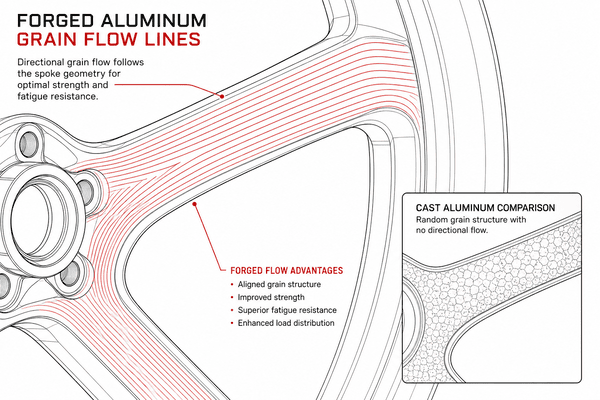
This goes alongside weight. When we produce a one-piece forged wheel, the aluminum billet is compressed under high pressure. This process creates directional flow lines in the metal — sometimes called forging grain or flow lines — that run along the spoke geometry.
You can sometimes see this on a finished wheel at the spoke surface, particularly where the machining hasn’t fully removed the outer layer. It appears as a subtle directional texture, not random, that follows the spoke’s length.
This is not decorative. It is a structural artifact of the production process. Cast wheels do not show this because cast aluminum solidifies in a mold without directional pressure — the grain is random or absent.
What to look for:
- On unmachined or lightly machined spoke surfaces, look for faint parallel lines running along the spoke direction
- Near the barrel-to-spoke junction, forged pieces often show a tighter, more uniform surface texture than cast equivalents
- Replicas made from low-pressure casting will show a uniform, matte texture without directional grain
This check requires some familiarity with forged surfaces. If you haven’t handled genuine forged wheels before, handling a confirmed set first — from a verifiable supplier — gives you a reference point.
Are certification markings on replica wheels real or fake?
This is where most buyers stop asking questions, and where the most expensive mistakes happen. A DOT stamp or TÜV marking on a wheel looks authoritative. It implies testing. It implies approval. But a stamp costs nothing to apply, and replicas carry them routinely.
Certification markings on replica wheels are not verified. DOT, TÜV, and similar markings can be physically stamped or cast onto any wheel regardless of whether the product was actually tested or approved3. The only way to confirm a certification is real is to trace the certification number back to a registered manufacturer in the certifying body’s records. Replicas cannot pass this check.
What real certification traceability looks like
Legitimate forged wheel suppliers maintain documentation that connects individual production runs to certified quality systems. At Tree Wheels, our manufacturing partner holds ISO9001, IATF16949, DOT, and TÜV certifications4 — and we treat those as documents buyers should actively verify, not marketing claims to take at face value.
Here’s what traceable certification looks like in practice:
| Document Type | What It Proves | How to Verify |
|---|---|---|
| DOT marking + DOT number | Compliance with FMVSS 110 or 139 testing | Cross-reference the DOT code against NHTSA records5 |
| TÜV certificate | Third-party structural testing to ECE R124 or equivalent6 | TÜV certificate number is searchable in TÜV’s online registry7 |
| ISO9001 / IATF16949 | Quality management system at the manufacturing facility | Certificate lists the certifying body — contact them directly |
| Test reports | Load testing, impact testing, fatigue testing | Should name the testing facility and include specimen identification |
Ask any supplier claiming forged and certified to provide:
- The full TÜV or DOT certificate, not just the marking on the wheel
- The name of the issuing body and certificate number
- ISO9001 or IATF16949 documentation showing the manufacturing facility address
If a supplier hesitates or provides only photos of the wheel with markings visible, that is not documentation. That is a photo of a stamp.
Why this matters specifically for Hellcat applications
A Hellcat running 707–807 hp (depending on variant)8 puts meaningful rotational stress on wheels, particularly under hard launches and at highway speed. Replica wheels are not load-rated or tested for the Hellcat’s torque output, which creates unquantified risk. A wheel that passes a visual inspection and even a weight check but carries no verifiable load rating has an unknown structural ceiling — and you don’t want to find that ceiling at 100 mph.
This is not a scare claim. It’s a scope-of-knowledge problem. Without test data tied to a real specimen, nobody — including the replica seller — knows how the wheel performs under load. That uncertainty alone should disqualify it from safety-critical applications like this platform.
Does a higher price mean a wheel is genuinely forged?
This assumption costs buyers money in both directions. It leads some to overpay for cast wheels with premium branding. It leads others to dismiss legitimate suppliers offering competitive pricing as "too cheap to be real."
No, price is not a reliable indicator of forged authenticity. Some genuine forged wheel suppliers offer competitive pricing because of direct factory relationships, low MOQ structures, or regional pricing differences. Some premium-priced wheels sold through established retail channels are high-quality cast, not forged. Price reflects market positioning and margin — not production method. Evaluate the production method directly.

Dismantling the price heuristic
The "too cheap to be forged" assumption has a surface logic: forging is more expensive than casting, so forged wheels cost more. That’s true at the process level — but it ignores everything that happens between the factory floor and the buyer.
Factors that lower price without compromising the production method:
- Direct factory relationships. A supplier working directly with a manufacturing partner eliminates distributor margin. We accept orders from 4 wheels up — that MOQ flexibility comes from the factory relationship, not from cutting production corners.
- Regional labor and material cost differences. Forged wheel production in established manufacturing regions operates at lower cost structures than comparable production in North America or Western Europe.
- Targeted market positioning. Some suppliers price competitively to build market share. That is a business decision, not a quality indicator.
Factors that inflate price without improving the production method:
- Brand licensing fees on OEM-replica designs
- Retail channel markups through distributors and dealers
- Marketing spend embedded in the product price
- "Forged appearance" marketing on wheels that use gravity or low-pressure casting
The correct move is to verify the production method through documentation and physical checks — not to use price as a proxy for either.
Frequently Asked Questions
Can I ask the seller to prove a wheel is forged before buying?
Yes — and you should. Ask for the production method documentation, not just a product description. A legitimate forged wheel supplier can provide the manufacturer’s ISO or IATF16949 certification, TÜV or DOT certificates with traceable numbers, and published per-wheel weights. If those documents aren’t available, the "forged" claim is unverified.
Are two-piece and three-piece forged wheels evaluated the same way?
The same principles apply, but the evaluation is slightly more complex. Two-piece and three-piece wheels use forged centers joined to spun or forged outer barrels. Verify the forging claim specifically for the center — that’s the structural component under the most stress. Ask for separate documentation for the center and barrel if the supplier distinguishes them.
What bolt pattern and sizing should I confirm for a Hellcat wheel fitment?
Dodge Challenger and Charger Hellcat models use a 5×115 bolt pattern9. Offset and center bore vary by year and whether you’re running staggered fitment. Always confirm with a qualified technician before ordering. Fitment errors on a high-output platform carry real consequences — this is an area where professional verification matters.
Is a forged wheel automatically safe for a Hellcat?
Not automatically. The wheel must be load-rated for the vehicle’s weight and torque output, and the fitment specs must be correct. A genuine forged wheel from a certified manufacturer is a strong starting point — but installation, torque specs, and application-specific fitment should be evaluated by a qualified technician.
How long does it take to get a genuine custom forged wheel made?
Production time varies by construction. One-piece forged wheels typically take 15–20 days from order confirmation. Two-piece builds run 20–25 days. Three-piece wheels take 30–35 days10. These timelines assume a clear design brief and confirmed specifications. Factor this into project planning, especially for shop orders with client deadlines.
Conclusion
Telling replica wheels from forged wheels on a Hellcat comes down to four checkpoints: measured weight against published specs, visible surface grain from the forging process, load ratings matched to the vehicle’s output, and certification numbers that trace back to verified manufacturer records. Appearance cannot do this job — and price is actively misleading in both directions.
The Hellcat platform deserves forged wheels that are what they claim to be. If you’re evaluating a supplier or an incoming order, use these criteria as your framework. At Tree Wheels, we’re happy to share our certification documentation and walk through production details with any buyer who asks — because that’s exactly what a legitimate supplier should do. Reach out if you want to talk through a specific fitment or order.
-
"What Testing Standards Do Quality Forged Wheels Meet?", https://treewheels.com/what-testing-standards-do-quality-forged-wheels-meet/. Research on manufacturing technology diffusion documents a sustained decline in the cost of CNC machining centers over the past two decades, attributed to increased competition among machine tool producers and advances in control system software, lowering barriers to entry for precision surface finishing. Evidence role: historical_context; source type: research. Supports: The reduction in capital costs for CNC machining equipment over time and its effect on accessibility for smaller or lower-volume manufacturers. Scope note: General CNC cost trend data may not be specific to the wheel manufacturing sector; the connection to replica wheel production quality is inferential rather than directly documented. ↩
-
"Prediction of Grain Structure and Texture in Twin-Roll Cast …", https://pmc.ncbi.nlm.nih.gov/articles/PMC11901212/. Materials science literature describes how plastic deformation during forging aligns the grain structure of aluminum alloys along the direction of metal flow, producing anisotropic mechanical properties not present in cast components where solidification produces equiaxed or dendritic grain structures. Evidence role: mechanism; source type: education. Supports: The metallurgical process by which compressive forging creates aligned grain flow in aluminum alloys, contrasted with the random grain structure of cast aluminum. ↩
-
"Interpretation ID: 3275yy", https://www.nhtsa.gov/interpretations/3275yy. NHTSA’s self-certification framework for Federal Motor Vehicle Safety Standards requires manufacturers to certify compliance before sale but does not mandate pre-market government inspection; enforcement occurs post-sale through recalls and investigations, a structure that has been identified as a vulnerability for counterfeit safety markings. Evidence role: general_support; source type: government. Supports: That DOT certification markings on automotive wheels are self-certified by manufacturers rather than verified by a government body prior to sale, creating conditions under which non-compliant products may carry the marking. Scope note: Direct government documentation of replica wheel DOT fraud specifically may be limited; the cited mechanism is structural rather than a confirmed enforcement case. ↩
-
"IATF 16949", https://en.wikipedia.org/wiki/IATF_16949. IATF 16949:2016, developed by the International Automotive Task Force, specifies quality management system requirements for automotive production and relevant service part organizations, building on ISO 9001 with additional automotive-specific requirements; certification requires third-party audit by an IATF-recognized certification body and does not itself certify product performance. Evidence role: definition; source type: institution. Supports: The scope and requirements of IATF 16949 and ISO 9001 as quality management system standards applicable to automotive component manufacturers including wheel producers. Scope note: IATF 16949 and ISO 9001 certify quality management processes at a manufacturing facility rather than the structural performance of individual products; their presence indicates systematic quality controls but does not substitute for product-level load testing documentation. ↩
-
"Tire Safety Ratings and Awareness | TireWise", https://www.nhtsa.gov/vehicle-safety/tires. NHTSA administers the DOT identification number system for tires under 49 CFR Part 574, which requires manufacturers to register codes; however, the agency’s public-facing lookup tools are primarily oriented toward tire recall searches rather than real-time manufacturer authentication. Evidence role: mechanism; source type: government. Supports: The process by which DOT identification codes on wheels or tires can be traced through NHTSA’s records or manufacturer registration systems. Scope note: NHTSA’s public database may not provide a straightforward authentication pathway for individual wheel DOT codes; the article’s verification instruction should be tested against the actual scope of available NHTSA tools. ↩
-
"r124e.pdf", https://www.unece.org/fileadmin/DAM/trans/main/wp29/wp29regs/old/r124e.pdf. UNECE Regulation No. 124 (ECE R124) establishes uniform provisions for the approval of wheels for passenger cars, specifying dimensional, load capacity, and dynamic testing requirements including rotary bending fatigue and radial fatigue tests; type approval under this regulation is administered by national authorities and recognized testing bodies including TÜV entities. Evidence role: definition; source type: institution. Supports: The scope and requirements of UNECE Regulation No. 124 as the applicable standard for alloy wheel testing and certification in European and international markets. Scope note: ECE R124 applies primarily to wheels intended for European market type approval; applicability to wheels sold in other markets and the equivalence of alternative national standards should be confirmed for non-European applications. ↩
-
"Certipedia – Certificate Database from TÜV Rheinland", https://www.certipedia.com/. TÜV certification bodies including TÜV Rheinland and TÜV SÜD maintain certificate verification portals that allow third parties to confirm the validity of issued certificates by number; the scope and public accessibility of these tools varies by certification type and issuing entity. Evidence role: mechanism; source type: institution. Supports: Whether TÜV certification numbers for automotive wheels are verifiable through a publicly accessible online registry maintained by TÜV Rheinland, TÜV SÜD, or equivalent bodies. Scope note: Verification portal availability and the specific certificate types covered should be confirmed directly with the relevant TÜV entity, as access procedures may differ between product certification and quality management system certificates. ↩
-
"Daily Drive a 797hp Car?", https://www.drivingline.com/articles/whats-it-like-to-daily-drive-797-horsepower-6-lessons-from-the-2019-dodge-challenger-srt-hellcat-redeye/. Dodge’s official model specifications list the SRT Hellcat at 707 horsepower and the Hellcat Redeye at 797 horsepower, with the Super Stock variant rated at 807 horsepower, figures confirmed in manufacturer press materials and EPA certification documents. Evidence role: general_support; source type: other. Supports: The factory-rated horsepower output of Dodge Hellcat variants, including the standard SRT Hellcat and higher-output Redeye configurations. Scope note: Horsepower ratings vary by model year and trim; the cited range should be verified against the specific production year under evaluation. ↩
-
"The WILDEST Hellcat Wheel Setup You Can Actually Drive", https://www.threepiece.us/blog/the-wildest-hellcat-wheel-setup-you-can-actually-drive/?srsltid=AYCX9vKRWP3HHgEk5OSVeP_MghJEng5j7juIsPqonTqCADp_L_W6qkYI. Dodge’s published vehicle specifications and OEM wheel fitment data confirm a 5×115 mm bolt pattern for Challenger and Charger SRT Hellcat models, consistent with the broader Chrysler LX and LC platform wheel interface standard. Evidence role: general_support; source type: other. Supports: The OEM bolt pattern specification for Dodge Challenger and Charger Hellcat models. Scope note: Fitment specifications including center bore and offset vary by model year and trim level; this figure should be verified against the specific vehicle year before ordering. ↩
-
"How Long Does It Take to Manufacture Custom Forged …", https://treewheels.com/how-long-does-it-take-to-manufacture-custom-forged-wheels/. Industry sources and manufacturer documentation for custom forged wheel production indicate lead times that vary substantially by construction complexity, with one-piece forged wheels generally requiring shorter production cycles than multi-piece assemblies that involve additional machining, barrel spinning, and assembly steps. Evidence role: general_support; source type: other. Supports: Typical production lead times for custom forged wheels by construction type in the aftermarket wheel manufacturing industry. Scope note: Lead times are supplier-specific and depend on order volume, design complexity, and current production capacity; the figures cited in the article reflect one supplier’s stated timelines and may not represent industry-wide norms. ↩