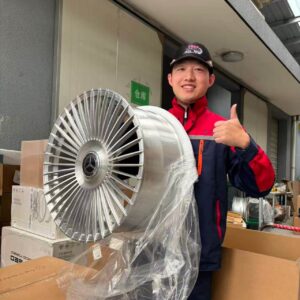

I still remember a conversation I had with a shop owner in the US. He bought a set of "forged" wheels from an online supplier. The price was right, the photos looked great, and the supplier said all the right things. Three months later, one of the wheels cracked under normal driving conditions. When he went back asking for documentation — a test report, a material spec, anything — the supplier went silent. He had nothing. No warranty document, no cert, no report. Just an invoice. That experience stuck with me, because it showed me that without proper documentation, even a $2,000 set of wheels is just a gamble.
Premium forged wheels should come with at least four core documents: manufacturer certifications, a warranty document, a material and process report, and a third-party test report. Each one serves a different purpose, and together they prove that what you are buying is what you are being told it is.
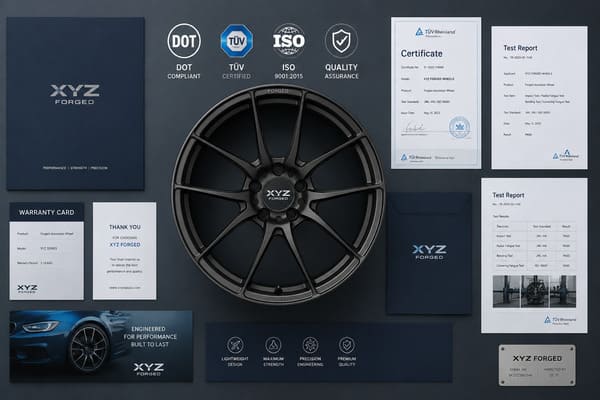
At Tree Wheels, documentation is not optional. It is part of what we sell. In this article, I want to walk through each document type, explain what it should contain, and show you how to tell the real ones from the fake ones.
What Certifications Should a Forged Wheel Manufacturer Provide?
Early in my career, I visited a supplier who had DOT, TÜV, and ISO logos printed across every page of their catalog. It looked impressive. But when I asked to see the actual certificates — the ones with the certificate number, the issuing body, the issue date, and the expiry date — they could only produce one. The other two logos were copied from somewhere else.
A legitimate forged wheel manufacturer should provide verifiable certifications including DOT (for the US market), TÜV (for European markets), ISO9001, and IATF16949. Each certificate should show a certificate number, an issuing body, an issue date, and an expiry date — not just a logo.
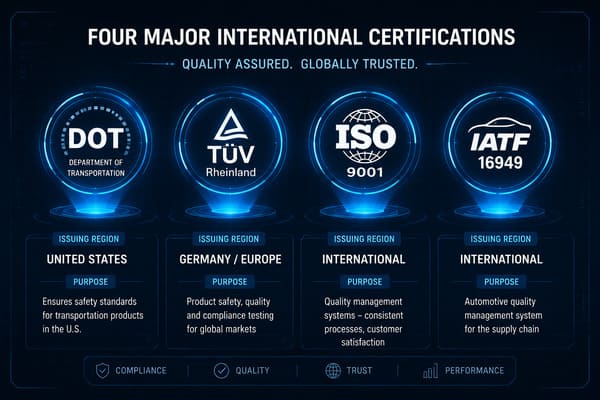
That moment taught me something I now tell every buyer: a logo on a website costs nothing to put there. A real certification costs time, money, and repeated audits to maintain. Here is what each certification actually means, and why it matters.
What Each Certification Covers
| Certification | Issuing Region | What It Means |
|---|---|---|
| DOT | United States | Meets US Federal Motor Vehicle Safety Standards for road use |
| TÜV | Europe | Independently tested and approved for safety by a German technical authority |
| ISO9001 | Global | Quality management system meets international standards |
| IATF16949 | Global (Automotive) | Quality system built specifically for automotive-grade production |
DOT is the baseline for wheels sold in the US market. Without it, a wheel is not legally approved for road use in the United States.1 TÜV carries serious weight in Europe and is recognized internationally as a mark of independent safety verification2. ISO9001 tells you the factory has a documented quality management system in place3. IATF16949 goes further — it is designed specifically for automotive production environments and requires much stricter controls than general manufacturing standards4.
The key thing to check is whether the certificates are current and traceable. Ask the supplier to send you the full certificate document, not a photo of a logo. A real certificate will have a unique certificate number that you can verify directly with the issuing body5. At Tree Wheels, we hold all four of these certifications, and we make the actual documents available to any buyer who asks.
Does a Quality Forged Wheel Come with a Warranty Document?
I once spoke with a buyer who told me his previous supplier offered a "lifetime warranty." He was thrilled — until something went wrong and he read the fine print. The warranty excluded road damage, cosmetic issues, improper installation, and "misuse" — which the supplier defined so broadly that almost nothing was actually covered. In practice, it was a zero-warranty warranty.
A genuine forged wheel warranty document should clearly state what is covered, what is not covered, the warranty period, and the exact steps to make a claim. A warranty that does not answer these four questions is not a real warranty.
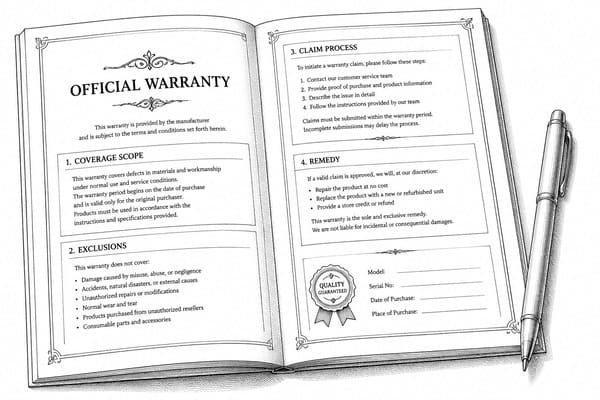
A warranty document is only as good as what it commits to in writing. Here is how to read one properly and spot the ones that are written to protect the seller, not the buyer.
How to Read a Forged Wheel Warranty
| What to Check | What a Good Warranty Says | What a Bad Warranty Says |
|---|---|---|
| Coverage scope | Covers manufacturing defects in materials and workmanship | Covers "product quality issues" with no definition |
| Exclusions | Lists specific exclusions clearly | Includes broad terms like "misuse" or "improper conditions" with no definition |
| Warranty period | States a fixed period (e.g., 1 year from delivery) | Says "lifetime" without defining what that means |
| Claim process | Gives a clear step-by-step process for filing a claim | Says "contact us" with no further detail |
| Remedy | States whether the remedy is replacement, repair, or refund | Leaves the remedy up to the seller’s discretion |
The most important thing to look for is specificity. Vague language in a warranty is almost always there to give the supplier a way out. If a warranty says it covers "quality issues" without defining what that means, the supplier can reject almost any claim by arguing the issue falls outside their interpretation. At Tree Wheels, we offer a 1-year warranty that covers replacement or repair for manufacturing defects. It is written in plain language. We believe a warranty should protect the buyer, not protect us from ever having to honor it.
What Is a Material and Process Report, and Why Does It Matter for Forged Wheels?
Here is something most buyers do not know: not every wheel sold as "forged" is actually fully forged. Some manufacturers use flow forming, or even low-pressure casting with a forged label6, because the end product can look similar to an untrained eye. The price looks similar too — at first.
A material and process report documents the aluminum alloy used, the forging pressure applied, the heat treatment process, and the final mechanical properties of the wheel. It is the document that proves a forged wheel is genuinely forged and not a lower-grade alternative.
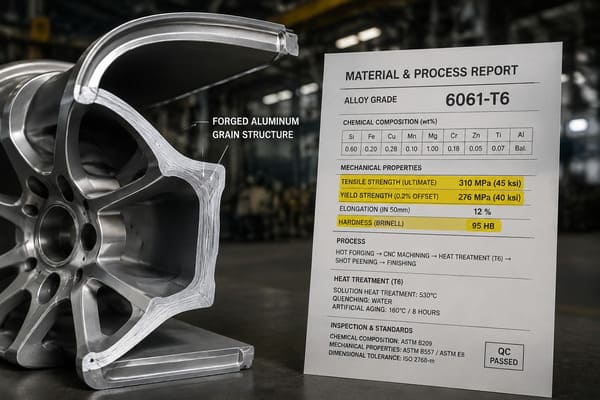
Our manufacturing partner has been producing forged wheels for over 20 years. When I first went through their production records, I was looking at forging pressure data, T6 heat treatment logs, and dimensional inspection sheets for every batch. That level of documentation is what separates a real forged wheel operation from one that is just using the word "forged" as a marketing term.
What a Material and Process Report Should Include
| Data Point | Why It Matters |
|---|---|
| Aluminum alloy grade (e.g., 6061-T6 or 7075) | Different alloys have very different strength and weight properties |
| Forging pressure data | Confirms the material was shaped under high pressure, not cast |
| Heat treatment process (e.g., T6 temper) | T6 treatment significantly increases tensile strength and hardness7 |
| Tensile strength (MPa) | Measures how much pulling force the wheel can resist before breaking |
| Hardness (HB or HRB) | Measures resistance to surface deformation under load |
| Dimensional inspection records | Confirms the finished wheel matches the design specification |
The alloy grade matters a great deal. 6061-T6 is the most common choice for forged wheels in everyday performance and luxury applications. 7075 is used in higher-stress applications like motorsport because it has greater tensile strength8. A material report that does not specify the alloy grade is telling you nothing useful. If a supplier cannot provide this document, you have no way to verify what the wheel is actually made of — and no way to hold them accountable if something goes wrong.
What Should a Forged Wheel Test Report Include?
A real test report has numbers in it. That sounds obvious, but you would be surprised how many "test reports" I have seen that just say "PASS" next to a list of test names, with no actual data. I have seen reports that list five test categories and provide nothing but a checkmark. That is not a test report. That is a marketing document dressed up to look like one.
A proper forged wheel test report should include the specific test standards used (such as JWL or SAE J328), the load and cycle values applied in each test, the actual measured results, the test date, and the name of the independent testing laboratory that conducted the tests.
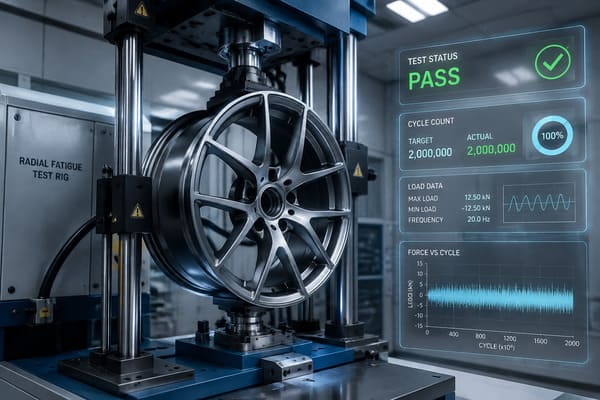
For context, a standard radial fatigue test for a passenger car wheel runs at a minimum of 500,000 cycles under a defined load9. If a report does not tell you how many cycles were run or what load was applied, it is not giving you real information. Here is what each key test covers and what the data should look like.
Core Tests in a Forged Wheel Test Report
| Test Type | Standard Referenced | What the Data Should Show |
|---|---|---|
| Radial fatigue test | JWL, SAE J328 | Number of cycles completed (minimum 500,000), load applied in kg or N |
| Cornering fatigue test | JWL, SAE J328 | Bending moment applied, number of cycles without failure |
| Impact test | JWL, SAE J1981 | Drop height, drop weight, pass/fail with no crack criteria |
| Dynamic balance test | ISO 1940 | Residual imbalance value in gram-millimeters |
| Dimensional inspection | Per design drawing | Actual measured values vs. specified tolerances |
The testing laboratory matters too. An internal test conducted by the manufacturer tells you less than a test conducted by an independent third-party lab. At Tree Wheels, we can provide full test reports with actual data — not just a stamp that says we passed. If a supplier cannot show you real numbers, ask yourself what they are hiding.
Conclusion
Proper documentation is what separates a trustworthy forged wheel supplier from one that disappears when something goes wrong. Ask for the certifications, the warranty, the material report, and the test data — every time. At Tree Wheels, we build every order on sincerity and transparency, because that is the only foundation worth building on.
-
"Interpretation ID: 86-1.39", https://www.nhtsa.gov/interpretations/86-139. Under the National Traffic and Motor Vehicle Safety Act, the National Highway Traffic Safety Administration (NHTSA) administers Federal Motor Vehicle Safety Standards (FMVSS), including standards governing wheel performance and labeling requirements for vehicles sold in the United States. Evidence role: definition; source type: government. Supports: That wheels sold for road use in the US must comply with federal motor vehicle safety standards administered by NHTSA. Scope note: Specific FMVSS provisions governing aftermarket wheels may differ from OEM requirements; the source should be checked for applicability to aftermarket wheel sales. ↩
-
"TUV Rheinland of North America, Inc.: Grant of Expansion …", https://www.federalregister.gov/documents/2026/03/11/2026-04721/tuv-rheinland-of-north-america-inc-grant-of-expansion-of-recognition. TÜV organizations, originating in Germany, operate as independent technical service providers conducting safety testing and certification across automotive and industrial sectors, with recognition in multiple regulatory frameworks including EU type-approval processes. Evidence role: general_support; source type: institution. Supports: That TÜV is an independent technical inspection organization with internationally recognized authority in safety testing and certification. Scope note: TÜV recognition varies by jurisdiction; the source should clarify which specific TÜV entity and regulatory framework applies to aftermarket wheel approval. ↩
-
"ISO 9000 family – Wikipedia", https://en.wikipedia.org/wiki/ISO_9000_family. ISO 9001, published by the International Organization for Standardization, specifies requirements for quality management systems applicable to any organization seeking to demonstrate consistent product and service quality and to enhance customer satisfaction through effective system application. Evidence role: definition; source type: institution. Supports: That ISO 9001 specifies requirements for a quality management system that organizations use to demonstrate the ability to consistently provide products meeting customer and regulatory requirements. Scope note: ISO 9001 certification confirms a quality management system is in place but does not itself certify product performance or safety; this distinction is relevant context the article does not explicitly state. ↩
-
"IATF 16949", https://en.wikipedia.org/wiki/IATF_16949. IATF 16949:2016, published by the International Automotive Task Force, specifies quality management system requirements for automotive production and relevant service part organizations, building upon ISO 9001 with additional automotive-specific requirements. Evidence role: definition; source type: institution. Supports: That IATF 16949 is an automotive-specific quality management system standard developed by the International Automotive Task Force, incorporating and extending ISO 9001 requirements. Scope note: The claim of ‘stricter controls’ is qualitative; a source should confirm specific requirements that exceed ISO 9001 scope rather than relying solely on the article’s assertion. ↩
-
"What Testing Standards Do Quality Forged Wheels Meet?", https://treewheels.com/what-testing-standards-do-quality-forged-wheels-meet/. Accreditation bodies such as the International Accreditation Forum (IAF) maintain databases of accredited certification bodies, and many certification organizations provide online certificate verification tools allowing users to confirm the authenticity and current status of issued certificates. Evidence role: general_support; source type: institution. Supports: That accredited certification bodies maintain publicly accessible registries allowing verification of certificate numbers, scope, and validity. Scope note: Verification processes differ between certification bodies and regions; not all certifiers offer real-time public lookup, and database completeness may vary. ↩
-
"What Is a Forged Wheel and How Does It Differ from Cast Wheels?", https://treewheels.com/what-is-a-forged-wheel-and-how-does-it-differ-from-cast-wheels/. Forging, flow forming, and low-pressure casting are distinct wheel manufacturing processes: forging uses compressive dies to shape solid aluminum billet, producing higher grain density; flow forming spins and thins a cast preform; low-pressure casting introduces molten aluminum into a mold under pressure, yielding different microstructural properties. Evidence role: historical_context; source type: research. Supports: That forging, flow forming, and low-pressure casting are distinct manufacturing processes with different material properties, and that distinguishing them requires process documentation. Scope note: The article’s claim of deliberate mislabeling is not directly supported by this process-comparison framing; a regulatory or consumer protection source would be needed to substantiate the mislabeling claim specifically. ↩
-
"Effect of Heat Treatment Process and Optimization of Its Parameters on …", https://pmc.ncbi.nlm.nih.gov/articles/PMC8125652/. T6 temper in aluminum alloys involves solution heat treatment followed by artificial aging, a precipitation-hardening process that increases tensile strength and hardness by forming fine precipitate phases that impede dislocation movement within the alloy matrix. Evidence role: mechanism; source type: education. Supports: That T6 temper, achieved through solution heat treatment and artificial aging, substantially increases the tensile strength and hardness of aluminum alloys such as 6061. Scope note: The magnitude of improvement varies by alloy composition; the source should specify results for the alloy grades discussed (6061, 7075) rather than aluminum alloys in general. ↩
-
"[PDF] 19720022809.pdf – NASA Technical Reports Server", https://ntrs.nasa.gov/api/citations/19720022809/downloads/19720022809.pdf. 7075 aluminum alloy, with a typical ultimate tensile strength of approximately 500–570 MPa in T6 temper, significantly exceeds the approximately 290–310 MPa tensile strength of 6061-T6, accounting for its use in aerospace and high-load structural components. Evidence role: mechanism; source type: encyclopedia. Supports: That 7075 aluminum alloy exhibits higher tensile strength than 6061-T6, making it suitable for higher-stress structural applications. Scope note: Exact values depend on temper condition, form, and testing method; a materials engineering database or ASM handbook would provide more precise comparative data than an encyclopedia entry. ↩
-
"(PDF) Radial Fatigue Analysis of Automotive Wheel Rim(ISO 3006)", https://www.academia.edu/90209625/Radial_Fatigue_Analysis_of_Automotive_Wheel_Rim_ISO_3006_. The Japanese Light Alloy Wheel (JWL) standard and SAE J328 define test procedures for radial fatigue of passenger car wheels, including specified load values and minimum cycle thresholds that wheels must complete without failure. Evidence role: definition; source type: research. Supports: That JWL and SAE J328 specify minimum cycle counts and load parameters for radial fatigue testing of passenger car wheels. Scope note: Exact cycle minimums may vary by wheel size, load rating, and standard version; the cited figure of 500,000 cycles should be verified against the current edition of the applicable standard. ↩