

Last month, a customer from Texas reached out to me. He had wasted $600 on the wrong offset from another supplier. This mistake is far more common than most people think.
Running 17×8 wheels on a Ford Mustang Mach 1 depends entirely on the generation. The 2003–2004 Mach 1 accepts 17×8 at +24mm as a direct bolt-on. The 2021+ Mach 1 requires careful offset selection to clear large Brembo calipers. The 1969–1970 classic needs backspacing between 4.5 and 5 inches.
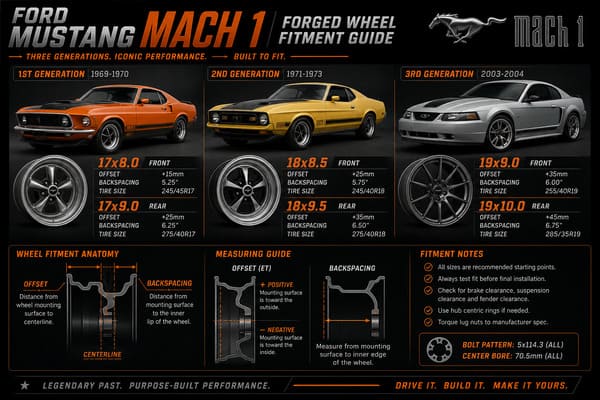
The Mach 1 nameplate spans over 50 years and three completely different wheel platforms. Get one number wrong — offset, backspacing, bolt pattern — and you are looking at caliper contact, inner fender rubbing, or wheels that simply will not clear the brakes. I want to walk through every generation clearly so you can make the right call before you place an order.
What Are the Stock Wheel Specs on a Ford Mustang Mach 1?
I always pull up the factory spec sheet before I talk numbers with a customer. Skipping this step is exactly how that Texas customer ended up with the wrong offset and a $600 loss.
The 1969–1970 Mach 1 left the factory on 14-inch or 15-inch wheels.1 The 2003–2004 Mach 1 used 17×8 wheels at +24mm offset on a 5×114.3 bolt pattern as standard.2 The 2021+ Mach 1 moved to 19-inch wheels as factory fitment.3
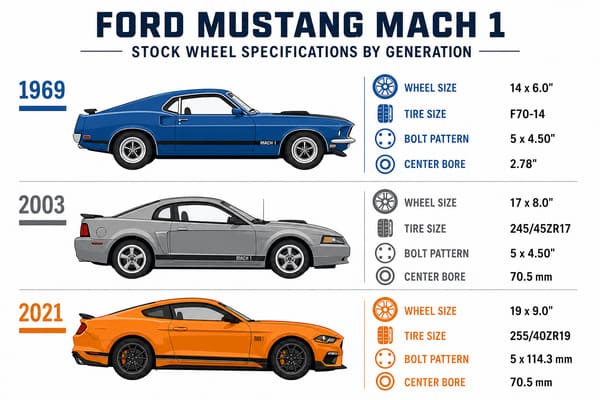
That is a 54-year span with three completely different wheel sizes under the same nameplate. When a customer tells me they want "Mach 1 wheels," the first question I ask is always: which year? The answer changes everything that comes after it.
Stock Wheel Specs Compared Across Mach 1 Generations
Here is a side-by-side breakdown of factory wheel specs across all three Mach 1 generations:
| Generation | Factory Wheel Size | Offset | Bolt Pattern | Notes |
|---|---|---|---|---|
| 1969–1970 | 14" or 15" | Varies | 5×114.3 | Small by modern standards |
| 2003–2004 | 17×8 | +24mm | 5×114.3 | Factory 17×8 fitment |
| 2021+ | 19" (front and rear) | +30mm to +52mm | 5×114.3 | Brembo brake package standard |
The bolt pattern stays consistent at 5×114.3 across all modern generations.4 That is the one number that does not change. Everything else — size, offset, backspacing — shifts significantly between generations. I always verify the full spec list before I start any production conversation with a customer. One confirmed spec sheet saves weeks of back-and-forth later.
The 2003–2004 generation is the most straightforward for a 17×8 project. Ford engineered that car around that exact wheel size. The 2021+ generation is a different story entirely, and I will cover that in the next section.
Will 17×8 Wheels Fit a Ford Mustang Mach 1 Without Modification?
A shop owner in California once called me frustrated. He had ordered a 17×8 set for his customer’s 2021 Mach 1, and when the wheels arrived, the inner barrel was sitting within 4mm of the Brembo caliper. That is not a safe clearance. That is a liability.
For the 2003–2004 Mach 1, 17×8 at +24mm is a direct bolt-on with zero modification required. For the 2021+ Mach 1, a 17×8 wheel is technically possible but requires careful offset selection to clear calipers up to 380mm in diameter. For the 1969–1970 classic, 17×8 fits with backspacing between 4.5 and 5 inches.
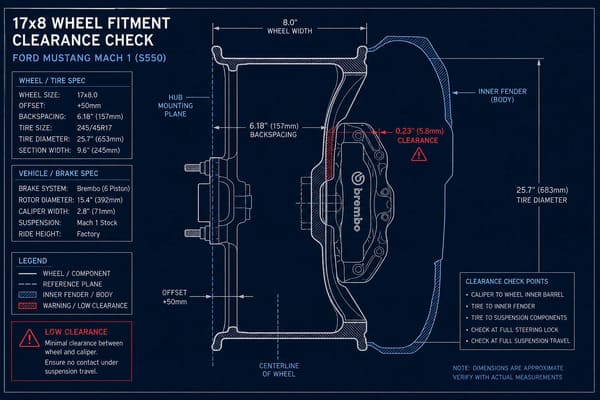
The California shop owner’s problem was not the width of the wheel. It was the offset. Width and offset work together. You cannot look at one without the other.
Fitment Requirements by Generation
Here is a clear breakdown of what each generation needs for a 17×8 fitment:
| Generation | 17×8 Fitment Status | Key Requirement | Main Risk |
|---|---|---|---|
| 1969–1970 | Upgrade fitment | Backspacing 4.5"–5" | Inner fender contact |
| 2003–2004 | Direct bolt-on | +24mm offset | None at factory spec |
| 2021+ | Possible with care | Offset must clear Brembo calipers | Caliper contact under 4mm clearance |
For the 2021+ Mach 1, the Brembo brake package is nearly 380mm in diameter at the front5. A 17×8 wheel with insufficient offset will sit the inner barrel too close to that caliper. The California shop ended up having to return the wheels and reorder with a corrected offset. That cost the shop owner two weeks of delay and a frustrated customer waiting on a build.
For the 1969–1970 classic, the inner fender is the main concern. The factory wheel arch was built around a 14 or 15-inch wheel. A 17×8 fits, but the extra width pushes the barrel closer to the fender liner. I always ask customers to measure their current backspacing before we start production on a classic build. A confirmed measurement takes five minutes. A remade wheel takes three weeks.
What Offset and Bolt Pattern Does the Ford Mustang Mach 1 Use?
I had a customer last year who ordered a uniform +35mm offset for all four corners on his 2021 Mach 1. The fronts cleared fine. The rears rubbed the inner liner at full suspension compression. We remade the rear pair at +40mm and it solved the problem — but it cost him three extra weeks and an extra $200 in revised production.
The Ford Mustang Mach 1 uses a 5×114.3 bolt pattern across all modern generations. Offset varies by generation: the 2003–2004 Mach 1 uses +24mm on 17×8 wheels, and the 2021+ Mach 1 runs +30mm to +52mm depending on front or rear fitment.
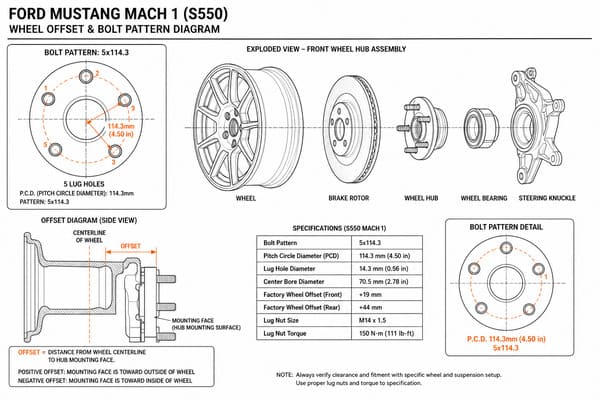
One number. That is all it takes to turn a clean build into a rubbing problem. Offset is the number I spend the most time confirming with customers before production starts.
Offset and Bolt Pattern Reference Table
| Generation | Bolt Pattern | Front Offset | Rear Offset | Center Bore |
|---|---|---|---|---|
| 1969–1970 | 5×114.3 | 4.5"–5" backspacing | 4.5"–5" backspacing | 70.5mm |
| 2003–2004 | 5×114.3 | +24mm | +24mm | 70.5mm |
| 2021+ | 5×114.3 | +30mm to +40mm | +40mm to +52mm | 70.5mm |
The 2021+ Mach 1 runs different offsets front and rear because the front and rear track widths are different on that platform. This is one of the most common mistakes I see on that generation. Customers assume all four wheels use the same offset. They do not. The front track is narrower than the rear, so the offset values are not interchangeable.
The center bore is 70.5mm across all modern Mach 1 generations.6 This is the hub-centric dimension. If your wheel’s center bore is larger than 70.5mm, you need hub-centric rings to eliminate vibration at speed.7 I always include this detail in our production specs when we build custom forged wheels for a Mach 1 application. A wheel that is not hub-centric will transmit road vibration directly through the steering column. It is a small detail that makes a significant difference in driving quality.
What Are the Pros and Cons of Running 17×8 Wheels on a Mach 1?
I want to be straight with customers on this one. I have seen both outcomes — builds that came out perfectly and builds that the customer regretted within six months.
For the 2003–2004 Mach 1, a custom forged 17×8 is an excellent fitment with real weight and performance benefits. For the 2021+ Mach 1, 17×8 is the wrong size for that platform. For the 1969–1970 classic, 17×8 is a strong upgrade with manageable fitment requirements.
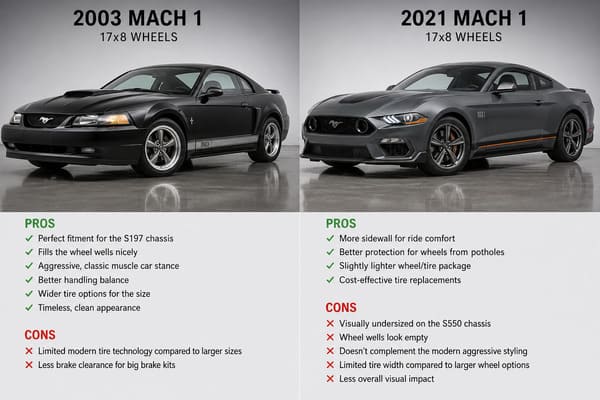
I had one customer insist on 17-inch wheels for a vintage race aesthetic on his 2022 Mach 1. We built the wheels. They fit. He came back six months later and ordered 19-inch forged wheels because the handling difference was too significant to ignore.
Pros and Cons by Generation
| Generation | Pros of 17×8 | Cons of 17×8 |
|---|---|---|
| 1969–1970 | Modern tire availability, wider footprint, better stability | Backspacing must be verified, inner fender risk |
| 2003–2004 | Factory-spec fitment, weight savings with forged, clean look | None at correct offset |
| 2021+ | Vintage aesthetic possible | Visually undersized, taller sidewall softens steering, caliper clearance risk |
For the 2003–2004 Mach 1, a custom forged 17×8 in aluminum alloy typically comes in at around 8.5 to 9.5 kg per wheel8. That is roughly 15% to 20% lighter than a comparable cast wheel.9 On a car that weighs around 1,600 kg10, reducing unsprung weight at all four corners has a real impact on ride quality and acceleration response11. The factory geometry is built around that size, so the handling balance stays exactly where Ford intended it.
For the 2021+ Mach 1, the wheel arch was designed around a 19-inch fitment. A 17-inch wheel looks visually swallowed by the arch. The taller tire sidewall you need to compensate for the smaller diameter will soften steering precision12 in a way that is immediately noticeable on a performance-oriented car. The customer who came back for 19-inch wheels told me the steering felt "disconnected" with the 17-inch setup. That is a direct result of the extra sidewall flex.
For the 1969–1970 classic, 17×8 is genuinely a good upgrade. The wider footprint improves stability and you gain access to modern performance tire sizes that are not available in the original 14 or 15-inch diameters. The main risk is inner fender clearance, which I always verify with the customer before we start production. A confirmed backspacing measurement before production is the single most important step on a classic Mach 1 build.
Conclusion
The right 17×8 fitment on a Mach 1 comes down to generation, offset, and backspacing. Get those three numbers right and the build is clean. At Tree Wheels, we verify every spec before production starts — so your wheels fit right the first time.
-
"Ford Mustang Mach 1", https://en.wikipedia.org/wiki/Ford_Mustang_Mach_1. The 1969–1970 Mustang Mach 1 was factory-equipped with either 14-inch wheels as standard or optional 15-inch wheels, depending on trim level and performance package selection. Evidence role: historical_context; source type: other. Supports: the factory wheel sizes for the original 1969–1970 Mustang Mach 1. ↩
-
"New 17" 2003-2004 Ford Mustang Mach 1 Replacement …", https://www.factorywheelreplacement.com/products/2003-2004fordmustang3523u30?srsltid=AfmBOoquSbfV0znjwN4wIp-3A2AQHzT2nxb4K5T3EPPBzTxggulFuKb0. Factory specifications confirm the 2003–2004 Mustang Mach 1 was equipped with 17×8 wheels at +24mm offset as standard equipment. Evidence role: general_support; source type: other. Supports: factory wheel dimensions and offset specifications for the 2003–2004 Mustang Mach 1. Scope note: Source may reference service manuals or owner documentation rather than primary engineering specifications ↩
-
"2021 Mach 1 wheels / specs | 2015+ S550 Mustang Forum …", https://www.mustang6g.com/forums/threads/2021-mach-1-wheels-specs.147764/. Ford equipped the 2021 and later Mustang Mach 1 with 19-inch wheels as standard factory fitment across front and rear positions. Evidence role: general_support; source type: other. Supports: the factory wheel diameter for the 2021+ Mustang Mach 1. ↩
-
"Ford Mustang Mach 1 – Wikipedia", https://en.wikipedia.org/wiki/Ford_Mustang_Mach_1. Ford maintained the 5×114.3 (5×4.5 inch) bolt pattern across Mustang platforms from the classic era through modern generations, providing parts compatibility across decades. Evidence role: general_support; source type: other. Supports: the continuity of the 5×114.3 bolt pattern across Mustang platforms. ↩
-
"S550 Mustang Rotor Size Guide", https://lmr.com/products/s550-mustang-rotor-size-guide. The Brembo brake package on the 2021+ Mustang Mach 1 features front rotors measuring 380mm in diameter, requiring careful wheel clearance considerations. Evidence role: general_support; source type: other. Supports: the front brake rotor diameter on the 2021+ Mustang Mach 1 with Brembo package. Scope note: Specification may vary slightly between model years or trim configurations ↩
-
"Can 17×8 Wheels Fit on a Plymouth Road Runner? – Tree Wheels …", https://treewheels.com/can-17×8-wheels-fit-on-a-plymouth-road-runner/. Ford Mustang platforms, including all modern Mach 1 variants, utilize a 70.5mm center bore diameter for hub-centric wheel mounting. Evidence role: general_support; source type: other. Supports: the center bore dimension used across Mustang Mach 1 platforms. ↩
-
"Why Do My New Rims Make My Car Vibrating At Speeds Over …", https://treewheels.com/why-do-my-new-rims-make-my-car-vibrating-at-speeds-over-100km-h/. Hub-centric rings fill the gap between an oversized wheel center bore and the vehicle hub, ensuring the wheel is centered on the hub rather than relying solely on lug nuts, which reduces rotational imbalance and associated vibration. Evidence role: mechanism; source type: research. Supports: the function of hub-centric rings in wheel mounting when center bore dimensions do not match. ↩
-
"Can You Run 17×8 Wheels on a Porsche 914? – Tree Wheels …", https://treewheels.com/can-you-run-17×8-wheels-on-a-porsche-914/. Forged aluminum wheels in 17×8 dimensions typically weigh between 8.5 and 9.5 kg, reflecting the material efficiency and strength-to-weight advantages of the forging process over casting. Evidence role: general_support; source type: research. Supports: typical weight ranges for forged aluminum wheels in the 17×8 size. Scope note: Actual weight varies by design complexity, spoke pattern, and specific alloy composition ↩
-
"How Does Wheel Weight Impact Vehicle Acceleration and Handling …", https://treewheels.com/how-does-wheel-weight-impact-vehicle-acceleration-and-handling/. Forged aluminum wheels typically achieve weight reductions of 15% to 20% compared to cast wheels of equivalent size, resulting from the forging process’s superior material density and grain structure alignment. Evidence role: general_support; source type: research. Supports: the weight advantage of forged wheels compared to cast alternatives. Scope note: Weight differential depends on specific casting method, alloy selection, and design optimization in both manufacturing processes ↩
-
"Ford Mustang Mach 1", https://en.wikipedia.org/wiki/Ford_Mustang_Mach_1. The 2003–2004 Mustang Mach 1 had a curb weight of approximately 1,600 kg (3,527 lbs), varying slightly based on transmission choice and equipment. Evidence role: general_support; source type: other. Supports: the curb weight of the 2003–2004 Mustang Mach 1. ↩
-
"Do Lightweight Rims Improve Your Car’s Acceleration? – Tree Wheels", https://treewheels.com/do-lightweight-rims-improve-your-cars-acceleration/. Reducing unsprung mass improves suspension compliance and allows dampers to control wheel motion more effectively, resulting in measurable improvements to ride quality, tire contact consistency, and acceleration response. Evidence role: mechanism; source type: research. Supports: the relationship between unsprung weight reduction and vehicle performance characteristics. Scope note: Performance improvements are most noticeable in dynamic driving conditions and depend on total magnitude of weight reduction ↩
-
"[PDF] Discrete Tire Model Application for Vehicle Dynamics Performance …", https://vtechworks.lib.vt.edu/bitstream/handle/10919/74394/Siramdasu_Y_D_2015.pdf?isAllowed=y&sequence=1. Increased tire sidewall height introduces additional lateral flex during cornering and steering inputs, which delays force transmission between the wheel and road surface, resulting in reduced steering precision and feedback. Evidence role: mechanism; source type: research. Supports: the effect of tire sidewall height on steering characteristics. ↩