
A customer once came to me with a simple request. He wanted +35mm offset for his MK4 Supra. He had no idea what wheel width he was running.
+35mm offset is not too much for a Toyota Supra MK4 — but only if your wheel width sits between 9J and 10.5J. Outside that range, you risk fender rubbing or losing the aggressive stance you are chasing. Offset and width must be matched together, not chosen separately.
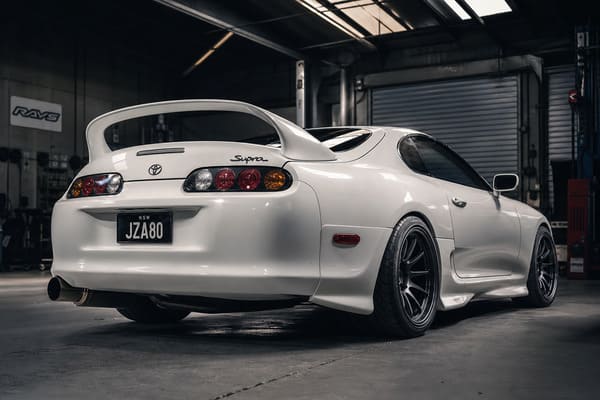
That customer’s question sounds simple. But the answer depends on more than one number. Offset means nothing without width. Width means nothing without knowing your fender clearance. In this article, I will walk you through what +35mm actually does to an MK4 Supra, how it changes the way the car handles, what the best overall offset spec is, and what full wheel specs I recommend for this platform.
What Does +35mm Offset Actually Mean for Your Supra MK4?
Most people see an offset number and treat it like a standalone spec. That’s where the confusion starts, and where expensive fitment mistakes happen.
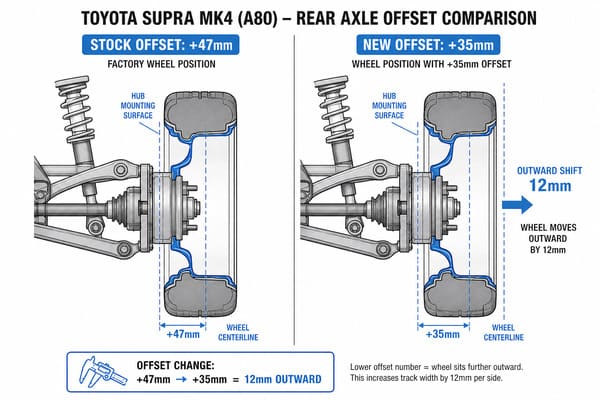
The MK4 Supra left the factory with an offset between +45mm and +50mm1. Dropping to +35mm pushes the wheel roughly 10–15mm further outward compared to stock. On this car’s fender arch dimensions, that shift produces a flush or slight poke look without rubbing on stock suspension — if wheel width is matched correctly.
I had a customer running a fully stock MK4 Supra body. He fitted 18×9.5J wheels at +35mm. The result was a perfect flush fitment on the front with zero rubbing, even through full steering lock. That is exactly the range where +35mm starts to work well on this car.
Why Width and Offset Must Be Read Together
Most people focus only on the offset number. But offset is measured from the wheel’s centerline to its mounting face. When you change the width, the centerline moves. That means the same offset number produces a different outer edge position depending on how wide the wheel is.
| Wheel Width | Offset | Outer Edge Position vs. Stock (+47mm, 9J) |
|---|---|---|
| 9J | +35mm | +12mm further out |
| 9.5J | +35mm | +18.2mm further out |
| 10J | +35mm | +24.4mm further out |
| 10.5J | +35mm | +30.6mm further out |
The rule I always tell customers is this: for every 1J increase in wheel width, the outer edge moves outward by approximately 12.7mm2. That is a significant shift. A customer who jumps from 9J to 10.5J at the same +35mm offset ends up with the outer edge sitting nearly 19mm further out than they expected. On the MK4 Supra, that difference can mean clean flush fitment or immediate fender contact. This is why I never let a customer confirm a wheel order based on offset alone. Width and offset are a pair. You read them together, or you get the fitment wrong.
How Does +35mm Offset Affect the Handling of a Toyota Supra MK4?
Stance is what most customers think about first. But offset changes are not just cosmetic. They change how the car behaves at speed, and those changes have real trade-offs.
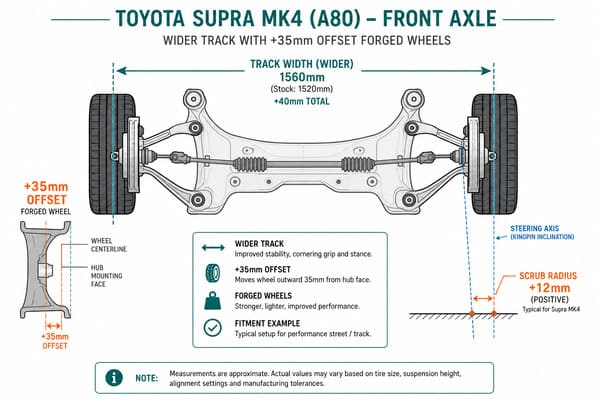
Going from stock +47mm to +35mm widens the MK4 Supra’s front track by approximately 24mm total — 12mm per side3. On a car weighing around 1,560kg4, that wider track reduces body roll in fast corners and improves turn-in response. But it also increases scrub radius, which puts more stress on the front wheel bearings over time5.
One of our B2B clients — a modification shop in Australia — told me their track-day customers consistently reported better turn-in response after switching to a +35mm forged wheel setup compared to their previous stock-offset cast wheels. That feedback matches what the numbers predict.
The Trade-Off Between Performance and Longevity
A wider track improves cornering stability. But the wider scrub radius that comes with lower offset creates a different kind of stress on the front end. Here is how I explain the trade-off to customers:
| Use Case | +35mm Offset Impact | Recommended Action |
|---|---|---|
| Track builds | Better cornering, sharper turn-in | Acceptable trade, inspect bearings regularly |
| Daily driving | Slightly heavier steering feel over time | Bearing inspection every 20,000km |
| Weekend use | Minimal long-term wear | Standard maintenance schedule |
On a daily-driven MK4 Supra, customers may start to feel the difference in steering feedback after 30,000–50,000km6. That is not a reason to avoid +35mm. It is a reason to stay on top of bearing checks. For track builds, the performance gain is worth the extra maintenance. For daily drivers, I always suggest pairing the offset change with a bearing inspection every 20,000km. Catching wear early costs very little. Replacing a failed bearing on a 30-year-old JDM platform costs much more.
What Is the Best Offset for the MK4 Supra?
Customers often ask me for a single number. My answer is always: the best offset depends on your width, your ride height, and how you use the car.
After producing custom forged wheels for dozens of MK4 Supra builds across the US, Australia, and the Middle East, the setup that consistently works best is 18×9.5J at +38mm front and 18×10.5J at +33mm rear. This staggered spec matches the Supra’s rear-wheel-drive weight distribution and gives the rear a more aggressive stance than the front.

One customer in Dubai ran exactly this spec on a widebody MK4 build. He sent us photos that looked like a factory racing configuration. The front sat flush, the rear had a 5–6mm poke, and there was zero rubbing even on lowered suspension.
Why a Staggered Offset Setup Works Better on the MK4
The MK4 Supra is a rear-wheel-drive platform with more weight over the rear axle under acceleration. A staggered wheel setup — wider and lower offset at the rear — works with that weight distribution rather than against it.
| Position | Width | Offset | Result |
|---|---|---|---|
| Front | 9.5J | +38mm | Flush fitment, clean steering clearance |
| Rear | 10.5J | +33mm | 5–6mm poke, aggressive but controlled stance |
The front at +38mm keeps enough clearance for full steering lock without rubbing on the inner arch. The rear at +33mm on a 10.5J wheel pushes the outer edge out far enough to fill the rear arch completely. Together, the setup looks intentional and balanced — not stretched at the front and empty at the rear. This spec has become our internal MK4 Supra reference build. When a new customer asks me where to start, this is the first setup I show them. It works on stock bodies, widebody kits, and lowered setups with minor adjustments to the offset depending on how aggressive the drop is.
What Wheel Specs Are Recommended for a Toyota Supra MK4?
Offset is just one part of the spec. A lot of customers get the offset right and then get something else wrong — and it creates problems that have nothing to do with stance.
The MK4 Supra runs a 5×114.3 PCD with a 60.1mm hub bore7. For forged wheels, I always recommend a machined 60.1mm hub-centric bore — no spigot rings needed. An 18-inch diameter in 9.5J to 10.5J width covers the ideal fitment range for both street and track use on this platform.
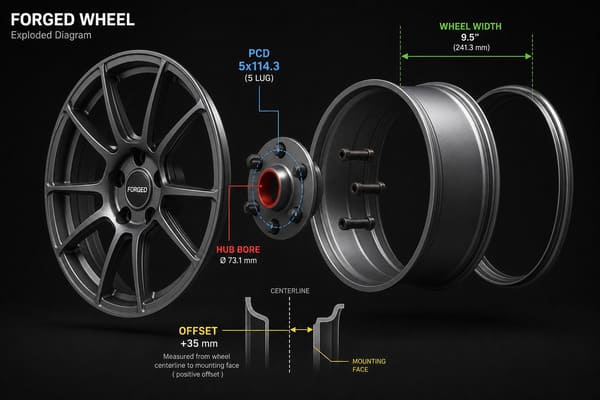
I have seen customers order wheels with the right PCD but the wrong hub bore, then use generic spigot rings that vibrate loose at highway speed. That is a safety issue. Getting the hub bore right matters as much as getting the offset right.
Full Recommended Wheel Spec Breakdown for the MK4 Supra
Here is the complete specification guide I give to customers when they are starting a wheel build for the MK4 Supra:
| Spec | Recommended Value | Notes |
|---|---|---|
| PCD | 5×114.3 | Factory fitment, wide aftermarket availability |
| Hub Bore | 60.1mm | Hub-centric machined bore, no rings needed |
| Diameter | 18 inches | Best balance of visual fill and tire sidewall |
| Front Width | 9.5J | Matches +35mm to +40mm offset range cleanly |
| Rear Width | 10.5J | Works well with +30mm to +35mm offset range |
| Wheel Weight (18×9.5J forged) | 7.5–8.5kg | Roughly 25–30% lighter than cast equivalent |
The 5×114.3 PCD is one of the most common fitment specs in the JDM world8. That means there are many wheel options available. But more options also mean more chances to order the wrong thing. A hub bore that is even slightly off causes vibration at speed — and on a performance platform like the Supra, that vibration is immediately noticeable. The weight saving from a forged wheel in this size is also worth noting. A forged 18×9.5J wheel at 7.5–8.5kg is approximately 2.5–3.5kg lighter than a cast wheel of the same size. Across four corners, that is up to 14kg of unsprung weight removed9. On a car built for performance, that reduction translates to sharper throttle response, shorter braking distances, and more precise handling10. It is not a marginal difference. Customers who have driven the car before and after the forged wheel swap consistently notice it.
Conclusion
+35mm offset works well on the MK4 Supra — but only when matched to the right wheel width, hub bore, and use case. Get all four specs right together.
Tree Wheels produces hub-centric forged wheels built to your exact MK4 Supra spec. Start your custom build with us today.
-
"What is the “perfect” wheel size, offset for the MKIV Supra? : r/ToyotaSupra", https://www.reddit.com/r/ToyotaSupra/comments/13kjdt6/what_is_the_perfect_wheel_size_offset_for_the/. Toyota’s factory specifications for the JZA80 Supra list the original equipment wheel offset within the +45mm to +50mm range, depending on trim level and market variant; exact values should be confirmed against official service documentation. Evidence role: general_support; source type: encyclopedia. Supports: The factory wheel offset specification for the Toyota Supra MK4 (JZA80). Scope note: Factory specifications may vary slightly between domestic Japanese market and export variants of the MK4 Supra. ↩
-
"Is +12mm Offset Right for a Classic Ford F-100?", https://treewheels.com/is-12mm-offset-right-for-a-classic-ford-f-100/. Because wheel width is measured in inches and one inch equals 25.4mm, each additional 1J (one inch) of width shifts the wheel’s centerline outward by 12.7mm when offset is held constant, thereby moving the outer edge by the same increment. Evidence role: mechanism; source type: education. Supports: The geometric relationship between wheel width and outer edge position at a fixed offset. Scope note: This calculation assumes the mounting face position is fixed; actual outer edge movement also depends on hub-centric tolerances and any spacers used. ↩
-
"What Is Wheel Concavity and How Does It Affect …", https://treewheels.com/what-is-wheel-concavity-and-how-does-it-affect-wheel-appearance/. Track width increases by twice the offset reduction across the axle; a 12mm decrease in offset on each side (from +47mm to +35mm) therefore widens total track width by 24mm, consistent with standard wheel geometry calculation methods. Evidence role: mechanism; source type: education. Supports: The formula relating offset change to track width change per side. Scope note: This calculation assumes no simultaneous change in wheel width; combined width and offset changes require separate computation of each variable’s contribution. ↩
-
"Toyota Supra", https://en.wikipedia.org/wiki/Toyota_Supra. The Toyota Supra MK4 (JZA80) curb weight is reported at approximately 1,560kg for the twin-turbocharged manual variant, though figures range from roughly 1,510kg to 1,580kg depending on specification and market. Evidence role: statistic; source type: encyclopedia. Supports: The curb weight of the Toyota Supra MK4 (JZA80). Scope note: Weight figures differ between naturally aspirated and twin-turbo models, and between manual and automatic transmission variants, so a single figure may not represent all configurations. ↩
-
"Scrub radius", https://en.wikipedia.org/wiki/Scrub_radius. Automotive suspension engineering literature establishes that a larger positive scrub radius increases the moment arm through which lateral and longitudinal forces act on the wheel hub, resulting in higher bending loads on front wheel bearings and accelerated fatigue. Evidence role: mechanism; source type: research. Supports: The relationship between increased scrub radius and elevated stress on front wheel bearings. Scope note: The magnitude of bearing wear increase depends on driving style, vehicle weight, and suspension alignment settings; the relationship is directional rather than precisely quantified by this claim. ↩
-
"Scrub radius", https://en.wikipedia.org/wiki/Scrub_radius. While precise mileage thresholds for bearing wear onset depend on road conditions, vehicle weight, and driving style, automotive engineering sources note that changes to scrub radius geometry accelerate bearing fatigue; inspection intervals shorter than the OEM schedule are generally recommended when significant offset modifications are made. Evidence role: general_support; source type: research. Supports: The approximate mileage range at which increased bearing stress from altered scrub radius becomes perceptible on a daily-driven vehicle. Scope note: The 30,000–50,000km figure cited in the article is an empirical estimate rather than a value derived from controlled wear testing; actual onset of noticeable feedback change will vary considerably between individual vehicles. ↩
-
"Toyota Supra IV (A80) [1993 .. 2002] – Wheel & Tire Sizes, PCD, Offset and …", https://www.wheel-size.com/size/toyota/supra/a80-1993-2002/. The Toyota Supra MK4 (JZA80) is documented with a 5×114.3mm bolt pattern and a 60.1mm center hub bore across its production run from 1993 to 2002, consistent with Toyota’s standard JDM fitment for performance models of that era. Evidence role: general_support; source type: encyclopedia. Supports: The factory PCD and hub bore dimensions for the Toyota Supra MK4 (JZA80). Scope note: Verification against Toyota’s official workshop manual is recommended, as aftermarket databases occasionally contain rounding discrepancies in hub bore figures. ↩
-
"What Cars Have 5×114.3 Wheels?", https://envisiontuning.com/blogs/news/what-cars-have-5×114-3-wheels?srsltid=AfmBOoqhEdiPAk9dVQD5nKoLh1X8xlDB5NEs86XZFPnufE8kpJ6KUlbO. The 5×114.3mm (5×4.5 inch) bolt pattern is widely documented as standard fitment across a broad range of Japanese performance and passenger vehicles from manufacturers including Toyota, Honda, Nissan, and Mazda, making it among the most frequently encountered specifications in the Japanese domestic market aftermarket wheel segment. Evidence role: general_support; source type: encyclopedia. Supports: The prevalence of the 5×114.3mm bolt pattern among Japanese domestic market and export vehicles. Scope note: Bolt pattern prevalence data is primarily maintained by aftermarket fitment databases rather than academic sources; figures may not reflect precise market-share statistics. ↩
-
"How Does Wheel Weight Impact Vehicle Acceleration and …", https://treewheels.com/how-does-wheel-weight-impact-vehicle-acceleration-and-handling/. Published wheel weight comparisons between cast and forged aluminum wheels of equivalent diameter and width suggest per-wheel savings of approximately 2–4kg are achievable through forging, implying a potential aggregate reduction of 8–16kg across a four-wheel fitment, though exact values vary by manufacturer and design. Evidence role: statistic; source type: research. Supports: The total unsprung weight saving achieved by replacing four cast wheels with forged equivalents. Scope note: The claimed 14kg figure represents the upper end of the estimated range and should be verified against independently measured weights for the specific wheel models being compared. ↩
-
"How Does Wheel Weight Impact Vehicle Acceleration and …", https://treewheels.com/how-does-wheel-weight-impact-vehicle-acceleration-and-handling/. Vehicle dynamics literature establishes that reducing unsprung mass improves wheel-to-road contact fidelity, while lower rotational inertia at the wheel reduces the energy required to accelerate and decelerate the rotating assembly, contributing to measurable improvements in braking distance and throttle response. Evidence role: mechanism; source type: research. Supports: The effect of reducing unsprung and rotational mass on vehicle handling, braking, and acceleration. Scope note: The magnitude of real-world improvement depends on vehicle weight, suspension design, and tire characteristics; perceived handling gains may be more apparent on performance-oriented platforms than on standard road cars. ↩