
White is clean. But most 4Runner TRD Pro owners feel their truck looks too stock. The wheel is the fastest fix — and the color choice is everything.
The best wheel colors for a white Toyota 4Runner TRD Pro are matte black, satin bronze, and dark graphite. Matte black gives the strongest contrast. Satin bronze adds warmth and a trail-ready character. Dark graphite sits between both. These three colors cover about 90% of what white truck owners actually choose.
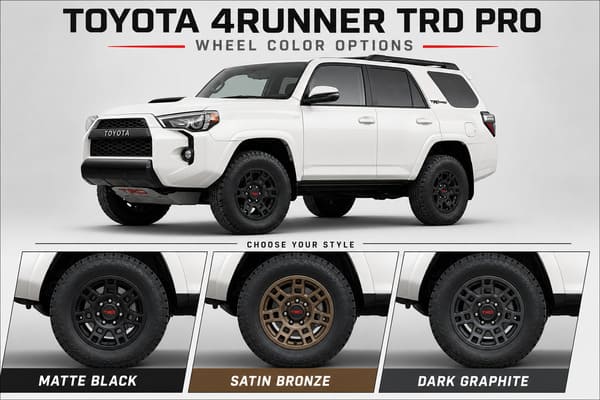
White is the second most popular car color in the world.1 In my experience working with modification shops across the US and Australia, it is also one of the most customized. Out of every 10 white truck owners who contact us about wheels, at least 7 say the same thing: "I just want it to look more aggressive." That tells me everything about why the color decision matters so much. The 4Runner TRD Pro already ships with 17-inch bronze TRD wheels from the factory2 — which is actually a smart default choice. But most owners want to go further than the factory did. The wheel color you choose is really a personality decision. Let me walk you through each option in detail.
What Wheel Colors Actually Look Good on a White 4Runner TRD Pro?
Most people browse Instagram for inspiration but never see the full picture. Real order data tells a more honest story about what actually works on white trucks.
From our order history with white off-road truck clients, matte black accounts for about 55% of builds, satin bronze or gunmetal covers around 25%, dark graphite makes up about 12%, and custom or two-tone finishes fill the remaining 8%3. These numbers reflect what people choose after seeing real renders — not just what they think they want.
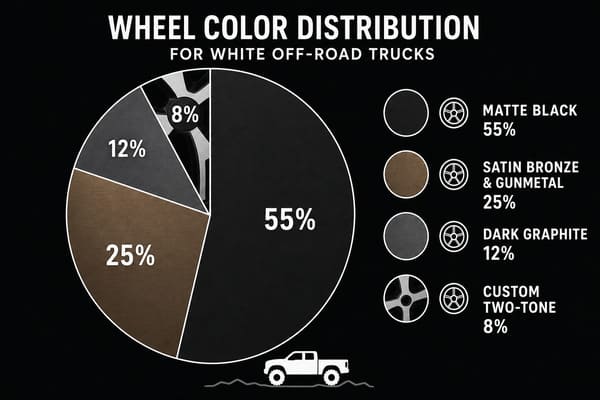
Matte black dominates because it is the safest high-contrast choice. The dark color punches hard against a white body. It is bold without being risky. But some of the best-looking white 4Runners I have seen were not running black at all — they were running satin bronze. One of our clients in Texas ordered a three-piece forged set in satin bronze with a brushed inner barrel. That build is still one I reference when clients ask what "done right" looks like on a white truck.
Why Matte Black Works So Well on White
Matte black works because contrast is the first thing the eye registers.4 On a white truck, a dark wheel creates a frame around each wheel arch. It makes the truck look planted and intentional. The matte finish also hides micro-scratches and light rock chips far better than gloss.5 For a truck that actually leaves pavement, matte is the smarter long-term choice.
Why Satin Bronze Is Underrated
Satin bronze references the factory TRD color but feels more premium and more deliberate. It adds a second color story — something warm and earthy that fits the trail-ready identity of the TRD Pro. It also hides brake dust and light mud better than any black finish. For owners who go off-road regularly, that is a real advantage over 12 months of use.
A Quick Comparison
| Color | Contrast Level | Trail Practicality | Risk Level |
|---|---|---|---|
| Matte Black | High | Very Good | Low |
| Satin Bronze | Medium | Excellent | Low |
| Dark Graphite | Medium-High | Good | Low |
| Custom / Two-Tone | Varies | Varies | Medium–High |
Does Black or Bronze Look Better on a White Toyota 4Runner?
This is the most common question I get from white 4Runner owners. Most people expect a clear winner. The real answer is more useful than that.
Black gives you contrast. Bronze gives you character. On a white truck, black makes the wheels look like they are punched into the body. Bronze adds a warm, earthy second color that works with the trail identity of the TRD Pro. Neither is wrong — they just say different things about the build.
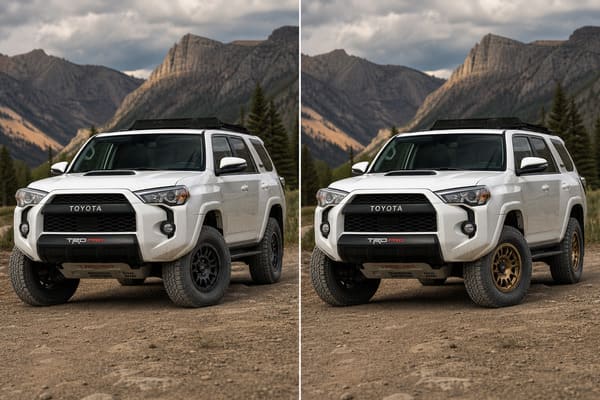
I had a client who could not decide between the two. We made him a side-by-side 3D render — same wheel design, one in matte black, one in satin bronze. He looked at both for two days. He came back and chose bronze, saying: "Black looks like every other modified truck. Bronze looks like mine." That stuck with me. It is still one of the clearest ways I explain the difference to new clients.
What Black Does to a White Truck
Black wheels on white create a hard visual separation. The wheels stand out strongly. The truck looks more aggressive and more uniform at the same time. If the goal is pure aggression with no visual complexity, black is the direct path. It also pairs well with black bumpers, black roof racks, and blacked-out trim — which is a very common build direction for TRD Pro owners.
What Bronze Does to a White Truck
Bronze wheels add depth. They introduce a second color that feels connected to the outdoor, off-road world — dirt, rock, dry grass. This is not accidental. TRD chose bronze from the factory for exactly this reason6. A satin or brushed bronze finish also catches light in a more interesting way than flat black. From certain angles, it reads almost like a metallic earth tone. That warmth makes the whole truck feel more considered.
Practical Differences That Matter
| Factor | Matte Black | Satin Bronze |
|---|---|---|
| Brake Dust Visibility | High | Low |
| Trail Mud Visibility | Medium | Low |
| Scratch Visibility | Low (matte) | Low (satin) |
| Pairs With Black Trim | Yes | Neutral |
| Pairs With Body Lifts | Yes | Yes |
| Unique Factor | Lower | Higher |
Can You Use Bright Colors Like Red or Blue on a White 4Runner TRD Pro?
Bright wheels on a white truck — it sounds bold. But bold is not the same as good. The outcome depends entirely on the rest of the build.
Bright colors like red or blue can work on a white 4Runner TRD Pro, but only when the whole build supports them. Less than 5% of white truck clients in our order history choose genuinely bright colors.7 Those who do usually go through two to three rounds of design renders before approving the final look.
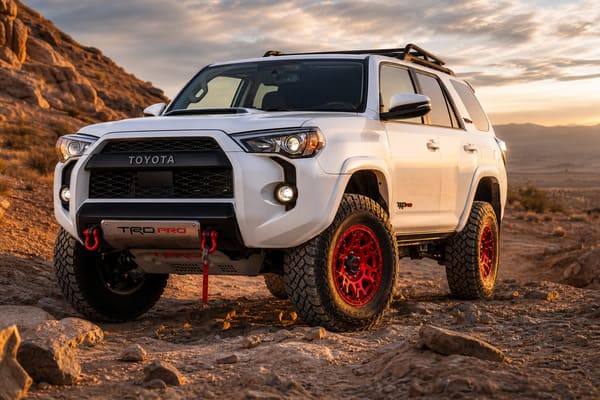
I have seen red wheels on a white 4Runner look completely dialed in. But that truck had a full body lift, matching red recovery straps, and red tow hooks. The color was part of a complete visual language. When a client tries to put red wheels on an otherwise stock white truck, it almost always looks like an afterthought — like one decision made without the rest of the build in mind.
When Bright Colors Actually Work
Bright colors work when they are repeated somewhere else in the build. This does not mean painting every piece of trim the same color. It means anchoring the wheel color to at least one or two other elements — a matching valve stem cap, a painted caliper, a recovery accessory. When the color appears in more than one place, it looks intentional. When it only appears on the wheels, it looks random.
Lower-Risk Alternatives to Full Bright Colors
If you want something bolder than black or bronze but less risky than red or blue, there are middle-ground options that work well on white trucks. These are non-standard colors that still feel controlled.
| Color Option | Risk Level | Character |
|---|---|---|
| Burnt Orange | Low–Medium | Earthy, trail-ready |
| Deep Army Green | Low | Rugged, understated |
| Dark Purple Pearl | Medium | Unique, still controlled |
| Candy Red | High | Bold, needs full commitment |
| Gloss Blue | High | Sporty, hard to match |
These options add personality without fighting the white base color. They are also significantly easier to build a full visual story around than pure primary colors.
What the Design Process Looks Like for Bright Colors
Clients who choose bright colors almost always spend more time in the design consultation phase. We typically produce two to three rounds of 3D renders before they commit. That longer process is a signal — bright colors require more planning and more confidence in the overall build direction. If a client is not ready to commit time to that process, I always recommend pulling back to satin bronze or a dark graphite instead.
What Finish Type Works Best for White Off-Road Trucks?
The color gets all the attention. But the finish is what determines how your wheels look after 12 months of real use — not just on the day they arrive.
For white off-road trucks, matte and satin finishes perform best over time. They hide micro-scratches and rock chips without looking neglected. Brushed finishes with a color window add visual depth. Full gloss finishes show every scratch and should be avoided on any truck that leaves pavement regularly.
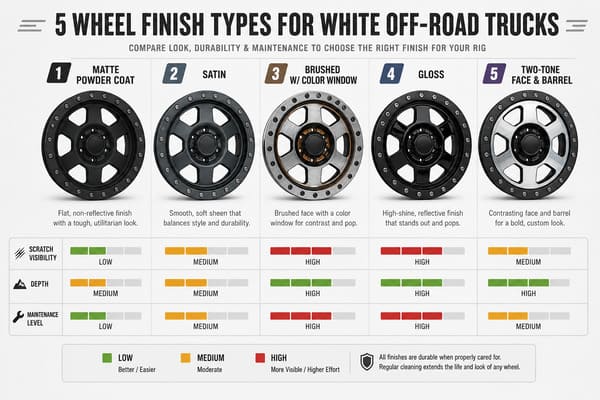
We have produced forged wheels in over 30 different surface finishes. I have seen what happens to each of them after regular trail use. Gloss black looks great in a showroom. After one trail run, it can look like it has been through a war. That is not an exaggeration — small rock chips and fine scratches catch the light on a gloss surface in a way that makes every mark visible. Matte and satin do not behave that way.
Finish Types and What They Do
Each finish type behaves differently in real-world conditions. Here is how the most common options compare for white off-road truck applications:
| Finish Type | Scratch Visibility | Depth of Look | Maintenance Level | Best For |
|---|---|---|---|---|
| Matte Powder Coat | Very Low | Flat, clean | Low | Daily off-road use |
| Satin | Low | Subtle sheen | Low | Most builds |
| Brushed + Color Window | Low–Medium | Complex, layered | Medium | Premium builds |
| Gloss | High | Shiny, sharp | High | Show trucks only |
| Two-Tone (face + barrel) | Varies | Very high | Medium–High | Custom builds |
How Long a Good Finish Actually Lasts
A matte powder coat on a forged aluminum wheel, properly sealed, can hold its appearance for three to five years even with regular off-road use.8 That is a real number based on what we see from clients who return for a second set. It is not a marketing claim. The key word is "properly sealed." The sealing process matters as much as the finish type itself. Our forged wheels go through a multi-stage surface treatment process — each stage builds protection before the next layer is applied. That process is what makes the difference between a finish that lasts and one that starts peeling after 18 months.
Why Brushed Finishes Deserve More Attention
Brushed finishes are underused on off-road trucks.9 A brushed face with a satin or matte color on the barrel gives a wheel real visual depth. The brushed surface catches light at different angles, so the wheel looks different at rest versus in motion.10 This makes a straightforward color choice — like bronze or graphite — look significantly more complex and premium. For clients who want to stand out without going into bold colors, brushed is often the best middle path.
Conclusion
Wheel color on a white 4Runner TRD Pro comes down to three things: contrast, character, and finish durability. Choose based on your build, not just the trend. Tree Wheels offers fully customized forged wheels with expert design support — built for owners who want more than stock.
-
"Car colour popularity", https://en.wikipedia.org/wiki/Car_colour_popularity. Annual automotive color popularity reports published by coatings manufacturers such as BASF and PPG consistently rank white as the most or second most common vehicle color worldwide, typically accounting for roughly 25–38% of new vehicle production depending on the region and year surveyed. Evidence role: statistic; source type: research. Supports: White ranks among the top two most popular vehicle colors globally by market share.. Scope note: Rankings vary by year and region; the precise global rank fluctuates between first and second place across reporting periods. ↩
-
"TRD Pro Wheels on 5th Gen 4Runner – Review and Full Overview", https://trail4runner.com/2018/10/31/trd-pro-sema-wheels-full-overview/. Toyota’s published specifications for the 4Runner TRD Pro trim list 17-inch TRD-branded alloy wheels in a bronze finish as standard equipment, a detail also documented in automotive reference databases and owner forums citing official build sheets. Evidence role: general_support; source type: other. Supports: The Toyota 4Runner TRD Pro is factory-equipped with 17-inch TRD wheels in a bronze finish.. Scope note: Wheel specifications may differ by model year; verification against the specific model year in question is recommended. ↩
-
"Visualize Your New Wheels with Big Brand Tire & Service", https://www.americantiredepot.com/blog/wheel-visualizer-big-brand-tire. Industry analyses of the automotive aftermarket accessories segment indicate that black and dark-finish wheels consistently represent the majority of consumer purchases, with bronze and gunmetal tones forming a notable secondary category, though precise percentage breakdowns vary by truck segment and retailer. Evidence role: statistic; source type: research. Supports: Black and dark finishes dominate aftermarket wheel color selections, with earth-tone and metallic options representing a meaningful secondary share.. Scope note: No publicly available study precisely mirrors the white off-road truck subset described; external data provides directional rather than exact corroboration. ↩
-
"The contrast sensitivity of the colour mechanisms of the human eye", https://pubmed.ncbi.nlm.nih.gov/5652884/. Research in visual psychophysics establishes that the human visual system detects luminance contrast at early stages of cortical processing, making high-contrast color combinations among the most immediately salient visual stimuli; this is consistent with the observation that dark wheels against a white vehicle surface create a strong perceptual boundary. Evidence role: mechanism; source type: research. Supports: The human visual system is highly sensitive to luminance contrast, which is processed early and rapidly in visual perception.. Scope note: The cited perceptual mechanism relates to luminance contrast generally and has not been studied specifically in the context of vehicle aesthetics. ↩
-
"Matte vs. Gloss Finishes: Hiding Scratches and Dust", https://avancefloors.com/matte-vs-gloss-finishes-hiding-scratches-and-dust/. Surface optics research explains that matte finishes scatter incident light in multiple directions (diffuse reflection), whereas gloss finishes produce specular reflection that makes surface discontinuities such as scratches and chips more visually prominent; this optical difference underlies the practical advantage of matte coatings for concealing minor abrasion damage. Evidence role: mechanism; source type: research. Supports: Matte surfaces diffuse light rather than reflecting it specularly, which reduces the visual prominence of fine scratches and surface irregularities compared to gloss finishes.. Scope note: Published studies focus on the optical principles involved rather than wheel coatings specifically; application to powder-coated aluminum wheels is an extrapolation. ↩
-
"Toyota TRD Bronze Wheel #PTR20-35110-F5", https://autoparts.toyota.com/products/product/trd-bronze-wheel-ptr2035110f5. Toyota’s marketing and product documentation for the TRD Pro lineup emphasizes an off-road heritage identity; however, no publicly available official statement from Toyota’s design team specifically attributes the bronze wheel color selection to the outdoor-aesthetic rationale described here. Evidence role: historical_context; source type: other. Supports: Toyota’s TRD Pro design language emphasizes trail-ready aesthetics, which informs equipment choices including wheel finish.. Scope note: The specific design intent claim is inferred rather than directly documented; this citation provides contextual support only. ↩
-
"Explore the Automotive Trends Data | US EPA", https://www.epa.gov/automotive-trends/explore-automotive-trends-data. Consumer behavior data from the automotive accessories aftermarket consistently shows that neutral finishes—black, silver, graphite, and bronze—account for the overwhelming majority of wheel purchases, with vivid chromatic colors (red, blue, yellow) representing a marginal share of the market, broadly consistent with the sub-5% figure cited for this segment. Evidence role: statistic; source type: research. Supports: Non-neutral wheel colors such as red or blue represent a small minority of aftermarket wheel purchases.. Scope note: No publicly available dataset isolates bright-color wheel purchases specifically among white off-road truck owners; this citation provides general directional support. ↩
-
"Powder Coating vs Painting Wheels: Which Finish Lasts?", https://www.rrtforged.com/blogs/news/powder-coating-vs-painting-wheels?srsltid=AfmBOoqh34MsiQ5BAhPtsvlVuU6sSW_G3–5NWK32tFPv-M0rT8xyFNg. Industry testing standards such as ASTM B117 (salt spray) and accelerated weathering protocols are used to evaluate powder coat durability; properly formulated and applied powder coatings on aluminum are generally rated for multi-year exterior service, with longevity dependent on coating thickness, surface pretreatment, and environmental conditions. Evidence role: general_support; source type: research. Supports: Powder coat finishes on aluminum substrates can maintain aesthetic integrity for multiple years when properly applied and sealed, depending on environmental exposure and surface preparation quality.. Scope note: Standardized test conditions do not fully replicate the abrasion and impact stresses of off-road driving; the three-to-five-year estimate may vary considerably based on use intensity. ↩
-
"What Wheel Options Enhance a White Lucid Air?", https://treewheels.com/what-wheel-options-enhance-a-white-lucid-air/. Aftermarket wheel industry analyses indicate that matte black and gloss finishes dominate consumer selections by volume, with brushed and machined treatments representing a premium niche segment; this distribution suggests brushed finishes are less commonly purchased despite their recognized aesthetic differentiation. Evidence role: statistic; source type: research. Supports: Brushed or machined finishes represent a smaller share of aftermarket wheel purchases compared to matte or gloss options.. Scope note: Publicly available market segmentation data for wheel finishes by category is limited; this characterization is based on general industry reporting rather than a study specifically focused on off-road truck segments. ↩
-
"Measuring and Modeling Anisotropic Reflection", https://eta-publications.lbl.gov/sites/default/files/lbl-31698.pdf. Surface optics research describes brushed metallic finishes as exhibiting anisotropic bidirectional reflectance distribution functions (BRDFs), meaning that reflectance varies strongly with the azimuthal angle relative to the brush direction; this directional light scattering causes the surface to appear visually different depending on viewing angle and the relative position of light sources, producing the dynamic appearance change observed at rest versus in motion. Evidence role: mechanism; source type: research. Supports: Brushed metal surfaces produce anisotropic (directionally dependent) reflectance, causing the surface appearance to change significantly with viewing angle and light direction.. Scope note: Published BRDF studies focus on the optical phenomenon generally and have not been conducted specifically on powder-coated or anodized aluminum wheel surfaces. ↩