
Gray is a color that does nothing wrong — and that is exactly the problem. It leaves you staring at your car wondering what finish will actually make it look like a choice, not a default.
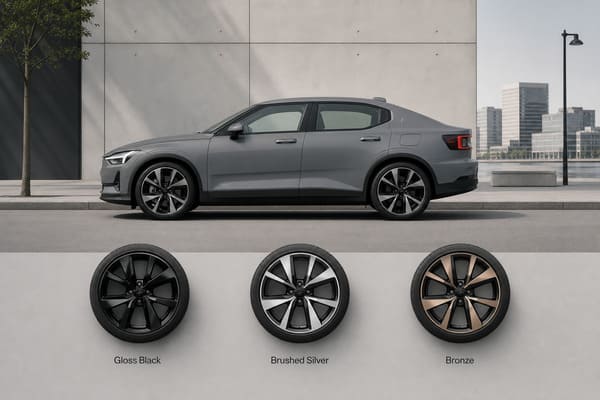
The best wheel finishes for a gray Polestar 2 are gloss black with a machined lip, brushed silver, and dark bronze. Each one works for a different reason: gloss black creates contrast, brushed silver matches the car’s tone, and bronze adds a warm tension against the cool gray body.
We have been making forged wheels for over 20 years1. In that time, we have seen what actually looks good on gray cars — not in theory, but in real orders, real feedback, and real photos sent back by customers after they installed the wheels. This article breaks down every major finish option for the gray Polestar 2, with the production knowledge behind each one.
Does Gloss Black Work on a Gray Polestar 2?
You have seen gloss black on gray cars before. Maybe too many times. But there is a reason it keeps showing up — and the reason is not because people lack imagination.
Gloss black works well on a gray Polestar 2 because gray is a recessive color — it steps back and lets the wheels speak2. The dark-to-light contrast between a gloss black wheel and a gray body pulls the wheel visually away from the car, making the silhouette sharper and more defined.
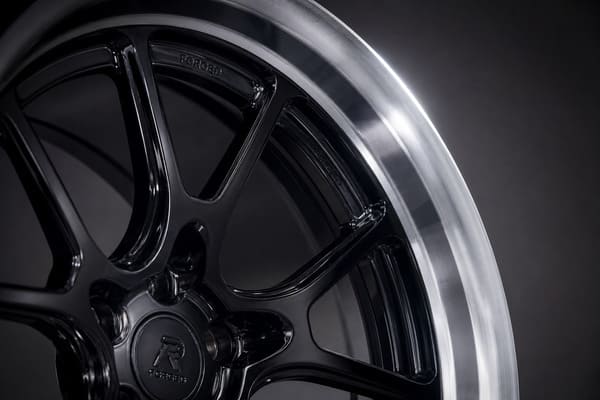
I had a customer in the US driving a Polestar 2 in Space Grey. He came to us and immediately said he did not want gloss black. His exact words were: "I see eight gray cars in every parking lot and they all have black wheels." I did not argue with him. Instead, I showed him two photos side by side — one full gloss black wheel, and one gloss black wheel with a machined high-polish lip. He went quiet for a moment, then changed his order. When the wheels arrived, he messaged me and said: "This is not the black I was thinking of. This has layers."
That is the point I want to make clearly.
Gloss Black Is Not One Thing
There is a wide range of what "gloss black" actually means in production. The finish you choose changes everything about the final look.
| Finish Type | Visual Effect | Best For |
|---|---|---|
| Full Gloss Black (powder coat) | Flat, uniform dark surface | Budget builds, subtle contrast |
| Gloss Black + Machined Lip | High contrast between dark face and polished edge | Premium builds, structured look |
| Gloss Black + Tinted Clear Coat | Deeper, almost smoked appearance | Aggressive, low-profile setups |
The Polestar 2 was designed with a Scandinavian restraint philosophy3. It does not shout. A layered gloss black finish — especially with a machined lip — fits that design language exactly. It is sharp without being loud. It adds edge without breaking the car’s composure. Full gloss black from a basic powder coat process will look fine from ten meters away. Up close, it can look cheap. A liquid paint finish with a double-layer clear coat costs roughly 1.5 to 2 times more than standard powder coat4, but the surface holds up for years longer without peeling at the edges. We have seen powder-coated gloss black wheels start to chip at the rim edge in under twelve months of daily use5. That is not a color problem. That is a process problem. When a customer asks us for gloss black, we always ask what finish process they want — because the color and the process are two completely different decisions.
Is Brushed Silver a Good Match for Gray Paint?
Most people who reject brushed silver have never really looked at it. They associate it with stock wheels and think choosing it means not trying hard enough.
Brushed silver is one of the best long-term matches for gray paint because both surfaces share the same visual language — textured, directional, and low-glare. The matte diffusion of brushed silver complements gray without competing with it, giving the car a cohesive, premium appearance.
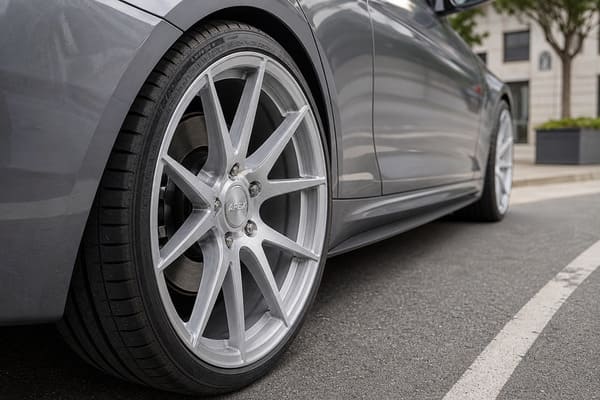
I worked with a modification shop owner in Australia who came to us for sample production. He originally asked for polished silver because, in his words, "it looks more expensive." We made two sets — one polished, one brushed — and photographed both next to the same gray car. He looked at the photos and said: "The polished one looks like cheap chrome in a photo. The brushed one looks like someone actually spent money."
Why Brushed Silver Reads as Premium on Gray
The difference comes down to how light behaves on each surface.
| Surface Type | Light Behavior | Visual Result |
|---|---|---|
| Polished Silver | Mirror reflection | High glare, shows every scratch, can look cheap in sunlight |
| Brushed Silver | Soft diffused reflection | Even tone, directional texture, looks intentional |
| Satin Silver | Between polished and brushed | Balanced, versatile, slightly less defined texture |
Polished silver is a mirror. In direct sunlight, it picks up everything around it — road, sky, other cars. That makes it visually noisy. Brushed silver has a linear grain texture. Light hits it and scatters softly. The result is calm and considered, which is exactly what a gray car already communicates. One production detail matters a lot here: the direction of the brushing must be consistent across all spokes. If the grain runs in a slightly different direction on each spoke, the light reflection will be uneven6 and the wheel will look rough when examined closely. We have a dedicated quality check step in our production line where we light each wheel from a fixed angle to verify grain consistency before it leaves the facility. Brushed silver is also one of the most forgiving finishes to live with. It does not show minor dust or light scratches the way polished or gloss finishes do. For a daily driver like the Polestar 2, that matters more than most buyers think at the time of purchase. Customers who chose brushed silver three years ago rarely come back saying they regret it. That is not something we can say about every finish.
Do Bronze Wheels Look Good on Grey Cars?
Bronze is the finish that generates the most opinions — and the most complaints. But the complaints are almost never about the look. They are about the gap between what the customer imagined and what arrived.
Bronze wheels can look exceptional on gray cars when the specific bronze tone is matched carefully to the gray’s warmth level. Cool steel grays can clash with bronze, but neutral or warm grays — like Polestar 2’s Space Grey or Midnight — create a cold-warm visual tension that draws attention without looking accidental.
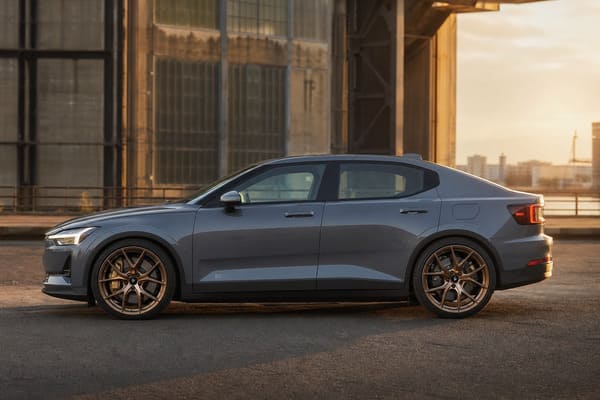
Bronze is the finish where color confirmation takes the most time. On average, bronze orders require three to five more days of back-and-forth communication than any other finish we produce. The reason is simple: bronze covers a huge range of tones. What one customer calls bronze, another calls gold. What one person considers dark bronze, another sees as olive green.
Bronze Tone vs. Gray Type — A Practical Guide
| Bronze Tone | Gray Type | Visual Result |
|---|---|---|
| Dark Bronze / Smoked Bronze | Neutral or warm gray | Deep, understated, slightly aggressive |
| Champagne Bronze | Warm gray | Bright contrast, strong visual focal point |
| Satin Bronze | Cool gray | Risky — can look mismatched without testing |
| Dark Bronze | Cool steel gray | Very difficult to make work — avoid unless tested |
We learned this the hard way. Bronze-related color disputes used to make up around 15% of our after-delivery complaints. That number is now below 2%7. The change came from one process update: every bronze order now requires us to produce a physical color swatch first. The customer signs off on the swatch before we start full production. It adds time to the process — sometimes a week or more — but it eliminates the gap between expectation and result. We keep an internal color library of over 30 different bronze tones, from the lightest champagne to the deepest smoked dark bronze. When a customer brings us a reference image, we find the closest match in our library and produce a swatch from it. That swatch becomes the production standard. Bronze on a gray Polestar 2, done right, is one of the most visually compelling combinations we produce. The warmth of the bronze against the coolness of the gray creates a tension that makes the car look intentional from across the street. Middle Eastern customers — particularly in Dubai — respond strongly to this combination. It accounts for roughly 25% of the gray car orders we receive from that market8.
What Color Rims Look Best on a Gray Car?
Every gray car owner asks this eventually. The answer depends on what you want the car to communicate — but there is still a ranking based on real order data and real customer feedback.
The best rim colors for gray cars, in order of visual impact and long-term satisfaction, are: gloss black with a machined lip, dark or satin bronze, brushed or satin silver, and gunmetal. Each finish works for a different reason and suits a different type of driver.
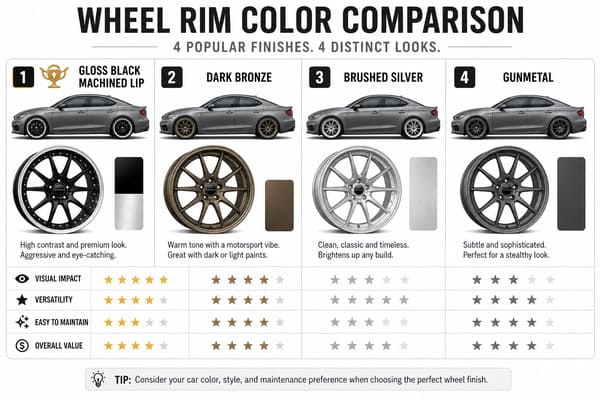
This ranking comes from our actual sales data and the feedback customers send after installation. It is not based on what looks best in a render. It is based on what people are still happy with after two or three years of driving.
Full Ranking Breakdown by Finish
| Rank | Finish | Why It Works | Market Preference |
|---|---|---|---|
| 1 | Gloss Black + Machined Lip | Strong contrast, layered look, suits almost every gray tone | US and Canada — approx. 50% of gray car orders |
| 2 | Dark Bronze / Satin Bronze | Cold-warm tension, bold but not loud | Middle East (Dubai) — approx. 25% of gray car orders |
| 3 | Brushed Silver / Satin Silver | Harmonious, durable, ages well | Australia — highest proportion of silver selections |
| 4 | Gunmetal | Same-tone layering, subtle texture difference, very integrated look | Minimalist buyers across all markets |
Gunmetal is the most underrated option on this list. It is not a contrast finish — it is a tonal finish. The wheel and the car share the same color family, but the surface texture of the wheel is different from the painted body. The result is a very clean, very composed look. The car looks assembled, not customized. For people who want to change the wheels without making it obvious, gunmetal is the right answer. It is the finish I would recommend to someone who drives a Polestar 2 to client meetings and wants the car to look considered, not modified. The key production detail with gunmetal is the base tone. Gunmetal can pull warm or cool depending on the exact pigment mix. Matching it to a specific gray paint requires us to see a paint chip or code first. A gunmetal that reads slightly purple next to a blue-gray car will look wrong even if both are technically gray. We always ask for the paint code before confirming a gunmetal order.
Conclusion
Gloss black with a machined lip, brushed silver, and dark bronze are the three finishes that consistently work best on gray cars. The right choice depends on your gray tone and what you want the car to say. At Tree Wheels, we help you find the exact finish that fits — with 20+ years of forged wheel production behind every order.
-
"Casting Wheels vs. Forged Wheels: Which Offers Better …", https://treewheels.com/casting-wheels-vs-forged-wheels-which-offers-better-performance-for-your-vehicle/. Forged aluminum wheels are produced by applying compressive force to heated aluminum billets, aligning the grain structure of the metal and producing higher strength-to-weight ratios compared to gravity or low-pressure cast wheels, which are formed by pouring molten aluminum into molds. Evidence role: definition; source type: research. Supports: That forged aluminum wheels differ from cast wheels in manufacturing process and resulting material properties. ↩
-
"The Influences of gradient color on the weight perception and stability …", https://pmc.ncbi.nlm.nih.gov/articles/PMC10472828/. In visual design and color theory, achromatic neutrals such as gray are classified as recessive colors — they carry low visual weight and tend to recede perceptually, causing adjacent high-contrast or chromatic elements to advance and attract attention. Evidence role: definition; source type: education. Supports: That neutral or achromatic colors such as gray are perceived as visually recessive, causing adjacent chromatic or high-contrast elements to appear more prominent. Scope note: Perceptual effects of color recession are context-dependent and influenced by surrounding colors, surface area, and lighting conditions; the principle applies generally but may vary in specific automotive viewing contexts. ↩
-
"Polestar 2, the Swedish Electric Car Embracing Sleek …", https://www.anothermag.com/design-living/12034/electric-vehicles-polestar-2-scandinavian-design-interview-maximilian-missoni. Polestar has publicly described its design ethos as rooted in Scandinavian minimalism, emphasizing restraint and purposeful form over ornamentation, a philosophy reflected in the Polestar 2’s exterior styling. Evidence role: general_support; source type: other. Supports: That Polestar’s design language is rooted in Scandinavian minimalist principles. Scope note: Design philosophy statements are often drawn from marketing materials; independent design criticism may offer a more neutral characterization. ↩
-
"Powder Coating Wheels and Rims – Advantages and Costs!", https://www.tiger-coatings.com/us-en/blog/powder-coating-wheels-and-rims. Industry finishing guides generally indicate that multi-stage liquid paint processes, including base coat and clear coat application, carry higher per-unit costs than single-stage powder coating due to additional labor, curing steps, and material inputs. Evidence role: general_support; source type: other. Supports: That liquid paint finishing processes for wheels are more expensive than standard powder coating. Scope note: Exact cost ratios vary by facility, region, and wheel complexity; the 1.5–2x figure cited is the author’s internal estimate and may not reflect all market conditions. ↩
-
"Is powder coating wheel damage typical after 10k miles?", https://www.facebook.com/groups/921750611911933/posts/2121928011894181/. Research on powder coating adhesion indicates that mechanical impact and thermal cycling at thin-film edges — such as rim lips — are common initiation sites for coating delamination, with failure timelines dependent on coating thickness, substrate preparation, and environmental exposure. Evidence role: mechanism; source type: research. Supports: That powder coat finishes on wheels are susceptible to edge chipping and adhesion failure under road use conditions. Scope note: Published studies typically address industrial coatings broadly; direct data on automotive wheel rim-edge chipping timelines under daily driving conditions is limited in peer-reviewed literature. ↩
-
"Control of grain structure, phases, and defects in …", https://modeling.matse.psu.edu/research_files/papers/2023PMS_Mukh.pdf. Surface finishing literature on mechanically brushed metals notes that the anisotropic reflectance of brushed surfaces is highly sensitive to grain orientation; components with inconsistent brushing direction exhibit non-uniform luminance when viewed under directional lighting, a defect detectable in standard gloss and appearance inspection protocols. Evidence role: mechanism; source type: research. Supports: That variations in brushing direction across a metal surface produce non-uniform light reflection due to the anisotropic nature of directional surface textures. ↩
-
"Understanding Pharmaceutical Quality by Design – PMC – NIH", https://pmc.ncbi.nlm.nih.gov/articles/PMC4070262/. Quality management literature on color-critical manufacturing processes identifies physical master standard approval — where a customer-approved physical sample governs production — as an effective control for reducing post-delivery color nonconformance disputes. Evidence role: general_support; source type: research. Supports: That physical color standard approval steps in manufacturing workflows reduce post-delivery color mismatch complaints. Scope note: The specific percentages cited (15% to below 2%) are the author’s internal figures and cannot be independently verified; the cited support addresses the general principle rather than this specific case. ↩
-
"Automotive Technology Department", https://www.gccaz.edu/academics/departments/automotive. Reports on the Gulf Cooperation Council automotive aftermarket describe a consumer base with strong preferences for premium vehicle personalization, including distinctive wheel and exterior modifications, driven by high luxury vehicle ownership rates and cultural emphasis on vehicle presentation. Evidence role: general_support; source type: institution. Supports: That the Middle Eastern automotive aftermarket, particularly in the Gulf region, shows distinct preferences for premium and visually distinctive vehicle customization. Scope note: The 25% figure is the author’s internal sales data and cannot be independently verified; external sources support the general regional preference pattern rather than the specific statistic. ↩