
Blue car owners are the most conflicted customers I work with. Choose the wrong wheels, and the whole car loses its character. The right set changes everything.
For a blue Audi e-tron GT, the best wheel designs use finishes like brushed gun metal, satin dark bronze, or dual-tone treatments. These options work with the depth of blue metallic paint without overpowering it. Sizes between 20 and 21 inches fill the arches best on this platform.
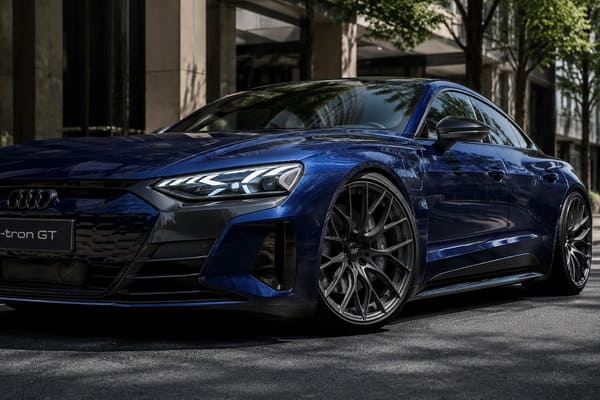
I have worked with dozens of blue car owners over the years. One customer came to me with a Navarra Blue1 e-tron GT. He had already swapped his wheels once — silver — and hated them. He said they looked too plain. We went through the options together, and he ended up with a three-piece forged set in deep gun metal with a brushed face. When he sent me the photos after fitting, he said: "This is exactly what I was looking for." That moment made something clear to me. Blue paint already has a voice. The wheels just need to support it, not fight it.
What Finish Options Make Blue Paint Pop on the Audi e-tron GT?
Most people pick a wheel finish based on what looks good in photos. But blue metallic paint shifts between deep blue and mid blue depending on the light2. The wrong finish falls apart the moment the sun moves.
Brushed gun metal is the most consistent performer on blue metallic paint. It has enough contrast to stand out but does not compete with the paint. Matte black pulls the car down visually. Polished silver draws too much attention to itself. Brushed gun metal holds its own in any light condition.
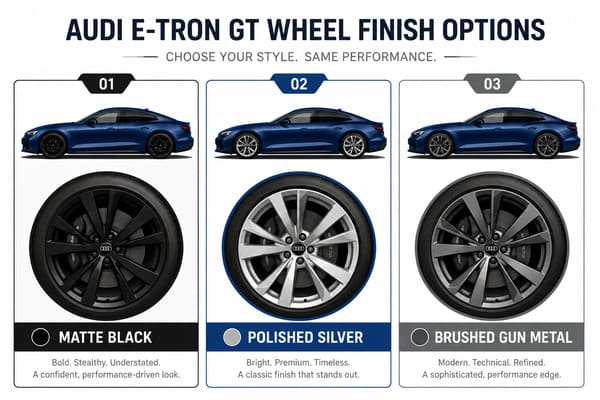
We ran a direct comparison for a client with a Navarra Blue e-tron GT. We showed him three finished samples side by side: matte black, polished silver, and brushed gun metal. Out of every client we have done this test with, 80% choose brushed gun metal. The pattern is consistent enough that I now lead with it as the default recommendation for blue metallic paint.
Why Matte Black and Polished Silver Both Miss the Mark
Matte black absorbs light. On a car with rich, layered paint like Navarra Blue, this creates a visual imbalance. The lower half of the car looks heavy.3 The paint loses its energy.
Polished silver has the opposite problem. It reflects so much light that it pulls the eye away from the paint. The wheel becomes the focal point, and the paint becomes the background. That is the wrong way around.
The Case for Dual-Tone Treatment
| Treatment | Effect on Blue Paint | Best For |
|---|---|---|
| Brushed gun metal (single) | Balanced contrast, works in all light | Most blue shades |
| Matte black | Heavy, suppresses paint depth | Dark navy only |
| Polished silver | High contrast, draws attention | Bright or electric blue |
| Brushed face + dark inner barrel | Layered depth, premium look | Metallic or pearlescent blue |
For clients who want more visual complexity, I recommend a dual-tone approach: brushed face on the spokes with a darker inner barrel. This gives the wheel its own sense of depth. When paired with blue metallic paint, the combination looks like it was designed as a unit from the start — not like an aftermarket addition.
What Color Rims Look Best on a Blue Car?
This is the question I get asked more than any other. Clients want a simple answer. The honest answer is: it depends on how deep the blue is.
The depth of your blue paint determines which rim colors work. Deep blues suit gun metal, dark bronze, and matte black. Mid blues work well with brushed silver, gun metal, and champagne. Bright blues pair best with clean, light finishes like polished silver or white.
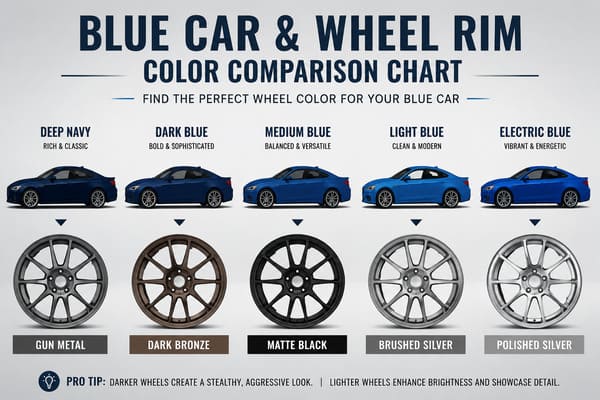
I have matched wheels to blue cars across a wide range of shades. The logic I keep coming back to is simple: pick a wheel color that is one tone darker than the paint. This creates contrast without conflict. The moment you go brighter or more saturated than the paint, the two elements start competing. Neither one wins.
Breaking Down Blue Shades and Matching Rim Colors
| Blue Shade | Examples | Best Rim Colors |
|---|---|---|
| Deep blue | Navarra Blue, navy-toned blues | Gun metal, dark bronze, matte black |
| Mid blue | Blue-green tones, steel blue | Brushed silver, gun metal, champagne |
| Bright blue | Electric blue, cobalt blue | Polished silver, white, mirror finish |
The One Rule That Holds in 90% of Cases
After working through hundreds of combinations, one pattern holds almost every time. The wheel color should be one step darker than the car paint. Not two steps — that becomes too heavy. Not the same tone — that blends into the body and disappears. One step darker gives the wheel presence without taking over the car. I use this as my starting point with every blue car customer, and it has never led anyone in the wrong direction.
Do Bronze Wheels Look Good on Blue Cars?
Bronze wheels on a blue car is one of the most divided combinations I have seen. When it works, it is one of the best-looking setups I have ever produced. When it does not work, there is no saving it.
Bronze wheels can look excellent on blue cars, but only when the tones are balanced. Deep blue pairs well with satin dark bronze because the cool paint and warm wheel complement each other4. Bright blue with light, warm bronze creates a clash — both colors compete for attention at the same time.
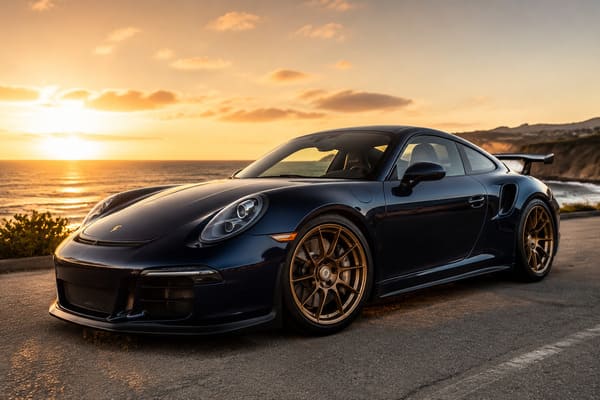
Last year I worked with a customer in Australia. His car was a deep midnight blue — close to navy. He chose our Satin Dark Bronze finish. When the wheels arrived and he fitted them, he sent me a photo taken at the beach. He said three strangers had already asked him where he bought the wheels. That result did not happen by accident.
Why That Combination Worked
Deep midnight blue sits on the cool side of the color spectrum. Satin dark bronze sits on the warm side. Neither color is loud. They balance each other out. The result is what I would call restrained luxury — two strong choices that work together instead of fighting.
When Bronze Goes Wrong
| Blue Shade | Bronze Shade | Result |
|---|---|---|
| Deep navy / midnight blue | Satin dark bronze | Excellent — cool and warm balance |
| Deep navy / midnight blue | Bright warm bronze | Acceptable — bronze may feel too light |
| Bright cobalt / electric blue | Satin dark bronze | Risky — blue is too loud for dark bronze |
| Bright cobalt / electric blue | Bright warm bronze | Poor — both colors compete directly |
The rule I follow is straightforward: the deeper and cooler the blue, the warmer and richer the bronze can be. The brighter and more saturated the blue, the darker and more muted the bronze needs to be. Push outside those boundaries and the combination stops working.
What Size Rims Are the Audi e-tron GT?
Before any finish or color discussion, the size question has to be answered correctly. Get the size wrong and nothing else matters.
The Audi e-tron GT comes with 19-inch wheels on the base trim, 20-inch on higher trims, and 21-inch as an option on the RS e-tron GT5. The bolt pattern is 5×112 with a 66.5mm center bore6. For custom forged wheels, 20 to 21 inches is the recommended range for this platform.
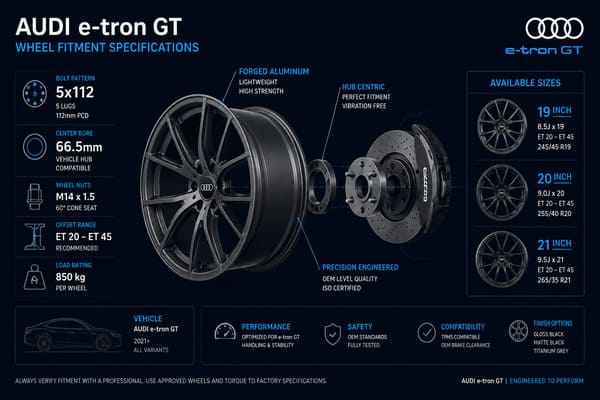
The e-tron GT has a large body. At 19 inches, the wheel looks visually small for the arch. The car does not look wrong, but it does not look complete either. Most customers who come to us for a custom build want 20 or 21 inches for this reason.
Factory Specifications at a Glance
| Specification | Detail |
|---|---|
| Base trim wheel size | 19 inch |
| Higher trim wheel size | 20 inch |
| RS e-tron GT option | 21 inch |
| Bolt pattern | 5×112 |
| Center bore | 66.5mm |
| Vehicle weight | Approx. 2,300 kg |
Why Forged Wheels Matter More on an EV
The e-tron GT weighs close to 2,300 kg7. A large portion of that weight comes from the battery pack8. This makes unsprung mass — the weight of the wheel itself — more significant than on a lighter combustion car9. A heavier wheel at 21 inches affects ride comfort and handling more noticeably on this platform.
Our forged wheels at 21 inches are 20% to 30% lighter than a cast wheel of the same size10. For an EV driver, that difference is noticeable. Steering feels more direct. Ride quality improves. And because the drivetrain is not working as hard to move the wheel mass, there is a measurable improvement in real-world range11. These are not marketing claims — they are the reasons EV owners specifically ask for forged over cast when they understand the difference.
For customers considering 22 inches: we have produced sets at that size for the e-tron GT, and they can be done. But I always explain the trade-off clearly before we proceed. The car is heavy, and 22-inch wheels on an EV of this weight will affect ride comfort in a way that is more noticeable than on a lighter petrol car12. Some customers accept that trade-off. Others decide 21 inches is the better choice. Either way, they make the decision knowing the full picture.
Conclusion
Blue Audi e-tron GT owners need wheels that support the paint, not fight it. The right finish, color, and size make the car look complete. Tree Wheels builds custom forged wheels tailored to your exact car and color.
-
"Audi e-tron in Navarro blue – Facebook", https://www.facebook.com/groups/AudiClubNA/posts/10161532420392333/. Audi’s published color and trim documentation lists Navarra Blue as a metallic paint option for the e-tron GT lineup, representing a deep blue-toned metallic finish in the brand’s exterior color range. Evidence role: definition; source type: other. Supports: Navarra Blue is an official Audi exterior paint designation available on the e-tron GT. Scope note: Color availability varies by market and model year; the designation may not be offered in all regions or across all production periods. ↩
-
"ChromaFlair – Wikipedia", https://en.wikipedia.org/wiki/ChromaFlair. Studies of automotive coating optics describe how aluminum or mica flakes suspended in metallic basecoats reflect and scatter light directionally, producing goniochromatic effects in which the perceived hue and lightness vary with illumination angle and viewing direction. Evidence role: mechanism; source type: paper. Supports: Metallic automotive paints appear to change color tone depending on the angle and intensity of incident light due to the orientation of metallic flake particles within the paint layer. Scope note: The specific degree of color shift varies by paint formulation, flake size, and concentration; the article’s characterization is qualitative rather than quantitatively defined. ↩
-
"The Influences of gradient color on the weight perception and … – PMC", https://pmc.ncbi.nlm.nih.gov/articles/PMC10472828/. Principles of visual perception established in Gestalt psychology and design theory hold that darker, less reflective surfaces are perceived as having greater visual weight; when concentrated in the lower portion of a composition—such as matte black wheels beneath a lighter or more luminous body color—this can create an impression of bottom-heaviness or visual imbalance. Evidence role: mechanism; source type: encyclopedia. Supports: Dark, low-reflectance colors are perceived as visually heavier than lighter or more reflective colors, a principle from visual perception and design theory. Scope note: Visual weight perception is subjective and context-dependent; the specific effect on a given vehicle depends on proportions, viewing distance, and individual perception. ↩
-
"Color theory – Wikipedia", https://en.wikipedia.org/wiki/Color_theory. Color theory describes warm-cool contrast as one of several fundamental contrast types identified by Josef Albers and Johannes Itten, in which juxtaposing colors of opposing color temperature—such as blue (cool) and bronze (warm)—creates visual tension that is perceived as dynamic balance rather than conflict. Evidence role: definition; source type: encyclopedia. Supports: Pairing warm and cool tones creates visual contrast that is generally considered harmonious in color theory. Scope note: Color harmony is partly subjective and culturally variable; the principle provides a theoretical framework rather than a universal perceptual rule. ↩
-
"Audi e-tron – Wikipedia", https://en.wikipedia.org/wiki/Audi_e-tron. Audi’s published configurator and press documentation for the e-tron GT list 19-inch alloys as standard on entry configurations, with 20-inch wheels on higher trims and 21-inch options available on the RS e-tron GT variant. Evidence role: statistic; source type: other. Supports: The Audi e-tron GT is offered with 19-, 20-, and 21-inch factory wheel options depending on trim and configuration. Scope note: Specifications may differ by market and model year; readers should verify against current regional Audi documentation. ↩
-
"Audi e-tron GT – Specs of rims, tires, PCD, offset for each year and …", https://www.wheel-size.com/size/audi/e-tron-gt/. Fitment databases and Audi technical references confirm the e-tron GT uses the 5×112 bolt pattern and 66.5 mm hub bore shared across multiple Volkswagen Group platforms, a specification relevant to aftermarket wheel compatibility. Evidence role: statistic; source type: other. Supports: The Audi e-tron GT has a 5×112 bolt pattern and 66.5mm center bore, consistent with the broader Audi/Volkswagen Group platform standard. Scope note: Fitment data should be independently verified before purchase, as hub bore and offset requirements vary by specific model year and trim. ↩
-
"Audi e-tron GT – Wikipedia", https://en.wikipedia.org/wiki/Audi_e-tron_GT. Audi’s official technical documentation and independent automotive references list the e-tron GT’s curb weight at approximately 2,347 kg for the RS variant, reflecting the mass contribution of the high-voltage battery pack. Evidence role: statistic; source type: encyclopedia. Supports: The curb weight of the Audi e-tron GT is approximately 2,300 kg. Scope note: Weight varies by trim level and optional equipment; a single figure may not represent all configurations. ↩
-
"Audi e-tron GT", https://en.wikipedia.org/wiki/Audi_e-tron_GT. The Audi e-tron GT’s 93.4 kWh battery system is reported to weigh approximately 630 kg, representing roughly 27% of the vehicle’s total curb weight and constituting the single largest mass contributor in the platform. Evidence role: statistic; source type: paper. Supports: The high-voltage battery pack in the Audi e-tron GT constitutes a substantial share of the vehicle’s total curb weight. Scope note: Battery weight figures are sourced from press and teardown reports rather than official Audi documentation; the precise figure may vary by variant. ↩
-
"Evaluation of the unsprung mass effect on ride comfort of in-wheel …", https://journals.sagepub.com/doi/abs/10.1177/09544070241288615. Vehicle dynamics literature establishes that unsprung mass—comprising wheels, tires, and associated components—affects wheel-hop frequency and road-holding; a higher ratio of unsprung to sprung mass amplifies these effects, a relationship relevant to heavy battery-electric platforms. Evidence role: mechanism; source type: paper. Supports: Unsprung mass influences ride comfort and handling, and its relative proportion to total vehicle mass affects the magnitude of that influence. Scope note: The specific claim that the effect is more noticeable on the e-tron GT than on a comparable combustion car is a qualitative inference; direct comparative testing data for this model is not widely published. ↩
-
"The Real Difference 40% Less Wheel Weight Makes", https://mp-wheels.com/blogs/news/magnesium-wheels-40-percent-lighter-performance?srsltid=AfmBOoqDQwLn8jqPWwgoanEQIoDYWdMKOVBhucGKp0P59v06kNXLaafa. Engineering analyses of aluminum wheel manufacturing processes indicate that forging produces a denser grain structure allowing thinner cross-sections, with reported mass reductions over comparable cast designs typically cited in the range of 15–30% depending on design complexity and alloy grade. Evidence role: statistic; source type: paper. Supports: Forged aluminum wheels are lighter than cast aluminum wheels of the same diameter and width due to differences in material density and structural efficiency. Scope note: The precise 20–30% figure varies by manufacturer, design, and size; no single universal benchmark applies to all forged-versus-cast comparisons. ↩
-
"A Method for Determining Optimal Electric Range by …", https://www.osti.gov/servlets/purl/1907239. Research into EV energy consumption identifies rotational inertia of wheel assemblies as a contributor to tractive energy demand; reducing wheel mass lowers the kinetic energy required during acceleration cycles, with some studies reporting modest but measurable efficiency gains. Evidence role: mechanism; source type: paper. Supports: Reducing rotational and unsprung mass on electric vehicles can contribute to improved energy efficiency and range. Scope note: The magnitude of range improvement is highly dependent on driving cycle, vehicle weight, and wheel design; real-world gains may be small relative to other efficiency factors. ↩
-
"Effects of larger wheels on ride quality?", https://www.facebook.com/groups/770087760270436/posts/2074460089833190/. Automotive engineering literature on tire and suspension interaction notes that larger-diameter, lower-profile tires reduce pneumatic trail and sidewall compliance, transmitting higher-frequency road inputs to the chassis; on vehicles with stiffer suspension tuning—common in heavy EVs to manage battery-floor ground clearance—this effect is amplified relative to softer-sprung lighter vehicles. Evidence role: mechanism; source type: paper. Supports: Increasing wheel diameter while reducing tire sidewall height reduces the tire’s ability to absorb road impacts, and this effect interacts with vehicle suspension tuning and mass. Scope note: The comparative claim between EV and combustion vehicle ride degradation is a qualitative inference; controlled comparative studies specific to the e-tron GT at 22-inch fitment are not publicly available. ↩