
Most buyers ask about size, finish, and price first. But one cracked wheel — and a lost customer — is all it takes to change that conversation completely.
Forged wheels go through three core structural tests before they are approved for sale: radial fatigue testing, cornering fatigue testing, and impact testing1. Each test targets a different failure mode. Together, they confirm that a wheel is safe for real-world driving conditions.
I had a client from a modification shop in Australia come to us after a wheel from his previous supplier cracked on a customer’s car after just four months. Nobody was hurt. But he lost the customer and had to cover the replacement cost himself. That conversation changed how I explain testing to every new client. Structural integrity testing is what separates a wheel that looks great from a wheel that actually holds up over time. I want to walk through exactly what that means.
What Tests Are Used to Check Forged Wheel Strength?
Many buyers assume a forged aluminum wheel is automatically strong enough to pass any test. That assumption has cost some of them real money.
There are three tests that serious wheel manufacturers run before approving a wheel for sale: the radial fatigue test, the cornering fatigue test, and the impact test. A wheel must pass all three. Each test targets a different failure mode, and passing one does not guarantee passing the others.
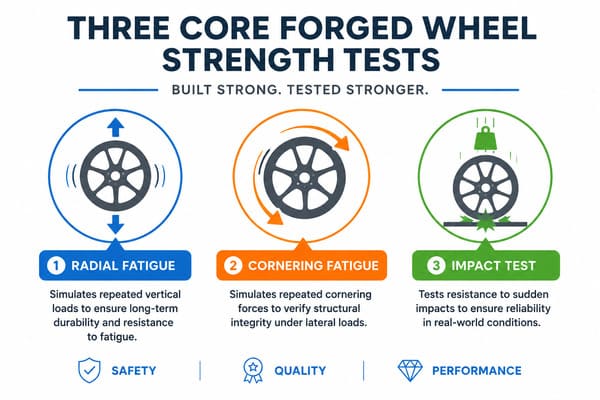
The radial fatigue test simulates the forward load a wheel carries during normal driving. Our testing cycles run to over 500,000 rotations under load2. The cornering fatigue test simulates the lateral forces that happen during turning, running up to 100,000 cycles3 at calculated stress levels. The impact test simulates sudden road hazards like potholes. All three must be passed before a wheel ships.
Why Each Test Targets a Different Weakness
A wheel that passes radial fatigue can still fail cornering fatigue if the spoke geometry is not right. The spoke design affects how stress is distributed during a turn. A wheel that passes both fatigue tests can still crack under a sharp impact if the alloy composition or forging process was inconsistent. This is why running only one or two tests gives a false sense of security.
| Test Type | What It Simulates | Typical Cycle Count |
|---|---|---|
| Radial Fatigue | Forward load during normal driving | 500,000+ rotations |
| Cornering Fatigue | Lateral force during turning | 100,000+ cycles |
| Impact Test | Sudden road hazard (e.g., pothole) | Single-event drop test |
Each test produces data on a specific failure mode. Only when all three are passed together does a wheel have a complete structural clearance. At Tree Wheels, we do not approve a wheel for shipment unless it clears all three.
How Does Impact Testing Reveal a Wheel’s True Durability?
A wheel can look solid, feel heavy, and still crack on the first serious pothole. Impact testing is where that difference becomes visible.
The standard impact test drops a weighted striker — typically around 600 kg of force — onto the wheel at a 13-degree angle4. This simulates hitting a pothole at approximately 60 km/h5. The wheel fails if it cracks or fractures. Minor surface deformation is acceptable and expected.
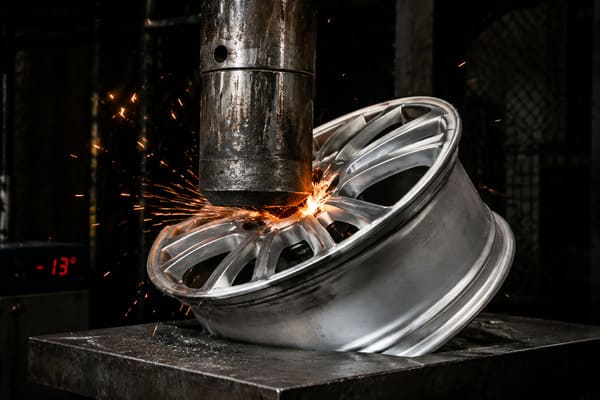
I once saw a side-by-side comparison at our manufacturing facility. A cast wheel of similar size and weight cracked completely through on the first drop. Our forged wheel showed a 2mm surface deformation and passed with no structural compromise. That difference comes from the grain structure of the metal itself.
Why Forging Changes How a Wheel Absorbs Impact
Casting pours molten metal into a mold and lets it cool. The grain structure of a cast wheel is random and unaligned.6 Forging compresses a solid aluminum billet under high pressure, which forces the grain structure to align along the shape of the wheel7. That alignment gives the metal a much higher ability to absorb energy without fracturing.
| Property | Cast Wheel | Forged Wheel |
|---|---|---|
| Grain Structure | Random, unaligned | Aligned under pressure |
| Impact Response | More likely to crack | Absorbs and deforms slightly |
| Weight for Strength | Heavier to compensate | Lighter with higher strength |
| Surface After Impact | Often fractures through | Minor deformation, no crack |
This is not a marketing claim. It is a measurable, documented difference that shows up every time we run the drop test. For clients who are fitting wheels on performance cars or luxury vehicles, this difference is not optional — it is the baseline.
Why Does Fatigue Testing Matter for Forged Wheels?
Fatigue failure is the kind of failure that scares me most as a manufacturer. A wheel can look completely fine for 20,000 km and then crack quietly at 35,000 km under repeated stress.8
Fatigue testing runs a wheel through hundreds of thousands of simulated stress cycles to find the point where the material begins to break down. It reveals weaknesses that no visual inspection or single-event test can detect. For high-performance vehicles driven frequently, fatigue testing is not optional.
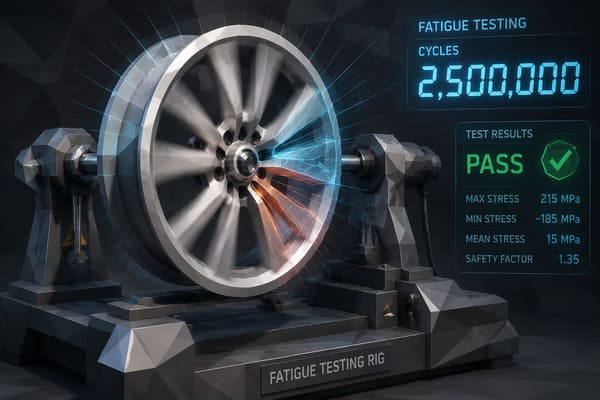
One of our B2B clients runs a modification shop in the US and fits wheels on customer vehicles almost every week. He told me that before switching to our wheels, he had two fatigue-related warranty claims in 18 months. In the two years since switching, he has had zero. That result comes directly from how seriously we treat fatigue testing on the production side.
How Fatigue Testing Works as a Production Diagnostic Tool
Fatigue testing is not just a pass-or-fail gate before shipment. We also use it as a diagnostic tool during production. If a test batch shows early fatigue signs — meaning cracks appear before the expected cycle count — we trace the cause immediately. The most common sources are forging pressure inconsistencies, material batch variation, or issues in the heat treatment process.
| Fatigue Failure Source | What It Affects | How We Trace It |
|---|---|---|
| Forging pressure inconsistency | Grain alignment and density | Review press force logs for that batch |
| Material batch variation | Alloy composition and hardness | Cross-check material certificates |
| Heat treatment issues | Internal stress distribution | Inspect temperature and time records |
Our customers are often buying for track cars, luxury SUVs, or modified sports cars. These vehicles are driven harder and more frequently than average. A fatigue failure on a car like that is not a minor inconvenience. It is a safety event. Fatigue testing is how we make sure that does not happen.
What Role Do International Standards Play in Wheel Safety Testing?
Certifications are not a list of badges. For a B2B buyer, they are your documented, defensible answer when something goes wrong.
DOT, TÜV, ISO9001, and IATF16949 are the four key certifications for wheel manufacturers selling in international markets. Each one covers a different area: legal compliance, independent testing, process quality, and automotive-specific traceability. At Tree Wheels, we hold all four.
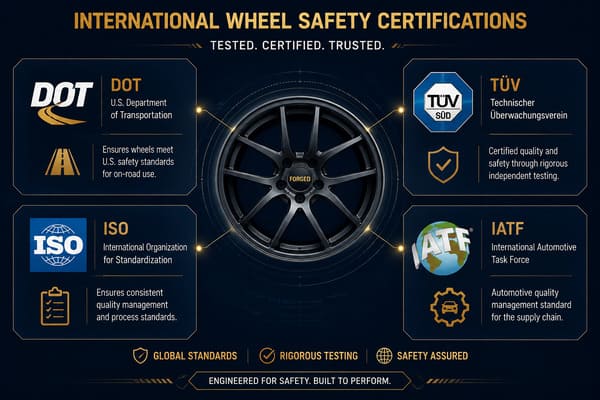
One of our clients in Dubai told me that having TÜV-certified wheels was the single factor that helped him close a contract with a luxury car dealership. That dealership had previously refused to work with any aftermarket wheel supplier. The certification gave them a documented, third-party-verified reason to say yes.
What Each Certification Actually Means in Practice
Each certification answers a different question that a serious buyer or end customer might ask.
| Certification | What It Covers | Why It Matters to Buyers |
|---|---|---|
| DOT | Legal road use compliance in the US | Required by law for US market sales |
| TÜV | Independent third-party structural testing | Carries weight in EU, AU, and luxury markets |
| ISO9001 | Quality management system and process consistency | Confirms production procedures are audited and repeatable |
| IATF16949 | Automotive-specific traceability and defect prevention | Required by many OEM-level and premium B2B clients |
DOT is a legal requirement. Without it, a wheel cannot be legally sold or installed in the United States.9 TÜV requires independent third-party testing — not self-reporting — which is why it carries more credibility in premium markets10. ISO9001 means our quality control procedures are documented and consistent across every order11. IATF16949 goes further and requires a higher level of defect prevention and traceability specific to automotive parts12. For a modification shop owner or service center manager, these certifications are the language that serious buyers and serious end customers both speak.
Conclusion
Structural integrity testing is what separates a safe wheel from a dangerous one. Testing is not a formality — it is the foundation of every wheel we ship.
Tree Wheels manufactures DOT, TÜV, ISO9001, and IATF16949 certified forged wheels with full structural testing on every production batch. Contact us to get started.
-
"Steel Automotive Wheel Rims—Data Fusion for the Precise … – PMC", https://pmc.ncbi.nlm.nih.gov/articles/PMC10817687/. SAE International standard J328 and ISO 3006 define the test procedures for passenger car wheel fatigue and impact testing, specifying radial load fatigue, cornering fatigue, and impact as the primary structural evaluation methods. Evidence role: definition; source type: institution. Supports: That radial fatigue, cornering fatigue, and impact testing are formally defined and required test procedures under recognized automotive standards. Scope note: Specific cycle count thresholds may vary by vehicle class, wheel size, and the version of the standard applied; the article’s figures should be verified against the applicable standard edition. ↩
-
"Radial Fatigue Analysis of Automotive Wheel Rim(ISO 3006)", https://www.academia.edu/90209625/Radial_Fatigue_Analysis_of_Automotive_Wheel_Rim_ISO_3006_. SAE J328 specifies minimum cycle requirements for radial fatigue testing of passenger car wheels, with thresholds that vary based on wheel load rating and test load multiplier. Evidence role: statistic; source type: institution. Supports: That radial fatigue testing for passenger car wheels involves a defined minimum number of load cycles, in the range cited. Scope note: The exact cycle count of 500,000 is manufacturer-reported; the applicable standard may specify a different minimum depending on wheel category and test load factor. ↩
-
"Radial Fatigue Analysis of Automotive Wheel Rim(ISO 3006)", https://www.academia.edu/90209625/Radial_Fatigue_Analysis_of_Automotive_Wheel_Rim_ISO_3006_. SAE J328 and equivalent standards define cornering fatigue test parameters including bending moment load and minimum cycle counts, which vary by wheel load rating. Evidence role: statistic; source type: institution. Supports: That cornering fatigue testing involves a defined cycle count requirement under recognized automotive wheel testing standards. Scope note: The 100,000-cycle figure is manufacturer-reported; actual required cycles under the applicable standard depend on the bending moment applied and the wheel’s rated load capacity. ↩
-
"Numerical simulation on 90° impact test of aluminium alloy wheel …", https://pmc.ncbi.nlm.nih.gov/articles/PMC11549285/. SAE J175 and ISO 7141 define impact test procedures for passenger car wheels, specifying striker mass, drop height, and a 13-degree wheel inclination angle to simulate oblique road hazard impacts. Evidence role: definition; source type: institution. Supports: That wheel impact testing standards specify a defined striker mass and impact angle to simulate pothole-type road hazards. Scope note: Exact striker mass requirements vary by wheel size and load rating; the 600 kg figure cited may reflect a specific vehicle class or manufacturer test protocol rather than a universal standard value. ↩
-
"Prediction of Aluminum Wheel Distortion under Pothole …", https://www.academia.edu/129205095/Prediction_of_Aluminum_Wheel_Distortion_under_Pothole_Impact. Research on wheel impact test correlation with real-world conditions has sought to establish equivalence between laboratory drop test parameters and vehicle speed at impact, though the specific speed equivalence varies by test configuration and road hazard geometry. Evidence role: mechanism; source type: paper. Supports: That standardized wheel impact test parameters correspond to a specific real-world vehicle speed when striking a road hazard. Scope note: The 60 km/h equivalence is a commonly cited approximation; the precise correlation depends on vehicle mass, suspension characteristics, and pothole geometry, and may not be universally standardized. ↩
-
"[PDF] Control of grain structure, phases, and defects in additive …", https://modeling.matse.psu.edu/research_files/papers/2023PMS_Mukh.pdf. Foundry and materials engineering references describe cast aluminum microstructure as dendritic with randomly oriented grains, porosity, and potential segregation, which contribute to lower fatigue strength and impact resistance compared to wrought aluminum products. Evidence role: mechanism; source type: education. Supports: That aluminum casting produces a dendritic or random grain structure that differs mechanically from wrought or forged aluminum. Scope note: Advanced casting techniques such as low-pressure die casting and squeeze casting can partially mitigate these deficiencies; the comparison is most applicable to conventional gravity or high-pressure die casting. ↩
-
"[PDF] Grain Orientation Effects on the Rotating-Bending Fatigue Properties …", https://digitalcommons.calpoly.edu/cgi/viewcontent.cgi?referer=&httpsredir=1&article=1166&context=matesp. Materials science literature documents that hot and cold forging of aluminum alloys produces a refined, directionally aligned grain structure that enhances tensile strength, fatigue resistance, and impact toughness relative to cast counterparts with random grain orientation. Evidence role: mechanism; source type: education. Supports: That the forging process aligns the grain structure of aluminum alloys, resulting in improved mechanical properties compared to casting. Scope note: The degree of improvement depends on alloy composition, forging temperature, die design, and post-forging heat treatment; the comparison is directionally accurate but not uniform across all alloy grades. ↩
-
"An In Situ Study of Short Crack Initiation and Propagation During …", https://pmc.ncbi.nlm.nih.gov/articles/PMC11643735/. Engineering fracture mechanics literature describes fatigue failure as a three-stage process of crack initiation, stable crack propagation, and final fracture, noting that components may appear undamaged until crack propagation reaches a critical length, at which point sudden fracture can occur. Evidence role: mechanism; source type: education. Supports: That metal fatigue failure is characterized by progressive crack initiation and propagation under cyclic loading, often without macroscopic deformation visible before fracture. Scope note: The specific mileage figures cited (20,000 km and 35,000 km) are illustrative rather than empirically derived; actual fatigue life depends on load spectrum, alloy grade, surface condition, and manufacturing quality. ↩
-
"[PDF] TP-110P-04 September 28, 2012 – NHTSA", https://www.nhtsa.gov/sites/nhtsa.dot.gov/files/tp-110p-04_sep28_2012_final.pdf. Federal Motor Vehicle Safety Standard No. 110 (49 CFR Part 571.110), administered by the National Highway Traffic Safety Administration, establishes tire and rim requirements for passenger vehicles, and wheels must conform to applicable standards to be legally sold for road use in the US market. Evidence role: historical_context; source type: government. Supports: That wheels sold for road use in the United States must comply with federal safety standards administered by the Department of Transportation. Scope note: DOT compliance for aftermarket wheels involves self-certification by the manufacturer rather than pre-market government approval; enforcement occurs through recalls and post-market audits rather than pre-sale testing by a government body. ↩
-
"Product certification and certification marks | TÜV Rheinland | US", https://www.tuv.com/usa/en/product-certification.html. TÜV Rheinland and TÜV SÜD offer type approval and certification services for automotive wheels that involve independent testing at accredited facilities and periodic factory audits, distinguishing them from self-certification schemes. Evidence role: definition; source type: institution. Supports: That TÜV certification for automotive wheels involves independent laboratory testing and audit by TÜV inspectors rather than manufacturer self-declaration. Scope note: TÜV encompasses multiple independent organizations; specific testing requirements and scope may vary between TÜV entities and the certification program applied. ↩
-
"How to define the scope of the QMS according to ISO 9001:2015", https://advisera.com/9001academy/knowledgebase/how-to-define-the-scope-of-the-qms-according-to-iso-90012015/. ISO 9001:2015, published by the International Organization for Standardization, specifies requirements for a quality management system that organizations must demonstrate, including documented processes, continual improvement, and third-party audit for certification. Evidence role: definition; source type: institution. Supports: That ISO 9001 certification establishes requirements for a quality management system including documented procedures, process consistency, and periodic audits. Scope note: ISO 9001 certifies the quality management system, not the product itself; it does not guarantee that individual products meet specific performance or safety specifications. ↩
-
"IATF 16949", https://en.wikipedia.org/wiki/IATF_16949. IATF 16949:2016, published by the International Automotive Task Force, supplements ISO 9001 with automotive-sector-specific requirements including APQP, FMEA, control plans, and enhanced traceability, and is required by many OEM customers as a condition of supply. Evidence role: definition; source type: institution. Supports: That IATF 16949 extends ISO 9001 with automotive-specific requirements including advanced product quality planning, failure mode analysis, and supply chain traceability. Scope note: IATF 16949 certification requires an ISO 9001 foundation and is audited by IATF-sanctioned certification bodies; it certifies the quality system rather than individual product performance. ↩