
Last month, a customer came to us with a 2022 Ford Bronco in Eruption Green. He had spent over $8,000 on lift kits and suspension upgrades — but he was completely stuck on wheel color.
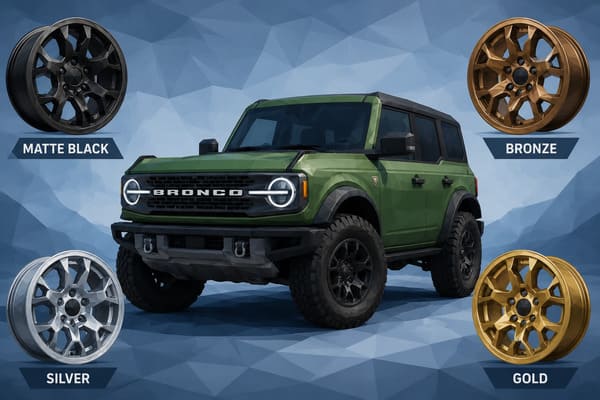
Wheel color for a green Ford Bronco depends on three things: the specific shade of green, the finish type, and the visual mood you want. Darker greens pair best with bronze, gunmetal, or matte black. Brighter greens like Eruption Green can handle matte black, satin silver, or subtle gold.
That conversation reminded me how often wheel color gets treated as an afterthought. It is actually the detail that ties the whole build together. Green is one of the trickiest base colors to work with. Ford alone offers at least four distinct green-toned shades across Bronco model years.1 Each one reacts differently to wheel color. The sections below break this down by color, finish, and real customer builds — so you can make a decision with confidence, not just guesswork.
What Color Rims Go Well with a Green Car?
Green sits in an unusual place on the color wheel.2 Depending on the exact tone, it can lean warm or cool3 — and that single factor changes everything about which wheel color works.
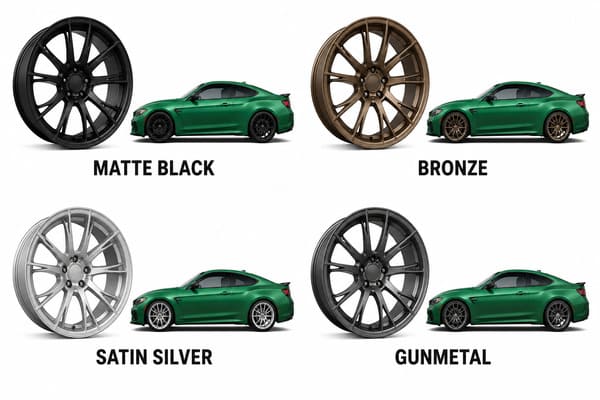
Warm greens like olive and military green pair best with bronze, gunmetal, and matte black because they share the same earthy undertones. Cool or bright greens like teal or Eruption Green can handle stronger contrast, making matte black, satin silver, and subtle gold all viable choices.
I have worked with customers running everything from dark military-olive wraps to factory Eruption Green, and the wheel color that worked on one looked completely wrong on the other. The single biggest mistake customers make is picking a wheel color by looking at a swatch on a screen, rather than holding it against the actual paint in natural daylight.4
Why Undertone Matters More Than You Think
Green is not one color. It is a family of colors, each with its own personality. When you choose a wheel color, you are not just matching a hue — you are matching a mood. Here is how different green tones respond to common wheel colors:
| Green Shade | Warm or Cool | Best Wheel Colors | Colors to Avoid |
|---|---|---|---|
| Eruption Green | Cool-bright | Matte black, satin silver, gold | Mirror chrome, white |
| Olive / Military Green | Warm-dark | Bronze, gunmetal, matte black | Bright silver, neon |
| Forest Green | Cool-dark | Gunmetal, dark bronze, matte black | High-gloss gold |
| Teal / Blue-Green | Cool-medium | Satin silver, gloss black, machined | Warm bronze |
The rule I follow is simple. If the green has yellow or brown in it, go warm with the wheel. If the green has blue in it, go cool or neutral.5 Matching the temperature of the wheel to the temperature of the paint is the fastest way to get a result that looks intentional rather than accidental. I have seen builds where the owner picked the right color but the wrong temperature — and the whole thing felt slightly off without anyone being able to explain why.
Does Black or Bronze Look Better on a Green Bronco?
This is the question I get most often. Probably six or seven out of every ten green Bronco inquiries mention this exact debate. My honest answer is: it depends on how the owner uses the truck.
Black gives a green Bronco a harder, more modern edge. Bronze gives it a natural, rugged feel — like the colors exist together in the same ecosystem. Neither is wrong. They just tell a different story about how the truck is used and where it belongs.
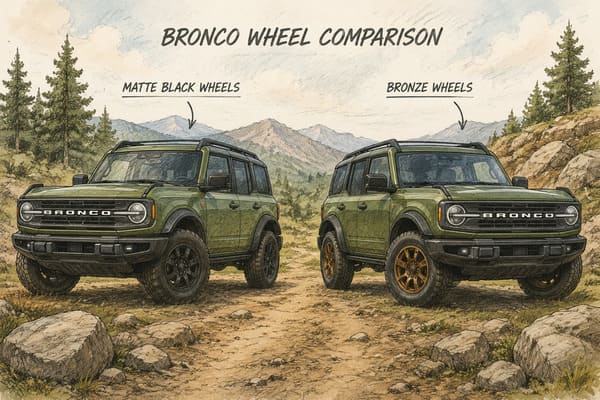
I had one customer in Arizona building a trail rig. He was torn between matte black and bronze. I told him to look at the landscape he drives through most — red dirt, dry brush, earthy tones everywhere. Bronze made his build look like it belonged in that environment. Another customer in Seattle wanted a street-focused build. He went with matte black, and the result looked sharp and aggressive against the wet pavement.
Breaking Down the Black vs. Bronze Decision
The choice between black and bronze is really a choice between two different visual identities. Here is how I help customers think through it:
| Factor | Matte Black | Bronze |
|---|---|---|
| Visual mood | Aggressive, modern, tactical | Natural, rugged, earthy |
| Best environment | Urban, street, overland with dark tones | Desert, forest, off-road terrain |
| Green shades it suits best | Eruption Green, teal, bright green | Olive, military green, forest green |
| Maintenance | Shows dust easily on darker builds | Hides dirt better in earthy tones |
| Finish options | Matte, satin, gloss, powder coat | Satin, brushed, anodized |
One more thing worth saying: bronze has become more popular in the last three years, especially on truck builds.6 It no longer reads as unusual or risky. If a customer was hesitant about bronze two years ago, I would have understood. Today, it is a mainstream choice that photographs well, ages well, and holds up on trail use. Matte black remains the safer default — but bronze is the more interesting answer for the right build.
Can Silver or Chrome Wheels Work on a Green Ford Bronco?
A lot of people dismiss silver and chrome immediately when they think about a Bronco build. I understand why. Full mirror-polish chrome looks out of place on a truck designed for the outdoors.7
Brushed silver and machined-face finishes are genuinely underrated on green Broncos. The rule is simple: the more textured and matte the silver finish, the better it works. Mirror-polish chrome fights the truck’s personality. Brushed or satin silver lands in a sweet spot — premium enough to look refined, rough enough to feel right on a 4×4.
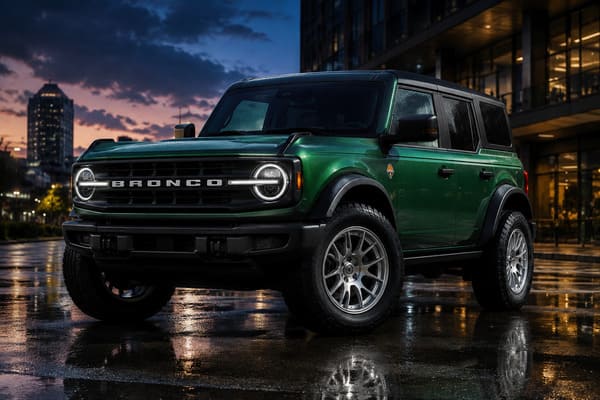
I had a customer last year running a 20-inch machined silver forged wheel on his Eruption Green Bronco. The contrast was clean, not flashy. Several people in his local car club asked about the wheels before they asked anything else about the build.
How to Use Silver Correctly on a Green Build
Silver is a wide category. The finish level changes everything about how it reads on a green vehicle. Here is a breakdown of how different silver finishes perform on a Bronco:
| Silver Finish Type | Visual Effect | Works on Green? | Best Use Case |
|---|---|---|---|
| Mirror-polish chrome | Flashy, reflective, formal8 | No — fights the truck’s character | Show cars, luxury sedans |
| Brushed silver | Subtle, textured, premium9 | Yes — clean contrast | Street builds, daily drivers |
| Satin silver | Smooth, low-glare, modern | Yes — versatile | Mixed use, street and light trail |
| Machined face with silver | Bold, structured, high-detail | Yes — strong visual interest | Show builds, pavement-focused |
| Gunmetal (dark silver) | Aggressive, understated | Yes — works on most greens | Trail rigs, overland builds |
The moment you go mirror-polished, the wheel starts competing with the paint instead of complementing it. A brushed or satin silver finish keeps the wheel looking intentional. It also photographs far better in outdoor settings, which matters if the owner plans to document the build on social media or at shows.
What Finish Type Should You Choose for Green Bronco Wheels?
Finish type is the decision most buyers spend the least time on. It is also the one that affects them every single week they own the wheel.
For a Bronco that sees any trail use, powder coat is the right choice — it is roughly three to four times more chip-resistant than standard wheel paint10 and holds color better under UV exposure.11 Matte and satin finishes hide minor abrasions and are easier to clean.12 Brushed or machined finishes work best for show or pavement-only builds.
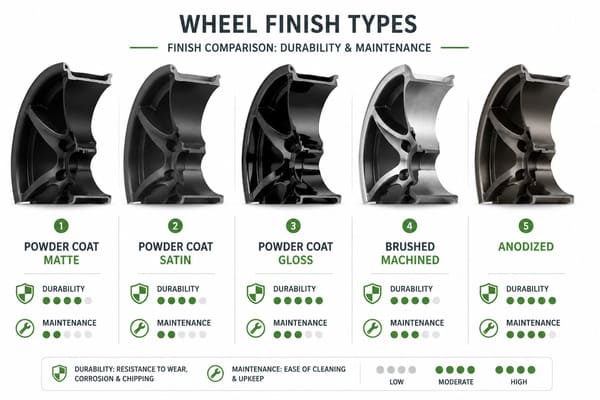
I have had customers come back to us after eight months frustrated because their high-gloss black wheels looked terrible. Not because the color was wrong — but because every rock chip, brake dust stain, and minor scratch showed up immediately. The finish type was the problem, not the color.
Matching Finish to How the Truck Is Actually Used
This is the framework I use with every customer before we confirm a finish. The question is not "what looks best in photos." The question is "what holds up best in real use."
| Finish Type | Durability | Maintenance | Best For |
|---|---|---|---|
| Powder coat matte | High | Low — hides dust and minor marks | Trail use, daily drivers |
| Powder coat satin | High | Low-medium | Mixed use, street and trail |
| Powder coat gloss | Medium | High — shows every mark | Street builds, show trucks |
| Brushed / machined | Medium | Medium — requires regular cleaning | Show builds, pavement use |
| Anodized | High | Low | Lightweight builds, racing |
| Standard paint gloss | Low | High | Not recommended for Broncos |
One More Thing About Powder Coat
Powder coat is not just more durable — it is also more consistent across large surface areas. When we produce forged wheels at Tree Wheels, powder coat gives us a finish that holds its color tone evenly across the entire wheel face. That matters more than most buyers realize. A wheel that looks slightly different on one spoke compared to another is a quality problem that shows up fast under direct sunlight. My general rule is simple: match the finish to how the truck is actually going to be used, not just how it looks in the first photo.
Conclusion
Wheel color on a green Bronco comes down to shade, finish, and use. Get those three right, and the build looks intentional. Get them wrong, and even expensive wheels look like an afterthought. At Tree Wheels, we produce fully customized forged wheels built to match your exact build — color, finish, and size, made to order.
-
"[PDF] 2025 Ford Bronco Order Guide", https://www.fromtheroad.ford.com/content/dam/fordmediasite/us/en/library/2025/order-guides/2025_Ford_Bronco_Order_Guide.pdf. Ford model-year brochures and color guides document multiple green or green-adjacent Bronco exterior colors across recent production years, supporting the claim that Bronco greens vary by model year and paint name. Evidence role: historical_context; source type: other. Supports: Ford has offered several distinct green-toned Bronco colors across model years.. Scope note: Manufacturer color lists establish availability of named colors, but they do not independently classify each shade by undertone. ↩
-
"Color Wheel – Color Calculator | Sessions College", https://www.sessions.edu/color-calculator/. Standard color-theory references describe green as a secondary hue located between yellow and blue on the color wheel, providing context for why green can appear warmer or cooler depending on its neighboring hue bias. Evidence role: definition; source type: education. Supports: Green’s position between yellow and blue helps explain why different greens can read as warm or cool.. Scope note: This supports the color-theory basis of the statement, not any specific automotive styling preference. ↩
-
"Warm versus cool colors and their relation to color perception – PMC", https://pmc.ncbi.nlm.nih.gov/articles/PMC12025320/. Color-theory sources explain that hues can have warm or cool variants depending on whether they are biased toward yellow/red or blue, supporting the claim that different greens can lean warm or cool. Evidence role: mechanism; source type: education. Supports: Green tones can be perceived as warmer or cooler depending on their hue bias.. Scope note: The source would explain perceptual color temperature generally, rather than evaluating Bronco paint colors specifically. ↩
-
"Metamerism (color) – Wikipedia", https://en.wikipedia.org/wiki/Metamerism_(color). Research on color appearance and device color management shows that perceived color varies with display calibration and illumination, supporting the caution that screen swatches may not match painted surfaces viewed in daylight. Evidence role: mechanism; source type: paper. Supports: Screen-based color swatches can misrepresent how a wheel finish will look against real paint in natural light.. Scope note: This evidence supports the general color-perception issue, not the author’s specific customer experiences. ↩
-
"Color theory – Wikipedia", https://en.wikipedia.org/wiki/Color_theory. Color-harmony and color-temperature references explain that yellow-biased hues are commonly treated as warmer and blue-biased hues as cooler, supporting the underlying principle behind matching wheel temperature to paint undertone. Evidence role: expert_consensus; source type: education. Supports: Yellow- or brown-biased greens read warmer, while blue-biased greens read cooler, making temperature matching a plausible design rule.. Scope note: The source would support the color-theory rationale, not prove that these choices are universally preferred on vehicles. ↩
-
"TIS Wheels 2025 SEMA Show Highlights", https://www.youtube.com/watch?v=yFAf51dDA18. Automotive aftermarket trend reports and show coverage can provide contextual evidence that bronze wheel finishes have become more visible in truck and off-road builds in recent years. Evidence role: general_support; source type: institution. Supports: Bronze wheel finishes have gained visibility or popularity in recent truck and off-road builds.. Scope note: Such sources may show industry trend context rather than a quantified market-share increase for Bronco-specific wheels. ↩
-
"2026 Ford Bronco® SUV | Pricing, Photos, Specs & More", https://www.ford.com/suvs/bronco/?srsltid=AfmBOorvTC1ao0EwC4gS5yJ2_eYiFthGAskovKddCIOF51F6FGnz0SF2. Ford’s Bronco launch and product materials describe the modern Bronco as an off-road-oriented vehicle with features intended for trail and outdoor use, supporting the contextual claim about its design purpose. Evidence role: historical_context; source type: other. Supports: The Ford Bronco is positioned and engineered as an outdoor/off-road vehicle.. Scope note: This supports the Bronco’s intended outdoor/off-road positioning, not the aesthetic judgment that chrome is unsuitable. ↩
-
"Chromium – Wikipedia", https://en.wikipedia.org/wiki/Chromium. Materials and surface-finishing references describe polished chromium finishes as highly specular and reflective, supporting the characterization of mirror-polished chrome as a high-reflectance wheel finish. Evidence role: definition; source type: encyclopedia. Supports: Mirror-polished chrome has a highly reflective surface appearance.. Scope note: The evidence supports the physical reflectivity of chrome, not the subjective descriptors “flashy” or “formal.” ↩
-
"Brushed metal – Wikipedia", https://en.wikipedia.org/wiki/Brushed_metal. Surface-finishing references describe brushing as a mechanical abrasion process that produces a directional, textured metal appearance, supporting the claim that brushed silver differs visually from polished silver or chrome. Evidence role: definition; source type: education. Supports: A brushed silver finish has a directional textured surface produced by abrasive finishing.. Scope note: The source would support the “textured” aspect directly; terms such as “subtle” and “premium” remain design judgments. ↩
-
"Liquid vs Powder – Pros and cons – TIGER Coatings", https://www.tiger-coatings.com/about/tiger-blog/liquid-vs-powder-pros-and-cons. Comparative coating-performance tests or technical coating references can support whether powder coatings show greater chip or impact resistance than conventional liquid paints under standardized testing. Evidence role: statistic; source type: paper. Supports: Powder coating can be substantially more chip-resistant than standard liquid wheel paint.. Scope note: The exact “three to four times” figure should be used only if the source reports a comparable test method and coating system; otherwise the citation should support a more general durability claim. ↩
-
"Do Some Powder Coating Colors Last Longer?", https://www.anocotepowder.com/blog/do-some-powder-coating-colors-last-longer/. Coatings research on polyester powder coatings and UV weathering can support the claim that certain powder-coat systems are formulated for improved color and gloss retention under ultraviolet exposure. Evidence role: mechanism; source type: research. Supports: Appropriate powder-coat systems can provide improved color retention under UV exposure.. Scope note: UV durability depends on resin chemistry, pigments, pretreatment, and exposure conditions, so the support may not apply equally to all powder-coated wheels. ↩
-
"Optimizing Defect Detection on Glossy and Curved Surfaces Using …", https://pmc.ncbi.nlm.nih.gov/articles/PMC12031545/. Optical studies of surface gloss and roughness show that gloss level affects the visibility of surface defects, supporting the idea that lower-gloss finishes can make minor abrasions less visually prominent. Evidence role: mechanism; source type: paper. Supports: Matte and satin finishes can reduce the visual prominence of small scratches or abrasions compared with glossy surfaces.. Scope note: The evidence may support reduced defect visibility more directly than ease of cleaning; cleaning performance depends on coating texture and contamination type. ↩