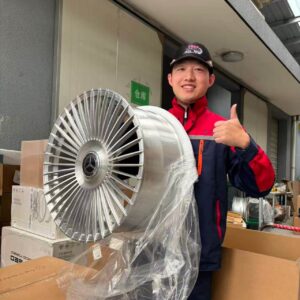

A customer sent me a photo of his red Giulia last year with one question: "Which finish?" He had already spent $8,000 on suspension and brakes. The wheels were the last piece.
The best wheel finishes for a red Alfa Romeo Giulia are dark gunmetal, bronze, and gloss or matte black. Each finish changes the mood of the car differently. Dark gunmetal grounds the red and adds visual weight. Bronze adds warmth without competing with the paint. Black creates the sharpest contrast.
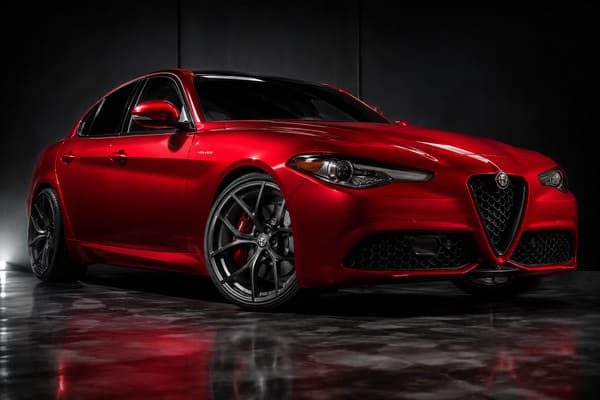
I told that customer the answer wasn’t about which finish was most popular. It was about which finish would make the whole build feel intentional. We spent 20 minutes on WhatsApp going back and forth. He ordered dark gunmetal. Three weeks later he sent me a photo. The car looked like it was designed that way from the factory. That conversation is why I’m writing this article.
What Wheel Finish Colors Actually Complement a Red Alfa Romeo Giulia?
Most people think "complement" means "match." It doesn’t. Red is already a statement color1. If your wheels try to match that energy, they compete with the car instead of completing it.
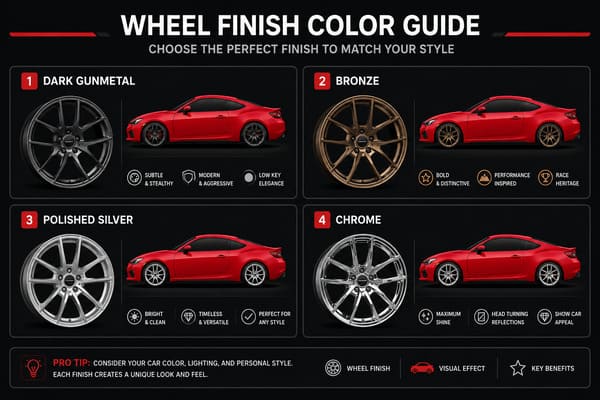
The two finishes that work best on a red Giulia are dark gunmetal and bronze. Gunmetal pulls visual weight downward and grounds the red. Bronze echoes the warmth in the paint without copying it. Both finishes let the car’s color stay the focal point.
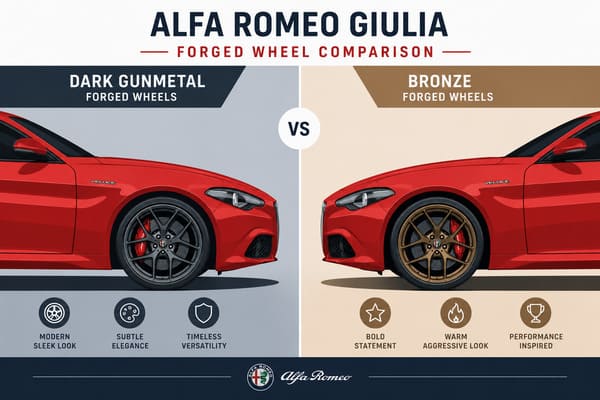
In my experience working with hundreds of red car builds, about 60% of customers initially ask for silver or chrome because it feels safe. But almost none of them end up with silver after we talk through the options. I had one customer with a Rosso Competizione2 Giulia who was completely set on polished silver. I sent him a side-by-side render of silver versus bronze on his exact paint color. He switched to bronze immediately. His words: "I didn’t know a wheel color could change the whole personality of the car."
Why Silver and Chrome Often Disappoint on Red Cars
Silver and chrome are reflective. On a red car, that reflectivity pulls attention away from the paint and toward the wheels3. The result is a build that feels split rather than unified.
| Finish | Effect on Red Paint | Best For |
|---|---|---|
| Dark Gunmetal | Grounds the car, adds visual weight | Aggressive or sporty builds |
| Bronze | Adds warmth, deepens the red | Elegant or track-inspired builds |
| Polished Silver | High contrast, draws eye to wheel | Show cars, not daily drivers |
| Chrome | Very high gloss, competes with paint | Rarely works on red |
The other reason I steer customers away from silver is maintenance. A polished or chrome finish on a performance car picks up brake dust, road film, and water spots faster than any other finish4. On a car you actually drive, that means cleaning every few days to keep the look you paid for. Dark gunmetal and bronze are far more forgiving in real-world use. They hold their appearance longer between washes, which matters more than most buyers realize before they take delivery.
What Color Rims Go With a Red Car?
Here is something I tell every customer who comes to me with a red car: the wheel color should answer the question, "what mood does this car have?" Red cars exist on a spectrum, and the finish needs to match the mood, not just the paint code.
For bright reds, dark finishes like gloss black or dark gunmetal create the sharpest contrast and the most aggressive look. For deep, wine-toned reds, warm finishes like bronze or rose gold pull out the depth in the paint in a way that silver and chrome simply cannot.
I tracked our order data over the past year and found that customers with deep red cars chose bronze or two-tone machined finishes about three times more often than customers with bright red cars. That pattern is consistent and it makes sense once you understand how light interacts with dark paint.
Matching Finish to Your Specific Shade of Red
Not all reds behave the same way in sunlight or under artificial light. A bright, punchy red like Alfa’s Rosso Alfa reflects light evenly. A deep red like Rosso Competizione absorbs light and shows more complexity. The wheel finish should work with that behavior, not against it.
| Shade of Red | Recommended Finish | Why It Works |
|---|---|---|
| Bright / Pure Red | Gloss Black, Dark Gunmetal | Maximum contrast, sharp and aggressive |
| Deep / Wine Red | Bronze, Rose Gold, Two-Tone Machined | Adds warmth, brings out paint depth |
| Metallic Red | Dark Gunmetal, Satin Black | Complements the metallic flake without competing |
| Matte Red | Matte Black, Satin Bronze | Keeps the surface texture consistent |
Two-tone machined finishes are worth mentioning separately. The machined face catches light differently than the spokes. That layered look adds dimension to the wheel without adding visual noise to the build. It works on almost every shade of red, which is why it consistently appears in our top five most ordered finishes for red cars across all markets we serve, including the US, Australia, and the UK.
Does Gloss Black or Matte Black Look Better on a Red Giulia?
This is the question I get most often, and my answer always surprises people: neither is universally better. They do completely different things to the same car.
Gloss black on a red Giulia creates a sharp, high-contrast look that photographs extremely well and looks aggressive in person. Matte black softens that contrast, gives the car a more understated presence, and hides surface imperfections far better in daily use.
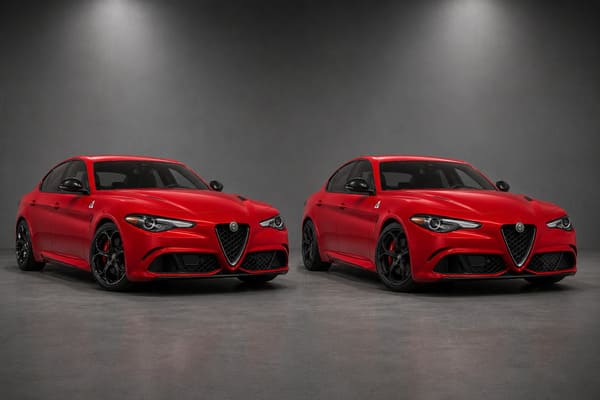
I always warn customers about gloss black before they commit: it shows brake dust within three days of driving, and a single water spot after rain is visible from five meters away. That is not an exaggeration. I have had customers call me after their first week with gloss black wheels saying they feel like they need to wash the car every other day. They are not wrong.
The Real Difference Between Gloss and Matte Black in Daily Use
From a production standpoint, matte finishes use a different surface treatment process. They are also more vulnerable to chemical cleaners5. One wrong product and you have permanent streaks. That is not a defect in the wheel — it is a property of the finish that every buyer needs to know before they order.
| Factor | Gloss Black | Matte Black |
|---|---|---|
| Visual Effect | Sharp, aggressive, high contrast | Understated, modern, softer contrast |
| Brake Dust Visibility | Very high | Low to moderate |
| Water Spot Visibility | Very high | Low |
| Cleaning Frequency | Every 2–3 days in heavy use | Weekly in most conditions |
| Cleaning Products | Standard wheel cleaner | Matte-specific products only |
| Refinishing Risk | Lower | Higher if wrong products used |
| Best Use Case | Show cars, weekend builds | Daily drivers, performance builds |
About 70% of my first-time wheel buyers who choose matte black contact me within a year asking about refinishing options. Not because the wheels failed. Because they used the wrong cleaner once or twice and the finish changed. Experienced enthusiasts know this going in. First-time upgraders often don’t, and I always make sure to tell them before the order is placed. A wheel finish is not just an aesthetic choice. It is also a maintenance commitment, and the two are inseparable.
What Wheels Fit an Alfa Romeo Giulia?
The Giulia has a 5×110 bolt pattern. That immediately eliminates the majority of off-the-shelf wheels on the market, and it is one of the main reasons Giulia owners end up working with custom forged manufacturers like us.
The Alfa Romeo Giulia uses a 5×110 bolt pattern6. Factory sizes run from 17 to 19 inches depending on trim7. For performance builds, 19×8.5 front and 19×9.5 rear in a staggered setup is the most common fitment8. Safe offset range is ET40 to ET459.
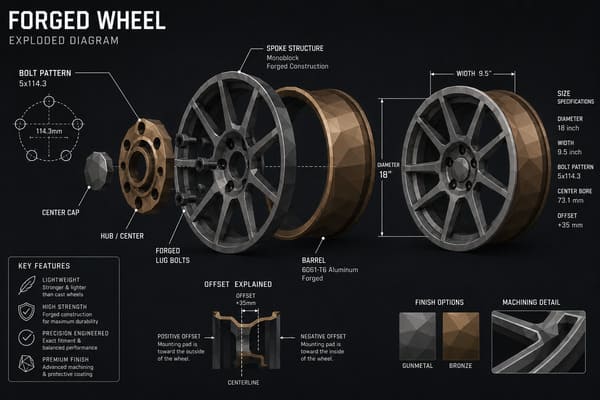
Offset is where most buyers make mistakes. I had a customer last year who ordered wheels from another supplier at ET35 without checking. The wheels rubbed on the front strut at full lock. He ended up buying hub spacers as a fix, but the fitment never looked fully intentional. When I build wheels for the Giulia, I always ask for the exact trim level and whether the car has been lowered, because a 10mm drop changes the clearance calculation.
Fitment Specs and Weight Advantages of Forged Wheels for the Giulia
Getting the fitment right on a Giulia is not just about avoiding rubbing. It is about making the wheel sit correctly in the arch so the whole build looks like it was engineered that way. A wheel that sits too far inward loses visual impact. A wheel that sits too far outward creates clearance problems. The numbers below are what I use as starting points for every Giulia build we take on.
| Trim Level | Factory Wheel Size | Recommended Forged Size | Offset Range |
|---|---|---|---|
| Base / Sprint | 17 inch | 18×8.0 or 19×8.5 | ET40–ET45 |
| Super / Veloce | 18–19 inch | 19×8.5 / 19×9.5 staggered | ET40–ET45 |
| Quadrifoglio | 19 inch | 19×9.0 / 19×10.0 staggered | ET38–ET42 |
One more thing worth knowing: a forged wheel for the Giulia typically comes in at 8 to 9 kg per wheel, compared to 11 to 13 kg for the OEM cast wheels10. That 3 to 4 kg difference per corner reduces unsprung rotational mass. The result is improved steering response and better brake feel11 — something you notice immediately on the first drive. For a car like the Giulia, which is already engineered for driver engagement12, that weight reduction is not a small upgrade. It changes how the car communicates with you through the steering wheel and the pedals. That is the part most buyers don’t expect, and it is consistently the part they mention first when they report back after delivery.
Conclusion
The right finish on a red Giulia is not about following a color chart. Every finish decision is a communication decision — it tells people what kind of driver you are. We have helped hundreds of Giulia owners get that decision right, and we are ready to help you do the same. Tree Wheels offers fully custom forged wheels built to your exact Giulia fitment — contact us to start your build.
-
"The color red attracts attention in an emotional context. An ERP study", https://pmc.ncbi.nlm.nih.gov/articles/PMC4413730/. Research in color psychology and visual perception indicates that red occupies a privileged position in human attention hierarchies, attributed in part to its long wavelength and cultural associations, making it one of the most visually salient colors in the spectrum. Evidence role: mechanism; source type: paper. Supports: Red is a perceptually dominant color that attracts visual attention more readily than many other hues. Scope note: Most color psychology research addresses human behavioral and emotional responses rather than automotive aesthetics specifically; application to wheel finish selection is inferential. ↩
-
"The many shades of Rosso Competizione – Alfa Romeo Giulia Forum", https://www.giuliaforums.com/threads/the-many-shades-of-rosso-competizione.51231/page-3. Alfa Romeo’s official configurator and press materials list Rosso Competizione as a distinct paint option for the Giulia, characterized as a deep, metallic red differentiated from the brighter Rosso Alfa solid color. Evidence role: definition; source type: other. Supports: Rosso Competizione is an official Alfa Romeo paint designation available on the Giulia. Scope note: Color availability varies by model year and regional market; availability should be confirmed against the manufacturer’s current configurator for the specific market and year in question. ↩
-
"A New Perspective on the Role of Physical Salience in Visual Search", https://pmc.ncbi.nlm.nih.gov/articles/PMC9905344/. Visual perception research demonstrates that specular highlights—intense, localized reflections from glossy or mirror-like surfaces—are processed as salient visual events, drawing fixation away from surrounding matte or diffuse surfaces. Evidence role: mechanism; source type: paper. Supports: Highly specular (mirror-like) surfaces attract disproportionate visual attention due to the intensity and variability of light they reflect. Scope note: This research addresses general visual attention mechanisms; its direct application to automotive wheel finish selection involves an inferential step not validated in controlled automotive design studies. ↩
-
"Brake wear particle emissions: a review – PMC – NIH", https://pmc.ncbi.nlm.nih.gov/articles/PMC4315878/. Brake dust is primarily composed of iron particles shed from cast-iron rotors, along with carbon residues and rubber compounds; these dark particulates create high visual contrast against polished or chrome surfaces, making contamination more immediately apparent than on dark or textured finishes. Evidence role: mechanism; source type: research. Supports: Brake dust, composed largely of iron particles and carbon compounds, is more visually apparent on light or reflective wheel finishes than on dark or matte surfaces. Scope note: Systematic comparative studies on contamination visibility across specific wheel finishes under standardized conditions are limited in the published literature; this claim is supported by the known composition of brake dust rather than direct finish-comparison research. ↩
-
"Powder Coating—Choosing Color, Gloss and Texture", https://xometry.pro/en-eu/articles/powder-coating-gloss-texture/. Matte finishes on aluminum wheels are typically produced by controlled surface texturing or low-sheen powder coat formulations; the micro-textured surface that creates the matte appearance can be irreversibly smoothed or stained by strong alkaline or acidic wheel cleaners, a vulnerability less pronounced in gloss-coated surfaces where the protective layer is more chemically uniform. Evidence role: mechanism; source type: research. Supports: Matte surface finishes, whether achieved through powder coating, anodizing, or mechanical texturing, have different chemical resistance profiles than gloss finishes and can be permanently altered by alkaline or acidic cleaning agents. Scope note: Chemical resistance varies significantly by specific coating formulation and manufacturer; generalizations about ‘matte finishes’ as a category may not apply uniformly to all products. ↩
-
"Alfa Romeo Giulia Wheels & Rims | 2017-2021 | Free Shipping!", https://www.bbwheelsonline.com/2017-to-2021-alfa-romeo-giulia-rims-wheels-5×110-bolt-pattern-black-chrome/?srsltid=AfmBOoqX3RP8SBwXdprK3kprl3FBdJPkvZ175J9_NNYOryk8SH96WWG2. The Alfa Romeo Giulia (Type 952) uses a 5×110 mm bolt pattern, a specification shared with select other Stellantis-platform vehicles and distinct from the more common 5×112 or 5×114.3 patterns used by many European competitors. Evidence role: definition; source type: encyclopedia. Supports: The Alfa Romeo Giulia’s wheel bolt pattern is 5×110. Scope note: Bolt pattern data from enthusiast databases or manufacturer documentation should be cross-referenced with the specific model year, as platform changes can occasionally alter fitment specifications. ↩
-
"Rim width help | Alfa Romeo Giulia Forum", https://www.giuliaforums.com/threads/rim-width-help.57724/. Alfa Romeo’s official configurator and press documentation for the Giulia (Type 952) list wheel sizes ranging from 17 inches on base trims to 19 inches on performance-oriented variants such as the Veloce and Quadrifoglio. Evidence role: general_support; source type: other. Supports: Factory wheel sizes on the Giulia range from 17 to 19 inches depending on trim level. Scope note: Exact sizes vary by model year and regional market; readers should consult the manufacturer’s specifications for their specific vehicle configuration. ↩
-
"Staggered Wheels??? | Alfa Romeo Giulia Forum", https://www.giuliaforums.com/threads/staggered-wheels.26682/. Fitment databases and Alfa Romeo Giulia owner communities document staggered 19-inch configurations as a prevalent aftermarket choice, consistent with the vehicle’s rear-wheel-drive architecture, which benefits from wider rear contact patches for traction and visual stance. Evidence role: general_support; source type: other. Supports: Staggered 19-inch fitments with wider rear wheels are a common aftermarket configuration for the rear-wheel-drive Alfa Romeo Giulia. Scope note: Optimal fitment depends on suspension modifications, ride height, and individual wheel design; figures cited represent common starting points rather than universally applicable specifications. ↩
-
"Rim width help | Alfa Romeo Giulia Forum", https://www.giuliaforums.com/threads/rim-width-help.57724/. Fitment resources for the Alfa Romeo Giulia (Type 952) commonly cite an offset range of approximately ET38–ET45 as compatible with factory suspension geometry, with deviations outside this range associated with increased risk of contact with suspension components or wheel arch liners. Evidence role: general_support; source type: other. Supports: Wheel offsets in the ET40–ET45 range are generally compatible with the Alfa Romeo Giulia’s suspension and brake clearance geometry. Scope note: Safe offset range is affected by wheel width, tire profile, suspension lowering, and individual vehicle tolerances; these figures should be treated as general guidance and verified against the specific wheel and vehicle configuration before purchase. ↩
-
"Is there a weight difference between new forged aluminum wheels …", https://www.facebook.com/groups/bmwr1300gs/posts/725169073079659/. Studies comparing forged and cast aluminum wheel manufacturing processes consistently report that forged wheels achieve greater strength-to-weight ratios, with weight savings per wheel commonly cited in the range of 20–35% relative to cast equivalents of the same diameter and width. Evidence role: statistic; source type: research. Supports: Forged aluminum wheels are meaningfully lighter than cast aluminum OEM wheels of equivalent size. Scope note: Exact weights vary by wheel design, spoke count, and diameter; the specific figures cited for the Giulia are illustrative estimates and should be confirmed against manufacturer data sheets for the wheels in question. ↩
-
"Unsprung mass – Wikipedia", https://en.wikipedia.org/wiki/Unsprung_mass. Automotive engineering literature establishes that unsprung mass—components not supported by the suspension spring—directly affects a vehicle’s ability to follow road irregularities; reducing rotational inertia at the wheel additionally lowers the gyroscopic resistance that the steering system must overcome, contributing to improved responsiveness. Evidence role: mechanism; source type: education. Supports: Reducing unsprung and rotational mass at the wheel improves vehicle handling, steering response, and braking performance. Scope note: The magnitude of perceptible improvement depends on total vehicle weight, suspension tuning, and driving conditions; subjective descriptions of ‘feel’ are difficult to quantify universally. ↩
-
"FCA Giorgio platform – Wikipedia", https://en.wikipedia.org/wiki/FCA_Giorgio_platform. Alfa Romeo’s press materials and independent automotive reviews of the Giulia (Type 952) consistently highlight the vehicle’s Giorgio platform as developed with rear-wheel-drive dynamics, near 50:50 weight distribution, and driver-focused chassis tuning as central engineering objectives. Evidence role: historical_context; source type: other. Supports: The Alfa Romeo Giulia was developed with an explicit focus on driving dynamics and driver engagement. Scope note: Claims of ‘driver engagement’ are partly subjective and marketing-influenced; independent assessments from automotive publications provide more neutral corroboration than manufacturer statements alone. ↩