

Getting the offset wrong on a Nova SS doesn’t just look bad — it can destroy your build. One wrong number, and you’re looking at rubbing tires, damaged fenders, and weeks of delays.
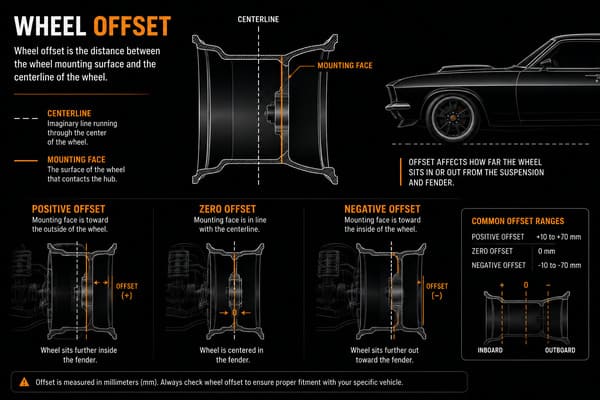
Wheel offset is the distance between a wheel’s mounting face and its centerline. For a Chevrolet Nova SS, the stock offset sits between +0mm and +6mm1. For a wider, aggressive stance, most builders run -12mm to -25mm on the rear and stay near 0mm on the front.

Offset is one of those specs that looks simple on paper but causes real problems when it’s wrong. I’ve seen it happen more than once. A shop orders wheels with an offset that’s "close enough," and three weeks later they’re paying to ship everything back. On a classic muscle car like the Nova SS, getting this number right is the difference between a clean build and an expensive mistake. Let me walk you through everything you need to know.
What Is Wheel Offset and Why Does It Matter for Your Nova SS?
Most people treat offset as a minor detail. It isn’t. Get it wrong on a Nova SS, and your tires will eat through the inner fender liner before you finish the first hard turn.
Wheel offset is measured in millimeters. It tells you how far the wheel’s mounting face sits from its true centerline. A positive offset pushes the wheel inward toward the car. A negative offset pushes it outward. On a classic platform like the Nova SS, even a 10mm error changes how the tire sits inside the wheel well.
Last year, a modification shop in California contacted me after a customer complained about rubbing on a Nova SS build. They had ordered wheels with a +25mm offset, thinking it was close enough to the original spec. It wasn’t. The wheel sat 31mm further inward than intended, and the tire was cutting into the inner fender liner on every hard turn. We remade all four wheels at -4mm offset to fix it. The whole problem cost them three weeks and roughly $800 in back-and-forth shipping.
That story isn’t unusual. It’s what happens when offset gets treated as a rough estimate instead of a precise spec.
Why Offset Affects More Than Just Clearance
Offset doesn’t only control whether the tire rubs. It changes how the entire front end behaves.
| Effect | What Happens When Offset Is Wrong |
|---|---|
| Bearing Load | Incorrect offset shifts the load point on the wheel bearing, causing premature wear2 |
| Steering Feel | Too much positive offset on the front makes the car feel twitchy and nervous3 |
| Tire Clearance | Wrong offset pushes the tire into the fender liner or suspension components |
| Track Width | Offset directly controls how wide the car sits, which affects cornering stability4 |
| Hub Centering | Offset errors can cause the wheel to sit off-center on the hub, creating vibration5 |
The Nova SS was designed around a very specific hub position. The suspension geometry, the fender clearance, and the brake hardware all assume the wheel sits in one exact location. Shift that position by even 10mm and you change how the car tracks, how the bearings load, and how much room the tire has to move. Offset isn’t just a number on a spec sheet. It’s the measurement that holds the entire build together.
What Is the Stock Offset for a Chevrolet Nova SS?
A lot of builders assume they already know the stock offset. Most of them are wrong. And that assumption is where expensive problems start.
The Chevrolet Nova SS from the late 1960s and early 1970s ran a stock offset between +0mm and +6mm. This near-zero offset was standard for American muscle cars of that era6. The wheels were pushed outward to fill wide fenders and clear the drum brake hardware underneath.
I always ask customers to confirm their exact OEM offset before we start any design work. One customer last spring came to me wanting to keep the stock look on his 1970 Nova SS. He assumed the offset was +12mm because someone on a forum told him so. The actual measurement from his original wheel was +4mm. That 8mm difference doesn’t sound like much. But on a classic platform with tight fender clearance, it would have pushed the tire 8mm deeper into the wheel well and caused rubbing under load.
Stock offset is your baseline. You have to confirm it before you can do anything else.
How to Confirm Your Stock Offset Before Ordering
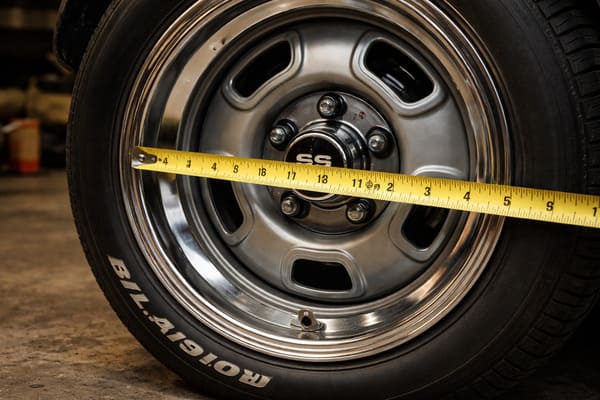
Don’t rely on forum posts or general guides to confirm your offset. Measure it yourself, or have your shop measure it.
| Method | How It Works | Accuracy |
|---|---|---|
| Measure the original wheel | Use a straight edge and ruler across the wheel face to find the centerline, then measure to the mounting face | High — most reliable method |
| Check the wheel stamp | Many OEM wheels have the offset stamped on the back of the spoke or barrel | Medium — stamp can be worn or misread |
| Use a fitment database | Sites like Wheel-Size.com list factory specs by year and trim | Medium — useful as a starting reference only |
| Ask a specialist | A forged wheel supplier with classic muscle experience can cross-reference your build | High — especially useful for modified suspensions |
The Nova SS also came in multiple configurations across its production years. A 1966 Nova SS and a 1972 Nova SS are not the same car. The suspension geometry changed, the brake hardware changed, and the fender clearances changed.7 Always confirm the exact year and any suspension modifications before treating any number as a baseline.
What Offset Range Works Best for a Wider, Aggressive Stance on the Nova SS?
Most builders want their Nova SS to look wide and planted. But chasing that stance without the right offset numbers will cost you more than just time.
For a Nova SS build targeting a wide, aggressive stance, the most common offset range is -12mm to -25mm on the rear. The front typically stays near 0mm to preserve steering feel and front-end geometry. These are starting points only — your final offset must come from your exact suspension and axle measurements.

I worked with a shop in Texas last year that was building a street/strip Nova SS with a 15×10 rear wheel. They wanted -18mm offset. On paper, it looked fine. But when we factored in their custom rear axle — which had a 2-inch wider track than stock — the actual clearance dropped to almost nothing. We adjusted to -22mm to push the wheel outward and clear the frame rail. That 4mm change made the difference between a clean build and a rubbing problem.
Offset Ranges by Build Type
The right offset range depends on what you’re building the Nova SS to do.
| Build Type | Rear Offset Range | Front Offset Range | Notes |
|---|---|---|---|
| Stock Restoration | +0mm to +6mm | +0mm to +6mm | Match OEM specs exactly |
| Street Cruiser | -6mm to -12mm | 0mm to -6mm | Slight stance improvement without suspension changes |
| Street/Strip | -12mm to -22mm | 0mm to -10mm | Wider rear for traction, front stays close to stock |
| Full Drag Build | -18mm to -25mm | 0mm to +6mm | Narrow front, wide rear for maximum traction |
| Show Build | -20mm to -30mm | -10mm to -20mm | Maximum visual stance, may require body modifications |
A few things affect where your offset lands within these ranges. Your rear axle width is the biggest factor. A stock rear axle and a custom 9-inch with a wider housing will produce completely different clearance numbers even at the same offset. Your suspension type matters too. A four-link rear suspension sits differently than a leaf spring setup, and that changes how much room you have between the tire and the frame. At Tree Wheels, we produce custom offset per wheel for exactly this reason. The range is your starting point. The final number has to come from your actual measurements.
What Are Some Popular Modifications for the Chevy Nova SS?
The Nova SS has one of the most dedicated builder communities in American muscle. And the modifications these builders choose directly affect what wheel specs they need.
The most common Nova SS modifications include rear wheel upgrades to 15×10 or 15×12 for drag builds, full tub conversions for maximum tire clearance, and LS or big block engine swaps. Each of these changes the wheel requirements, especially offset, load rating, and wheel weight.

A lot of builders are moving away from steel and cast aluminum toward forged wheels. The reason is simple — weight and strength. A typical cast wheel in a 15×10 size runs around 22–25 lbs. A forged equivalent comes in at 17–19 lbs.8 That’s a 5–8 lb difference per corner. On a drag build, unsprung weight directly affects 60-foot times. Lighter wheels mean the suspension can react faster, and the tire plants harder off the line9.
How Common Mods Change Your Wheel Spec Requirements
| Modification | How It Affects Wheel Specs |
|---|---|
| LS Engine Swap | Higher torque output demands stronger wheels — forged construction recommended |
| Big Block Swap | Increased weight over the front axle changes front wheel load requirements |
| Rear Tub Conversion | Removes the inner fender liner, allowing much wider tires and more aggressive negative offset |
| Custom Rear Axle | Changes the track width, which directly shifts the offset required for proper fitment |
| Four-Link Suspension | Changes the geometry of how the rear wheel sits, affecting both offset and backspacing |
| Coilover Conversion | Alters front clearance, may require offset adjustment to avoid contact with coilover body |
I’ve made wheels for Nova SS builds ranging from clean street cruisers to full race cars. The customer almost always knows exactly what they want visually. My job is to make sure the specs behind that vision actually work. When a builder tells me they want a 15×10 rear with a deep lip and a wide stance, I don’t just start on the design. I ask about the axle, the suspension, the tub, and the fender clearance. Every one of those answers changes the offset. Getting those numbers right before production starts is what separates a clean build from a costly one.
Conclusion
Offset controls everything on a Nova SS build — clearance, stance, handling, and bearing life. Confirm your stock baseline, choose your range by build type, and always verify against your actual measurements.
Tree Wheels produces fully custom forged wheels with precise offset specifications — built for classic muscle builds that demand exact fitment.
-
"Chevrolet Chevy II / Nova – Wikipedia", https://en.wikipedia.org/wiki/Chevrolet_Chevy_II_/_Nova. Factory service documentation or verified fitment databases for the Chevrolet Nova SS list the original wheel offset in the near-zero to slightly positive range, consistent with standard American muscle car wheel packaging of the era. Evidence role: general_support; source type: other. Supports: The factory wheel offset range for the Chevrolet Nova SS across its production years. Scope note: Offset specifications varied across model years and trim configurations; a single range may not apply uniformly to all Nova SS variants. ↩
-
"Have you noticed premature wheel bearing wear with offset rims?", https://www.facebook.com/groups/335580669908320/posts/3475394415926914/. Automotive engineering analyses of wheel and hub assembly dynamics demonstrate that offset deviation from the design specification increases the bending moment applied to the wheel bearing, which can reduce bearing service life. Evidence role: mechanism; source type: paper. Supports: That deviating from the designed wheel offset alters the bending moment and load path at the wheel bearing, accelerating wear. Scope note: The magnitude of wear acceleration depends on the degree of offset deviation, vehicle weight, and operating conditions; the claim of ‘premature wear’ is directionally supported but not quantified. ↩
-
"Negative impact on steering feel with increasing scrub radius, let’s …", https://www.facebook.com/groups/proawetechforum/posts/4461511107414302/. Suspension geometry references explain that increasing positive wheel offset reduces or reverses the scrub radius, which can make steering more sensitive to road surface irregularities and braking forces, producing a less stable steering feel. Evidence role: mechanism; source type: education. Supports: That increased positive offset alters scrub radius geometry, which affects steering feedback and stability. Scope note: The subjective description of ‘twitchy and nervous’ depends on the degree of offset change and the specific suspension design; this is a directional effect rather than a universal outcome. ↩
-
"[PDF] DEPARTMENT OF TRANSPORTATION – NHTSA", https://www.nhtsa.gov/sites/nhtsa.dot.gov/files/rolloverresistance_0.pdf. Vehicle dynamics principles establish that increasing track width lowers the roll center relative to the center of gravity, reducing lateral load transfer during cornering and improving stability; wheel offset is one of the parameters that determines effective track width. Evidence role: mechanism; source type: education. Supports: That track width, which is influenced by wheel offset, affects a vehicle’s lateral stability and cornering behavior. Scope note: Track width is one of several factors affecting cornering stability; suspension geometry, center of gravity height, and tire characteristics also play significant roles. ↩
-
"How To Solve Wheel Vibration | What Are Hub Centric Rings?", https://www.youtube.com/watch?v=Gz1k5ZEGDto. Automotive wheel fitment references distinguish between offset, which positions the wheel laterally, and hub centricity, which ensures the wheel bore is concentric with the hub flange; vibration from wheel imbalance or runout is more directly associated with hub centricity errors, though severe offset mismatches can also introduce dynamic imbalance. Evidence role: mechanism; source type: education. Supports: That improper wheel fitment relative to the hub can produce vibration. Scope note: The article’s attribution of vibration specifically to offset errors may conflate offset with hub bore concentricity; the two are related fitment parameters but have distinct mechanical effects. ↩
-
"Muscle car – Wikipedia", https://en.wikipedia.org/wiki/Muscle_car. Automotive engineering literature from the period indicates that American rear-wheel-drive muscle cars of the late 1960s and early 1970s commonly used near-zero offset wheels to accommodate wide drum or disc brake assemblies and fill broad fender openings. Evidence role: historical_context; source type: encyclopedia. Supports: That near-zero or low-positive offset was characteristic of American muscle car wheel design in the late 1960s and early 1970s. Scope note: Offset practices varied by manufacturer and model line; this characterization is a generalization across a diverse vehicle segment. ↩
-
"Chevrolet Chevy II / Nova – Wikipedia", https://en.wikipedia.org/wiki/Chevrolet_Chevy_II_/_Nova. Automotive historical records document that the Chevrolet Nova underwent a full platform redesign between its second generation (1966–1967) and third generation (1968–1974), with changes to body structure, suspension architecture, and available brake configurations that affect wheel fitment parameters. Evidence role: historical_context; source type: encyclopedia. Supports: That the Chevrolet Nova SS changed substantially across model years between 1966 and 1972, including suspension and chassis differences. Scope note: Specific dimensional changes to fender clearances and offset requirements across years are not uniformly documented in general historical sources and require model-specific verification. ↩
-
"Cast vs. Forged Wheels (Comparing EXACT Sizes) – YouTube", https://www.youtube.com/watch?v=KjgyrEo5GcU. Comparative studies and manufacturer specifications for aluminum alloy wheels consistently show that forged wheels achieve lower mass than cast equivalents of the same dimensions, with reported weight reductions typically in the range of 20–30 percent, attributable to the higher material density achievable through the forging process. Evidence role: statistic; source type: research. Supports: That forged aluminum wheels are meaningfully lighter than cast aluminum wheels of equivalent size. Scope note: Exact weights vary significantly by manufacturer, design, and spoke configuration; the specific figures cited (22–25 lbs cast, 17–19 lbs forged) are illustrative estimates rather than universal benchmarks. ↩
-
"How does adding unsprung weight to a car affect its handling and …", https://www.facebook.com/groups/proawetechforum/posts/4273417109557037/. Vehicle dynamics literature establishes that unsprung mass reduction improves the ability of the suspension to follow road surface variations, maintaining tire contact patch load; additionally, reduced rotational inertia of the wheel-tire assembly lowers the energy required for acceleration, both of which contribute to improved launch performance. Evidence role: mechanism; source type: paper. Supports: That reducing unsprung and rotational wheel mass improves suspension compliance and traction during acceleration. Scope note: The magnitude of the effect on 60-foot times depends on total vehicle weight, suspension design, and tire characteristics; isolated wheel weight reduction is one of several contributing factors. ↩