

The wrong offset on a classic build doesn’t just look bad — it costs real money. I’ve seen it happen more than once, and the 1969 Camaro is one of the most misunderstood fitments in the business.
The 1969 Chevrolet Camaro needs a wheel offset between -6mm and +6mm1, depending on trim. The factory steel wheels run approximately 0mm offset with a backspacing of 4.25" to 4.5"2 on a standard 14×6" wheel. Modern offset standards do not apply to this platform.3
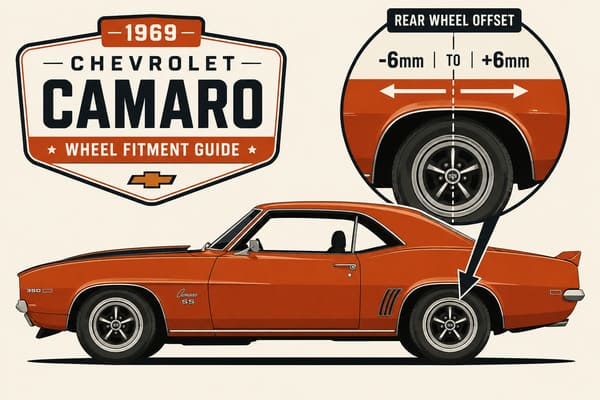
I had a customer — a modification shop owner in California — who ordered a set of forged wheels for his customer’s 1969 Camaro build. He gave us specs based on his daily driver, a 2021 BMW, which runs at +40mm offset4. When the wheels arrived, the tires sat nearly 1.5 inches too deep inside the wheel well. The whole stance looked wrong. We had to remake the set at 0mm offset. That mistake cost him 3 weeks and real money. The 1969 Camaro was engineered in a completely different era. Its suspension geometry was built around near-zero offset. Modern offset standards simply don’t apply here, and assuming they do is one of the most common and costly mistakes I see on classic builds.
What Is the Factory Offset on Chevy Wheels?
A lot of builders assume that two cars sharing the same name must share similar specs. That assumption has caused more fitment problems than I can count, especially on first-gen Camaros.
The factory offset on a 1969 Camaro steel wheel is approximately 0mm to -6mm, with a backspacing of around 4.25" to 4.5" on a standard 14×6" wheel. A 2023 Chevrolet Camaro runs at +40mm to +45mm offset5 — a difference of nearly 45 to 50mm between the two generations6.
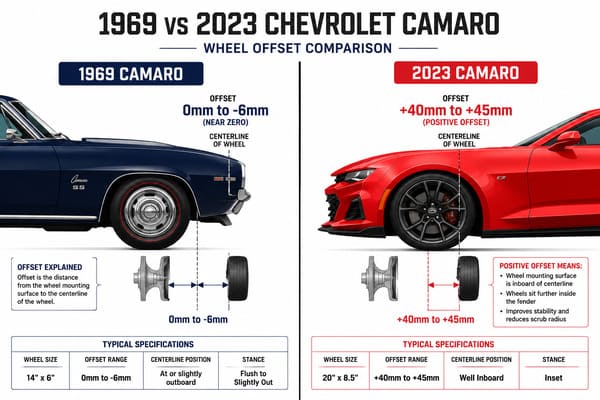
I once had a shop technician tell me, "They’re both Camaros, the offset should be close, right?" No. They share a name, not a platform. The 1969 car was built on a body-on-frame design7 with a completely different suspension setup. The wide, low-offset wheel placement was deliberate. It gave the car that aggressive, wide-hipped stance that made the first-gen Camaro a legend. Replicating that stance today requires going back to those original low-offset specs, not borrowing from a modern parts catalog.
Why the Two Generations Are So Different
The gap between these two Camaro generations is not just about age. It comes down to fundamental engineering differences.
| Specification | 1969 Camaro | 2023 Camaro |
|---|---|---|
| Platform | Body-on-frame | Unibody (Alpha platform8) |
| Front Suspension | Double A-arm9 | MacPherson strut10 |
| Factory Offset | 0mm to -6mm | +40mm to +45mm |
| Standard Wheel Size | 14×6" | 19×8.5" to 20×9.5" |
| Backspacing (standard) | 4.25" to 4.5" | ~6.5" to 7.0" |
The 1969 platform places the suspension mounting points much closer to the center of the wheel well. This means the wheel needs to sit further outboard to clear the inner fender and suspension arms. Modern platforms do the opposite — the suspension is tucked inward, and the wheel needs to sit deeper inside the well to maintain proper geometry. When you order forged wheels for a classic build, the year and platform must drive the spec. The model name means nothing in this context.
What Is the Backspacing of the 1969 Camaro Rally Wheels?
Backspacing is where a lot of classic builders get confused. It sounds simple, but it has a direct impact on clearance, stance, and long-term reliability.
The original 14×6" Rally Wheel on the 1969 Camaro used a backspacing of approximately 3.875"11, which equals roughly -5mm to 0mm offset. When upgrading to wider wheels like a 15×8" or 17×9", backspacing typically needs to increase to 4.25"–4.75" to maintain proper clearance.
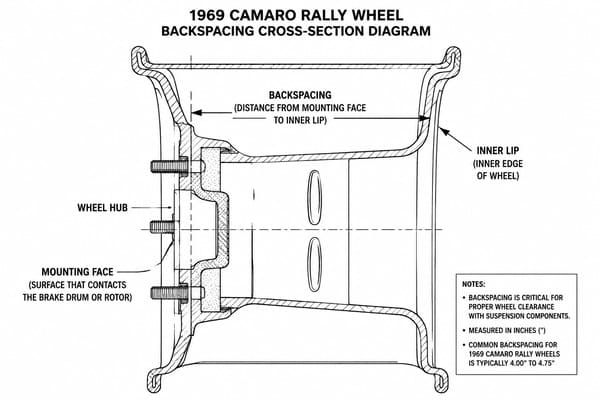
I worked with a restoration shop last year that was building a restomod 1969 Camaro with 17×9" rear wheels. They initially ordered wheels at 4.0" backspacing. After test fitting, the outer edge of the tire was protruding about 12mm past the fender lip. Not illegal, but not the clean flush look they wanted. We adjusted to 4.5" backspacing on the next production run, and the fitment was perfect. That 0.5" backspacing change moved the wheel inward by about 12.7mm — exactly what the build needed.
How Backspacing Changes With Wheel Width
As wheel width increases, backspacing must be recalculated to keep the offset consistent. This is a step many builders skip.
| Wheel Size | Target Offset | Required Backspacing |
|---|---|---|
| 14×6" (factory) | 0mm to -6mm | 3.875" |
| 15×7" | 0mm | 3.937" |
| 15×8" | 0mm to +5mm | 4.25" |
| 17×8" | 0mm to +5mm | 4.25" to 4.5" |
| 17×9" | 0mm to +5mm | 4.5" to 4.75" |
| 18×10" (wide-body) | -5mm to +5mm | 4.75" to 5.25" |
The formula is straightforward: backspacing equals half the wheel width plus the offset (converted to inches). But in practice, the final number also depends on your specific suspension setup, fender clearance, and whether the car has been modified. That is why we always ask for detailed measurements before we start production on any classic fitment. A number on a spec sheet is a starting point, not a guarantee.
Does Wheel Offset Need to Be Exact?
This is one of the most common questions I get from builders who are trying to decide whether to use an off-the-shelf wheel or go custom. The answer matters more on a classic platform than almost anywhere else.
For the 1969 Camaro, most experienced builders accept a tolerance of ±5mm to ±8mm from the target offset. Beyond that range, real mechanical problems begin. Going more than +10mm past ideal causes tire rub. Going more than -10mm increases scrub radius and stresses wheel bearings.12
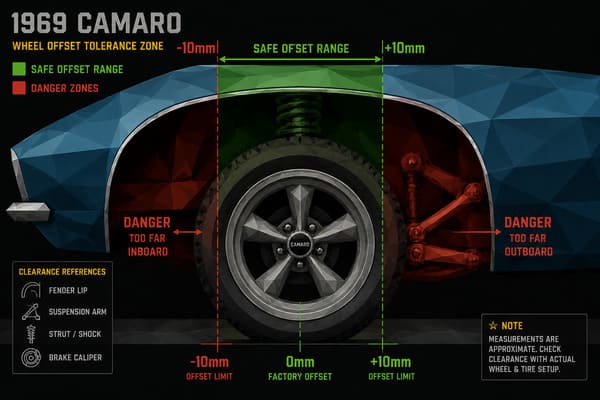
I had a customer who built a track-focused 1969 Camaro and ran the rear wheels at -15mm offset for a more aggressive poke. Within 6 months and roughly 4,000 miles, he reported unusual wear on both rear wheel bearings. We rebuilt the rear set at -5mm, and the issue stopped. The lesson is clear: offset tolerance has real mechanical consequences, not just cosmetic ones. Custom forged wheels let us hit the exact spec needed — that is the entire point of going custom.
What Happens When Offset Is Out of Range
The effects of incorrect offset are not always immediate. Some problems take months to show up, which makes them harder to trace back to the wheel spec.
| Offset Error | Immediate Effect | Long-Term Effect |
|---|---|---|
| +10mm or more (too positive) | Tire rubs inner fender under compression | Accelerated inner tire wear |
| +15mm or more | Constant contact with suspension arms | Suspension damage, unsafe handling |
| -10mm (too negative) | Wheel protrudes past fender lip | Increased scrub radius, pulling under braking |
| -15mm or more | Aggressive poke, looks intentional | Premature wheel bearing failure |
| Within ±5mm of target | No visible or mechanical issues | Normal wear, correct geometry maintained |
The 1969 Camaro’s suspension was not designed with much tolerance for offset deviation. The A-arm geometry is sensitive. The steering feedback is direct. When the scrub radius changes because of an offset error, you feel it immediately in the steering — and the bearings feel it over time. This is exactly why we do not recommend adapting off-the-shelf wheels to classic builds. The cost of a custom forged set is almost always lower than the cost of fixing a problem caused by the wrong offset.
What Does +35 Offset Do?
The number +35 sounds reasonable to anyone who buys wheels for modern cars. On a 1969 Camaro, it is one of the worst choices you can make.
A +35mm offset places the wheel’s mounting face 35mm outboard of the centerline, pushing the entire wheel inward toward the car. On a 1969 Camaro, this means the wheel sits approximately 35 to 40mm deeper inside the wheel well than it should, completely destroying the car’s classic wide stance.
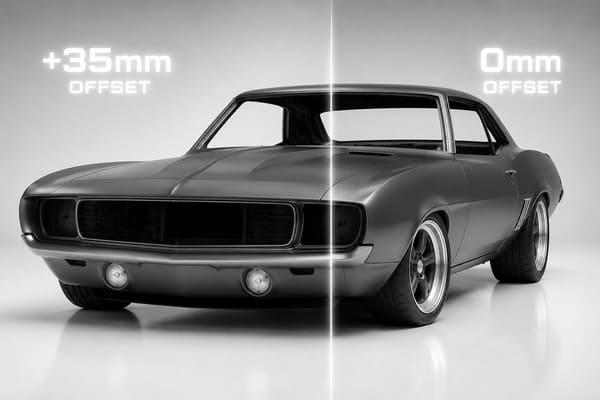
I tested this visually once using a mockup at our facility. We mounted the same 17×8" forged wheel at three different offsets on a 1969 Camaro shell: +35mm, 0mm, and -10mm. The difference was dramatic. The +35mm version looked like the wheel was hiding inside the car. The 0mm version looked stock and clean. The -10mm version gave a slightly wider, more aggressive look that most restomod builders prefer. Three offsets, same wheel, completely different car.
A Direct Visual Comparison
The numbers alone do not tell the full story. Here is what each offset actually does to the appearance and mechanics of the same 17×8" wheel on a 1969 Camaro.
| Offset | Wheel Position | Visual Result | Mechanical Risk |
|---|---|---|---|
| +35mm | 35mm inboard of center | Wheel hidden deep inside well | High — rubs suspension, kills stance |
| +15mm | 15mm inboard of center | Slightly tucked, looks modern | Moderate — borderline for this platform |
| 0mm | Centered | Stock-correct, clean look | Low — within factory spec |
| -10mm | 10mm outboard of center | Wider, aggressive restomod stance | Low to moderate — acceptable for most builds |
| -20mm or more | 20mm+ outboard | Extreme poke, fender clearance issues | High — bearing stress, possible fender contact |
The reason +35mm is so damaging on this platform comes down to how the 1969 Camaro was designed. The wheel well is wide, and the suspension sits close to the center. When you push the wheel inward by 35mm, you are not just changing the look — you are moving the tire directly toward the control arm and the inner fender. On a modern car, +35mm is normal because the wheel well is shaped to accommodate it. On a 1969 Camaro, the geometry simply does not support it. Every time I see a builder try to use modern offset specs on a classic platform, this is the result. The car looks wrong, the fitment is wrong, and fixing it costs more than getting it right the first time.
Conclusion
The 1969 Camaro needs 0mm to -6mm offset and 3.875" to 4.75" backspacing depending on wheel width. Modern offset specs will ruin the fitment and the stance. Get the numbers right from the start. Tree Wheels builds custom forged wheels to your exact spec — contact us for a fitment consultation today.
-
"1969 Chevrolet Camaro – Wheel & Tire Sizes, PCD, Offset and Rims …", https://www.wheel-size.com/size/chevrolet/camaro/1969/. A factory specification source or period Chevrolet parts documentation should support the original wheel dimensions from which the near-zero offset range is inferred. Evidence role: general_support; source type: institution. Supports: The 1969 Chevrolet Camaro needs a wheel offset between -6mm and +6mm, depending on trim.. Scope note: Many factory sources list wheel size and backspacing rather than metric offset, so the offset may need to be calculated from those dimensions. ↩
-
"69 15 inch wheel backspacing help | Team Camaro Tech", https://www.camaros.net/threads/69-15-inch-wheel-backspacing-help.483649/. A factory service manual, assembly manual, or recognized historical specification table should verify the original 14×6 wheel backspacing range used to derive the offset estimate. Evidence role: general_support; source type: institution. Supports: The factory steel wheels run approximately 0mm offset with a backspacing of 4.25 inches to 4.5 inches on a standard 14×6 inch wheel.. Scope note: Backspacing can vary by wheel code and option package, so the source should be matched to the specific 1969 Camaro wheel type discussed. ↩
-
"Scrub radius – Wikipedia", https://en.wikipedia.org/wiki/Scrub_radius. A source explaining wheel offset, backspacing, and suspension-geometry dependence would support the general principle that fitment specifications are platform-specific rather than transferable across generations. Evidence role: mechanism; source type: education. Supports: Modern offset standards do not apply to the 1969 Camaro platform.. Scope note: Such a source would support the engineering rationale, but it may not directly evaluate a 1969 Camaro versus a modern Camaro. ↩
-
"Bmw Fitting Chart and Wheel Fitment Guide", https://www.alloywheelsdirect.net/information/fitting_chart/bmw. A manufacturer specification page or vehicle database derived from OEM data should document the modern Camaro’s factory wheel offset range for comparison with first-generation fitment. Evidence role: general_support; source type: institution. Supports: A 2021 BMW or modern vehicle-style fitment such as +40mm offset is substantially different from the near-zero offset used on a 1969 Camaro.. Scope note: Offset can vary by trim, wheel diameter, and optional package, so the cited source should identify the exact model year and configuration. ↩
-
"2023 – Wikipedia", https://en.wikipedia.org/wiki/2023. An OEM specification source or vehicle fitment database should substantiate that late-model Chevrolet Camaro factory wheels commonly use offsets in the +40 to +45 mm range. Evidence role: general_support; source type: institution. Supports: A 2023 Chevrolet Camaro runs at +40mm to +45mm offset.. Scope note: The value is trim- and wheel-package-dependent, so support should be limited to the cited 2023 Camaro configuration. ↩
-
"Chevrolet Camaro (first generation) – Wikipedia", https://en.wikipedia.org/wiki/Chevrolet_Camaro_(first_generation). A citation comparing factory wheel specifications for first-generation and sixth-generation Camaros would support the calculated offset difference between the two model generations. Evidence role: general_support; source type: institution. Supports: There is nearly a 45 to 50mm offset difference between the 1969 Camaro and the 2023 Camaro.. Scope note: The comparison depends on the specific wheel options selected for each generation, so the stated difference should be framed as approximate. ↩
-
"Chevrolet Camaro (first generation) – Wikipedia", https://en.wikipedia.org/wiki/Chevrolet_Camaro_(first_generation). A historical vehicle-platform source should verify the first-generation Camaro’s chassis construction, including whether it used unitized construction with a front subframe rather than a conventional body-on-frame layout. Evidence role: historical_context; source type: encyclopedia. Supports: The article characterizes the 1969 Camaro platform as a body-on-frame design.. Scope note: This source may contradict the article’s wording if it identifies the Camaro as unibody or semi-unitized with a bolt-on front subframe. ↩
-
"Chevrolet Camaro – Wikipedia", https://en.wikipedia.org/wiki/Chevrolet_Camaro. A manufacturer or encyclopedia source should confirm that the 2023 Chevrolet Camaro is built on General Motors’ Alpha platform. Evidence role: historical_context; source type: encyclopedia. Supports: The 2023 Camaro uses GM’s Alpha platform.. Scope note: This supports platform identification only, not the wheel-offset conclusions drawn from it. ↩
-
"Chevrolet Camaro (first generation) – Wikipedia", https://en.wikipedia.org/wiki/Chevrolet_Camaro_(first_generation). A factory service manual or technical history source should confirm the front suspension type used on the 1969 Chevrolet Camaro. Evidence role: definition; source type: institution. Supports: The 1969 Camaro used a double A-arm front suspension layout.. Scope note: Terminology may vary between “double A-arm,” “short-long arm,” and “independent front suspension,” so the citation should be matched to equivalent technical language. ↩
-
"Struts & Components for 2023 Chevrolet Camaro | OEM Parts Online", https://g.oempartsonline.com/v-2023-chevrolet-camaro–lt1–6-2l-v8-gas/suspension–struts-and-components. A manufacturer specification or technical reference should verify the front suspension design of the 2023 Chevrolet Camaro before using it as a contrast with the 1969 model. Evidence role: definition; source type: institution. Supports: The 2023 Camaro uses a MacPherson strut front suspension.. Scope note: Modern Camaro suspension descriptions can vary by source and trim, so the source should specifically refer to the sixth-generation or 2023 model. ↩
-
"Chevy Rally Wheels 14×6 Code Set of 4 1969 Camaro SS-350 Nova …", https://www.ebay.com/itm/365771665776. A period Chevrolet parts catalog, assembly manual, or documented wheel-code reference should support the stated backspacing for the 14×6 Rally Wheel. Evidence role: general_support; source type: institution. Supports: The original 14×6 inch Rally Wheel on the 1969 Camaro used approximately 3.875 inches of backspacing.. Scope note: Rally Wheel backspacing may differ by wheel code and application, so the citation should identify the specific Camaro wheel option. ↩
-
"How Wheel Offset Affects Suspension Stress, Turning …", https://www.liftedtrucks.com/blog/2025/november/17/how-wheel-offset-affects-suspension-stress-turning-radius-and-tire-wear.htm. A vehicle-dynamics or suspension-engineering source should explain how moving the wheel centerline outward changes scrub radius and increases leverage on hub or wheel-bearing assemblies. Evidence role: mechanism; source type: education. Supports: Excessively negative offset can increase scrub radius and impose greater load on wheel bearings.. Scope note: The source may support the general mechanical relationship rather than the article’s exact -10 mm threshold for a 1969 Camaro. ↩