

Most people hear "diamond-cut" and picture wheels studded with gemstones. That misunderstanding is everywhere — and it leads buyers to make poor decisions when choosing a wheel finish.
The diamond-cut process is a CNC machining technique where the wheel face is re-machined on a lathe after painting, removing 0.05–0.1mm of material to expose bare aluminum. The result is a mirror-like surface with razor-sharp edges, created by a polycrystalline diamond (PCD) cutting insert1 — not actual diamonds.
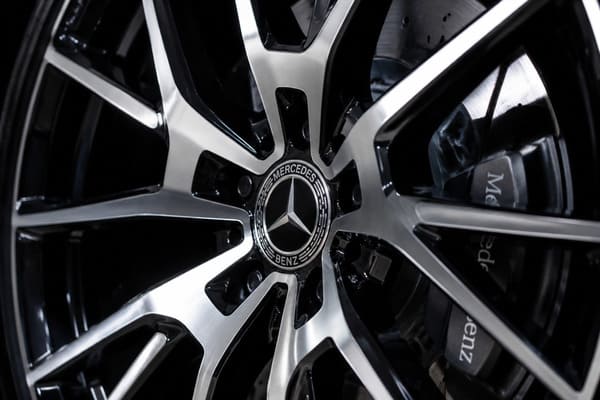
I still remember the first time I watched a diamond-cut wheel come off our CNC lathe. I ran my finger along the edge between the machined face and the dark painted recess. The transition was so clean it felt like a fold in the metal rather than a cut. That contrast — bright aluminum face against a dark background — is what makes diamond-cut wheels look like nothing else on the market. In this article, I want to break down exactly how this process works, what machines and materials are involved, and what you need to know to keep a diamond-cut wheel looking the way it should.
What Tools and Machines Are Used in the Diamond-Cut Process?
Most people assume the machine does all the work. In reality, the setup before any cutting begins is what separates a clean result from a ruined wheel.
The core machine is a CNC lathe — specifically a 4-axis CNC lathe for complex wheel profiles2. The cutting insert is made from polycrystalline diamond (PCD), rated at 9,000–10,000 HV on the Vickers hardness scale3. Spindle speed runs between 800–1,200 RPM, with a feed rate of 0.05–0.1mm per revolution to ensure surface consistency.
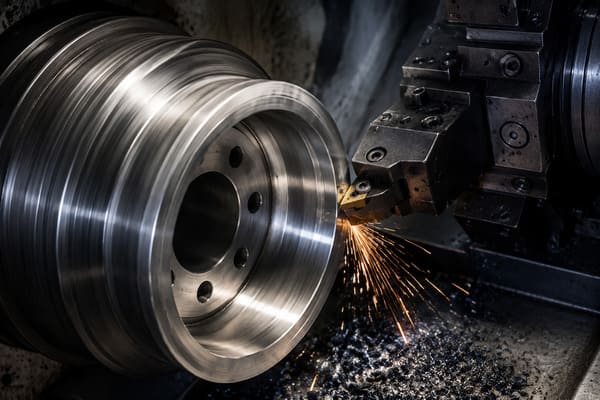
Before a single wheel is touched, our technician spends 30–45 minutes programming the toolpath for that specific wheel design. That time investment is not optional — it is the difference between a consistent finish and visible chatter lines across the face.
Why the PCD Insert Matters
The PCD insert is not a generic cutting tool. It is chosen specifically because aluminum responds poorly to standard carbide at high surface quality requirements. PCD sits near the top of the hardness scale, which means it maintains a sharp cutting edge far longer than carbide and produces less heat during the cut. Less heat means less risk of micro-deformation on the aluminum surface.
How Wheel Geometry Affects Machine Time
Not all wheels take the same amount of time to machine. A flat-faced wheel with a simple profile might take 20 minutes on the lathe. A complex multi-spoke design with varying depths and tight geometry can take over an hour. The toolpath has to navigate every spoke edge, every transition, and every radius without leaving step marks. In many cases, the programming and setup time is longer than the actual cutting time.
Feed Rate Is Not a Minor Detail
| Parameter | Typical Range | Effect on Output |
|---|---|---|
| Spindle Speed | 800–1,200 RPM | Controls surface temperature and cut stability4 |
| Feed Rate | 0.05–0.1mm/rev | Directly determines surface roughness |
| Depth of Cut | 0.05–0.1mm | Exposes fresh aluminum without over-removing material |
| Tool Material | PCD Insert | Maintains edge sharpness across full machining run |
Shops that push feed rate to save cycle time produce wheels with faint parallel grooves across the face. Those grooves catch light at certain angles and make the finish look inconsistent. We keep our finishing pass feed rate at 0.05mm per revolution. That is not a preference — it is a production standard.
How Does Diamond Cutting Create Such Sharp and Clean Edges?
A sharp edge on a machined wheel does not happen by accident. Two things have to work together, and if either one is off, the result shows immediately.
The sharpness of a diamond-cut edge comes from the combination of PCD insert hardness and near-zero vibration in the CNC lathe environment. This produces a surface roughness of Ra 0.4–0.8 μm5 — the range that gives the face its mirror quality and the edge its clean, defined appearance.
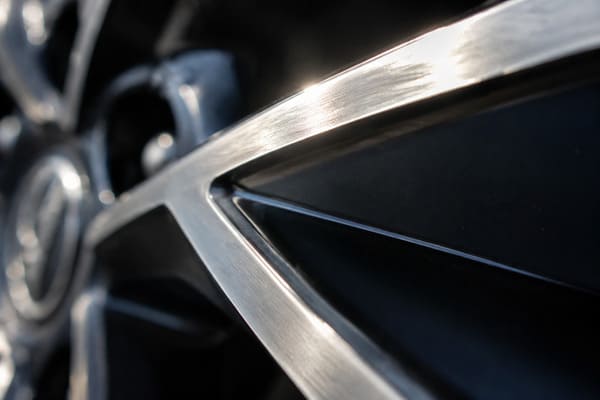
A standard carbide tool leaves micro-burrs on aluminum edges. You cannot always see them, but you can feel them. A PCD insert at the correct parameters shaves the surface rather than scraping it, and the edge it leaves is both visually sharp and physically smooth.
The Role of Vibration Control
A CNC lathe produces vibration. Every rotation of the spindle, every pass of the tool, generates movement in the system. At low levels, that vibration is manageable. At higher levels, it translates directly into surface defects — chatter lines, uneven depth, and edges that look rough under direct light. Our machines are maintained to minimize runout, and each wheel is checked for centering before the cut begins. A wheel that is even slightly off-center will produce an uneven finish, regardless of how good the tool is.
What Ra 0.4–0.8 μm Actually Means
Surface roughness is measured in Ra — the average deviation of the surface from a perfectly flat plane. To put Ra 0.4–0.8 μm in context:
| Surface Type | Typical Ra Value |
|---|---|
| Standard painted wheel face | Ra 1.6–3.2 μm |
| Diamond-cut wheel face | Ra 0.4–0.8 μm |
| Polished mirror surface | Ra 0.1–0.2 μm |
Diamond-cut sits between a standard painted surface and a full mirror polish. It reflects light cleanly without the maintenance demands of a fully polished wheel. That balance is exactly why the finish has become popular in the premium wheel segment.
Why Competitor Wheels Show Tooling Lines
I once had a customer send me a photo comparing a diamond-cut wheel they bought elsewhere with one of ours. The competitor’s wheel had visible parallel grooves across the face — faint, but clearly there when the light hit at an angle. The cause was feed rate. The other shop was running too fast, likely to reduce cycle time and increase output. Our feed rate on finishing passes stays at 0.05mm per revolution. That extra time per wheel is what keeps our surface within the Ra 0.4–0.8 μm range consistently.
What Types of Wheels Are Best Suited for Diamond-Cut Finishing?
Not every wheel is a good candidate for diamond-cut finishing. The material and face geometry both play a direct role in whether the result looks clean or flawed.
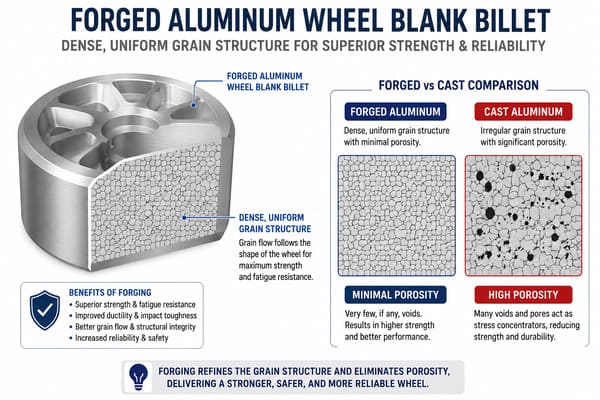
Forged wheels are the best match for diamond-cut finishing. Their near-zero porosity — achieved through compression under 8,000–10,000 tons of force6 — means the machined surface stays clean and pit-free. Cast wheels, with a typical porosity rate of 1–3% by volume7, risk exposing voids when the surface is machined.
I had a customer once who wanted diamond-cut finishing on a cast wheel design they had developed. The design itself was strong — clean spoke lines, good proportions. But I told them directly: cast aluminum at that face geometry was going to show pitting on 30–40% of the machined area. The porosity in cast aluminum is not visible before machining. Once you remove even 0.1mm of surface material, those voids open up and there is nothing you can do to fix them after the fact. They switched to forged, and the result was exactly what they were looking for.
Why Porosity Is a Non-Negotiable Factor
| Wheel Type | Typical Porosity | Diamond-Cut Suitability |
|---|---|---|
| Cast Aluminum | 1–3% by volume | High risk of surface pitting |
| Flow-Formed | 0.5–1% by volume | Moderate — depends on specific area |
| Forged Aluminum | Near zero | Ideal — consistent, pit-free surface |
The forging process compresses the aluminum billet under extreme force8. This eliminates the gas pockets that form during casting and creates a grain structure that is tight and uniform all the way through. When the PCD insert machines across that surface, it finds consistent material at every point. The result is a finish that holds its quality edge to edge.
Face Geometry and Finish Consistency
Beyond material, face geometry matters. Wheels with large, open face sections — 5-spoke or 10-spoke designs with wide blade areas — give the CNC lathe long, uninterrupted cutting runs. Those runs produce the most consistent finish because the tool maintains steady contact without having to navigate tight transitions. Wheels with very busy face geometry, multiple small pockets, or deep recesses are harder to machine cleanly and require significantly more programming time to avoid step marks at geometry changes.
How Do You Maintain and Care for Diamond-Cut Wheels?
Diamond-cut wheels look premium, but the machined face is more vulnerable than most owners realize. Understanding what is actually protecting the surface changes how you approach maintenance.
Diamond-cut wheels are protected by a clear lacquer coat that is typically only 60–80 microns thick9. This coat sits directly over bare aluminum. pH-neutral soap, immediate drying after washing, and annual clear coat inspection are the three non-negotiable steps in maintaining a diamond-cut wheel.

I have seen wheels where the clear coat was compromised after a single winter of harsh driving. Road salt, abrasive grit, and acidic wheel cleaners worked through the lacquer and started oxidizing the aluminum underneath within 8–10 months10. By the time the owner noticed the clouding, the damage was already below the surface. At that point, maintenance is no longer an option — refurbishment is.
What Refurbishment Actually Involves
Refurbishment means putting the wheel back on the CNC lathe and machining a fresh layer off the face. This removes the oxidized aluminum and restores the mirror finish. It works, but it has a limit. Each refurbishment removes 0.05–0.1mm of material. A wheel can go through this process 2–3 times before the face becomes too thin to cut safely11. After that, the wheel needs to be replaced. That limit makes prevention far more important than most owners treat it.
Products and Practices to Avoid
| Product / Practice | Why It Damages Diamond-Cut Wheels |
|---|---|
| Acidic wheel cleaners | Attacks the clear lacquer and oxidizes bare aluminum12 |
| Abrasive pads or brushes | Scratches the lacquer surface, creating entry points for moisture |
| High-pressure washing at close range | Can force water under micro-chips in the lacquer |
| Leaving wheels wet | Water pooling under the lacquer accelerates oxidation |
The Simple Maintenance Routine That Works
The routine itself is not complicated. Wash with pH-neutral soap, rinse thoroughly, and dry immediately — do not let water sit on the surface. Inspect the clear coat once or twice a year, specifically looking for chips, bubbles, or areas where the lacquer looks dull or uneven. A minor chip caught early can be touched up for almost nothing. Ignored, that same chip can become a refurbishment job or a replacement wheel within a season. The cost difference between those two outcomes is significant.
Conclusion
The diamond-cut process delivers a finish that no paint or coating can replicate — but it requires the right material, the right machine setup, and the right care to perform as it should. At Tree Wheels, we produce forged wheels built for exactly this kind of precision finishing — reach out to discuss your next project.
-
"What is Polycrystalline Diamond (PCD)", https://telconpcd.com/what-is-polycrystalline-diamond-pcd/. Polycrystalline diamond (PCD) is a synthetic cutting tool material produced by sintering diamond particles under high pressure and temperature; it is widely used in non-ferrous metal machining due to its exceptional hardness and wear resistance compared to carbide alternatives. Evidence role: definition; source type: encyclopedia. Supports: What polycrystalline diamond (PCD) is, how it differs from natural diamond, and why it is used as a cutting insert material in precision machining. Scope note: General references to PCD tooling may not specifically address wheel-face machining applications; contextual extrapolation is required. ↩
-
"4-Axis Machining Guide: Precision & Innovation", https://hexagonmachine.com/4-axis-machining-guide/. A 4-axis CNC lathe adds a secondary rotary or milling axis to the standard X/Z turning configuration, enabling the machine to produce features such as off-center holes, angled cuts, and complex contoured profiles in a single setup without repositioning the workpiece. Evidence role: definition; source type: education. Supports: What a 4-axis CNC lathe is and why additional axes enable machining of complex geometric profiles. Scope note: The specific requirement for 4-axis capability in wheel diamond-cutting depends on wheel design complexity; simpler profiles may be achievable on 2-axis lathes. ↩
-
"Vickers hardness test – Wikipedia", https://en.wikipedia.org/wiki/Vickers_hardness_test. Published materials data for polycrystalline diamond report Vickers hardness values in the range of approximately 8,000–10,000 HV, placing PCD among the hardest known cutting tool materials and significantly above cemented carbide at 1,300–1,800 HV. Evidence role: statistic; source type: research. Supports: The Vickers hardness value range of polycrystalline diamond cutting inserts. Scope note: Exact HV values vary by PCD grade and sintering process; a single cited figure may not represent all commercial PCD insert formulations. ↩
-
"Speeds and feeds – Wikipedia", https://en.wikipedia.org/wiki/Speeds_and_feeds. In CNC turning of aluminum alloys, cutting speed directly influences heat generation at the tool-workpiece interface; excessively high speeds increase thermal load and risk built-up edge formation, while speeds optimized for the tool material and workpiece alloy minimize surface roughness and tool wear. Evidence role: mechanism; source type: research. Supports: The relationship between spindle speed, cutting temperature, and surface finish quality in CNC turning of aluminum alloys. Scope note: Optimal RPM depends on wheel diameter, alloy grade, and tool geometry; the 800–1,200 RPM range cited is specific to the described application and may not generalize to all diamond-cut wheel machining setups. ↩
-
"Surface roughness – Wikipedia", https://en.wikipedia.org/wiki/Surface_roughness. Ra (arithmetic average roughness) is defined under ISO 4287 as the arithmetic mean of absolute profile deviations from the mean line; CNC turning of aluminum alloys under optimized conditions can achieve Ra values in the range of 0.4–1.6 μm depending on feed rate, tool geometry, and cutting speed. Evidence role: definition; source type: institution. Supports: The meaning of Ra surface roughness measurement and typical achievable Ra values for CNC-turned aluminum components. Scope note: Published Ra ranges for CNC turning are process-dependent; the specific 0.4–0.8 μm claim for wheel-face finishing is not independently verified by a single authoritative source. ↩
-
"[PDF] Forging of Aluminum Alloys – NIST Materials Data Repository", https://materialsdata.nist.gov/bitstream/handle/11115/223/Forging%20of%20Aluminum%20Alloys.pdf?isAllowed=y&sequence=1. Industrial forging of aluminum alloy wheel blanks typically employs hydraulic or mechanical presses operating in the range of several thousand to over ten thousand tons of force, with exact requirements determined by wheel diameter, alloy, and die geometry. Evidence role: statistic; source type: institution. Supports: The range of press forces used in industrial aluminum wheel forging. Scope note: Publicly available sources rarely specify exact tonnage for proprietary wheel forging operations; the 8,000–10,000 ton figure could not be independently confirmed from open literature. ↩
-
"A Review on Porosity Formation in Aluminum-Based Alloys – PMC", https://pmc.ncbi.nlm.nih.gov/articles/PMC10004325/. Studies on aluminum casting defects report volumetric porosity levels typically ranging from 0.5% to over 3% depending on casting method, alloy composition, and process control; gravity die casting and low-pressure casting generally exhibit higher porosity than squeeze casting or semi-solid processes. Evidence role: statistic; source type: research. Supports: Typical volumetric porosity levels found in cast aluminum components. Scope note: Porosity varies significantly by casting method and process parameters; a single range may not accurately represent all cast wheel manufacturing processes. ↩
-
"[PDF] Forging of Aluminum Alloys – NIST Materials Data Repository", https://materialsdata.nist.gov/bitstream/handle/11115/223/Forging%20of%20Aluminum%20Alloys.pdf. Forging subjects aluminum billets to compressive stress that breaks down dendritic grain structures, closes internal voids, and produces a refined, directional grain flow; this results in lower porosity and improved mechanical properties relative to cast aluminum of equivalent alloy composition. Evidence role: mechanism; source type: education. Supports: How the forging process mechanically refines aluminum grain structure and reduces internal porosity compared to casting. Scope note: The specific porosity elimination claim depends on forging temperature, die design, and alloy; ‘near-zero porosity’ is a relative rather than absolute characterization. ↩
-
"What is the best tool for measuring clear coat thickness? – Facebook", https://www.facebook.com/groups/226043429672219/posts/1302597235350161/. Automotive clear coat systems applied to alloy wheels are generally specified at dry film thicknesses of 60–100 microns depending on the coating chemistry and application method; thinner coatings reduce weight and cost but offer less barrier protection against environmental degradation. Evidence role: statistic; source type: institution. Supports: Typical dry film thickness of clear lacquer coatings applied to automotive alloy wheels. Scope note: Coating thickness specifications vary by manufacturer and coating system; the 60–80 micron figure cited in the article may reflect one supplier’s standard rather than an industry-wide norm. ↩
-
"The influence Cl− on stress corrosion of 7xxx series aluminium …", https://pmc.ncbi.nlm.nih.gov/articles/PMC11259798/. Chloride ions from road deicing salts are well-documented initiators of pitting corrosion in aluminum alloys; once a protective coating is breached, chloride ingress accelerates localized corrosion beneath the lacquer layer through an electrochemical mechanism that can progress rapidly under wet conditions. Evidence role: mechanism; source type: research. Supports: How chloride-containing road salt and acidic chemicals degrade protective coatings and initiate corrosion of underlying aluminum. Scope note: The specific 8–10 month timeline is anecdotal; actual degradation rates depend on coating integrity, alloy composition, climate, and exposure frequency. ↩
-
"Machining Safety in Dry Rough Milling of Casting Magnesium Alloy …", https://pmc.ncbi.nlm.nih.gov/articles/PMC11901311/. Each machining cycle removes a defined layer of aluminum from the wheel face; cumulative material removal across multiple refurbishment cycles reduces face thickness, and industry practice generally limits diamond-cut refurbishment to two or three cycles to preserve structural integrity and maintain design geometry. Evidence role: general_support; source type: institution. Supports: That repeated material removal during wheel refurbishment has a finite limit before structural or aesthetic integrity is compromised. Scope note: No publicly available engineering standard specifies a universal refurbishment cycle limit; the 2–3 cycle figure reflects common industry practice rather than a formally codified specification. ↩
-
"Can Acid Cleaners Damage Clear Coat? – Jimbo’s Detailing", https://jimbosdetailing.com/blogs/diy-detailing/can-acid-cleaners-damage-clear-coat?srsltid=AfmBOoptuwfutkhvfCbVEwwFLPW9i0cphLvzkEK9bxRFDS4_EpCyakib. Acidic solutions can hydrolyze ester and urethane linkages in polymer clear coat systems, reducing coating adhesion and barrier properties; once the coating is compromised, aluminum exposed to acidic environments undergoes accelerated oxidation through dissolution of the native oxide layer and formation of aluminum hydroxide corrosion products. Evidence role: mechanism; source type: research. Supports: How low-pH (acidic) chemical solutions degrade polymer lacquer coatings and accelerate oxidation of aluminum substrates. Scope note: The severity of damage depends on acid concentration, exposure duration, and specific lacquer chemistry; not all acidic cleaners cause equivalent damage under typical use conditions. ↩