
Choosing the wrong clear coat for forged wheels can cost you hundreds of dollars and months of frustration. The wrong product peels, yellows, or bubbles — and most people only find out after the damage is done.
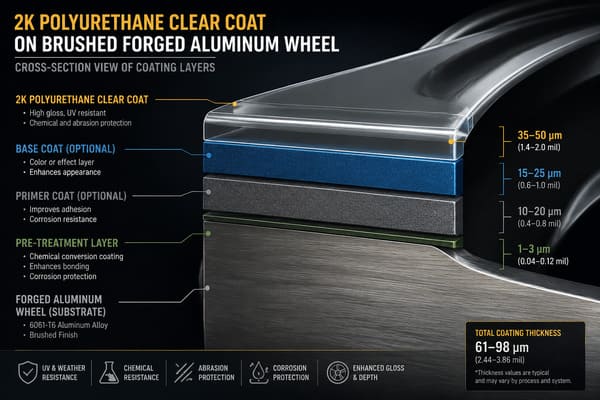
The best clear coat for forged wheels is a 2K polyurethane clear coat (two-component). It reaches a pencil hardness of 2H–3H1, handles heat up to 150°C2, and scores Grade 0 on cross-cut adhesion tests3. The right formula also depends on your surface finish — gloss, matte, or brushed.
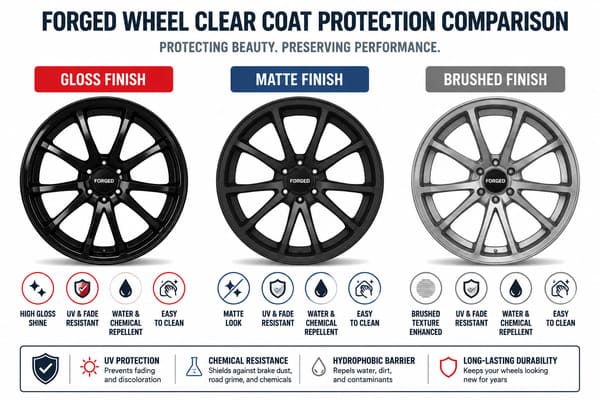
Picking the right clear coat is only the starting point. There are three more decisions that directly affect how long your wheels stay protected — ceramic coating, powder coating, and daily maintenance. Each one carries risks that most people overlook. I will walk through all of them below.
What Is the Best Clear Coat for Wheels?
Most people pick a clear coat based on price or what the local paint shop has in stock. That decision alone is responsible for most of the premature peeling and yellowing we see on customer wheels.
A 2K polyurethane clear coat is the correct choice for forged wheels. It offers superior hardness (2H–3H), heat resistance up to 150°C, and top-tier adhesion. The formula must match the surface finish — high-gloss for polished surfaces, matte or semi-matte for brushed finishes.
We had a customer from Canada who ordered a set of brushed-finish forged wheels last year. After the wheels arrived, he took them to a local paint shop and had a single-component clear coat applied on top. About five months later, he sent us photos. The edges had started to yellow, and there were two visible bubbles near the brake caliper area.
The problem was clear to us immediately. Single-component clear coats do not have enough hardness, and their heat resistance is poor. When a wheel is in use, the surface temperature can easily reach 80°C–120°C. A single-component product simply cannot hold up under those conditions.
Why 2K Polyurethane Clear Coat Is the Right Choice
2K polyurethane clear coat uses a chemical cross-linking reaction between two components — the base and the hardener. This reaction creates a dense, rigid film that single-component products cannot replicate.
| Property | Single-Component Clear Coat | 2K Polyurethane Clear Coat |
|---|---|---|
| Pencil Hardness | H or below | 2H–3H |
| Heat Resistance | ~80°C | ~150°C |
| Cross-Cut Adhesion (ISO 2409) | Grade 2–3 | Grade 0 |
| Yellowing Resistance | Poor | Good |
| Suitable for Wheels | No | Yes |
Beyond the product itself, the formula must match the surface treatment of the wheel. Polished surfaces need a high-gloss formula to maintain their mirror-like appearance. Brushed surfaces need a matte or semi-matte formula — a high-gloss coat on a brushed finish will visually destroy the texture. Anodized surfaces already have an oxide layer, and we do not recommend adding clear coat on top. Adhesion on anodized aluminum typically drops to 60%–70%4, and the coat will peel within months. The best clear coat is not one single product. It is the product that matches your specific surface finish.
Should You Ceramic Coat Forged Wheels?
Ceramic coating sounds like the ultimate protection. Many wheel owners treat it as an upgrade over clear coat. But there is a critical misunderstanding behind that idea — and it has caused real damage to customer wheels.
Ceramic coating can protect forged wheels, but only when the underlying clear coat is fully intact. Ceramic coating is 1–3 microns thick5. It protects the clear coat, not the aluminum. If the clear coat is damaged before application, ceramic coating will seal in the problem rather than solve it.
In early 2024, we had a customer in Australia who sent his new wheels to a ceramic coating shop immediately after delivery. The technician performed a standard paint prep step — light polishing with a mild abrasive compound to open up the surface for better bonding. That process removed approximately 30% of the original 2K clear coat thickness. Three months later, the customer noticed small corrosion spots forming near the brake disc area. Every spot started exactly where the clear coat had been thinned.
What Ceramic Coating Actually Does — and What It Cannot Do
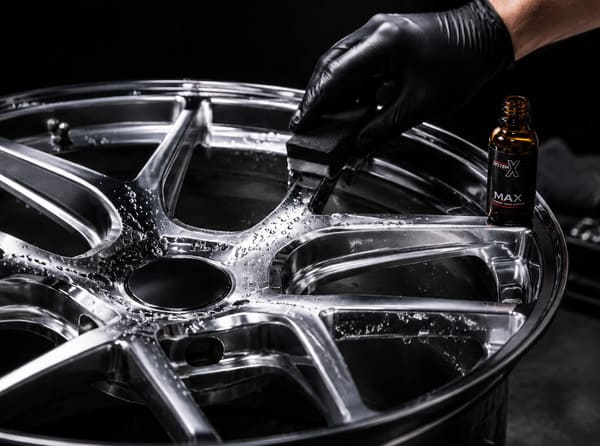
Ceramic coating forms a hard, hydrophobic layer on top of the clear coat. It repels water, brake dust, and road contaminants. It makes cleaning easier and adds a layer of UV protection. For daily-driven vehicles, these are real benefits.
| Factor | What Ceramic Coating Covers | What It Cannot Fix |
|---|---|---|
| Water and contamination repellency | ✓ Strong | — |
| UV protection | ✓ Moderate | — |
| Damaged or thinned clear coat | — | ✗ Will seal damage in |
| Corrosion already in progress | — | ✗ Hides it, does not stop it |
| Track use (repeated heat cycles) | — | ✗ Micro-cracking risk |
There is one more point that rarely gets mentioned. Wheels used on track are not good candidates for ceramic coating. During aggressive driving, wheel surface temperatures can exceed 200°C6. Most ceramic coating products are rated to around 250°C7, so the temperature alone is not the problem. The issue is repeated thermal cycling — heating up and cooling down, lap after lap. Over 6–12 months, this cycle causes micro-cracks to develop in the ceramic layer8. Those cracks then trap brake dust and moisture, which is the opposite of the protection you were looking for. Before applying any ceramic coating, confirm that the original clear coat is undamaged. Do not allow abrasive polishing as a prep step. And if the wheels see regular track use, liquid sealants with higher thermal flexibility are a better fit.
Is It Safe to Powder Coat Forged Wheels?
Powder coating is popular for its durability and wide color range. Many modification shops offer it as a standard service. But for forged wheels made from 6061-T6 aluminum alloy, powder coating carries a structural risk that most shops do not mention.
Powder coating is not recommended for forged aluminum wheels. The curing temperature of 180°C–200°C overlaps with the artificial aging range of 6061-T6 aluminum (160°C–180°C)9. Extended heat exposure at this range causes the alloy’s precipitate phases to coarsen, reducing hardness by 5%–15% and lowering toughness at the same time.
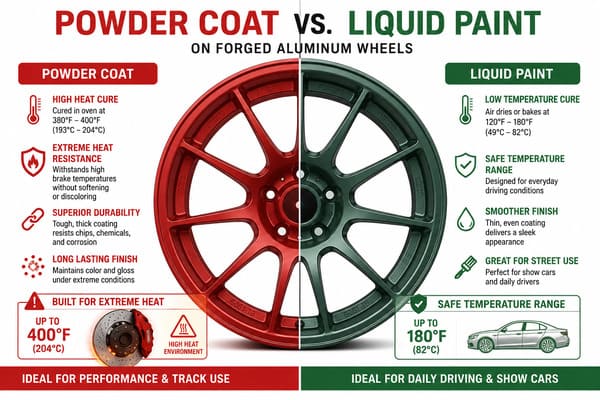
We declined an order from a modification shop in the United States. The shop wanted us to ship forged wheels with powder coating already applied. We did not accept the request. The reason is straightforward: the curing process for powder coating requires 180°C–200°C, held for 20–30 minutes. That is exactly the temperature range used for artificial aging of 6061-T6 aluminum alloy.
What Happens to Forged Aluminum Under Powder Coat Curing Conditions
6061-T6 aluminum gets its mechanical properties through a heat treatment process called artificial aging. During this process, fine precipitate phases form inside the alloy and block dislocation movement — that is what gives the material its strength. When the alloy is reheated to the same temperature range, those precipitate phases coarsen. The blockage weakens. Strength drops10.
| Condition | Hardness Change | Toughness Change | Risk Level |
|---|---|---|---|
| Liquid paint (60°C–80°C cure) | None | None | Low |
| Powder coat (180°C–200°C, 20–30 min) | −5% to −15% | Reduced | High for performance wheels |
| Repeated powder coat cycles | Cumulative loss | Significant reduction | Very High |
For a daily commuter car, this strength reduction may not be noticeable. But for high-performance vehicles, or for our wheel designs with wall thicknesses of 8–10mm, this is a real safety concern under extreme load conditions. The alternative we offered that American customer was liquid paint combined with 2K clear coat. The color result is approximately 95% similar to powder coat. The curing temperature is only 60°C–80°C, which has zero effect on the mechanical properties of the aluminum. He accepted that solution. That is the approach we recommend to all customers who want a durable, colored finish on forged wheels.
How to Protect Forged Wheels?
Buying high-quality forged wheels is only half the job. What happens after delivery — during installation and daily use — determines how long the finish actually lasts. Most damage we see is not from the road. It is from installation errors and the wrong cleaning products.
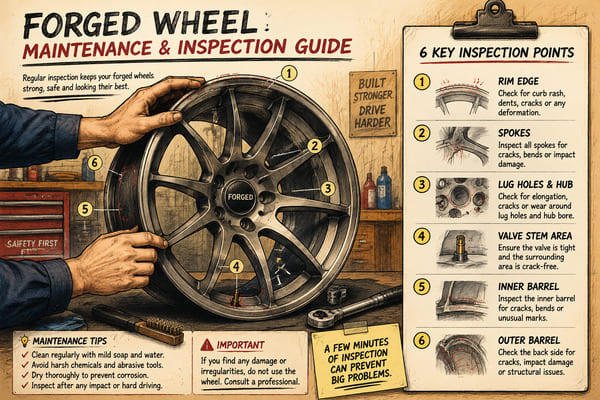
To protect forged wheels, inspect all six key areas before installation, use pH-neutral wheel cleaner every 2–3 weeks11, and never use abrasive products on matte or brushed surfaces. Damage from incorrect cleaning products is irreversible.
We had a customer in Dubai who bought four custom forged wheels. About two months after installation, he sent photos showing small corrosion spots on the inner rim edge. We pulled his order records and the pre-shipment inspection photos. The finish was perfect at the time of shipping. After some back-and-forth, we found out what happened. He had not inspected the wheels before installation. The tire shop’s mounting machine claws scratched the inner rim edge during fitting. Those scratches broke through the clear coat. Over two months, fine desert dust and moisture worked their way in through those cuts.
A Practical Protection Plan for Forged Wheels
This is the most common situation we see — customers receive the wheels, skip the inspection, go straight to the tire shop, and then blame the wheel quality when corrosion appears. We now include a printed inspection checklist with every shipment. Customers are asked to check six specific areas before handing the wheels to any installer.
| Inspection Point | What to Look For | Why It Matters |
|---|---|---|
| Inner rim edge | Scratches, chips, bare metal | First area exposed to mounting damage |
| Valve stem hole perimeter | Micro-cracks, finish gaps | Entry point for moisture |
| Lug bolt hole chamfers | Paint chips, bare aluminum | High-stress area, corrosion starts here |
| Spoke faces | Surface finish consistency | Visible quality check |
| Barrel exterior | Transit scratches | Catch packaging damage early |
| Center bore edge | Finish integrity | Contact point with hub |
For ongoing maintenance, clean the wheels every 2–3 weeks using a pH-neutral wheel cleaner. Do not use any product with abrasive particles. This is especially important for matte and brushed finishes. A single application of the wrong cleaner — anything with polishing compounds or strong alkaline agents — will permanently alter the surface texture. That kind of damage cannot be reversed. The finish is gone. We also recommend applying a non-abrasive liquid sealant every three to four months on polished and gloss-finish wheels. For brushed finishes, use a matte-compatible sealant only. These small steps add significantly more service life to the finish than any single coating choice at the time of manufacturing.
Conclusion
The right clear coat, a careful approach to ceramic and powder coating, and consistent maintenance are what keep forged wheels in top condition long-term. Choose based on your surface finish, not just price.
Tree Wheels produces fully customized forged wheels with professional surface treatment guidance included — get in touch to discuss your project.
-
"KBS MAXX Clear – 2K Urethane Clear Coat | UV Stable, Direct to Metal", https://kbs-coatings.com/kbs-maxx-clear?srsltid=AfmBOordaRyRt3BNm6BcKIjrH9_EMlBTiPO390_PFqo_p8C5g6su7KSB. Published coating studies and technical datasheets for two-component polyurethane systems report cured film pencil hardness in the range of 2H–3H when tested per ASTM D3363, reflecting the dense cross-linked network formed during cure. Evidence role: statistic; source type: paper. Supports: Pencil hardness values achievable by cured 2K polyurethane coatings. Scope note: Exact hardness values vary by formulation, pigment loading, and cure conditions; a single published figure may not represent all commercial 2K polyurethane products. ↩
-
"Improving Thermal Stability of Polyurethane through the Addition of …", https://pmc.ncbi.nlm.nih.gov/articles/PMC6523278/. Technical literature on two-component polyurethane coatings indicates continuous service temperature limits typically in the range of 120°C–160°C, depending on cross-link density and hardener type, with performance degradation observed above these thresholds. Evidence role: statistic; source type: paper. Supports: Thermal resistance ceiling of cured 2K polyurethane coatings. Scope note: Heat resistance is formulation-dependent; the 150°C figure cited in the article represents a general benchmark rather than a universal specification for all 2K polyurethane products. ↩
-
"[PDF] INTERNATIONAL STANDARD ISO 2409", https://cdn.standards.iteh.ai/samples/76041/7576c7ae546c437dafe5ede5f518aa7c/ISO-2409-2020.pdf. ISO 2409 defines a six-point classification scale for cross-cut adhesion testing of paint films; Grade 0 indicates that the cut edges are completely smooth with no detachment of any square of the lattice, representing the highest adhesion performance. Evidence role: definition; source type: institution. Supports: What Grade 0 signifies under the ISO 2409 cross-cut adhesion test standard. Scope note: The standard defines the grading scale but does not itself confirm that 2K polyurethane coatings universally achieve Grade 0; substrate preparation and application conditions affect results. ↩
-
"[PDF] Process Specification for the Anodizing of Aluminum Alloys – NASA", https://www.nasa.gov/wp-content/uploads/2023/03/prc-5006-current.pdf. Research on coating adhesion to anodized aluminum substrates indicates that the dense, chemically stable oxide layer formed during anodizing reduces mechanical and chemical bonding sites for organic coatings, resulting in measurably lower adhesion strength compared to bare or chemically etched aluminum. Evidence role: statistic; source type: paper. Supports: Reduced paint or clear coat adhesion performance on anodized aluminum surfaces relative to untreated aluminum. Scope note: The specific 60%–70% figure cited in the article is not directly confirmed by a single published source; adhesion reduction depends on anodizing type, thickness, and coating chemistry. ↩
-
"Development of Car Coating Materials over the Past Decade for …", https://pmc.ncbi.nlm.nih.gov/articles/PMC12694507/. Studies characterizing automotive ceramic coatings based on silicon dioxide or titanium dioxide chemistry report cured film thicknesses generally in the range of 1–3 micrometers, substantially thinner than conventional paint clear coats which typically measure 40–60 micrometers. Evidence role: statistic; source type: paper. Supports: Typical dry film thickness of consumer and professional-grade automotive ceramic coatings. Scope note: Thickness varies by product formulation, number of applied layers, and application method; the cited range is representative but not universal across all ceramic coating products. ↩
-
"Cold water ingestion ameliorates increase in core temperature and …", https://pmc.ncbi.nlm.nih.gov/articles/PMC11876140/. Thermal analyses of brake systems in motorsport and performance driving contexts document that sustained hard braking can elevate wheel rim temperatures well above 200°C, driven by conductive and radiative heat transfer from brake discs operating at temperatures exceeding 600°C. Evidence role: statistic; source type: paper. Supports: Wheel rim surface temperatures achievable during track or motorsport driving conditions. Scope note: Measured rim temperatures depend heavily on wheel material, spoke geometry, brake system design, and track conditions; 200°C represents a threshold observed under aggressive use rather than a universal value. ↩
-
"[PDF] Ceramic coatings for high-temperature protection of steel", https://nvlpubs.nist.gov/nistpubs/jres/38/jresv38n3p293_A1b.pdf. Technical characterization of SiO2-based automotive ceramic coatings indicates that most commercial formulations retain hydrophobic and protective properties up to approximately 200°C–250°C, beyond which thermal degradation of the siloxane network begins to occur. Evidence role: statistic; source type: paper. Supports: Thermal resistance limits of consumer automotive ceramic coatings. Scope note: Thermal ratings are product-specific and often derived from manufacturer datasheets rather than independent third-party testing; the 250°C figure should be treated as a general benchmark. ↩
-
"[PDF] Review of the Fatigue Behavior of Hard Coating-Ductile Substrate …", http://www.eng.usf.edu/~volinsky/FatigueHardCoatingDuctileSubstrate.pdf. Materials science literature on thin protective coatings documents that repeated thermal cycling induces cyclic stress from differential thermal expansion between the coating and substrate, which can nucleate and propagate micro-cracks in brittle ceramic films over time. Evidence role: mechanism; source type: paper. Supports: Thermal cycling as a mechanism for micro-crack formation in thin ceramic or silica-based coatings. Scope note: Most published research addresses industrial or aerospace ceramic coatings rather than consumer automotive ceramic coating products specifically; the 6–12 month timeframe cited in the article is experiential rather than experimentally established. ↩
-
"6061 aluminium alloy – Wikipedia", https://en.wikipedia.org/wiki/6061_aluminium_alloy. ASM International and Aluminum Association technical references specify that the T6 temper in 6061 aluminum alloy is achieved through artificial aging at approximately 160°C–177°C for 8–18 hours, a range that overlaps with typical powder coat oven cure cycles of 180°C–200°C. Evidence role: historical_context; source type: institution. Supports: The artificial aging temperature range used to achieve T6 temper in 6061 aluminum alloy. Scope note: Exact aging parameters vary by specification and part geometry; the degree of property change from a 20–30 minute powder coat cure differs from a full aging cycle, and the article’s strength reduction figures require independent metallurgical verification. ↩
-
"Precipitation hardening – Wikipedia", https://en.wikipedia.org/wiki/Precipitation_hardening. Metallurgical studies on age-hardened aluminum alloys document that prolonged or repeated exposure to artificial aging temperatures causes Ostwald ripening of strengthening precipitates (primarily Mg2Si in 6061), increasing inter-precipitate spacing and reducing resistance to dislocation motion, thereby lowering yield strength and hardness. Evidence role: mechanism; source type: paper. Supports: Precipitate coarsening mechanism and associated strength reduction in 6061-T6 aluminum upon re-exposure to aging temperatures. Scope note: The magnitude of strength reduction depends on time, temperature, and number of thermal exposures; the 5%–15% hardness reduction cited in the article is a general estimate and may vary with specific processing conditions. ↩
-
"Effect of Alkaline Cleaning and Activation on Aluminum Alloy 7075-T6", https://scholarsmine.mst.edu/matsci_eng_facwork/687/. Corrosion science literature establishes that aluminum and its alloys are amphoteric, dissolving in both strongly acidic and strongly alkaline solutions; alkaline cleaners above pH 10–11 attack the native oxide layer and underlying aluminum, while acidic products can degrade polyurethane clear coat films, supporting the use of pH-neutral formulations for routine wheel maintenance. Evidence role: mechanism; source type: paper. Supports: Why alkaline or acidic cleaning agents damage aluminum surfaces and clear coat finishes. Scope note: Published research addresses aluminum corrosion chemistry broadly; specific effects on decorative wheel finishes such as brushed or matte textures are less systematically studied in peer-reviewed literature. ↩