

Last year, we almost shipped the wrong wheels to a customer in Australia. The mistake was small on paper — but it would have made the entire set useless.
The Chrysler Valiant Charger has a hub bore of 83.1mm.1 This is not the same as the Dodge Charger, which runs a 71.5mm hub bore2. The two cars share a name, but they are completely different vehicles built in different countries3 with different specifications. Always confirm the exact hub bore before ordering.
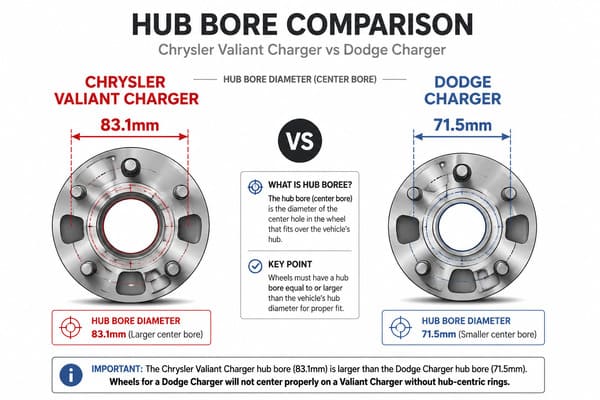
The customer sent us an email asking for "Charger wheels." He attached a photo of a Dodge Charger as a design reference. He wanted the look of that car. But the vehicle he was actually fitting the wheels to was a Chrysler Valiant Charger — an Australian-built muscle car produced from 1971 to 19784. The only thing these two cars have in common is the word "Charger" in their names. The hub bore difference between them is nearly 12mm. If we had skipped verification and gone straight to production based on his reference photo, those wheels would have been scrap. That one order is why we now require confirmed measurements or a VIN before we begin any job.
What Is the Center Bore of a Dodge Charger Wheel?
The answer depends on the year. Many customers assume the number is fixed, but it is not — and that assumption has caused real problems.
For most model years from 2006 to the present, the Dodge Charger uses a hub bore of 71.5mm with a 5×114.3mm bolt pattern.5 This specification remained consistent across the 2006–2023 production range6, though we always recommend verifying against your specific year before ordering custom wheels.
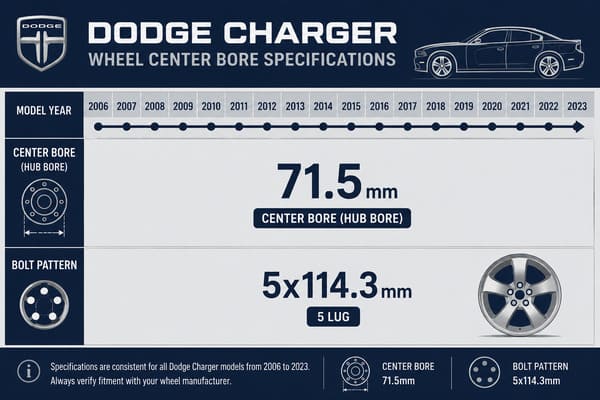
We keep an internal data sheet that covers the major model years of the Dodge Charger. The 71.5mm figure holds steady across most of this range, but that does not mean every customer walks in with the right number. We once had a customer who ordered wheels using 2008 specifications for a 2015 model. When he fitted them, there was a slight wobble. The actual difference was 0.3mm. That sounds like nothing. But at highway speed, his steering wheel vibrated noticeably. He came back to us, and we had to remake the set.
That experience shaped how we handle every order now. We do not accept "it should be this size" as a valid input. The table below shows the hub bore data we use as a reference for common Dodge Charger model years.
| Model Year | Hub Bore | Bolt Pattern | Studs |
|---|---|---|---|
| 2006–2010 | 71.5mm | 5×114.3mm | 5 |
| 2011–2014 | 71.5mm | 5×114.3mm | 5 |
| 2015–2019 | 71.5mm | 5×114.3mm | 5 |
| 2020–2023 | 71.5mm | 5×114.3mm | 5 |
The consistency across years is actually useful. But it can also make customers overconfident. Because the number has not changed for nearly two decades, some buyers assume they do not need to verify. We still ask for a physical measurement or a VIN on every single order. The cost of remaking a set of forged wheels is far higher than the two minutes it takes to confirm a number.
Does the Center Bore Have to Be Exact?
A lot of aftermarket sellers will tell you that a close fit is fine. We disagree — and we have seen what happens when the fit is not exact.
The center bore should match the hub diameter as precisely as possible. A wheel that is slightly too large will not sit centered on the hub.7 This causes vibration at speed and puts uneven stress on the wheel studs.8 Hub centric rings can compensate for small gaps9, but they are a secondary solution, not a design target.
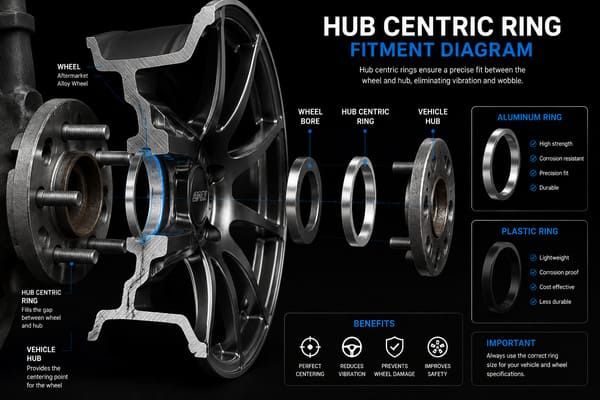
One of our customers bought an aftermarket set from another supplier. The center bore was 1.5mm larger than his hub. The seller told him to use a hub centric ring and sent him a set of plastic rings that cost a few dollars each. He drove on them for about 8,000 kilometers. Then the rings cracked. The wheel shifted off-center. At highway speed, the vibration became severe enough that he pulled over and called a shop. The technician found the problem immediately.
We are not saying hub centric rings are useless. They work — but only under the right conditions.
When Hub Centric Rings Work
| Condition | Acceptable | Not Acceptable |
|---|---|---|
| Ring material | Aluminum alloy10 | Plastic or low-grade polymer |
| Wall thickness | Adequate for load | Thin or undersized |
| Gap being filled | 0.5mm or less | More than 1mm |
| Inspection frequency | Regular | Never checked after install |
Our Standard at Tree Wheels
When we produce a custom forged wheel, we machine the center bore to match the customer’s hub exactly. We do not build in extra clearance and expect a ring to handle it. If the customer’s hub measures 71.5mm, the bore comes out at 71.5mm. The ring is a valid repair tool in some situations. It is not something we design around. Precision at the production stage is always the better answer.
What Size Hub Is a 2014 Charger?
The 2014 Dodge Charger is one of the most common vehicles we produce wheels for in the North American market. The specification is well-documented, but we still see wrong data come in.
The 2014 Dodge Charger has a hub bore of 71.5mm and a bolt pattern of 5×114.3mm.11 This puts it in line with most Charger models from 2006 onward. These numbers are consistent and well-established, but physical verification is still the most reliable way to confirm fitment before ordering.
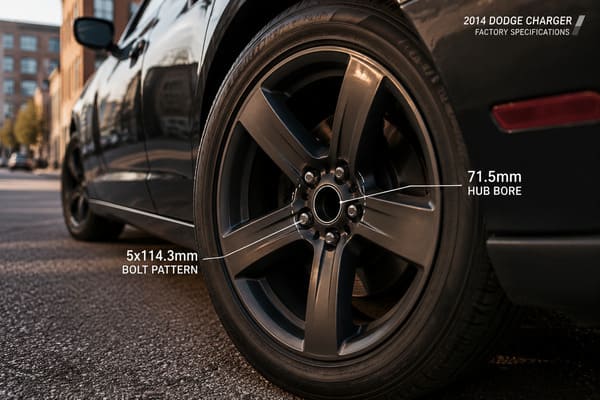
About 30% of our North American customers drive Dodge vehicles, and the Charger is the most common model in that group. The 2014 spec is one we know well. But knowing it well does not mean we skip verification. A few months ago, a customer from Canada insisted his 2014 Charger had a 73mm hub bore. He had read it on a forum. We asked him to measure it. The result was 71.5mm — exactly what the standard data shows.
Why Forum Data Is Unreliable
Forum posts are written by individuals. Those individuals may have measured incorrectly, confused their model year, or simply repeated something they read elsewhere. The data spreads and gets cited as fact. We have seen this pattern many times.
| Data Source | Reliability | Our Recommendation |
|---|---|---|
| Forum post | Low | Do not use as sole reference |
| Manufacturer spec sheet | High | Good starting point |
| Physical measurement of your hub | Highest | Always required before production |
| VIN-based lookup | High | Acceptable alternative to measuring |
The 2014 Charger spec is stable and well-documented. But the customer’s actual car is the only thing that matters. We treat every order as an individual case. The specification table is a reference. The customer’s confirmed measurement is the production input.
What Is the Center Bore of a 2010 Dodge Charger?
The 2010 Dodge Charger uses the same 71.5mm hub bore as the 2014 model. But this question gives us a chance to address a mistake we see regularly.
The 2010 Dodge Charger has a hub bore of 71.5mm and a 5×114.3mm bolt pattern with 5 studs.12 This matches the specification used across most of the modern Charger lineup. However, vehicles that share a platform with the Charger do not always share the same hub bore.
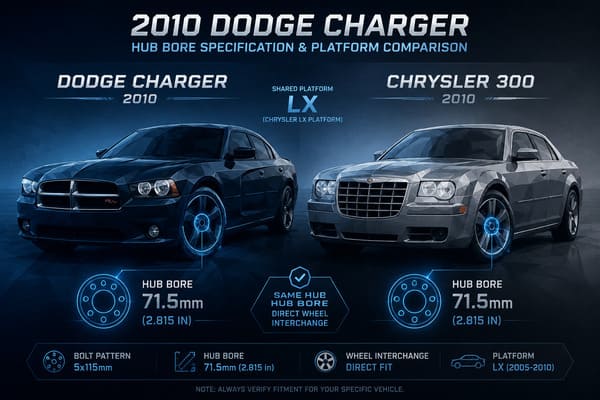
We have a long-term customer who works in the North American used car modification business. He had a 2010 Dodge Charger and a 2010 Chrysler 300 at the same time. Both cars sit on a related platform. He assumed the hub bore was the same on both and submitted one set of specifications for two orders. The Chrysler 300 does run a 71.5mm hub bore, so that part was fine. But he later told us that a friend of his owned an older Chrysler model — and that friend had almost made the same assumption with a different result. The hub bore was not the same.
Platform Similarity Does Not Mean Specification Similarity
This is a point we raise with customers regularly, especially those who own multiple vehicles from the same brand family.
| Vehicle | Hub Bore | Bolt Pattern | Notes |
|---|---|---|---|
| 2010 Dodge Charger | 71.5mm | 5×114.3mm | Standard modern spec |
| 2010 Chrysler 300 | 71.5mm | 5×114.3mm | Matches Charger |
| Chrysler Valiant Charger (AU) | 83.1mm | Varies by year | Completely different vehicle |
| Older Chrysler models (pre-2005) | Varies | Varies | Must verify individually |
Shared branding and shared platforms are not the same as shared specifications. Every vehicle needs its own confirmed measurements. We apply this rule without exception, whether a customer is ordering four wheels or forty.
Conclusion
Hub bore is not a detail you can guess. The Chrysler Valiant Charger runs 83.1mm. The Dodge Charger runs 71.5mm. Similar names, very different specs. Always measure first. At Tree Wheels, we verify every specification before production — because precision is how we protect your investment.
-
"Chrysler Valiant Charger – Wikipedia", https://en.wikipedia.org/wiki/Chrysler_Valiant_Charger. An OEM workshop manual or authoritative fitment database identifying the Chrysler Valiant Charger’s hub-center diameter as 83.1 mm would directly substantiate this specification. Evidence role: general_support; source type: other. Supports: The Chrysler Valiant Charger has a hub bore of 83.1mm.. Scope note: Publicly available factory documentation for Australian-market legacy models may be limited, so some support may come from digitized manuals or archival databases rather than a current manufacturer page. ↩
-
"4x 20mm Thick 5x115mm 71.5mm Bore HubCentric Wheel Spacer …", https://www.ebay.com/itm/384709569995. A Dodge service manual, Mopar technical specification, or authoritative fitment reference listing a 71.5 mm hub-center diameter for modern Dodge Charger models would support the stated bore size. Evidence role: general_support; source type: other. Supports: The Dodge Charger runs a 71.5mm hub bore.. Scope note: The evidence should be checked by model year and trim because wheel specifications can vary across generations or special packages. ↩
-
"Chrysler Valiant Charger", https://en.wikipedia.org/wiki/Chrysler_Valiant_Charger. Historical accounts of the Australian Chrysler Valiant Charger and the North American Dodge Charger support that the two nameplates were developed and produced as distinct vehicles in different national markets. Evidence role: historical_context; source type: encyclopedia. Supports: The Chrysler Valiant Charger and Dodge Charger are different vehicles built in different countries.. Scope note: Such sources establish distinct production histories rather than proving wheel-fitment incompatibility by themselves. ↩
-
"Chrysler Valiant Charger – Wikipedia", https://en.wikipedia.org/wiki/Chrysler_Valiant_Charger. Historical references on the Chrysler Valiant Charger describe it as an Australian-market model produced from 1971 to 1978, supporting the article’s date range and market context. Evidence role: historical_context; source type: encyclopedia. Supports: The Chrysler Valiant Charger was an Australian-built muscle car produced from 1971 to 1978.. Scope note: Classification as a “muscle car” is partly descriptive; the production years are the directly verifiable portion. ↩
-
"New 20 inch Aluminum Wheel Rim for Dodge Charger 2006-2023 …", https://www.ebay.com/itm/204801316166. A model-year fitment specification or OEM service reference listing the Dodge Charger hub bore as 71.5 mm and bolt pattern as 5×114.3 mm across post-2006 models would substantiate this technical summary. Evidence role: general_support; source type: other. Supports: Most Dodge Charger model years from 2006 onward use a 71.5mm hub bore with a 5×114.3mm bolt pattern.. Scope note: The wording “most model years” requires cross-year confirmation and may not cover every trim, police package, or aftermarket wheel configuration. ↩
-
"Dodge Charger [2005-2023] – Bolt Patterns – Wheel-Size.com", https://www.wheel-size.com/pcd/5×115/dodge/charger/2005-2023/. A cross-year Dodge Charger wheel-specification reference showing the same hub-center diameter and bolt pattern from 2006 through 2023 would support the claim of specification continuity. Evidence role: general_support; source type: other. Supports: The Dodge Charger hub bore and bolt pattern specification remained consistent across the 2006–2023 production range.. Scope note: The source should be reviewed for exclusions such as special editions, brake packages, or nonstandard factory wheels. ↩
-
"How To Solve Wheel Vibration | What Are Hub Centric Rings?", https://www.youtube.com/watch?v=Gz1k5ZEGDto. Engineering or automotive service literature on hub-centric wheel mounting explains that excess center-bore clearance can prevent the wheel from being centered by the hub pilot. Evidence role: mechanism; source type: education. Supports: A wheel with an oversized center bore may not sit centered on the vehicle hub.. Scope note: The source may describe the general mounting mechanism rather than quantify the exact clearance at which a particular vehicle becomes unsafe or vibrates. ↩
-
"How To Solve Wheel Vibration | What Are Hub Centric …", https://www.youtube.com/watch?v=Gz1k5ZEGDto. Automotive engineering or service references on wheel imbalance and improper wheel centering support that eccentric mounting can produce speed-related vibration and alter load distribution at the studs or fasteners. Evidence role: mechanism; source type: education. Supports: An improperly centered wheel can cause vibration at speed and uneven stress on wheel studs.. Scope note: The evidence is likely to support the mechanism generally; the severity depends on clearance, fastener torque, wheel design, and vehicle operating conditions. ↩
-
"bore on custom wheel is wider then my hub. Is this ok ?? : r/cars", https://www.reddit.com/r/cars/comments/ua8wgb/bore_on_custom_wheel_is_wider_then_my_hub_is_this/. Technical explanations of hub-centric rings describe their function as adapters that fill the clearance between a vehicle hub pilot and a larger wheel center bore, supporting the claim that they can compensate for limited gaps. Evidence role: definition; source type: education. Supports: Hub-centric rings can compensate for small gaps between the vehicle hub and wheel center bore.. Scope note: This supports the function of the rings but does not establish that every ring material or gap size is suitable for long-term use. ↩
-
"Metal vs. Plastic Hub Rings – Konig Behind The Wheel Podcast", https://podcast.konigwheels.com/videos/hub-centric-rings-plastic-vs-metal/. Materials and automotive maintenance references comparing polymers and aluminum alloys under wheel-end heat and load conditions can support the article’s preference for metal hub-centric rings in demanding applications. Evidence role: mechanism; source type: research. Supports: Aluminum alloy hub-centric rings are more acceptable than plastic or low-grade polymer rings in the article’s fitment table.. Scope note: The evidence may justify material considerations generally rather than prove that all plastic rings are unsuitable or that all aluminum rings are adequate. ↩
-
"2014 Dodge Charger – Wheel & Tire Sizes, PCD, Offset and Rims …", https://www.wheel-size.com/size/dodge/charger/2014/. A 2014 Dodge Charger service specification or authoritative wheel-fitment listing showing a 71.5 mm center bore and 5×114.3 mm bolt pattern would directly substantiate the model-year claim. Evidence role: general_support; source type: other. Supports: The 2014 Dodge Charger has a 71.5mm hub bore and 5×114.3mm bolt pattern.. Scope note: The source should be verified against trim and brake-package variations, even if the base hub and bolt pattern are common. ↩
-
"2010 Dodge Charger sxt rwd. Rim suggestion 5×114.3 or 5×115 not …", https://www.chargerforumz.com/threads/2010-dodge-charger-sxt-rwd-rim-suggestion-5×114-3-or-5×115-not-sure-which-one-fits-in-a-20-or-22-inch.199161/. A 2010 Dodge Charger factory service manual or technical fitment table identifying the 71.5 mm center bore, 5×114.3 mm bolt circle, and five-stud layout would support this model-year specification. Evidence role: general_support; source type: other. Supports: The 2010 Dodge Charger has a 71.5mm hub bore, 5×114.3mm bolt pattern, and five studs.. Scope note: The citation should distinguish OEM hub specifications from aftermarket wheel dimensions, which may have different center bores. ↩