

A Texas customer almost ruined his resto-mod build with one wrong number. The offset spec he trusted online was not built for his car.
+25mm is not the right offset for a stock-fender 1970 Dodge Challenger. The factory offset on a 1970 Challenger is approximately +0mm to +6mm. That near-zero offset is what produces the car’s wide, aggressive stance. +25mm will push the wheel too far inward and kill the flush fitment.
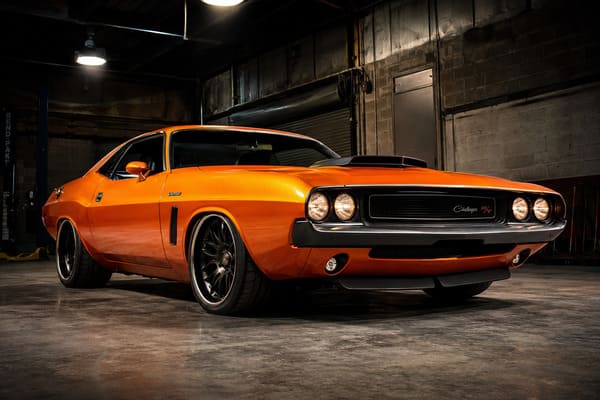
Last year, a customer from Texas contacted us. He was building a 1970 Dodge Challenger resto-mod and wanted a set of forged wheels at +25mm offset. He had seen that number on a forum and assumed it was the standard answer. Before we quoted anything, we asked him three questions: Are your fenders stock? Have you lowered the suspension? What tire width are you running? He said yes to stock fenders, confirmed a 2-inch drop, and told us he was running 275mm rear tires. Based on that, we told him +25mm would push the rear wheels roughly 19mm too far inward from the fender lip. That would destroy the flush, wide look he was after. We produced his wheels at +6mm front and +0mm rear. The fitment was perfect. +25mm is not wrong for every build. But it is wrong for a stock-fender, wide-tire setup on this car.
How Do You Measure the Correct Offset for a 1970 Dodge Challenger?
Three different spec sheets gave one customer three different numbers. None of them told him how to verify which one was actually right for his car.
The most reliable way to find the correct offset is to measure your existing wheel’s backspacing, then use this formula: offset = backspacing − (total wheel width ÷ 2)1. On a stock 1970 Challenger with 8-inch-wide wheels, this typically produces an offset of around +6mm.
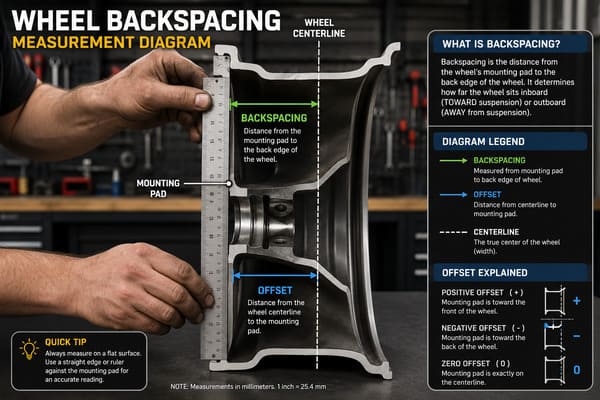
A customer once sent us a photo of his 1970 Challenger sitting in his garage with the wheels already removed. He wanted to order a new set of forged wheels but had no idea what offset to specify. He had searched online and found three different numbers — +0mm, +6mm, and +12mm — all listed as "correct" for his car. The confusion is real. Many 1970 Challengers have been modified over 50 years and no longer match factory specs2.
Why Spec Sheets Are Unreliable on a 50-Year-Old Car
We walked him through a simple measurement process. His old wheels were 8 inches wide. He measured the backspacing — from the back face of the wheel to the hub mounting surface — and got 4.25 inches. We then applied the formula:
| Measurement | Value |
|---|---|
| Total wheel width | 8 inches (203.2mm) |
| Half of total width | 4 inches (101.6mm) |
| Backspacing | 4.25 inches (107.95mm) |
| Calculated offset | +6.35mm ≈ +6mm |
That result became our production target. The reason this method works better than a spec sheet is simple. A spec sheet reflects what the factory built in 1970. Your car may have a different suspension setup, a different hub, or a different fender clearance than the original. Measuring the wheel that actually fit the car before gives you a real-world number, not a theoretical one. We always recommend this step before placing any order. It takes five minutes and prevents weeks of remakes.
What Is the Offset on Challenger Wheels?
This question sounds like it has one answer. It does not. The answer changes completely depending on which Challenger you own.
The 1970 Dodge Challenger uses an offset of approximately +0mm to +6mm. The 2023 Dodge Challenger uses +20mm to +38mm depending on the configuration3. These two cars share a name but use entirely different suspension geometry, hub depth, and fender clearance.
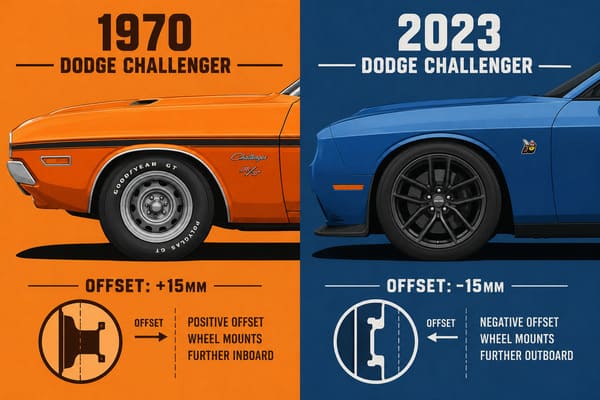
We once had a customer who owned both a classic and a modern Challenger. He wanted matching-style forged wheels for both cars. When he first contacted us, he assumed the offset would be similar because the cars share the same name. We had to explain that they are fundamentally different vehicles from a fitment standpoint.
Classic vs. Modern Challenger Offset: Side by Side
Here is how the two cars compare across the key fitment dimensions:
| Specification | 1970 Challenger | 2023 Challenger Scat Pack (Widebody) |
|---|---|---|
| Typical offset range | +0mm to +6mm | +20mm to +38mm |
| Common wheel width | 7–8 inches | 9–11 inches |
| Suspension geometry | Torsion bar front | Independent multi-link |
| Hub depth | Shallow | Deeper |
| Fender clearance style | Wide, open arch | Tighter, flared arch |
We produced his classic set at +4mm and his modern set at +28mm. That is a 24mm difference between two cars wearing the same wheel design. The visual result looked cohesive. The fitment numbers were completely different. This is why we never assume offset based on a car’s name alone. We ask for the year, the configuration, and the fender setup before we begin any design work. Same brand, same model name, completely different wheel engineering.
What Happens If You Use the Wrong Offset on a Classic Muscle Car?
One wrong offset number cost a customer two production runs and three extra weeks of waiting. The wheels arrived, and he had to pull them off the same day.
Using the wrong offset on a classic muscle car causes either inner contact with brake calipers and suspension arms, or outer rubbing against the fender lip. On a 50-year-old car, these tolerances are tight. There is very little room for error in either direction.
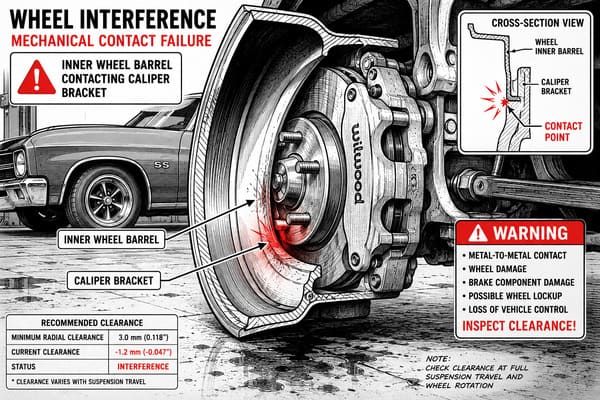
We had a customer who ordered forged wheels for his 1970 Challenger at +25mm offset — without consulting us first. He had found that number on a parts website that listed it generically for "Dodge Challenger." When the wheels arrived and he mounted the fronts, the inner edge of the wheel made contact with the brake caliper bracket at full steering lock. There was roughly 4mm of clearance on one side and zero on the other. He pulled the wheels off the same day.
The Two Ways Wrong Offset Fails on a Classic Car
The failure mode depends on which direction you get it wrong:
| Offset Error | What Happens | Where It Fails |
|---|---|---|
| Too much positive offset | Wheel sits too far inward | Inner edge contacts caliper, suspension arm, or strut |
| Too much negative offset | Wheel sits too far outward | Outer edge rubs fender lip at full steering lock or over bumps |
| Correct offset | Wheel sits flush with fender | Full clearance on both sides |
The fix for that customer required us to remake the front wheels at +8mm, adding 17mm of clearance back into the design. He waited an additional 15 business days for the new set. The cost of that mistake was two full production runs and a very frustrated customer. On a 50-year-old car, the tolerances between the wheel, the caliper, and the fender are tight and unforgiving. A number that sounds close enough is not always close enough. We always verify clearance specs before we cut a single piece of forged aluminum.
Is 5×5 and 5×5.5 the Same Bolt Pattern?
They look almost identical. They are not. Confusing these two patterns is one of the most common ordering mistakes we see every month.
5×5 and 5×5.5 are not the same bolt pattern. 5×5 equals 5x127mm. 5×5.5 equals 5×139.7mm. The difference is 12.7mm4. The 1970 Dodge Challenger uses neither — it uses a 5×4.5 bolt pattern, which converts to 5×114.3mm5.
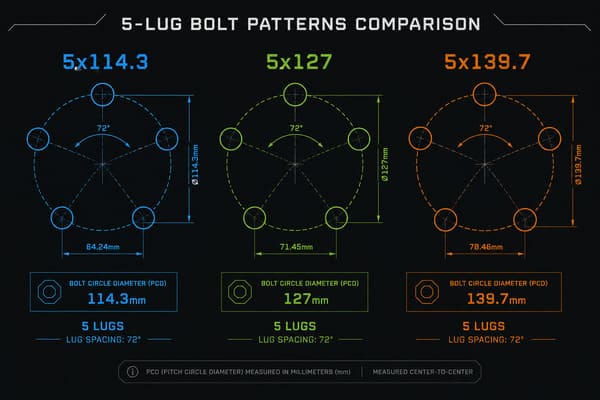
We receive at least two to three inquiries per month from customers who have confused these three patterns. One customer last spring ordered a full set of 5×127 forged wheels for his 1970 Challenger, believing that "5×5" and "5×4.5" were close enough. They are not. The lug bolts would not seat correctly, and the wheel could not be safely mounted. We caught the error during our order verification call.
The Three Bolt Patterns Most Often Confused
Here is a clear breakdown of all three patterns and where they actually appear:
| Bolt Pattern (Inches) | Bolt Pattern (mm) | Common Applications |
|---|---|---|
| 5×4.5 | 5×114.3 | 1970 Dodge Challenger, many Mustangs, Honda, Nissan |
| 5×5 | 5×127 | Full-size Chevrolet trucks, older GM platforms |
| 5×5.5 | 5×139.7 | RAM trucks, Toyota Land Cruiser, Jeep Wrangler |
The 12.7mm gap between 5×127 and 5×139.7 is small enough that the wheel may appear to sit on the hub. But the lug seats will not align correctly, and the clamping force will be uneven. On a moving vehicle, that is a safety failure6, not just a fitment issue. This is exactly why we confirm bolt pattern in millimeters — not inches — before we begin any production. Inch-based naming is too imprecise and too easy to misread. Millimeter measurements remove the ambiguity entirely. If you are unsure which pattern your car uses, measure the bolt circle directly or send us a photo of the hub. We will confirm it before we quote.
Conclusion
Offset and bolt pattern errors are avoidable. Measure first, verify in millimeters, and match specs to your actual build — not a generic forum post.
Tree Wheels produces custom forged wheels built to your exact specs. Contact us before you order — we’ll get the fitment right the first time.
-
"Backspace & Offset Calculator | Convert Fast", https://tireswheelsdirect.com/wheel-offset-and-backspace-calculator/?srsltid=AfmBOopPw20nNOHdRL6nvDeciEQ50GF0iV15mOhJJPbZrsg8oW2aSUSu. Wheel offset is defined in automotive engineering as the distance from the hub mounting surface to the wheel’s centerline; it is calculated by subtracting half the total wheel width from the backspacing measurement, a relationship described in standard automotive engineering and wheel fitment references. Evidence role: mechanism; source type: education. Supports: The mathematical relationship between wheel backspacing, total wheel width, and offset. Scope note: Sources may express the formula using different sign conventions or unit systems; the underlying geometric relationship is consistent across references. ↩
-
"What happened to classic muscle cars? Are they too expensive to …", https://www.quora.com/What-happened-to-classic-muscle-cars-Are-they-too-expensive-to-maintain-or-do-people-just-want-more-fuel-efficient-vehicles-now. Classic vehicle surveys and restoration industry data indicate that a substantial proportion of surviving muscle cars from the late 1960s and early 1970s have undergone suspension, wheel, or drivetrain modifications over their operational lifetimes, making reliance on factory specifications alone unreliable for fitment purposes. Evidence role: general_support; source type: institution. Supports: That a significant proportion of surviving 1970 Dodge Challengers have undergone modifications that alter their original specifications. Scope note: Precise modification rate data for the 1970 Challenger specifically is not widely published; the claim is supported by general patterns in classic car restoration literature rather than model-specific census data. ↩
-
"Please educate me on wheel offset/Widebody wheels", https://www.hellcat.org/threads/please-educate-me-on-wheel-offset-widebody-wheels.229175/. OEM wheel specifications for the 2023 Dodge Challenger indicate offset values ranging from approximately +20mm to +38mm depending on trim level and whether the vehicle is equipped with the standard or widebody fender package. Evidence role: definition; source type: other. Supports: The factory wheel offset range for the 2023 Dodge Challenger across its configurations. Scope note: Offset values vary across the 2023 Challenger’s trim hierarchy; the stated range reflects multiple configurations and may not apply uniformly to all variants. ↩
-
"BOLT PATTERNS CONVERSIONS (METRIC TO SAE)", https://premiertiresandwheels.ca/pages/bolt-patterns-conversions-metric-to-sae?srsltid=AfmBOopT2sVZq5O8ueytiPApdcMpttPwCo_5HAW9DVjMkjmjZmIU3SdM. Standard unit conversion establishes that a 5-inch bolt circle equals 127.0mm and a 5.5-inch bolt circle equals 139.7mm, yielding a difference of 12.7mm between the two commonly confused patterns; this distinction is documented in automotive wheel fitment references and engineering standards. Evidence role: definition; source type: other. Supports: The millimeter equivalents of the 5×5 and 5×5.5 inch bolt pattern designations and the numerical difference between them. Scope note: The conversion is arithmetically exact; the safety implication of mismatched lug seating is an engineering inference rather than a directly cited experimental result. ↩
-
"Dodge Challenger [1970-1974] – Bolt Patterns – Wheel-Size.com", https://www.wheel-size.com/pcd/5×114.3/dodge/challenger/1970-1974/. The 1970 Dodge Challenger is documented as using a five-lug bolt circle with a 114.3mm (4.5-inch) pitch circle diameter, a specification shared with several other Chrysler, Ford, and Japanese vehicles of various eras. Evidence role: definition; source type: other. Supports: That the 1970 Dodge Challenger uses a 5×114.3mm (5×4.5 inch) bolt pattern. Scope note: Bolt pattern databases aggregate data from multiple sources; confirmation against a factory service manual or physical measurement is recommended before wheel procurement. ↩
-
"[PDF] national – transportation – NTSB", https://www.ntsb.gov/safety/safety-studies/Documents/SIR9204.pdf. Automotive engineering standards establish that proper wheel retention depends on uniform clamping force distributed evenly across all lug seats; misalignment of the bolt circle prevents full lug seat engagement, reducing clamping force and increasing the risk of wheel separation under dynamic loading. Evidence role: mechanism; source type: institution. Supports: That incorrect bolt pattern alignment causes uneven lug seat contact and compromised clamping force, creating a safety risk. Scope note: The specific failure threshold depends on vehicle load, speed, and the degree of misalignment; the cited mechanism is a general engineering principle rather than a result specific to the 1970 Challenger. ↩