
Most Ferrari 488 owners get the wheel choice wrong the first time. The wrong finish, wrong structure, or wrong size can ruin a car worth over $250,0001.
Choosing forged wheels for a black Ferrari 488 comes down to four decisions: finish, structure, size, and budget. The right finish adds visual depth. The right structure matches your driving style. The right size needs exact fitment data. Budget ranges from $1,500 to $6,000 for a full set.
Getting this right the first time saves you weeks of rework and real money. I have handled dozens of Ferrari 488 wheel orders, and the same mistakes come up again and again. Let me walk you through each decision so you can avoid them.
Which Forged Wheel Finish Looks Best on a Black Ferrari 488?
Black on black sounds clean. In reality, it kills the car visually. The wrong finish makes a $250,000 Ferrari disappear in a parking lot.
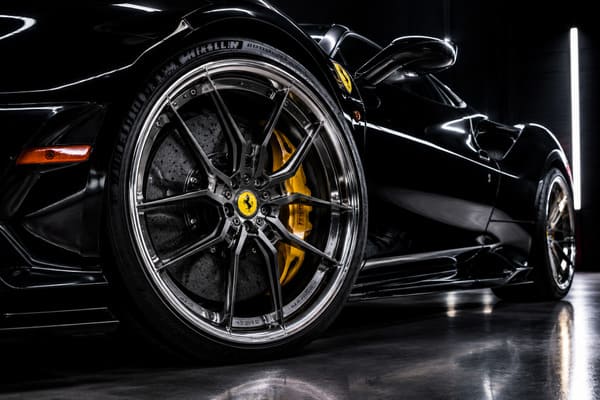
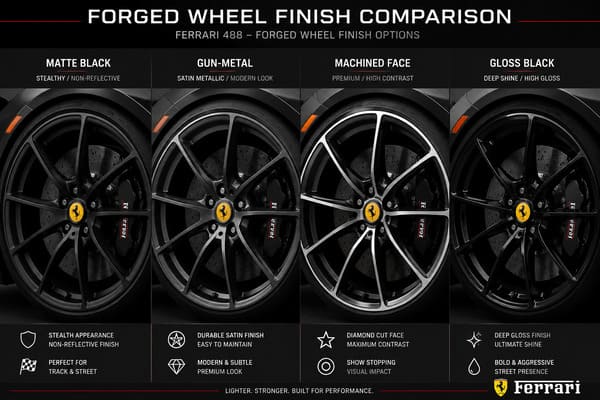
On a black Ferrari 488, a two-tone finish works best. Gun-metal spokes paired with a mirror-polished lip creates contrast and depth. A machined face with brushed spokes and polished lip is the strongest option for maximum visual impact under sunlight.
A customer came to me once and said he wanted something "low-key" for his black 488. His first choice was matte black. I told him directly: if you park that car on the street, nobody will look twice. A black car with black wheels has no visual layers. The whole car goes flat.
I pointed him in a different direction instead. We went with gun-metal spokes and a mirror-polished lip. After the wheels were installed, he sent me a photo from a parking lot and said people were turning their heads as they walked past.
Why Black Cars Need Contrast
Black is actually the best car color for showing off wheel detail. The dark body acts as a background that makes the wheel stand out. But only if the wheel has something to stand out with.
| Finish Option | Visual Effect | Best For |
|---|---|---|
| Matte Black | No contrast, flat look | Not recommended on black cars |
| Gun-metal + Mirror Lip | Strong contrast, layered depth | Daily drivers, street use |
| Machined Face + Brushed Spokes | Reflective layers, premium look | Show cars, high-budget builds |
| Gloss Black + Polished Lip | Subtle contrast | Minimalist preference |
We have completed over 30 Ferrari orders using the gun-metal and mirror-lip combination. The repeat order rate and referral rate from those clients is higher than any other finish we offer. If a client has a larger budget and wants stronger visual impact, I recommend the machined face treatment. The brushed spokes and mirror-polished lip reflect light at different angles. In direct sunlight, the layered effect is something a single-color wheel simply cannot produce. The black body of the 488 makes every detail on the wheel more visible. The key is to choose a direction that adds contrast, not one that removes it.
Are One-Piece or Multi-Piece Forged Wheels Better for a Ferrari 488?
A beautiful three-piece wheel on a track car can become a safety concern in three months. The structure you choose matters as much as the look.
For a Ferrari 488 used on track, one-piece forged wheels are the better choice. The single-body structure handles high-speed vibration without any joint movement. Three-piece wheels offer superior visual impact and wide-lip options, making them ideal for street and show use.
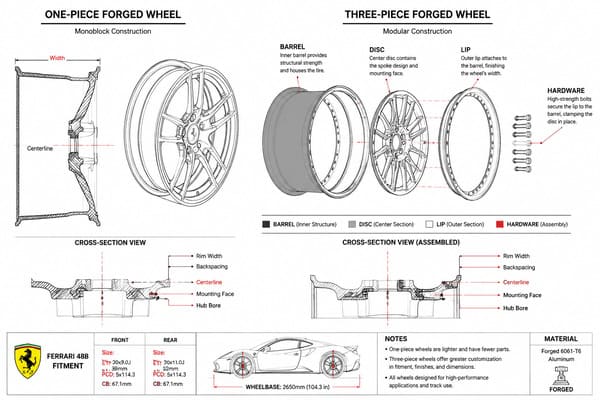
I had a client who ordered a set of three-piece forged wheels for his 488. They looked great. He took photos and was very happy. Three months later he came back and told me there was a slight vibration in the steering wheel after a few track sessions. We traced the problem to the bolt connections on the three-piece assembly. Under sustained high-speed vibration, the joints can develop micro-movement over time2. This is not a quality defect. It is a structural characteristic.
Matching Structure to How You Drive
The Ferrari 488 has a curb weight of around 1,475 kg3 and an engine that pulls to 8,000 RPM4. At that level of performance, the structural integrity of the wheel is critical. I ask every 488 client one question before recommending a structure: how many track days do you do per year?
| Use Case | Recommended Structure | Reason |
|---|---|---|
| 3+ track days per year | One-piece forged | No joints, maximum structural rigidity |
| Mostly street, occasional track | One-piece forged | Still the safer long-term choice |
| Weekend show car, street only | Three-piece forged | Wide lip options, superior visual depth |
| Car show and photography focus | Three-piece forged | Maximum customization and visual impact |
Three-piece wheels have a wide-lip aesthetic that one-piece wheels cannot match5. For a car that spends 90% of its time on weekend drives and car meets, the visual payoff of a three-piece is real and worth it. But the moment track use becomes regular, I stop recommending multi-piece structures for a 488. The driving purpose decides the right structure. The price does not.
How Much Do Custom Forged Wheels for a Ferrari 488 Cost?
I once saw a quote for four "forged" wheels at $800 total. I knew immediately they were cast wheels being sold as forged. Real forged wheels cannot be made at that price.
Custom forged wheels for a Ferrari 488 typically cost $1,500 to $3,500 for a one-piece set of four. Three-piece forged wheels range from $3,000 to $6,000 per set, depending on size and surface finish complexity. Any price far below these ranges should be questioned.
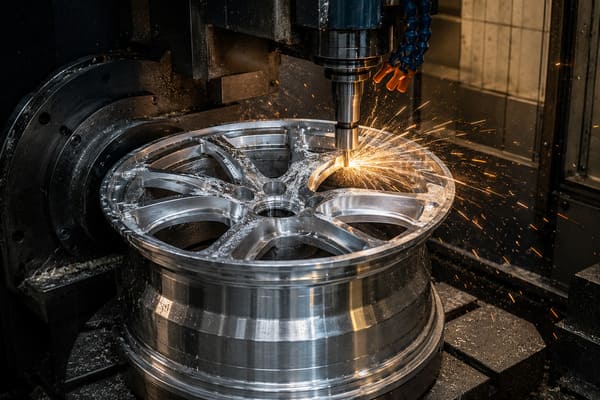
The reason the $800 quote is impossible is simple. The aluminum billet material cost alone, plus the CNC machining time required for a true forged wheel, already exceeds that number before any finishing work begins6. Forging is not just a label. It is a manufacturing process that requires specific equipment, specific material grades, and significant time.7
What You Are Actually Paying For
A one-piece forged wheel is machined from a single aluminum billet8. The process is straightforward relative to multi-piece work, which is why the price is lower. A three-piece wheel requires the front lip, rear barrel, and center disc to be manufactured separately and then assembled with hardware. That is more than twice the machining steps, and the price reflects it.
| Wheel Type | Price Range (Set of 4) | Key Cost Factors |
|---|---|---|
| One-Piece Forged | $1,500 – $3,500 | Size, finish complexity |
| Two-Piece Forged | $2,500 – $5,000 | Lip width, surface treatment |
| Three-Piece Forged | $3,000 – $6,000 | Assembly complexity, custom finish |
I have a client who runs a modification shop in Dubai. He told me that Ferrari owners in his market budget $4,000 and above for wheels. He said they are not buying the most expensive option available. They are buying something they can explain to other people. That observation is accurate. When a client spends serious money on wheels, they want to be able to point to the craftsmanship and name the process. Machined face, brushed spokes, polished lip, forged billet — these are things a client can describe. That is the value they are paying for. It is not a brand name. It is a process that can be verified.
What Size Are the Wheels on a Ferrari 488?
Ferrari 488 owners often assume they can upgrade size freely. A 5mm fitment error on this car will affect steering feel and can cause the wheel to contact the suspension9.
The Ferrari 488 comes from the factory with 20-inch wheels on both axles. Front fitment is 235/35 R20 and rear is 305/30 R2010. The staggered width setup supports rear-wheel-drive balance. Many owners upgrade the rear to 21 inches for a wider, more aggressive stance.
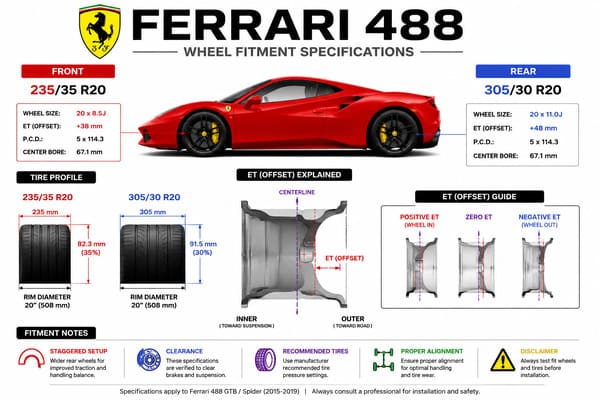
A client once measured his own fitment data and placed an order. He reported the ET value (offset) incorrectly by 5mm. After the wheels were installed, the inner edge of the wheel contacted the suspension. The wheels had to come off. He waited three more weeks for a replacement set. He lost time. We lost the cost of a full set of machined wheels. After that experience, we made a rule for all Ferrari orders. The client must provide the factory ET value and center bore diameter, or give us the VIN so we can look it up ourselves.
Why Fitment Precision Matters More on a Ferrari
On a standard sedan, a 5mm offset error might go unnoticed. On a Ferrari 488, the suspension geometry and steering feedback are tuned to precise tolerances. Any deviation from the correct offset changes the scrub radius, which directly affects how the steering feels at speed.
| Fitment Spec | Factory Value | Notes |
|---|---|---|
| Front Wheel Size | 20 inch | 235/35 R20 tire |
| Rear Wheel Size | 20 inch | 305/30 R20 tire |
| Common Upgrade | Rear 21 inch | Wider stance, visual upgrade |
| ET Value | Must be confirmed | 5mm error causes suspension contact |
| Center Bore | Must be confirmed | Required for hub-centric fit |
The 488 has a front-to-rear width difference built into the factory spec. The front runs narrower to allow steering movement. The rear runs wider to maximize grip and visual stance.11 When clients upgrade to 21 inches on the rear, the look is noticeably more aggressive and planted. But the ET and center bore data must still be exact. A wheel that looks perfect in a photo but has the wrong offset is not a finished product. It is a problem waiting to happen. The detail has to be right before anything else matters.
Conclusion
Choosing forged wheels for a black Ferrari 488 requires the right finish, structure, size data, and a realistic budget. Every detail affects the final result.
Tree Wheels offers fully custom forged wheels with expert fitment support — built for Ferrari owners who refuse to compromise.
-
"Ferrari 488 – Wikipedia", https://en.wikipedia.org/wiki/Ferrari_488. The Ferrari 488 GTB had a base MSRP of approximately $252,000 at launch, with configured examples frequently exceeding that figure; see Ferrari official pricing archives or automotive reference sources such as Car and Driver for documented pricing. Evidence role: general_support; source type: encyclopedia. Supports: The Ferrari 488’s market price exceeding $250,000. Scope note: Actual transaction prices vary by configuration, market, and year; the $250,000 figure is an approximation and may not reflect current used-market values. ↩
-
"(PDF) “ Study of Vibration Loosening of Bolted Joints-A Review ”", https://www.academia.edu/63504570/_Study_of_Vibration_Loosening_of_Bolted_Joints_A_Review_. Mechanical engineering literature on bolted joint behavior under dynamic loading documents the phenomenon of fretting and micro-slip at fastener interfaces subjected to cyclic vibration, which can progressively reduce clamping force; this principle is relevant to multi-piece wheel assemblies used in high-speed driving conditions. Evidence role: mechanism; source type: research. Supports: That bolted joints in multi-piece assemblies can experience micro-movement or fretting under sustained vibration loads. Scope note: The article attributes this behavior to a specific customer case rather than controlled testing; the degree of micro-movement depends on bolt preload, surface finish, and vibration frequency, which are not specified. ↩
-
"Ferrari 488 – Wikipedia", https://en.wikipedia.org/wiki/Ferrari_488. Ferrari’s official technical specifications list the 488 GTB’s dry weight at approximately 1,370 kg, with a curb weight (including fluids) cited by automotive references at approximately 1,475 kg; figures should be verified against Ferrari’s published data sheet for the specific model year. Evidence role: statistic; source type: encyclopedia. Supports: The Ferrari 488 GTB’s curb weight of approximately 1,475 kg. Scope note: Dry weight and curb weight differ; the article does not specify which measurement is intended, and values may vary slightly by market and optional equipment. ↩
-
"Ferrari 488 – Wikipedia", https://en.wikipedia.org/wiki/Ferrari_488. Ferrari’s published specifications for the 488 GTB’s 3.9-litre twin-turbocharged V8 engine indicate a maximum engine speed of 8,000 RPM; this figure is corroborated by automotive reference sources including Ferrari’s own press materials. Evidence role: statistic; source type: encyclopedia. Supports: The Ferrari 488 GTB engine’s maximum RPM of 8,000. Scope note: The RPM figure is used in the article to support a structural argument about wheel integrity; while the specification itself is verifiable, the direct mechanical link between engine RPM and wheel joint stress requires additional engineering context. ↩
-
"Monobloc vs. 3 Piece? – Porsche Forum and Luxury Car Resource", https://www.6speedonline.com/forums/wheels-tires/192554-monobloc-vs-3-piece.html. Three-piece wheel construction—comprising a separate front lip, rear barrel, and center disc joined by hardware—allows the outer lip depth to be varied independently of the center section, enabling wider lip profiles than are typically achievable in a one-piece forging where the entire wheel geometry is constrained by a single billet and die; this design flexibility is a recognized characteristic of multi-piece wheel construction in the aftermarket industry. Evidence role: mechanism; source type: other. Supports: That three-piece wheel construction allows greater lip width customization compared to one-piece forged wheels. Scope note: No standardized engineering publication specifically benchmarks maximum achievable lip widths by construction type; this claim reflects industry convention rather than a formally published specification. ↩
-
"Cast vs Flow Formed vs Forged Wheels – The Real Difference", https://astforgedwheels.com/cast-vs-flow-formed-vs-forged-wheels-the-real-difference/. Studies on aluminum forging processes indicate that billet material, die tooling, and CNC finishing represent substantial per-unit costs; industry analyses of automotive wheel manufacturing suggest forged wheels carry significantly higher production costs than gravity-cast equivalents due to material grade requirements and multi-stage machining. Evidence role: mechanism; source type: research. Supports: That genuine forged aluminum wheel manufacturing costs preclude extremely low retail prices. Scope note: Specific cost figures vary by manufacturer, region, alloy grade, and production volume; the article’s implied cost floor is an approximation and no primary source is cited. ↩
-
"Magnesium wheels – Wikipedia", https://en.wikipedia.org/wiki/Magnesium_wheels. Forging is defined in materials engineering literature as a manufacturing process in which metal is shaped by applying compressive forces, typically using a press or hammer, resulting in a refined grain structure and improved mechanical properties compared to cast equivalents; see ASM International or Wikipedia’s ‘Forging’ article for a technical overview. Evidence role: definition; source type: encyclopedia. Supports: That forging is a distinct manufacturing process from casting, involving compression of metal under high pressure to achieve specific material properties. Scope note: The article does not specify the forging method (open-die, closed-die, or flow-forming), and mechanical property advantages vary by alloy and process parameters. ↩
-
"The Basics of One-Piece Wheel Construction", https://www.revoforged.com/post/the-basics-of-one-piece-wheel-construction. One-piece forged wheels, also termed monoblock forged wheels, are produced by first compressing an aluminum alloy billet under high pressure to consolidate the grain structure, followed by CNC machining to achieve the final spoke geometry and surface finish; this two-stage process is described in automotive manufacturing literature and distinguishes forged wheels from gravity-cast or low-pressure-cast alternatives. Evidence role: definition; source type: research. Supports: That one-piece forged wheels begin as a solid aluminum billet that is forged under pressure and then CNC-machined to final shape. Scope note: Some manufacturers use flow-forming or rotary forging as intermediate processes; the article’s simplified description may not apply uniformly across all forged wheel producers. ↩
-
"Scrub radius – Wikipedia", https://en.wikipedia.org/wiki/Scrub_radius. Automotive engineering references establish that wheel offset directly determines scrub radius; deviations from the designed offset value alter the moment arm of lateral forces at the contact patch, affecting steering feel and potentially causing wheel-to-suspension clearance issues, particularly on vehicles with tightly packaged suspension geometry. Evidence role: mechanism; source type: education. Supports: That incorrect wheel offset alters scrub radius and steering feedback, and may cause physical interference with suspension components. Scope note: The specific 5mm threshold cited in the article is based on the author’s experience with the Ferrari 488 and is not derived from a published engineering standard; tolerance sensitivity varies by vehicle design. ↩
-
"2019 Ferrari 488 GTB – Wheel & Tire Sizes, PCD, Offset and Rims …", https://www.wheel-size.com/size/ferrari/488-gtb/2019/. Ferrari’s official technical documentation and automotive specification databases list the 488 GTB’s standard tire fitment as 235/35 ZR20 front and 305/30 ZR20 rear on 20-inch alloy wheels; readers should confirm specifications against the vehicle’s door placard or Ferrari’s published data for their specific model year and variant. Evidence role: statistic; source type: other. Supports: Ferrari 488 GTB factory tire dimensions of 235/35 R20 front and 305/30 R20 rear on 20-inch wheels. Scope note: Specifications may differ between the 488 GTB, 488 Spider, and 488 Pista variants; the article does not specify which variant is referenced. ↩
-
"[PDF] Traction/Braking Force Distribution for Optimal Longitudinal Motion …", https://huei.engin.umich.edu/wp-content/uploads/sites/186/2015/02/vehicle.pdf. Vehicle dynamics literature notes that wider rear tires on rear-wheel-drive vehicles increase the rear contact patch area, improving traction under acceleration, while narrower front tires reduce unsprung mass and provide clearance for steering lock; this configuration is standard practice on high-performance rear-wheel-drive platforms. Evidence role: mechanism; source type: education. Supports: That staggered wheel and tire fitment on rear-wheel-drive vehicles serves functional purposes including increased rear traction and front steering clearance. Scope note: The article presents this as a design rationale without citing Ferrari’s engineering documentation; the specific balance of grip, handling, and aesthetics in the 488’s design is not publicly detailed by the manufacturer. ↩