
Most people ask the wrong question. They ask "which is better" — but the real question is "which is right for what you actually do with your car?"
Racing wheels are built for one thing: lap times. They sacrifice everything else to get there. Street performance wheels must be light, strong, DOT-compliant, and hold up on real roads every single day. That is actually a harder engineering problem.
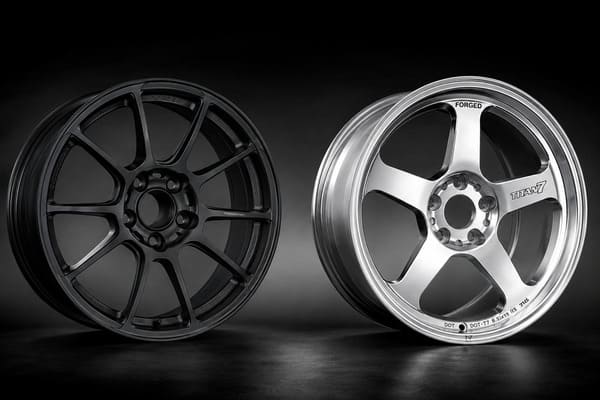
I get this exact confusion every week. A customer from a modification shop in Dubai messaged me last month wanting "full racing wheels" for his client’s Porsche 911. I asked one question: how many track days does this car see per year? He went quiet for a moment, then replied: "Actually… just street." That one question changed the entire order. The difference between racing wheels and street performance wheels is not just technical — it decides whether your customer comes back happy or comes back with a cracked rim.
Is It Worth Getting a Racing Wheel?
For 95% of people asking this question, the honest answer is no. Racing wheels are not built for public roads, and the consequences of using them there are real.
A racing wheel has no DOT certification, no street warranty, and is tuned for smooth, controlled track surfaces. It is not designed to absorb a pothole at 40 mph. For street use, a high-quality forged street performance wheel delivers the same dramatic look, significant weight savings, and full certification.
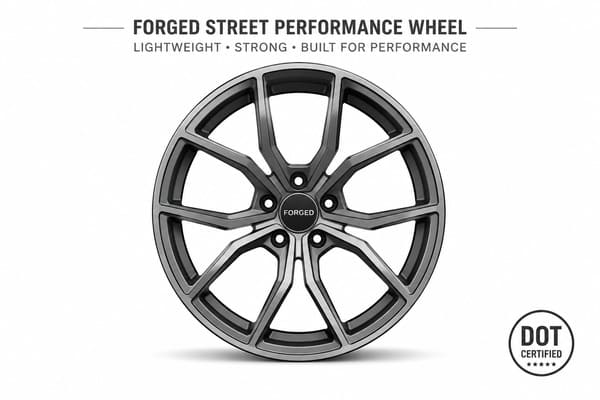
I had a shop owner in California reach out to me after a bad experience. He had sourced race-spec wheels for three of his clients. Within eight months, two of those clients came back with cracked wheels. One of them had hit a pothole at 40 mph. That is not a failure of the wheel — that is a failure of using the wrong wheel for the wrong job. What that shop owner needed was not a racing wheel. He needed a better forged street performance wheel. He now orders from us, and he has not had a single complaint since.
Why Racing Wheels Fail on the Street
Racing wheels are engineered around a very specific set of conditions. Understanding those conditions makes it clear why they do not belong on public roads.
| Factor | Racing Wheel | Street Performance Wheel |
|---|---|---|
| Surface Type | Smooth, controlled track | Public roads, varied conditions |
| Impact Design | Optimized for lateral load | Built for vertical road impact |
| DOT Certification | Not required | Required for street legal use |
| Warranty | None for street use | 1-year replacement or repair |
| Pothole Resistance | Low | High |
| Intended Lifespan | Race season or event | Long-term daily or performance use |
The table above shows the core difference. A racing wheel is not inferior — it is just designed for a completely different environment.1 The problem starts when customers assume "race-spec" means "better for everything." It does not. On a public road, a certified forged street performance wheel is the stronger, safer, and more practical choice. It handles the unpredictable. A racing wheel does not need to. That gap matters every single time the car leaves a controlled surface.
Do Race Wheels Make a Difference?
Yes — but only inside the environment they were built for. Outside of that environment, the difference shrinks fast, and the trade-offs grow.
A dedicated racing wheel in a 19-inch size can weigh as little as 6.5 kg. A standard cast wheel of the same size sits at 11–13 kg.2 That unsprung weight gap sharpens steering, shortens braking distance, and tightens cornering response. The physics are real — but only on a track.
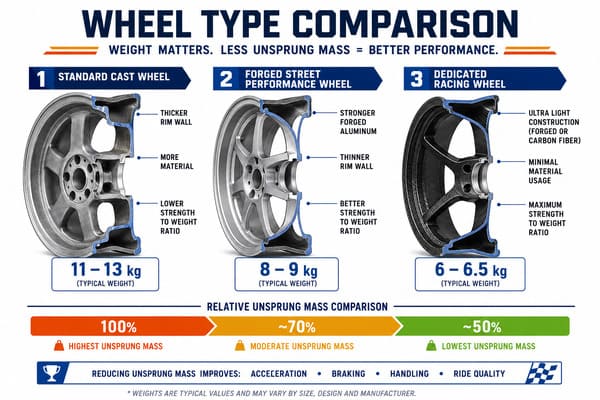
Here is the part nobody talks about. A high-quality forged street performance wheel in the same 19-inch size comes in around 8–9 kg.3 That is already 3–4 kg lighter than cast. One of our clients in Australia told me his car "felt like a different machine" after switching from cast to our forged wheels — and he had never set foot on a track. The jump from cast to forged street is huge. The jump from forged street to full race is much smaller. And for anyone driving on public roads, that smaller gap is not worth the trade-offs.
Breaking Down the Weight Gap
Weight reduction in wheels matters because wheels are unsprung mass. Every kilogram saved at the wheel has a bigger effect on handling than a kilogram saved anywhere else on the car.4
| Wheel Type | Approx. Weight (19-inch) | Unsprung Mass Impact | Street Legal |
|---|---|---|---|
| Standard Cast | 11–13 kg | Baseline | Yes |
| Forged Street Performance | 8–9 kg | Significant improvement | Yes |
| Dedicated Racing Wheel | 6–6.5 kg | Maximum reduction | No |
The numbers tell a clear story. Moving from cast to forged street performance gives you most of the weight benefit — with full certification and real-world durability. Moving from forged street to full race gives you a small additional gain, but removes all the protections that matter for daily or performance street driving. For the vast majority of customers, including enthusiasts, luxury car owners, and modification shops, the forged street performance wheel is the right answer. It delivers the performance upgrade they can actually feel, without the risks they cannot afford.
Are Forged Wheels Better for Racing or Street Use?
Forged is the right choice for both — but for different reasons. The manufacturing process is the same. What changes is how the wheel is spec’d for its environment.
For racing, forged wheels survive extreme lateral forces at high speed because the strength-to-weight ratio is unmatched. For street use, forged wheels handle road impact better, last longer, and can be fully customized without cutting into structural integrity. Forged is the answer in both cases.
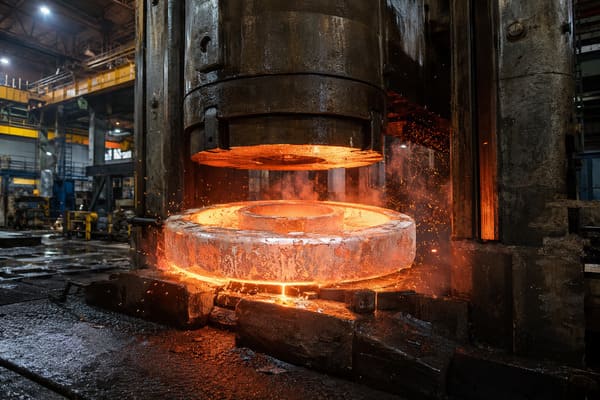
The forging process compresses aluminum billet under 6,000 to 10,000 tons of pressure.5 That creates a grain structure so dense and aligned that it cannot be replicated by pouring molten aluminum into a mold.6 I use this comparison with customers: cast aluminum is like stacking dry sand — it holds shape, but pressure finds the weak points. Forged aluminum is like compressed hardwood — the structure runs all the way through it. Same base material. Completely different internal strength.
What Changes Between Racing Spec and Street Spec
The forging method stays the same. The engineering decisions around it change based on the application.
| Specification | Racing Spec | Street Performance Spec |
|---|---|---|
| Wall Thickness | Minimized for weight | Optimized for impact resistance |
| Offset | Track-specific fitment | Road and fitment flexible |
| Load Rating | Track load conditions | DOT and TÜV road standards |
| Surface Treatment | Functional, minimal | Custom finish, wide color range |
| Certifications | FIA / sanctioning body | DOT, TÜV, ISO9001, IATF16949 |
| Customization Range | Limited | Full — size, design, color, finish |
We adjust every one of these factors for each order. A modification shop in the UK ordering wheels for a track-day Porsche gets a different spec than a luxury car center in Dubai fitting wheels for a daily-driven Lamborghini. The forging process is the foundation. The spec built on top of it is what makes the wheel right for its purpose. That flexibility is exactly why forged is the correct answer across both racing and street applications.
What Weight and Strength Standards Do Racing Wheels Need to Meet?
People assume racing wheels have higher standards than street wheels. In some ways, the opposite is true. Racing wheels meet track-specific standards — but they skip the certifications that matter most for everyday use.
Racing wheels meet FIA or sanctioning body specifications for controlled track conditions.7 They do not carry DOT, TÜV, or IATF16949 certification. Street performance forged wheels must pass independent testing for impact resistance, fatigue loading, and dynamic cornering stress across real-world road conditions.
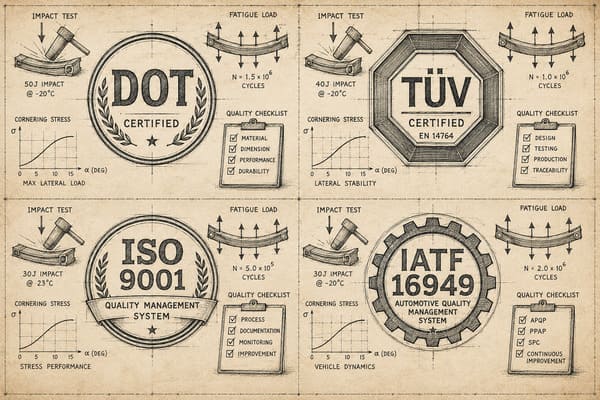
Our wheels carry DOT, TÜV, ISO9001, and IATF16949 certification. These are not marketing labels. Each one represents independent testing under conditions that reflect what a wheel actually faces on public roads — potholes, wet corners, emergency braking, long-term fatigue cycles. A race wheel is not tested for any of that. It does not need to be. But a street wheel absolutely does.
Certification Standards Compared
The table below shows what each certification actually tests for, and which type of wheel carries it.
| Certification | What It Tests | Racing Wheel | Street Performance Wheel |
|---|---|---|---|
| DOT | Impact resistance, street safety compliance8 | No | Yes |
| TÜV | Structural integrity, fatigue and load testing9 | No | Yes |
| ISO9001 | Manufacturing quality management system10 | No | Yes |
| IATF16949 | Automotive production quality standard11 | No | Yes |
| FIA / Sanctioning Body | Track-specific performance compliance | Yes | No |
A race wheel in a 19-inch fitment might weigh 6–6.5 kg. Our forged street performance wheels in the same size start from around 8–9 kg. That 1.5–2 kg difference is what buys full certification, a 1-year warranty covering replacement or repair, and a wheel that handles a pothole on a wet road in Toronto just as well as a sweeping corner in Dubai. That is not a compromise. That is a more complete product — built for the full range of conditions your customers actually face.
Conclusion
Racing wheels win on the track. Forged street performance wheels win everywhere else. Choose based on where the car actually drives, not on what sounds more impressive. Tree Wheels builds certified, fully customized forged wheels — engineered for real roads, real performance, and real customers.
-
"Design of a special rigid wheel for traversing loose soil – PMC – NIH", https://pmc.ncbi.nlm.nih.gov/articles/PMC9813352/. Automotive engineering literature distinguishes between wheels designed for controlled motorsport environments—where surface quality, load profiles, and operating durations are predictable—and road wheels engineered for stochastic impact loads, long service life, and regulatory compliance across varied conditions. Evidence role: expert_consensus; source type: paper. Supports: The engineering principle that racing and street wheels are optimized for fundamentally different load cases and operating environments, making direct quality comparisons inappropriate. Scope note: Direct comparative engineering analyses of racing versus street wheel design criteria are more commonly found in manufacturer technical documentation than in peer-reviewed literature. ↩
-
"[PDF] OE Alloy Wheel Weight Applications", https://www.weber.edu/WSUImages/automotive/O.E.%20Alloy%20Wheel%20Weight%20Applications.pdf. Published weight specifications from wheel manufacturers or independent automotive engineering sources document typical mass ranges for cast and forged 19-inch wheels, providing a basis for comparing the figures cited here. Evidence role: statistic; source type: research. Supports: Typical weight ranges for cast, forged street, and racing wheels in 19-inch fitments. Scope note: Exact weights vary by design, spoke count, and manufacturer; published ranges may not precisely match the specific values stated in the article. ↩
-
"18" vs 19" wheels the gritty details – BMW M3 Forum (E90 E92)", https://www.m3post.com/forums/showthread.php?t=373729. Published specifications from forged wheel manufacturers and independent automotive media reviews document typical weights for 19-inch forged street performance wheels, providing a basis for evaluating the 8–9 kg range cited in the article. Evidence role: statistic; source type: other. Supports: Typical weight range for forged street performance wheels in 19-inch fitment from established manufacturers. Scope note: Wheel weight varies considerably by design complexity, spoke count, width, and offset; the cited range may not represent the full market spectrum and could reflect a specific product tier. ↩
-
"Evaluation of the unsprung mass effect on ride comfort of in …", https://journals.sagepub.com/doi/abs/10.1177/09544070241288615. Vehicle dynamics literature establishes that unsprung mass—components not supported by the suspension—directly affects wheel contact force variation and suspension response, with reductions yielding handling improvements disproportionate to equivalent sprung mass savings. Evidence role: mechanism; source type: paper. Supports: The mechanical principle that unsprung mass reduction has a greater proportional effect on suspension response and handling than equivalent sprung mass reduction. Scope note: The magnitude of the effect depends on suspension geometry, spring rates, and road surface; general principles may not translate linearly to the specific weight differences cited. ↩
-
"12000 Ton Hydraulic Forging Press Machine For Aluminum Forged …", https://www.taitianpress.com/product/12000-ton-hydraulic-forging-press-machine-for-aluminum-forged-wheels/. Industry and manufacturing engineering sources describe aluminum closed-die forging for automotive components as requiring press forces typically in the thousands of tons, with the exact range depending on part geometry, alloy, and die design. Evidence role: statistic; source type: institution. Supports: The range of press forces used in aluminum billet forging for automotive wheel production. Scope note: Published tonnage figures vary by source and application; the specific 6,000–10,000 ton range cited may reflect particular equipment configurations rather than a universal industry standard. ↩
-
"Grain Orientation Effects on the Rotating-Bending Fatigue …", https://digitalcommons.calpoly.edu/cgi/viewcontent.cgi?referer=&httpsredir=1&article=1166&context=matesp. Materials science sources document that forging refines and aligns the grain structure of aluminum alloys along the direction of stress, reducing porosity and improving tensile strength and fatigue resistance compared to cast components of equivalent alloy composition. Evidence role: mechanism; source type: encyclopedia. Supports: The metallurgical basis for superior mechanical properties in forged versus cast aluminum, specifically regarding grain structure alignment and density. Scope note: The degree of improvement depends on alloy grade, heat treatment, and forging parameters; the comparison is valid in general terms but may not apply uniformly across all wheel designs. ↩
-
"Formula One regulations – Wikipedia", https://en.wikipedia.org/wiki/Formula_One_regulations. The Fédération Internationale de l’Automobile publishes technical regulations for each sanctioned championship that specify permissible wheel dimensions, materials, and in some series homologation requirements, with the scope varying significantly between formula, endurance, and rally categories. Evidence role: definition; source type: institution. Supports: FIA regulatory requirements governing wheel specifications in sanctioned motorsport competitions. Scope note: FIA wheel regulations differ substantially by championship; the article’s general reference to ‘FIA specifications’ may not accurately represent the diversity of requirements across different racing series. ↩
-
"Interpretation ID: 86-1.39 – NHTSA", https://www.nhtsa.gov/interpretations/86-139. U.S. Federal Motor Vehicle Safety Standards, administered by the National Highway Traffic Safety Administration, establish performance requirements for wheels and tires used on public roads, including load and impact criteria that manufacturers must meet to sell DOT-compliant products. Evidence role: definition; source type: government. Supports: The regulatory basis and testing requirements underlying DOT certification for automotive wheels sold in the United States. Scope note: DOT marking for wheels is largely self-certified by manufacturers rather than independently tested by a government body; the article’s description of DOT as an independent test may overstate the certification’s verification rigor. ↩
-
"Wheel Testing Services | TÜV SÜD", https://www.tuvsud.com/en-us/industries/mobility-and-automotive/automotive-and-oem/automotive-testing-solutions/wheel-testing. TÜV testing organizations apply standards such as those derived from SAE and ISO wheel test procedures, evaluating rotary fatigue, radial fatigue, and impact resistance to certify that wheels meet structural requirements for road use in European and other markets. Evidence role: definition; source type: institution. Supports: The scope and methodology of TÜV certification as applied to automotive wheels, including fatigue and structural load testing. Scope note: TÜV encompasses multiple independent organizations with varying scopes; the specific tests applied depend on the certifying body and the target market’s regulatory requirements. ↩
-
"4.3 Determining the Scope of the Quality Management System [ISO …", https://www.iso-9001-checklist.co.uk/4.3-how-to-write-your-scope-for-iso-9001-with-7-examples.htm. ISO 9001, published by the International Organization for Standardization, specifies requirements for a quality management system that organizations can use to demonstrate consistent ability to provide products meeting customer and regulatory requirements, and is applicable across manufacturing sectors including automotive components. Evidence role: definition; source type: institution. Supports: The scope of ISO 9001 as a quality management system standard applicable to manufacturing organizations including wheel producers. Scope note: ISO 9001 certifies an organization’s quality management processes rather than the safety or structural performance of specific products; its inclusion alongside product-level certifications such as DOT and TÜV represents a different category of assurance. ↩
-
"IATF 16949 – Wikipedia", https://en.wikipedia.org/wiki/IATF_16949. IATF 16949, published by the International Automotive Task Force, specifies quality management system requirements for automotive production and relevant service part organizations, building on ISO 9001 with sector-specific requirements for defect prevention and supply chain quality. Evidence role: definition; source type: institution. Supports: The scope and purpose of IATF 16949 as a quality management system standard for automotive production suppliers. Scope note: IATF 16949 governs manufacturing process quality systems rather than certifying the structural or safety performance of individual wheel products; presenting it alongside DOT and TÜV may conflate process certification with product safety certification. ↩