
People spend months picking the right wheel color and still get it wrong. The wrong choice on a white car doesn’t just look off — it looks like a mistake you paid for1.
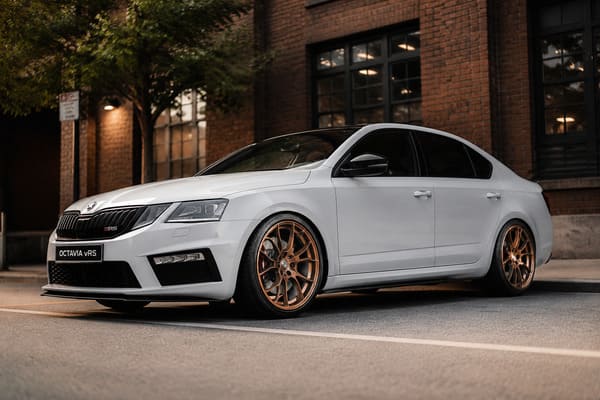
Copper forged wheels on a white Škoda Octavia RS create a warm-against-cool contrast that makes the wheels look intentional and expensive. The white body steps back completely, letting the copper finish own the visual. For a sleeper car like the RS, that combination is one of the strongest wheel choices available.
Most people searching for wheel inspiration look at the wheel first and the car second. That’s the wrong starting point. The car’s color, weight, and arch dimensions all shape whether a wheel choice works or falls flat. The Octavia RS is a specific kind of car — restrained on the outside, sharp underneath. That combination changes everything about how you should think about copper wheels on this platform. I want to walk through each part of that decision carefully, because the customers who get this right are the ones who understood the full picture before they placed an order.
Are Copper Forged Wheels the Right Choice for the Škoda Octavia RS?
Most modified cars announce themselves immediately. The Octavia RS does the opposite — and that’s the whole point. Picking the wrong wheel destroys that tension in one second.
Copper forged wheels work on the Octavia RS precisely because the car is a sleeper. The restraint of the exterior makes copper feel like a deliberate, confident choice rather than a loud statement. On a supercar, copper is expected. On an RS, it makes people look twice2.
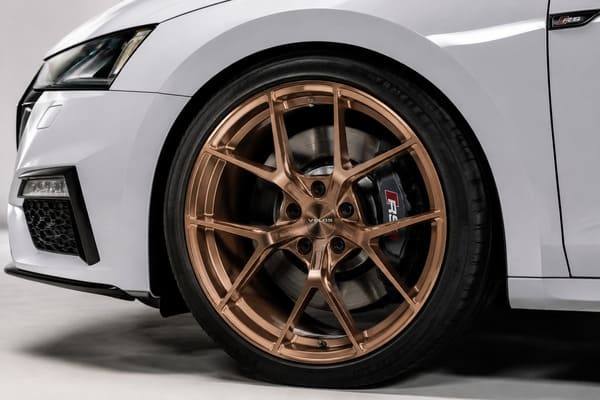
Last year, a customer from Australia came to us with a white Octavia RS 245. He had already looked at black wheels and silver wheels. He kept coming back to copper. His reason was simple — he didn’t want people to see a modified car. He wanted people to see a normal car, and then look twice. That’s the tension copper creates on a sleeper. On a Ferrari, copper reads as flashy. On an Octavia RS, copper tells you the owner made a choice on purpose.
There is also a weight argument that matters here. The RS weighs around 1,450 kg3. It is tuned to feel sharp and direct. Every gram that sits outside the suspension — in the wheel itself — works against that feeling. Our forged wheels run approximately 30% lighter than comparable cast wheels at the same size4. On a car built to feel responsive, that reduction is something the driver notices immediately, not just on paper.
| Wheel Type | Typical Weight (18-inch) | Weight Reduction vs Cast |
|---|---|---|
| Standard Cast Alloy | 10–11 kg per wheel | — |
| Tree Wheels Forged | 7–8 kg per wheel | ~25–30% lighter |
The visual choice and the performance choice point in the same direction here. That doesn’t happen often.
What Makes Copper Wheels Stand Out on a White Car?
Most people choose a wheel color by looking at the wheel alone. That’s the mistake. The car’s body color is half the equation, and white changes the math completely.
White doesn’t compete with copper — it steps back and lets the wheels own the visual entirely. Against a cool, neutral white body, copper reads as warm, intentional, and expensive. The contrast works the same way jewelry works against a plain background.
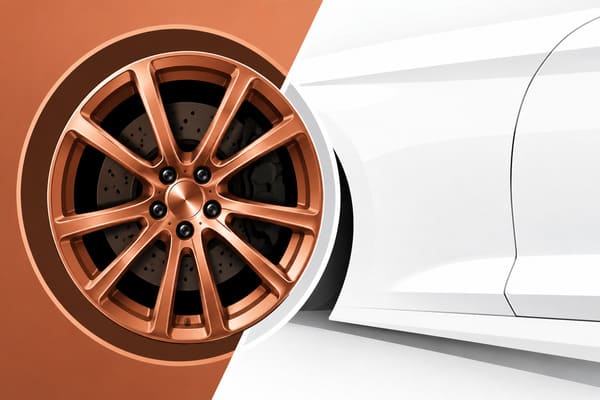
I’ve seen the same copper finish placed on three different car colors — black, dark blue, and white. On white, the copper looked the most expensive. Not the loudest — the most intentional. When copper goes on a red or black car, the colors compete. White removes that competition entirely.
There is also a technical reason the effect works as well as it does on a forged wheel specifically. Copper is the warmest metallic tone in the standard wheel color range. Against a cool white body, that temperature contrast is sharp and clean. But the finish alone doesn’t explain everything.
Why Forged Surfaces Make Copper Look Different
A forged wheel face has real physical depth. The machining process creates contours, spoke edges, and shadow lines that a cast wheel simply cannot replicate5. Our wheels go through a multi-step surface treatment process. On a copper finish, those shadow lines make the color appear three-dimensional under light.
| Surface Type | Copper Finish Result | Visible Depth |
|---|---|---|
| Cast wheel with copper paint | Flat, sticker-like appearance | Minimal |
| Forged wheel with copper finish | Carved, three-dimensional look | High — visible from 10 meters |
A cast wheel with copper paint looks like a color applied on top. A forged wheel with copper finish looks like the color came from inside the metal. That difference is visible from 10 meters away, and it is the reason customers who care about the final result choose forged.
What Should You Know Before Ordering Custom Copper Forged Wheels?
Most buyers pick the color first and figure out fitment later. That order costs people money, time, and sometimes a full reorder. The fitment decision shapes the entire result.
Before ordering custom copper forged wheels, confirm your offset, width, and center bore against your specific car’s specifications. The color choice is the easy part. Offset and width determine how the wheel sits in the arch — and that determines whether the finish is visible at all.
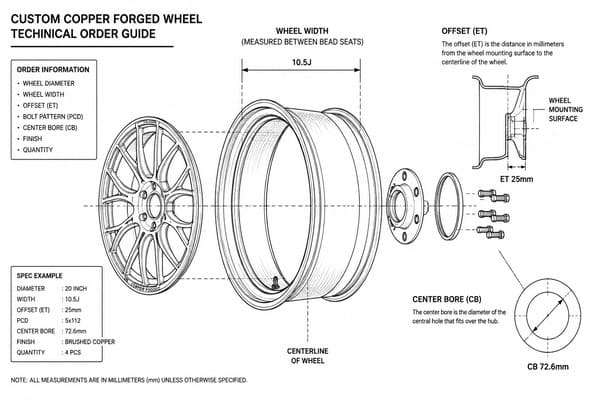
We had a customer who ordered a stunning copper finish on a 19×8.5 wheel, but he had guessed his offset. The wheels arrived, they fit, but they sat 12mm too deep inside the arch. The copper was barely visible from the side. He had to reorder with a corrected offset. That mistake cost him 6 weeks and an extra full set of production costs.
Fitment Details That Matter
| Specification | Why It Matters | Common Mistake |
|---|---|---|
| Offset (ET value) | Controls how far the wheel sits inside or outside the arch | Guessing instead of measuring |
| Width | Affects stance and clearance | Choosing width for looks without checking arch clearance |
| Center Bore | Must match hub size exactly | Assuming universal fit works |
Beyond fitment, copper finishes — whether PVD or painted with clear coat — are more sensitive to brake dust than silver or dark finishes. Brake dust is acidic. On a copper surface, staining can appear within 2 to 3 weeks6 if the wheels are not cleaned regularly. We tell every customer this before they confirm their order. That conversation takes 5 minutes. It saves months of frustration later.
We also provide 3D models and design sketches before production begins. That step exists for one reason — so the customer sees exactly what they are getting before a single piece of aluminum is forged. Surprises at delivery are expensive for everyone.
What Size Wheels Are on a Škoda Octavia RS?
The factory Octavia RS ships with 18-inch wheels as standard. Higher trims offer 19-inch as an option7. Most enthusiasts who contact us are already thinking beyond that.
The Škoda Octavia RS comes standard with 18-inch wheels, with 19-inch available on higher trims. The most common aftermarket fitment we see is 19×8.5 at ET45 offset8. This fills the arch cleanly without rubbing and gives the car a planted stance without requiring arch modification.
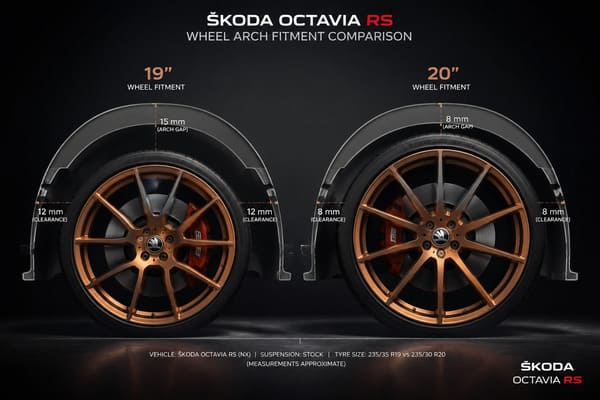
The 19×8.5 at ET45 is the fitment we recommend most often for this platform. It works within the factory arch dimensions, sits flush without sitting too deep, and gives the car a stance that looks intentional without looking aggressive to the point of impracticality.
19-inch vs 20-inch Fitment on the Octavia RS
The 20-inch fitment is where things become more precise. It sits at the edge of what the RS arch clearance comfortably handles9. The offset needs to fall within a 3 to 5mm tolerance to sit correctly. Outside that range, the wheel either tucks too deep or risks contact with the arch liner under full compression.
| Wheel Size | Recommended Offset | Arch Modification Needed | Notes |
|---|---|---|---|
| 19×8.5 | ET45 | No | Most common fitment, clean result |
| 20×8.5 | ET40–ET45 | Usually no | Tight tolerance, verify carefully |
| 20×9.0 | ET38–ET42 | Sometimes | Check clearance before ordering |
The Weight Argument in Numbers
Here is the number that makes the forged case easy to understand. A standard 18-inch cast alloy wheel on the Octavia RS weighs around 10 to 11 kg per wheel10. Our 20-inch forged wheel for the same platform comes in at around 8 to 9 kg. You go up 2 inches in diameter and still lose weight.
The car stays sharp. The RS still feels like an RS. That is not a marketing claim — that is how forged aluminum behaves when the grain structure of the metal is aligned through the forging process rather than poured randomly through casting11. The physics does the work.
Conclusion
Copper forged wheels on a white Octavia RS work because every part of the decision — color contrast, weight, fitment, and finish depth — points in the same direction. Get the details right, and the result speaks for itself. Tree Wheels builds fully custom forged wheels with expert fitment guidance — from first sketch to your door.
-
"Color Contrast – Accessibility by Design", https://www.chhs.colostate.edu/accessibility/best-practices-how-tos/color-contrast/. Design and color theory literature notes that achromatic backgrounds such as white amplify the perceived saturation and temperature of adjacent colors, making tonal mismatches more visually prominent than they would appear against darker or chromatic backgrounds. Evidence role: general_support; source type: education. Supports: That white, as a neutral and high-contrast background color, makes color mismatches on adjacent elements more visually apparent. Scope note: The specific claim that white is uniquely unforgiving for wheel color choices is an editorial interpretation of general color contrast principles rather than a finding specific to automotive design. ↩
-
"Is copper bronze wheel color achievable? | Dallas, TX – Facebook", https://www.facebook.com/groups/14306578977/posts/10162817858448978/. Automotive customization media and aftermarket wheel industry reports have documented the rise of bronze and copper finishes as a premium wheel color trend, particularly on performance and luxury vehicles, over the past decade. Evidence role: historical_context; source type: other. Supports: That copper or bronze wheel finishes have become associated with high-end or performance vehicles in aftermarket customization. Scope note: The characterization of copper as ‘expected’ on supercars is an editorial judgment; no industry data directly quantifies copper wheel prevalence by vehicle segment. ↩
-
"Škoda Octavia – Wikipedia", https://en.wikipedia.org/wiki/%C5%A0koda_Octavia. Škoda’s official technical specifications for the Octavia RS list curb weight figures that vary by drivetrain and model year; the figure cited here should be verified against the manufacturer’s published data for the specific variant in question. Evidence role: statistic; source type: other. Supports: The curb weight of the Škoda Octavia RS in the relevant generation and trim. Scope note: Curb weight varies across RS generations (e.g., RS 230, RS 245, RS iV) and body styles; a single figure may not apply universally. ↩
-
"Cast vs. Forged Wheels (Comparing EXACT Sizes) – YouTube", https://www.youtube.com/watch?v=KjgyrEo5GcU. Engineering literature on aluminum wheel manufacturing indicates that forged wheels can achieve meaningful mass reductions compared to cast counterparts due to higher material density and optimized geometry, though the precise percentage varies by design, alloy grade, and wheel size. Evidence role: statistic; source type: paper. Supports: The typical weight difference between forged and cast aluminum wheels of equivalent size. Scope note: Published weight-reduction figures vary widely by manufacturer and wheel design; a 30% figure represents one end of the reported range and may not apply to all forged-versus-cast comparisons. ↩
-
"Step 9 of the forging process: surface treatment. heels are loaded …", https://www.facebook.com/ApexRaceParts/posts/step-9-of-the-forging-process-surface-treatment-heels-are-loaded-into-a-vibrator/1282575930584678/. Forged aluminum blanks, being denser and more homogeneous than cast alloy, support tighter CNC machining tolerances, enabling sharper spoke profiles and surface contours; cast wheels are constrained by porosity and grain irregularities that limit achievable surface detail. Evidence role: mechanism; source type: research. Supports: That forged wheels allow for finer surface detail and sharper geometric features than cast wheels due to material density and CNC machining. Scope note: The claim that cast wheels ‘simply cannot replicate’ forged surface detail is a generalization; high-pressure die casting and flow-forming processes can produce competitive surface quality in some applications. ↩
-
"Brake Dust May Cause More Problems Than Blackened Wheel Covers", https://biosciences.gatech.edu/news/brake-dust-may-cause-more-problems-blackened-wheel-covers-1. Studies on brake wear particles indicate that brake dust contains iron oxides, heavy metals, and organic compounds that can be mildly acidic and corrosive to metallic surfaces upon prolonged contact, particularly in the presence of moisture. Evidence role: mechanism; source type: paper. Supports: That brake dust has acidic properties capable of degrading metallic wheel finishes. Scope note: The specific 2–3 week staining timeframe cited in the article is not established in published literature and likely depends on driving conditions, climate, brake pad composition, and wheel coating quality. ↩
-
"Skoda Octavia – Specs of rims, tires, PCD, offset for each year and …", https://www.wheel-size.com/size/skoda/octavia/. Škoda’s official configurator and press materials specify wheel size options by trim level and model year; the 18-inch standard and 19-inch optional fitment described here should be confirmed against the manufacturer’s published specifications for the relevant generation. Evidence role: statistic; source type: other. Supports: The factory-standard and optional wheel sizes offered on the Škoda Octavia RS. Scope note: Wheel size offerings differ across Octavia RS generations (Mk3, Mk4) and regional markets; the claim may not apply to all variants. ↩
-
"What is a good ET for 18 inch wheels on a Skoda Octavia? – Facebook", https://www.facebook.com/groups/octaviaVRS/posts/10165625911307269/. Wheel fitment databases and Octavia RS owner communities document commonly used aftermarket sizes and offsets; the 19×8.5 ET45 specification cited here is consistent with fitment data reported for the MQB-platform Octavia RS, though individual results depend on suspension setup and tire profile. Evidence role: general_support; source type: other. Supports: That 19×8.5 ET45 is a widely used aftermarket wheel fitment for the Škoda Octavia RS. Scope note: Fitment compatibility varies between Octavia RS generations and body styles; the cited specification should be verified against the owner’s specific vehicle build before ordering. ↩
-
"Will 255x40x20 inch fit skoda octavia VRS without issues – Facebook", https://www.facebook.com/groups/octaviaVRS/posts/10163425032207269/. Fitment guides and owner-reported data for MQB-platform vehicles indicate that 20-inch wheel fitments require precise offset and width selection to maintain adequate clearance between the tire sidewall and arch liner under full suspension compression, particularly on standard-height suspension. Evidence role: general_support; source type: other. Supports: That 20-inch wheels require careful offset selection to avoid arch liner contact on the Škoda Octavia RS. Scope note: Arch clearance is affected by suspension ride height, tire aspect ratio, and wheel width in combination; the claim that 20-inch is specifically at the limit of RS clearance is a generalization that may not apply to all configurations. ↩
-
"NEW FLOW FORMED JR-Wheels SL02 – Skoda Octavia Size", https://www.facebook.com/JapanRacing/posts/new-flow-formed-jr-wheels-sl02-skoda-octaviasize-19x85approximate-weights18x8-83/8642303179113899/. Independent wheel weight databases and automotive enthusiast resources document OEM alloy wheel weights by vehicle and size; 18-inch cast alloy wheels in the 10–11 kg range are consistent with figures reported for comparable MQB-platform vehicles, though exact weight depends on wheel design and alloy specification. Evidence role: statistic; source type: other. Supports: The approximate weight of standard 18-inch cast alloy wheels as fitted to the Škoda Octavia RS. Scope note: OEM wheel weights are not always published by manufacturers and vary by specific wheel design; the figures cited are approximations based on comparable vehicles rather than confirmed Octavia RS measurements. ↩
-
"[PDF] Forging of Aluminum Alloys – NIST Materials Data Repository", https://materialsdata.nist.gov/bitstream/handle/11115/223/Forging%20of%20Aluminum%20Alloys.pdf?isAllowed=y&sequence=1. Materials science literature establishes that the forging process induces directional grain flow aligned with the part geometry, which generally improves tensile strength and fatigue resistance relative to cast aluminum, where grain structure is less controlled. Evidence role: mechanism; source type: education. Supports: That forging aligns the grain structure of aluminum alloys, improving mechanical properties compared to casting. Scope note: The degree of improvement depends on alloy composition, forging temperature, and post-process heat treatment; the claim as stated is a simplification of a more complex metallurgical relationship. ↩