

Most people see a color-shifting wheel and think it’s just a fancy paint job. It’s not. The science behind it is precise, the materials are expensive, and the application process leaves almost no room for error.
Color-shifting and chameleon finishes use multi-layer interference pigments — microscopic flakes that split light into multiple wavelengths simultaneously. The color you see changes with your viewing angle. The finish is built from 5 to 7 distinct layers, including a dark base coat, an effect coat, and UV-stable clear coats, applied over a properly prepared substrate.
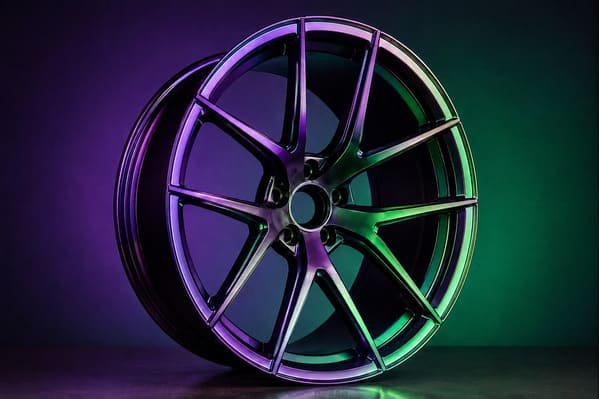
These finishes are one of the most technically demanding surface treatments we offer. Every layer has a purpose. Every step in the process has a tolerance. Miss any of them, and the result looks wrong — or fails early. I want to walk through exactly how this works, from the pigment chemistry to the substrate choice, so you understand what you’re actually getting when you order a chameleon finish.
What Makes Color-Shifting Finishes Different From Regular Wheel Paints?
Most customers who ask about color-shifting finishes have seen one in person and want to know how to get that same effect. But very few understand why regular paint can’t produce it — and that gap leads to a lot of wrong expectations.
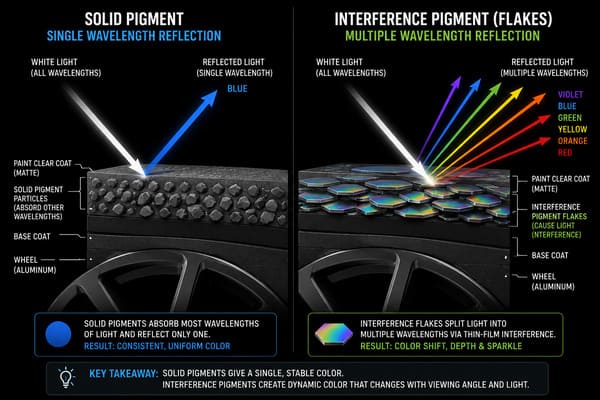
Regular wheel paint uses solid pigments. Light hits the surface, one wavelength reflects back, and you see one fixed color. Color-shifting finishes use interference pigments — microscopic flakes that split incoming light into multiple wavelengths at once1. The color you see shifts across a 60 to 90-degree viewing angle range2, which creates that "living" appearance.
A customer once sent me a photo of a wheel he’d seen at a car show — deep black at one angle, vivid purple at another. He said, "I want exactly that." My first response wasn’t "sure, we can do that." It was: "what base color is under that finish?"
That question matters more than most people realize.
Why the Base Coat Controls Everything
The base coat underneath the effect coat is not decorative. It is functional. The interference pigments in the effect coat are semi-transparent. They need a dark background to absorb the wavelengths that don’t reflect, so the ones that do reflect appear vivid and clean.
| Base Coat Lightness (L value) | Effect on Color Shift Intensity |
|---|---|
| Below L=15 (near-black) | Maximum perceived shift intensity |
| L=20–35 (dark gray) | Moderate shift, slightly washed out |
| L=40+ (mid-gray or lighter) | Shift becomes weak, colors appear dull |
A near-black base — with a lightness value below L=15 in colorimetry terms — can double the perceived intensity of the color shift3 compared to a mid-gray base. This is a measurable, documented difference. It’s not a matter of preference. Without the right base, you don’t get the effect you saw at the car show. You get an expensive, slightly iridescent disappointment. When a customer shows me a reference photo, the base coat color is the first thing I identify before we discuss anything else.
What Materials Are Used to Create Chameleon Wheel Finishes?
The materials that make chameleon finishes work are not the same as standard automotive paint materials. They are more specialized, more expensive, and more sensitive to handling. Understanding what goes into the finish helps explain why the cost is what it is.
Chameleon wheel finishes use multi-layer interference flakes — typically synthetic mica or aluminum oxide coated with extremely thin layers of titanium dioxide and iron oxide4. The coating thickness, ranging from 100 to 300 nanometers, determines the color travel range5. These flakes are suspended in a urethane or epoxy binder and applied as a dedicated effect coat.
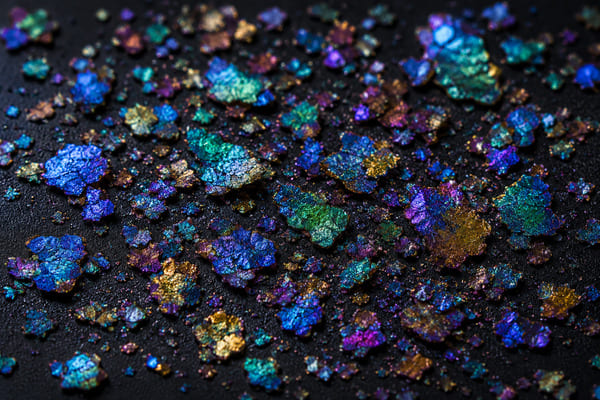
The first time I visited our surface treatment partner’s facility, the lead technician handed me a small jar of chameleon pigment — maybe 50 grams — and told me it cost more per kilogram than some of the aluminum alloy we use in the wheels themselves. That stayed with me.
How Layer Thickness Determines Color Range
The color travel you see in a chameleon finish is not chosen from a color chart. It is determined by the physical thickness of the oxide coating on each interference flake.
| Oxide Layer Thickness | Resulting Color Travel Range |
|---|---|
| ~100–150 nm | Blue to gold |
| ~150–200 nm | Green to purple |
| ~200–300 nm | Red to copper |
Change the thickness by 50 nanometers, and you shift the entire color range. This is why pigment batches from different production runs can produce slightly different results even when labeled the same — nanometer-level variation is difficult to fully eliminate at scale.
Why Pigment Concentration in the Effect Coat Is Critical
The pigment concentration in the effect coat is just as important as the pigment itself. Our surface treatment team works with a target of 8 to 12 percent pigment by weight in the effect coat mixture.
- Below 6%: The shift is too subtle to read clearly on a curved wheel surface. The wheel looks slightly iridescent rather than truly color-shifting.
- 8–12%: The flakes orient properly, overlap minimally, and produce a clean, vivid shift across the full face of the wheel.
- Above 15%: The flakes start to stack on top of each other. The effect turns muddy and the color shift loses its definition.
Hitting that window consistently across a full set of four wheels requires precise measurement and mixing. It is one of the reasons we do not outsource this step.
How Is the Application Process for Color-Shifting Wheels Carried Out Step by Step?
The application process is where most chameleon finishes fail — not because of bad materials, but because of process errors that are invisible until the finish is already cured. I’ve seen this happen to customers who had the work done elsewhere, and the cause is almost always the same.
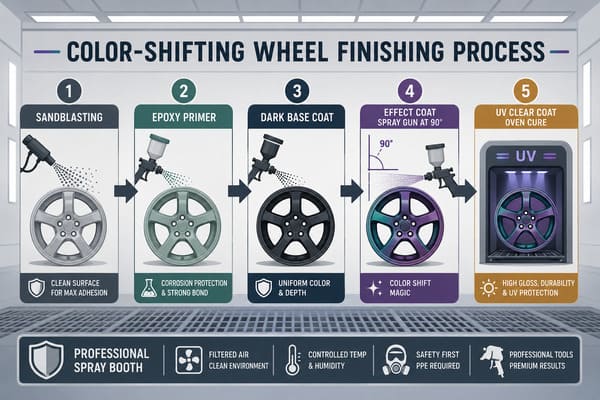
The application process for color-shifting wheels involves surface preparation, epoxy primer, dark base coat, a multi-pass effect coat applied at a consistent 90-degree spray angle, and UV-stable clear coats. Total process time for one wheel, done correctly, is 6 to 8 hours. Spray angle consistency during the effect coat is the most critical variable.
A client once came back to me frustrated. He’d had a chameleon finish applied locally, and one wheel out of four looked noticeably different — same colors, but the shift happened at a different angle. He thought it was a pigment batch issue. It wasn’t. It was a spray angle issue during the effect coat application.
The Full Process, Step by Step
Here is how the process runs at our facility, with the specifications we hold at each stage:
| Stage | Process Detail | Key Specification |
|---|---|---|
| Surface Preparation | Sandblasting + phosphate treatment | Sa 2.5 cleanliness standard6 |
| Epoxy Primer | High-build epoxy primer, oven-cured | 60–80 microns DFT, 160°C for 20 min |
| Base Coat | Near-black color coat | 40–50 microns, L value below 15 |
| Effect Coat | 3–4 thin passes, 5-min flash-off between passes | 8–10 microns per pass, 90° spray angle |
| Clear Coat | 2–3 layers UV-stable clear, oven-cured | 140°C cure, total 60–80 microns |
The effect coat stage is where skill matters most. On a flat panel, holding a consistent 90-degree spray angle is straightforward. On a wheel with deep spokes, concave pockets, and curved spoke edges, it requires constant repositioning of the spray gun. A 10-degree deviation in spray angle during the effect coat is enough to cause the color-shift direction to read differently across the wheel face. That is exactly what happened to my client’s fourth wheel — the technician drifted on the inner spoke faces, and the shift on that wheel peaked at a slightly different viewing angle than the other three.
Why Total Layer Count Matters for Structural Integrity
A complete chameleon finish stack sits between 180 and 250 microns total dry film thickness7. Each layer must fully cure before the next is applied. Rushing the process — skipping flash-off time, under-baking the primer, applying the effect coat in fewer passes at higher wet film thickness — creates internal stress between layers. That stress shows up later as micro-cracking or delamination, especially under thermal cycling from brake heat.
How Do Forged Wheels Perform With Color-Shifting Finishes Compared to Cast Wheels?
Substrate choice is the part of this conversation that most customers don’t think about until it’s too late. The finish is only as durable as the surface it’s bonded to. And for a finish as complex as a chameleon, the substrate matters more than almost any other factor.
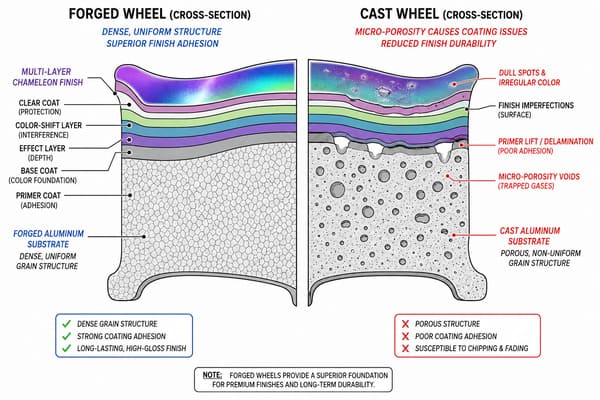
Forged wheels provide a denser, porosity-free substrate that holds chameleon finishes significantly better than cast wheels. Adhesion pull-off strength on forged aluminum measures above 8 MPa, compared to 5 to 6 MPa on cast8. This difference directly determines how long a multi-layer chameleon finish lasts under real driving conditions.
Early in our business, a client asked if he could get a chameleon finish on cast wheels to save money. I told him honestly: you can, but I’ve seen it fail within 18 months, and I explained exactly why.
The Porosity Problem in Cast Wheels
Cast aluminum wheels have micro-porosity — tiny air pockets in the metal left over from the casting process. Under a standard solid-color paint system with 2 to 3 layers, this rarely causes visible problems. But a chameleon finish involves 5 to 7 distinct layers with a total thickness of 180 to 250 microns. That stack is sensitive to what happens at the substrate level.
| Condition | Cast Wheel Behavior | Forged Wheel Behavior |
|---|---|---|
| Micro-porosity present | Yes — inherent to casting process | No — forging eliminates porosity |
| Adhesion pull-off strength | 5–6 MPa | 8+ MPa |
| Behavior under thermal cycling | Primer lifts at porosity points | Primer remains bonded |
| Visible failure on chameleon finish | Dull spots, dead zones in color shift | Finish remains intact |
| Expected finish lifespan | 12–24 months under normal use | 5+ years under normal use |
Brake heat alone can push rim temperatures to 150°C or higher on performance cars9. Over dozens of heat cycles, those trapped air pockets in cast wheels expand and contract. The primer starts to lift at those points. On a solid color, you might not see it for years. On a chameleon finish with its translucent effect layers, you see it immediately — a small dull spot where the color shift just stops.
Why Forged Wheels Are the Only Substrate We Recommend for Chameleon Finishes
The forging process compresses the aluminum grain structure under high pressure. This eliminates porosity almost entirely.10 The result is a surface that bonds to primer at a fundamentally higher strength level. When a customer invests in a chameleon finish — which adds $80 to $150 per wheel in surface treatment cost alone11 — they need a substrate that will hold that finish for 5 years, not 18 months. Recommending cast wheels for this application would mean selling a finish we know will fail. We don’t do that.
Conclusion
Color-shifting finishes are built on precise materials, controlled processes, and the right substrate. Every layer has a reason, and every variable has a tolerance. At Tree Wheels, we build forged wheels designed to hold these finishes for the long term — because the finish you invest in should last as long as the wheel beneath it.
-
"Thin-film interference – Wikipedia", https://en.wikipedia.org/wiki/Thin-film_interference. The color-shifting behavior of interference pigments arises from thin-film interference, in which light waves reflecting from the upper and lower surfaces of a nanoscale coating interact constructively or destructively depending on viewing angle and wavelength; see, e.g., the Wikipedia article on ‘Structural color’ or ‘Thin-film interference’ for a general treatment of this mechanism. Evidence role: mechanism; source type: encyclopedia. Supports: The optical physics of thin-film interference that causes angle-dependent color shifts in interference pigments. Scope note: General optical physics sources may not address pigment-specific formulations used in automotive coatings directly. ↩
-
"(PDF) Description and Characterization of Interference Pigments", https://www.academia.edu/93888118/Description_and_Characterization_of_Interference_Pigments. Goniochromatic coatings containing interference pigments exhibit color travel that is measurable across a range of illumination and viewing angles; multi-angle spectrophotometry studies document the angular dependence of color shift, with the perceptible range depending on pigment type, concentration, and base coat lightness. Evidence role: statistic; source type: paper. Supports: The angular range over which color shift is perceptible in goniochromatic interference pigment coatings. Scope note: The 60–90 degree figure is a practical characterization; the precise angular range varies by pigment formulation and measurement geometry. ↩
-
"[PDF] Color Science in the Examination of Museum Objects", https://www.getty.edu/conservation/publications_resources/pdf_publications/pdf/color_science.pdf. Colorimetric studies of effect pigment coatings demonstrate that base coat lightness significantly influences the chroma and perceived color travel of the effect layer, as darker bases absorb non-reflected wavelengths and increase color contrast; the magnitude of this effect is documented in coatings science literature, though the specific claim of a twofold intensity increase depends on measurement conditions and pigment type. Evidence role: mechanism; source type: paper. Supports: The influence of base coat lightness (L value) on the perceived intensity of color shift in interference pigment coatings. Scope note: The ‘double intensity’ characterization is a practical approximation; quantitative outcomes vary with pigment type, concentration, and the specific L values compared. ↩
-
"[PDF] DuPont™ Ti-Pure® titanium dioxide", https://ptacts.uspto.gov/ptacts/public-informations/petitions/1557529/download-documents?artifactId=Kq9HPXxZwkHZSb1s7Mpk3BpmIv2Bf9iHG5eRE-9TRCdrLP4B0ZTIdR8. Commercial interference pigments are commonly produced by depositing thin layers of metal oxides such as titanium dioxide and iron oxide onto platelet substrates including natural or synthetic mica and aluminum oxide; this composition is described in technical literature on effect pigments, including peer-reviewed reviews of pearlescent and interference colorants. Evidence role: definition; source type: paper. Supports: The material composition of interference pigments, specifically mica or aluminum oxide substrates coated with metal oxide layers. Scope note: Specific formulations vary by manufacturer and may not be fully disclosed in open literature. ↩
-
"Thin Film Interference | Harvard Natural Sciences Lecture …", https://sciencedemonstrations.fas.harvard.edu/presentations/thin-film-interference. The color produced by thin-film interference is governed by the optical path difference, which depends on film thickness and refractive index; published studies on effect pigments document that oxide layer thicknesses in the range of approximately 100–300 nm correspond to specific reflected color ranges across the visible spectrum. Evidence role: mechanism; source type: paper. Supports: The quantitative relationship between metal oxide coating thickness in nanometers and the resulting reflected color range in interference pigments. Scope note: Exact thickness-to-color mappings vary with refractive index of the specific oxide used and the substrate material, so published ranges are approximate. ↩
-
"Surface Preparation Standards Explained – SSPC/NACE & ISO 8501", https://www.graco.com/gb/en/contractor/solutions/articles/surface-prep-standards-explained-sspc-nace-iso-8501.html. The Sa 2.5 designation refers to a ‘near-white blast cleaning’ grade as defined in ISO 8501-1, which specifies visual cleanliness standards for steel surfaces prepared by abrasive blasting; this standard is widely referenced in industrial coating specifications. Evidence role: definition; source type: institution. Supports: The definition and requirements of the Sa 2.5 surface cleanliness grade for abrasive blast cleaning. Scope note: ISO 8501-1 addresses steel substrates; its application to aluminum wheel surfaces is by industry convention rather than direct specification. ↩
-
"The Problem with Meeting Dry Film Thickness Specifications", https://www.elcometerusa.com/The-Problem-with-Meeting-Dry-Film-Thickness-Specifications.html?srsltid=AfmBOop4f1lDOCtHBMR3Eb9YYdJwBtFq8xiylL35GWlFLfZbQLLx1mjU. Dry film thickness (DFT) is a standard quality parameter for industrial and automotive coatings, measured per ISO 2808 or ASTM D7091; total system DFT for multi-layer automotive finishes varies by application, with thicker systems generally providing greater protection but also increased risk of internal stress and delamination under thermal cycling. Evidence role: general_support; source type: institution. Supports: That multi-layer automotive coating systems are characterized by total dry film thickness measured in microns, and that thickness affects coating performance. Scope note: The 180–250 micron range cited is specific to the author’s process; published standards define measurement methods rather than prescribing universal thickness targets for chameleon finishes. ↩
-
"A Review on Porosity Formation in Aluminum-Based Alloys – PMC", https://pmc.ncbi.nlm.nih.gov/articles/PMC10004325/. Pull-off adhesion testing per ISO 4624 or ASTM D4541 measures the force required to detach a coating from its substrate; published data on aluminum alloy coatings indicate that substrate surface condition and porosity significantly affect adhesion strength, though specific values for forged versus cast wheel alloys depend on alloy grade, surface preparation, and primer system. Evidence role: statistic; source type: paper. Supports: Quantitative adhesion pull-off strength values for coatings on forged versus cast aluminum substrates. Scope note: The specific MPa values cited in the article are not directly verifiable from a single published source and likely reflect proprietary or application-specific test data. ↩
-
"An In-Depth Review on Sensing, Heat-Transfer Dynamics …", https://pmc.ncbi.nlm.nih.gov/articles/PMC12899374/. Engineering studies on brake system thermal behavior document that heat generated at the rotor-pad interface conducts into the wheel hub and rim; measured rim temperatures during repeated hard braking events on performance vehicles have been reported in the range of 100–200°C depending on brake system design, driving conditions, and wheel material. Evidence role: statistic; source type: research. Supports: Wheel rim temperatures reached during braking on performance vehicles. Scope note: Reported temperatures vary widely by vehicle type, brake specification, and measurement location on the rim; 150°C is a representative midpoint rather than a universal value. ↩
-
"A Review on Porosity Formation in Aluminum-Based Alloys – PMC", https://pmc.ncbi.nlm.nih.gov/articles/PMC10004325/. Forging subjects metal to compressive forces that close internal voids and refine grain structure, producing a denser microstructure with significantly reduced porosity compared to cast components; this is documented in standard metallurgy references including ASM Handbook volumes on forming and casting of aluminum alloys. Evidence role: mechanism; source type: encyclopedia. Supports: The metallurgical mechanism by which forging reduces or eliminates porosity in aluminum alloys compared to casting. Scope note: The degree of porosity elimination depends on forging temperature, die design, and alloy composition; ‘almost entirely’ is a qualitative characterization. ↩
-
"The EASY Way to Get COLORSHIFTING Wheels! – YouTube", https://www.youtube.com/watch?v=mZnUcEzMEac. The cost premium for specialty effect finishes on automotive wheels reflects higher material costs for interference pigments, increased labor time for multi-pass application, and additional quality control requirements; market pricing for such finishes varies by region, wheel size, and supplier, and the figures cited represent the author’s operational cost structure rather than an industry-wide benchmark. Evidence role: general_support; source type: other. Supports: That specialty interference pigment finishes carry a significant cost premium over standard wheel coatings. Scope note: No independent market survey or industry pricing database is available to directly verify the $80–$150 per wheel range; this figure is operator-specific. ↩