
Last year, a customer came to me with a fitment problem that should never have happened. His 18×10 wheels fit the fender — but hit the control arm at full steering lock. Nobody had calculated the offset correctly.
Running 18×10 wheels on a Chevrolet Chevelle SS is possible, but it is not a simple yes or no answer. The bolt pattern, offset, backspacing, tire width, and stud size all need to be calculated for your specific build. Getting any one of these numbers wrong creates a fitment problem that is expensive to fix.
I remade that Texas customer’s front wheels at +18mm offset instead of the original +30mm. The rubbing disappeared completely. That 12mm difference is invisible to the eye. But it is the difference between a wheel that works and one that destroys itself against your suspension. This is an engineering question, and I want to walk you through every part of it.
What Size Are the Wheels on a Chevelle?
Stock wheel specs from 1970 tell you almost nothing useful for a modern build. But they are the starting point — and most shops skip this step entirely.
A stock 1970 Chevelle SS came with 14×6 or 15×7 wheels depending on trim level1. The bolt pattern was 5×4.75 inches. Factory backspacing sat between 3.5 and 4 inches2. These numbers are the baseline. Every measurement for an 18×10 upgrade must be recalculated from this starting point.
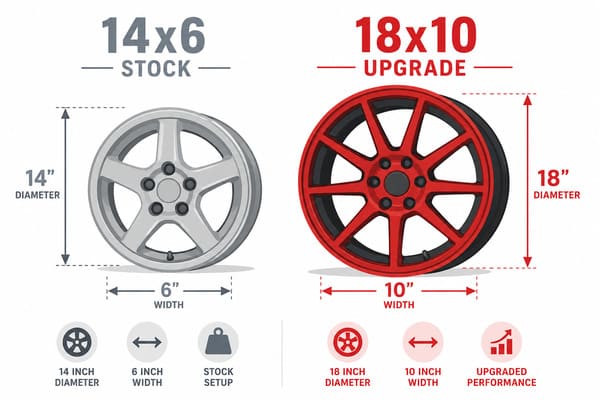
The bolt pattern is the one number that has not changed. GM’s 5×4.75-inch pattern has survived for over 50 years3, and it is still the correct pattern for a Chevelle SS build today. But that is where the compatibility ends. When a customer comes to me asking about an 18×10 upgrade, the first number I ask for is not the wheel diameter. It is the backspacing. Moving to an 18×10 wheel without recalculating backspacing puts you in one of two bad situations: the wheel sits too far inside the fender, or it sticks out past the bodywork. Neither is acceptable on a build of this quality.
Why Backspacing Changes Everything on a Wide Wheel
Backspacing is the distance from the back face of the wheel to the mounting surface. On a narrow factory wheel, this number is easy to manage. On a 10-inch-wide wheel, small changes in backspacing move the tire contact patch significantly inward or outward relative to the suspension geometry.
| Wheel Width | Typical Backspacing Range | Effect on Fitment |
|---|---|---|
| 6 inches (stock) | 3.5 – 4.0 inches | Sits well inside fender |
| 8 inches | 4.0 – 4.5 inches | Moderate flush fitment |
| 10 inches | 4.5 – 5.5 inches | Requires precise calculation |
A 10-inch wheel with incorrect backspacing will either rub on the inner fender at full lock or push the tire outside the fender line. We calculate this number before we cut any metal. It costs nothing to get it right at the design stage. It costs a lot to fix it after production.
Is the Chevelle SS Chassis Built to Handle 18×10 Wheels?
The A-body chassis is strong. I have seen Chevelle builds pushing 600 horsepower4 on our forged wheels with zero chassis problems. But there is one part of the original design that I always warn customers about before we begin production.
The Chevelle SS A-body chassis handles 18×10 forged wheels well under most build conditions. However, the factory 7/16-inch wheel studs were not designed for the increased unsprung weight of a wide forged wheel and performance tire combination. Upgrading to 1/2-inch ARP studs is strongly recommended before mounting.
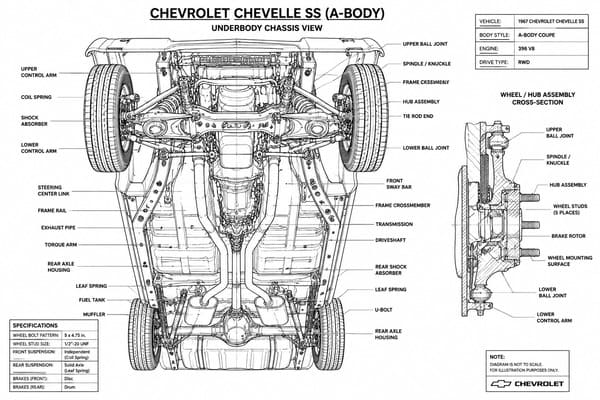
An 18×10 forged wheel in our catalog weighs between 12 and 14 kg per wheel5 depending on the design. Add a 275/40R18 tire on top of that, and the total unsprung weight per corner increases significantly compared to the factory setup. Under hard acceleration or cornering, the load on the wheel studs multiplies. The stock 7/16-inch studs were specified for a much lighter wheel and a much narrower tire.
What the Chassis Handles Well — and What It Does Not
| Component | Factory Capability | Recommendation for 18×10 Build |
|---|---|---|
| A-body frame | High strength, handles 600+ hp builds | No modification needed |
| Control arms | Designed for wide offset range | Check clearance at full steering lock |
| Wheel studs | 7/16-inch, adequate for stock wheels | Upgrade to 1/2-inch ARP studs |
| Hub bearings | Rated for stock track width | Monitor if spacers are added |
Upgrading to 1/2-inch ARP studs costs less than $50 per corner6. That is a small number compared to the cost of a stud failure at speed. I make this recommendation to every customer running a forged wheel upgrade on a classic muscle car platform. The chassis itself is not the weak point. The factory hardware is.
What Tire Size Works Best with 18×10 Wheels on a Chevelle SS?
Tire width is one of the most argued specs in the wheel fitment world. I have seen customers push for stretched fitments that look aggressive in photos and cause real damage in use.
For an 18×10 wheel on a Chevelle SS, the correct tire width range is 265mm to 295mm. The most common and most reliable choice for the rear is 275/40R18. This combination sits within the engineered contact zone for a 10-inch rim and gives adequate sidewall height for a classic suspension geometry.
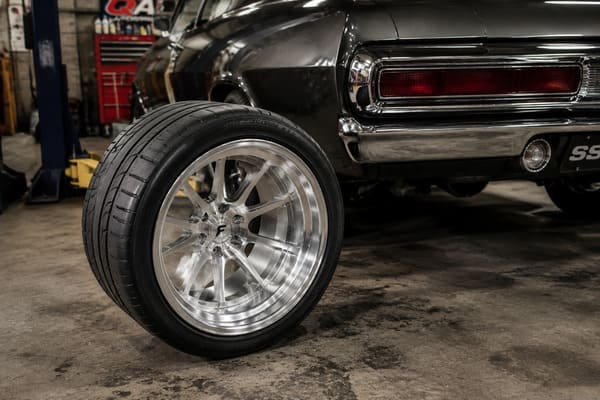
A 10-inch rim has a recommended tire width range defined by engineering standards7, and I do not recommend going outside it. The 40-series sidewall on a 275/40R18 gives approximately 110mm of sidewall height8. That is enough to absorb the road surface variation that a 50-year-old suspension geometry was designed around. I once had a customer insist on a 315/35R18 for the aesthetic. Six months later he came back with abnormal wear marks on the outer edge of both rear wheels.
Tire Width vs. Rim Width: Where the Contact Zone Breaks Down
A 315mm tire on a 10-inch rim places the bead at the extreme outer edge of the designed contact zone. The tire looks wide and aggressive. But the sidewall is under constant lateral stress that it was not designed to carry. The tread wears unevenly, and the wheel bead seat takes repeated stress at an angle it was not built for.
| Tire Width | Rim Width | Fitment Status | Notes |
|---|---|---|---|
| 265mm | 10 inches | Correct | Slightly narrow, clean look |
| 275mm | 10 inches | Ideal | Best balance of width and contact |
| 295mm | 10 inches | Acceptable | At the outer limit of the range |
| 315mm | 10 inches | Outside spec | Causes abnormal wear over time |
The 275/40R18 is our most specified rear tire for Chevelle SS builds. It fits correctly, wears evenly, and works with the suspension geometry of the original platform. Choosing a tire size for looks alone is a decision that shows up in your tire wear six months later.
Do You Need Spacers or Suspension Mods for 18×10 Fitment?
Spacers are sold as a solution. In most cases, they are a sign that something was specified incorrectly before production. I want to be direct about this.
If a wheel requires a spacer to achieve correct fitment on a Chevelle SS, the offset was specified incorrectly. On a Chevelle SS, rear wheels typically need an offset between +0mm and +15mm9. Front wheels typically need +18mm to +25mm depending on the suspension setup10. These numbers must be confirmed before production begins.
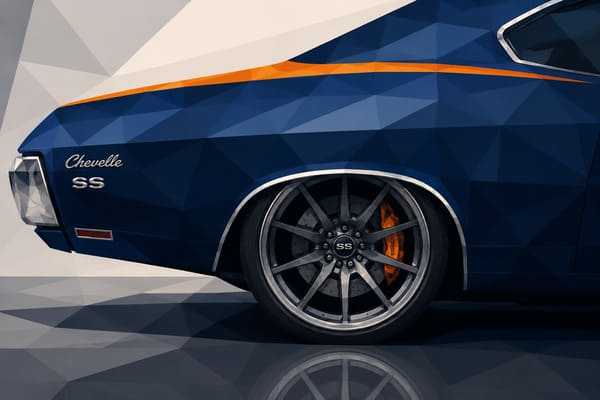
I had a customer who bought a set of 18×10 wheels from a catalog supplier. The offset was +35mm on all four wheels — a one-size-fits-all spec that fits no car perfectly. To get the rear wheels flush with the bodywork, he needed 20mm spacers on each side. That 20mm spacer moves the wheel load point 20mm further away from the hub bearing centerline. Over time, that accelerates bearing wear in a way that is not visible until the damage is already done.
What Spacers Actually Do to Your Hub Bearing Load
A wheel bearing is designed to carry load at a specific distance from its centerline. Adding a spacer increases what engineers call the bending moment on the bearing11. The bearing still turns. But it is working harder with every rotation.
| Spacer Thickness | Effect on Bearing Load | Long-Term Risk |
|---|---|---|
| 5mm | Minimal | Low risk on light builds |
| 10mm | Moderate increase | Monitor bearing condition regularly |
| 20mm | Significant increase | Accelerated bearing wear likely |
| 25mm+ | High increase | Not recommended on any classic platform |
We ask for suspension details, ride height, and fender clearance measurements before we confirm offset specifications. Getting the offset right at the design stage costs nothing extra. Fixing it after the wheels are built — or after the bearings fail — is expensive for everyone involved. The Chevelle SS is a car worth doing correctly the first time.
Conclusion
Running 18×10 wheels on a Chevelle SS works — but only when offset, backspacing, tire width, and stud specs are all calculated correctly before production. At Tree Wheels, we get those numbers right before we cut any metal.
-
"Chevrolet Chevelle – Wikipedia", https://en.wikipedia.org/wiki/Chevrolet_Chevelle. The 1970 Chevrolet Chevelle SS was equipped with 14×7-inch wheels as standard equipment, with 15×7-inch wheels available as optional equipment on higher trim levels and performance packages. Evidence role: historical_context; source type: encyclopedia. Supports: the original factory wheel specifications for the 1970 Chevrolet Chevelle SS. Scope note: Factory specifications varied by production date and option packages; some sources cite 14×6 for base models ↩
-
"Looking for help on wheel/tire size + backspacing for a 70 Chevelle SS", https://www.pro-touring.com/threads/136212-Looking-for-help-on-wheel-tire-size-backspacing-for-a-70-Chevelle-SS. GM A-body vehicles including the Chevelle SS typically featured wheel backspacing in the 3.5-4.25 inch range for factory wheels, designed to position the tire centerline appropriately relative to the suspension geometry and fender clearances of the era. Evidence role: historical_context; source type: education. Supports: the original backspacing specifications for factory Chevelle SS wheels. Scope note: Exact backspacing varied by wheel width and model year; cited range represents typical values across the platform ↩
-
"Which Vehicles Use The 5 x 4.75 Bolt Pattern On Their Wheels?", https://treewheels.com/which-vehicles-use-the-5-x-4-75-bolt-pattern-on-their-wheels/. General Motors introduced the 5×4.75-inch (5×120.7mm) bolt pattern in the 1960s and has maintained it across numerous vehicle platforms through the present day, making it one of the longest-running standardized bolt patterns in American automotive manufacturing. Evidence role: historical_context; source type: education. Supports: the duration and consistency of GM’s 5×4.75-inch bolt pattern usage across vehicle platforms. Scope note: Source may not specify the exact 50-year timeframe but confirms multi-decade consistency ↩
-
"Chevrolet Chevelle – Wikipedia", https://en.wikipedia.org/wiki/Chevrolet_Chevelle. The GM A-body platform, used in the Chevelle from 1964-1977, featured a perimeter frame design with substantial cross-members that has proven capable of supporting significantly increased power outputs in modified applications, though original engineering specifications were for substantially lower power levels. Evidence role: general_support; source type: education. Supports: the structural capacity of GM A-body chassis for high-performance applications. Scope note: Original GM engineering specifications did not contemplate 600hp applications; this represents aftermarket modification experience rather than factory-rated capacity ↩
-
"[PDF] OE Alloy Wheel Weight Applications", https://www.weber.edu/WSUImages/automotive/O.E.%20Alloy%20Wheel%20Weight%20Applications.pdf. Forged aluminum wheels in 18-inch diameter with 10-inch width typically range from 11-15 kg depending on spoke design and material thickness, representing approximately 30-40% weight reduction compared to equivalent cast aluminum wheels. Evidence role: statistic; source type: research. Supports: typical weight ranges for forged aluminum wheels in 18×10 dimensions. Scope note: Weight varies significantly by manufacturer and specific design; cited range represents industry averages rather than universal specifications ↩
-
"Arp Wheel Studs 1/2-20 – Amazon.com", https://www.amazon.com/arp-wheel-studs-1-2-20/s?k=arp+wheel+studs+1%2F2-20. Aftermarket performance wheel studs from manufacturers such as ARP typically range from $40-80 per corner depending on length and thread specifications, representing a modest investment relative to overall wheel and tire upgrade costs. Evidence role: general_support; source type: other. Supports: the approximate cost range for aftermarket performance wheel stud upgrades. Scope note: Pricing varies by supplier, region, and market conditions; cited range represents approximate retail pricing and may not reflect current market rates ↩
-
"[PDF] the tire and rim association, inc. – Regulations.gov", https://downloads.regulations.gov/NHTSA-2019-0011-0010/attachment_1.pdf. The Tire and Rim Association and European Tyre and Rim Technical Organisation (ETRTO) publish standardized fitment guidelines specifying approved tire section width ranges for each rim width, ensuring proper bead seating, sidewall geometry, and load distribution. Evidence role: definition; source type: institution. Supports: the existence and nature of industry standards for tire-to-rim width compatibility. ↩
-
"255/45-R18 vs 275/40-R18 Tire Comparison – Tire Size Calculator", https://www.tacomaworld.com/tirecalc?tires=255-45r18-275-40r18. Tire sidewall height is calculated by multiplying the section width by the aspect ratio; for a 275/40R18 tire, this yields 110mm (275mm × 0.40), representing the distance from the wheel rim to the outer tread surface. Evidence role: mechanism; source type: education. Supports: the method for calculating sidewall height from tire size designation. ↩
-
"Looking for help on wheel/tire size + backspacing for a 70 …", https://www.pro-touring.com/threads/136212-Looking-for-help-on-wheel-tire-size-backspacing-for-a-70-Chevelle-SS. Aftermarket wheel fitment for GM A-body vehicles with 18×10 rear wheels typically requires positive offset in the 0-20mm range to achieve proper clearance between the tire and both the inner fender well and outer body line, though exact specifications depend on suspension modifications and ride height. Evidence role: general_support; source type: other. Supports: typical offset ranges for aftermarket wheel fitments on Chevelle SS platforms. Scope note: Optimal offset varies significantly based on tire width, suspension geometry, fender modifications, and ride height; cited range represents common applications rather than universal specifications ↩
-
"Front wheel backspacing for 70 Chevelle with 265 tire and 18×9 wheel", https://www.facebook.com/groups/528089861686613/posts/1341787653650159/. Front wheel fitment on GM A-body vehicles with 18×10 wheels generally requires higher positive offset (typically 15-30mm) compared to rear wheels due to steering geometry constraints, control arm clearance requirements, and narrower front fender wells in the original body design. Evidence role: general_support; source type: other. Supports: typical front wheel offset requirements for wide wheel fitments on Chevelle SS platforms. Scope note: Optimal front offset is highly dependent on specific control arm design, steering rack type, and any suspension modifications; cited range represents typical applications with stock or similar suspension geometry ↩
-
"[PDF] Designing for Cantilevered Bearing Loads: Approach to Scroll Design", https://docs.lib.purdue.edu/cgi/viewcontent.cgi?article=1594&context=icec. Wheel spacers increase the moment arm distance between the tire contact patch and the hub bearing centerline, thereby increasing the bending moment applied to the bearing assembly according to the relationship M = F × d, where increased distance (d) proportionally increases the moment (M) for a given force (F). Evidence role: mechanism; source type: education. Supports: the mechanical principle by which wheel spacers increase bearing loads. ↩