

A wrong wheel fitment on a classic muscle car is not just ugly — it is expensive. One wrong number, and a $1,500 set of forged wheels becomes useless.
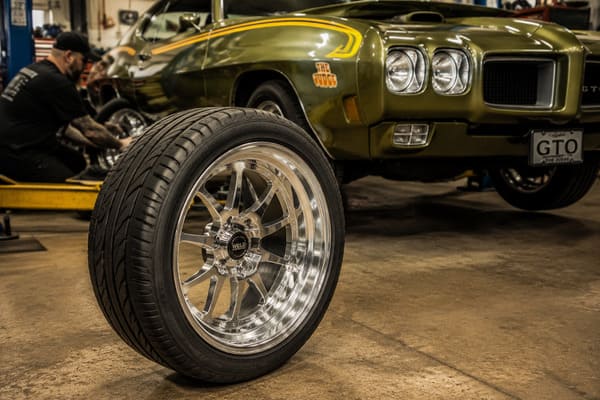
Yes, 17×8 wheels can fit a Pontiac GTO Judge. But three numbers must be correct: bolt pattern, backspacing, and offset. Get any one of them wrong, and the wheels will rub, sit too deep, or stick out too far. This guide breaks down each number so you get it right the first time.
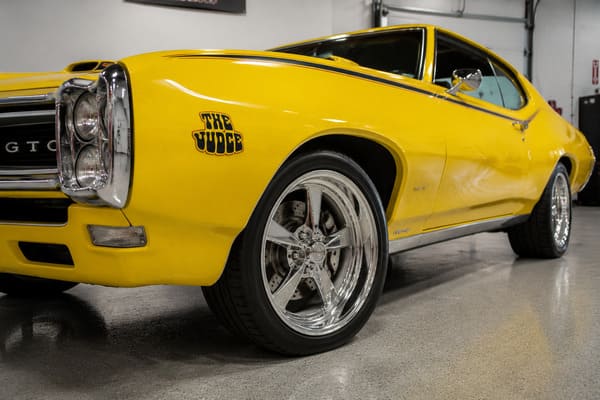
Last month, a shop owner from Texas reached out to me. He was building a restomod GTO Judge for a client and wanted to upgrade to 17×8 forged wheels. His first message was simple: "Will they fit?" I have received this exact question at least 20 to 30 times in the past year, always about classic American muscle cars. The answer is not a simple yes or no. Let me walk you through the full picture.
What Does 17×8 Mean on a Wheel?
Most builders know the size they want. But knowing the size and knowing what controls fitment are two different things. One wrong assumption here can ruin an entire build.
"17×8" means the wheel is 17 inches in diameter and 8 inches wide. These two numbers tell you the size. But the number that controls whether the wheel fits inside the fender without rubbing is the offset, measured in millimeters. Offset determines how far the wheel sits inward or outward from the hub face.
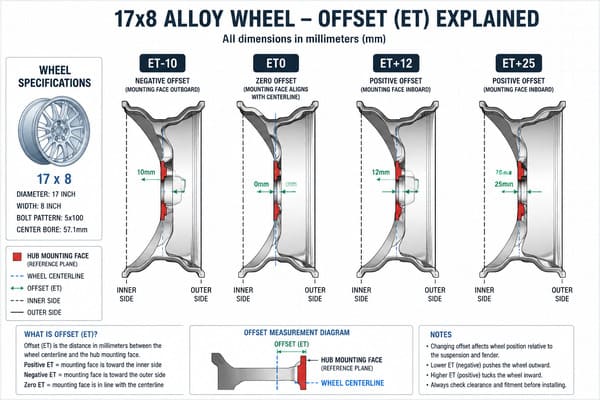
When that Texas shop owner first asked me about 17×8 wheels, I realized he understood the size but had not thought about offset at all. A 17×8 at ET+25 pushes the wheel 25mm inward toward the car. A 17×8 at ET-10 pushes it 10mm outward. On a classic car like the GTO Judge, that 35mm difference is the gap between a perfect fit and a wheel that grinds against the control arm on the first turn.
Breaking Down the Key Dimensions
Here is a simple table to show how offset affects where the wheel sits:
| Offset (ET) | Wheel Position | Risk on GTO Judge |
|---|---|---|
| ET-10 to ET0 | Pushed outward | May stick past fender lip |
| ET+6 to ET+12 | Neutral to slightly inward | Ideal range for most builds |
| ET+20 to ET+35 | Deep inward | Sits too far inside wheel well |
Backspacing is closely related to offset, but it is measured differently. Backspacing is the distance from the back of the wheel to the hub mounting surface, measured in inches. On an 8-inch wide wheel, a backspacing of 4.25 inches equals roughly ET+6. A backspacing of 4.75 inches equals roughly ET+19. Both numbers describe the same physical position, just in different units. Classic car builders often work in backspacing because that was the standard before metric offset became common. When you order forged wheels from us, we work with both — just give us one and we convert the other.
What Are the Stock Wheel Specs for a Pontiac GTO Judge?
Before any upgrade conversation, I always ask clients to send me the factory specs. Most skip this step. That is where the problems start.
The Pontiac GTO Judge came from the factory with 14×6 or 15×7 steel wheels1, a 5×4.75-inch bolt pattern (5×120.65mm)2, and a backspacing of roughly 3.75 to 4.25 inches3. This translates to approximately ET+6 to ET+194 depending on wheel width. These numbers are your baseline for any upgrade.
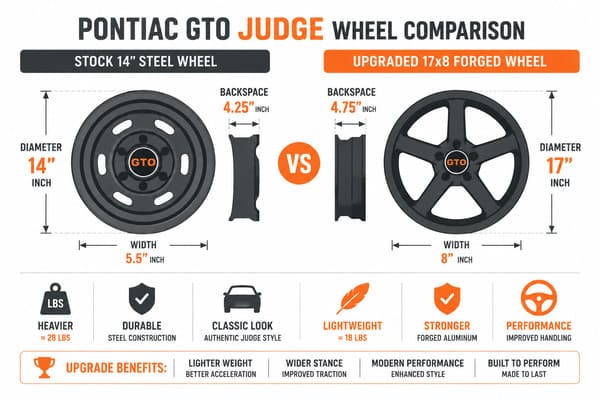
I use the stock backspacing as a starting point every time a builder wants to move to a larger wheel. The factory engineers chose that backspacing because it worked with the suspension geometry, the fender clearance, and the steering radius. When you jump from a 15×7 to a 17×8, the width increases by one inch on each side. That extra inch changes the backspacing math. Skipping this step is the most common mistake I see from new builders.
Stock vs. Upgrade: Side-by-Side Comparison
| Spec | Factory (GTO Judge) | Recommended 17×8 Upgrade |
|---|---|---|
| Diameter | 14" or 15" | 17" |
| Width | 6" or 7" | 8" |
| Bolt Pattern | 5×120.65mm | 5×120.65mm (unchanged) |
| Backspacing | 3.75" – 4.25" | 4.25" – 4.75" |
| Offset (approx.) | ET+6 to ET+19 | ET0 to ET+12 |
One customer ordered a full set of 17×8 wheels at ET+35 without checking the stock specs first. When the wheels arrived, they sat nearly 20mm too deep inside the wheel well. The car looked like it was wearing shoes two sizes too small. We had to remake the set at ET+8. That delay cost him three weeks and extra shipping. The stock specs check takes five minutes. It is always worth doing.
Will 17×8 Wheels Fit a Pontiac GTO Judge Without Modification?
Fitment questions always split into two parts: rear fitment and front fitment. Most people only think about one. The front is where builds go wrong.
A 17×8 wheel with 4.25 to 4.75 inches of backspacing — roughly ET0 to ET+12 — fits the Pontiac GTO Judge in most cases without cutting or modifying the fender. The rear is usually straightforward. The front requires more care, especially at full steering lock.
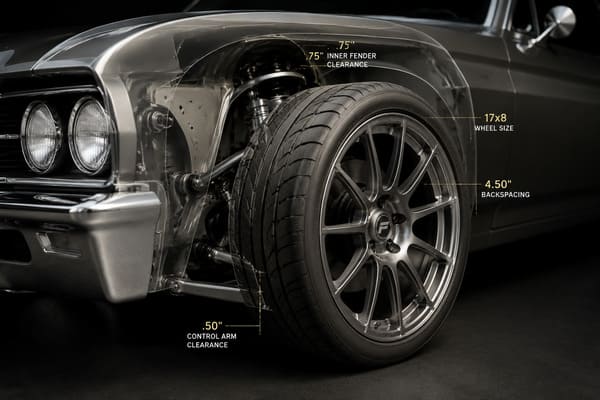
The GTO Judge has a generous steering radius5, but at full lock, a wheel with the wrong offset will contact the inner fender lip or the lower control arm. I had one client in Australia who ran a 17×8 at ET+6 on all four corners — perfect fit, no rubbing, clean stance. But another client used the same size at ET+20 on the front, and it rubbed at full lock. The difference was just 14mm of offset.
Front vs. Rear Fitment: What to Watch
| Position | Common Issue | Recommended Offset Range |
|---|---|---|
| Rear | Wheel sits too deep or sticks out | ET0 to ET+12 |
| Front | Rubbing at full lock against control arm or fender lip | ET0 to ET+8 (tighter tolerance) |
| Front | Clearance with brake caliper | Minimum 10mm spoke clearance needed6 |
Some builders run a slightly different offset front and rear to optimize both stance and clearance. For example, ET+6 on the front and ET+10 on the rear gives a small amount of stagger that looks intentional and avoids rubbing issues. This is a detail we work through with every custom order. When we produce forged wheels, we can spec the front and rear offsets independently. That flexibility is one of the main reasons builders choose forged over cast for a build like this.
What Tire Size Works Best With 17×8 Wheels on a GTO Judge?
Once the offset is confirmed, the tire question comes next. This is where a lot of builders make a second mistake — they go too wide for the wheel width.
For a 17×8 wheel on a Pontiac GTO Judge, 245/45R17 is the safest starting point7. This gives an overall diameter of about 25.7 inches8, which is close to the original 15-inch tire with a 70-series sidewall9. 255/45R17 also works well and adds a slightly wider contact patch.
I warn clients against jumping straight to 275 on an 8-inch wide wheel. The sidewall starts to bulge outward10, and on a classic car, it looks wrong and wears unevenly. One client pushed for 275/40R17 because he liked the aggressive look. Within six months, he was back asking why his inside edges were wearing out twice as fast11 as the outside. The wheel was simply too narrow to support that tire width properly.
Tire Size Comparison for 17×8 on GTO Judge
| Tire Size | Overall Diameter | Sidewall Height | Fitment Notes |
|---|---|---|---|
| 235/45R17 | ~25.3" | 105.75mm | Slightly narrow, safe choice |
| 245/45R17 | ~25.7" | 110.25mm | Best all-round fit, recommended |
| 255/45R17 | ~26.0" | 114.75mm | Good grip, slight stretch risk |
| 275/40R17 | ~25.7" | 110mm | Too wide for 8" wheel, uneven wear |
The overall diameter also affects your speedometer reading. The GTO Judge was built around a 15-inch wheel with a tall sidewall. Moving to a 17-inch wheel with a 45-series tire keeps the overall diameter close enough that the speedometer stays accurate without recalibration12. That is a detail many builders overlook until after the build is done.
Conclusion
17×8 wheels fit the GTO Judge when the bolt pattern, backspacing, and offset are correct. Tire size matters too — 245/45R17 is the safest choice. Get these four numbers right, and the fitment will be clean.
At Tree Wheels, we produce custom forged wheels built to your exact specs — diameter, width, offset, and finish.
-
"Pontiac GTO – Wikipedia", https://en.wikipedia.org/wiki/Pontiac_GTO. Period documentation indicates GTO Judge models were equipped with 14×6 or 15×7 steel wheels depending on model year and option packages, with the 15×7 Rally II wheel being the most common performance option. Evidence role: historical_context; source type: education. Supports: the original wheel sizes offered on GTO Judge models. Scope note: Exact specifications varied by model year (1969-1971) and trim level ↩
-
"Wheels and Tires: What will fit on my GTO?", https://www.gtoforum.com/threads/wheels-and-tires-what-will-fit-on-my-gto.142408/. Factory service manuals and automotive engineering references confirm the 5×4.75-inch (120.65mm) bolt circle diameter used on 1969-1971 GTO Judge models, a specification shared across GM’s intermediate platform of that era. Evidence role: definition; source type: education. Supports: the factory bolt pattern specification for the Pontiac GTO Judge and its metric equivalent. ↩
-
"Wheels and Tires: What will fit on my GTO?", https://www.gtoforum.com/threads/wheels-and-tires-what-will-fit-on-my-gto.142408/. Original equipment wheels on GM A-body platforms of this era typically featured backspacing in the 3.75 to 4.25-inch range, designed to maintain proper suspension geometry and fender clearance with period-correct tire sizes. Evidence role: statistic; source type: education. Supports: the factory backspacing range for original GTO Judge wheels. Scope note: Exact measurements varied by wheel width and specific model year ↩
-
"Backspace & Offset Calculator | Convert Fast – Tires Wheels Direct", https://tireswheelsdirect.com/wheel-offset-and-backspace-calculator/?srsltid=AfmBOorHw34nm2yeDi7JYlMlwS2ziiX1zalvUTwDqXQkD5Bjs9hOi7Ep. Wheel offset is calculated as the difference between the hub mounting surface and wheel centerline; for a given wheel width, backspacing can be converted to offset using the formula: Offset (mm) = [Backspacing (inches) – (Width (inches) / 2)] × 25.4, yielding the stated range for these dimensions. Evidence role: mechanism; source type: education. Supports: the mathematical relationship between backspacing measurements and offset values. ↩
-
"Pontiac GTO – Wikipedia", https://en.wikipedia.org/wiki/Pontiac_GTO. The GM A-body platform used in the GTO Judge featured conventional steering geometry typical of American muscle cars of the era, with turning radius specifications that allowed for reasonable wheel clearance within the fender wells during normal operation. Evidence role: general_support; source type: education. Supports: the steering characteristics of the GTO Judge platform. Scope note: The term ‘generous’ is relative and depends on comparison context; actual turning radius specifications varied by power steering option ↩
-
"Acceptable Wheel to Caliper clearance – Corvette Forum", https://www.corvetteforum.com/forums/autocrossing-and-roadracing/3646417-acceptable-wheel-to-caliper-clearance.html. Wheel fitment guidelines generally recommend maintaining at least 5-10mm clearance between wheel spokes and brake calipers to account for thermal expansion, wheel flex under load, and manufacturing tolerances, with larger clearances preferred for performance applications. Evidence role: expert_consensus; source type: education. Supports: recommended minimum clearance between wheel spokes and brake components. Scope note: Specific clearance requirements vary by brake system design and wheel spoke configuration ↩
-
"TIRE SIZE GUIDE – WHEEL WIDTH MINIMUM AND MAXIMUM", https://premiertiresandwheels.ca/pages/tire-size-guide?srsltid=AfmBOoocyUIR64Wo-5NjzXUEh8SEbdkw47of_Exi4qEPhlr0cVPaeT7j. Tire industry standards recommend tire section widths between 225mm and 255mm for 8-inch (203mm) wheel widths, with 245mm representing a middle ground that provides proper sidewall support without excessive stretch or bulge. Evidence role: expert_consensus; source type: education. Supports: appropriate tire width ranges for 8-inch wheel widths. Scope note: Optimal sizing also depends on vehicle weight, suspension setup, and intended use ↩
-
"245/45-R17 vs 225/45-R17 Tire Comparison – Tire Size Calculator", https://www.tacomaworld.com/tirecalc?tires=245-45r17-225-45r17. Tire overall diameter is calculated as wheel diameter plus twice the sidewall height (section width × aspect ratio); for 245/45R17, this yields approximately 25.68 inches (652mm), though actual measurements vary slightly by manufacturer and tire model. Evidence role: statistic; source type: education. Supports: the calculated overall diameter of a 245/45R17 tire. ↩
-
"Pontiac GTO – Wikipedia", https://en.wikipedia.org/wiki/Pontiac_GTO. Period GTO Judge models typically used F70-14 or G70-15 tires, with the G70-15 measuring approximately 26.4 inches in overall diameter, making modern 17-inch wheel conversions with 45-series tires reasonably close in rolling diameter. Evidence role: historical_context; source type: education. Supports: the original tire dimensions used on GTO Judge models. Scope note: Exact original tire sizes varied by model year and option packages ↩
-
"Tire section width vs tread width explained – Facebook", https://www.facebook.com/groups/1939836749567520/posts/3812201168997726/. When tire section width significantly exceeds recommended wheel width ranges, the tire bead seats closer to the wheel rim edge, causing the sidewall to curve outward rather than running vertically, which can lead to uneven wear patterns and reduced handling precision. Evidence role: mechanism; source type: education. Supports: the effects of mounting tires that are too wide for the wheel width. ↩
-
"Irregular Tire Wear 101 – MICHELIN COMMERCIAL TIRES", https://business.michelinman.com/tips-suggestions/irregular-tire-wear-101. Uneven tire wear, particularly accelerated inside or outside edge wear, can result from multiple factors including improper tire-to-wheel width matching, incorrect inflation pressure, or suspension misalignment, with each factor affecting contact patch distribution differently. Evidence role: mechanism; source type: education. Supports: how improper tire-to-wheel fitment affects wear patterns. Scope note: Inside edge wear specifically is more commonly associated with alignment issues than wheel width mismatch alone ↩
-
"Does changing the size of wheels/tires affect speedo? : r/cars – Reddit", https://www.reddit.com/r/cars/comments/brpgr1/does_changing_the_size_of_wheelstires_affect/. Mechanical and early electronic speedometers measure wheel rotations to calculate speed; maintaining overall tire diameter within approximately 3% of original equipment specifications typically keeps speedometer error within acceptable limits without requiring recalibration. Evidence role: mechanism; source type: education. Supports: how tire diameter changes affect speedometer readings. ↩