

If you’ve ever ordered wheels based on a vague fitment guide, you know how badly that can go. The wrong offset, a mismatched center bore, or an incompatible bolt pattern — any one of these will stop your build cold.
Yes, 17×8 wheels can fit a Holden Monaro HQ, but fitment depends on getting the bolt pattern (5×120.65), offset (ET0 to ET10), and center bore exactly right. A 235/45R17 tire is the recommended pairing1. Spacers are possible but not ideal — a custom offset is the better long-term solution.
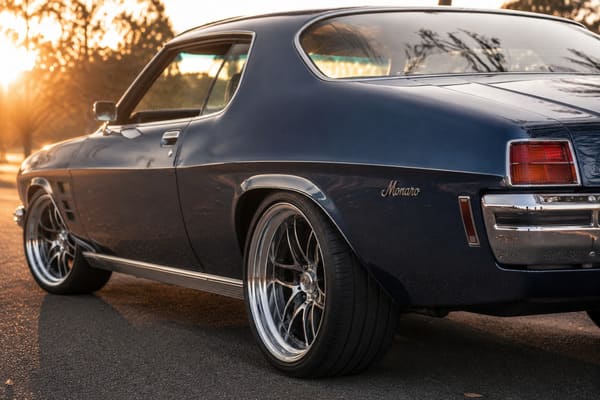
The HQ Monaro is a specific car with specific numbers. Getting those numbers right before you order is the only way to make sure the wheels you wait three weeks for actually go on the car. Here is everything you need to know before you buy.
What Wheels Fit Holden?
"Fits Holden" is one of the most misleading phrases in the wheel industry. Holden made cars for over 60 years, and almost nothing carries over between generations2.
Holden wheel fitment varies significantly by model and year. The HQ Monaro (1971–1974) uses a 5×120.65 bolt pattern3, while later models like the VE Commodore use 5×1204. Center bore, offset, and caliper clearance also differ between generations and cannot be assumed from brand name alone.
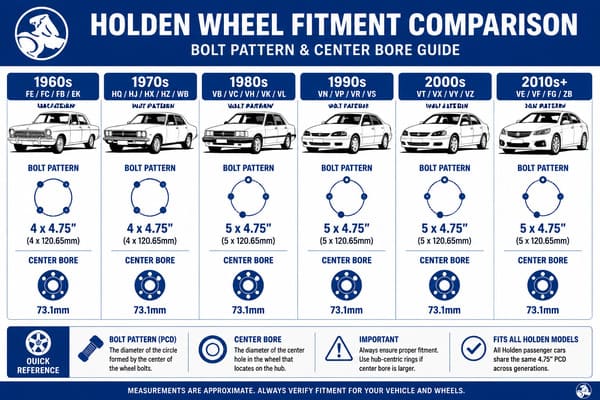
I had a customer from Melbourne last year who ordered wheels for his Holden after finding a fitment guide online. The guide said "fits Holden" and listed a 5×120 bolt pattern. He ordered, waited three weeks, and the wheels arrived. The bolt pattern bolted up fine, but the center bore was 2mm too small and the wheels would not sit flush on the hub5. He had to machine the center bore locally, which cost him an extra $80 and two more weeks of waiting.
The HQ from 1971 and a VE Commodore from 2008 share almost nothing in terms of hub size, brake caliper clearance, or suspension geometry. When I work with customers on classic Holden fitment, I ask for three things at minimum — the exact model, the exact year, and a photo of the existing wheel from behind so I can see the hub and caliper situation myself.
The Key Fitment Variables for Classic Holdens
| Variable | Why It Matters | HQ Monaro Spec |
|---|---|---|
| Bolt Pattern | Determines if the wheel mounts at all | 5×120.65 |
| Center Bore | Controls hub centering and vibration | 83.1mm |
| Offset (ET) | Controls wheel position inside the guard | ET0 to ET10 |
| Caliper Clearance | Prevents contact between wheel and brake | Check per wheel |
Each of these needs to be confirmed individually. A wheel that passes on three out of four of these checks will still not fit correctly. There is no shortcut here, and "close enough" is not a standard I work to when a customer is building a classic car.
What Offset and Bolt Pattern Does the HQ Monaro Need?
The bolt pattern on the HQ Monaro is one of the most misquoted specs in the classic Australian car community. Getting it wrong causes real mechanical damage over time.
The HQ Monaro requires a 5×120.65 bolt pattern — not 5×120. The 0.65mm difference causes micro-movement at the hub interface under load, which leads to stud wear over time6. For a 17×8 wheel, an offset of ET0 to ET10 is the correct range for stock guards.
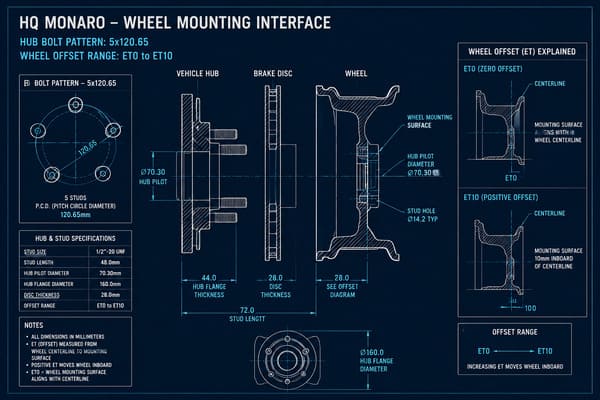
I have seen suppliers tell customers that 5×120 and 5×120.65 are close enough to ignore. They are not. At the hub interface, that gap causes micro-movement every time the wheel rotates under load. On a car doing 10,000 kilometers a year of normal driving, that is manageable for a while. On a car doing track days or hard driving, I have seen stud wear appear in as little as 8,000 kilometers7. One customer sent me photos of his wheel studs after 14 months — the contact surface looked like it had been filed down. That came from running 5×120 wheels on a 5×120.65 hub.
Offset and Width: Where Does the Extra Width Go?
| Wheel Size | Offset | Wheel Position | Risk |
|---|---|---|---|
| 17×8 at ET0 | Centered | Even split inward and outward | Low with stock guards |
| 17×8 at ET15 | Pushed inward | More clearance at guard, less at suspension | Suspension contact risk |
| 17×8 at ET-10 | Pushed outward | More guard exposure | Guard rubbing risk |
| 17×7 at ET0 | Centered | Narrower, easier to fit | Less visual impact |
When you move from a 15×6 or 15×7 stock wheel to a 17×8, you are adding width. That width has to go somewhere — either inward toward the suspension arm or outward toward the guard. Getting the offset right the first time saves a lot of grinding and headaches later. I always recommend confirming the offset with a physical measurement of your guard-to-hub distance before placing a custom order.
Do You Need Spacers or Modifications to Run 17×8 Wheels?
Spacers are a common fix in the classic car world, but they come with trade-offs that most workshops do not explain clearly before they sell them to you.
Spacers can work for small gaps of 5mm or less on light-use vehicles. For the HQ Monaro running 17×8 wheels, a custom offset built into the wheel is the better solution. It removes extra interfaces, keeps the original stud length, and does not require periodic re-torquing.
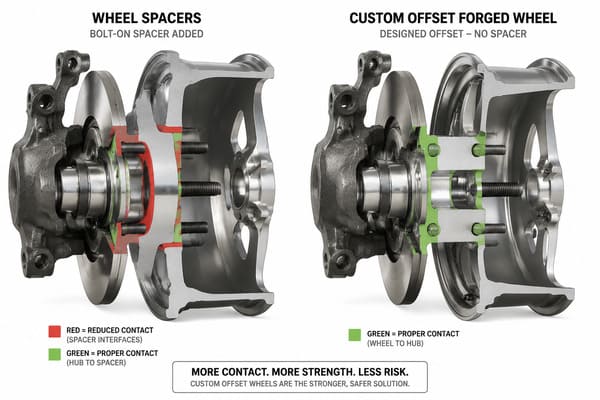
A customer in Sydney came to me after his workshop quoted him $120 for a pair of 15mm spacers to make his 17×8 wheels fit his HQ. He asked me what I thought. I told him the spacers would work, but I also told him what he was signing up for — two extra interfaces between the wheel and the hub, longer wheel studs required, and a setup that needs to be re-torqued every 5,000 kilometers or so8. He decided to order a custom offset instead.
Spacers vs. Custom Offset: A Direct Comparison
| Factor | Spacers (15mm) | Custom Offset Wheel |
|---|---|---|
| Upfront Cost | Lower | $30–$50 more per wheel |
| Long-Term Maintenance | Re-torque every 5,000km | None |
| Stud Length | Requires longer studs | Stock studs work |
| Hub Interfaces | Adds two extra contact points | Single direct interface |
| Risk on Classic Car | Higher over time | Lower |
| Recommended Use | 5mm or less, light use | Any serious build |
The price difference between a standard offset forged wheel and a custom offset forged wheel from us is usually around $30 to $50 per wheel. Over the life of a classic car, that is nothing compared to the cost and risk of running spacers long-term. Spacers have their place — small gaps, 5mm or less, on a car that rarely sees hard use. Anything beyond that, I would rather build the offset into the wheel from the start.
What Size Tire Fits on a 17×8 Rim?
Tire width is not just about looks. Running the wrong tire width on a rim affects handling, tread wear, and load distribution across the contact patch.
The recommended tire width range for a 17×8 rim is 225mm to 245mm9. A 235/45R17 is the best fitment for the HQ Monaro — it keeps overall diameter close to stock, maintains correct speedometer readings, and fills the rim without pulling the sidewall out of shape.
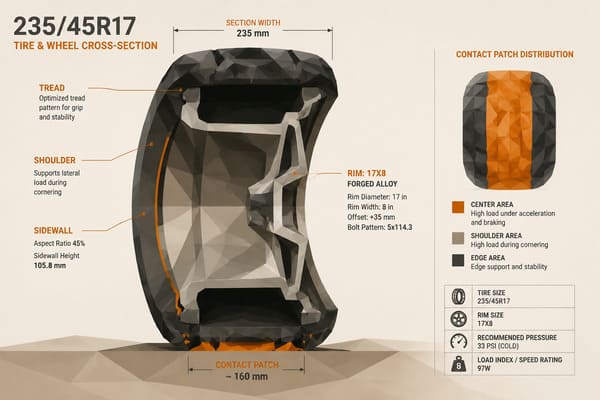
A customer in Brisbane once asked me about running 265s on his 17×8 because he liked the aggressive look. I told him that a 265 on an 8-inch rim means the sidewall is pulling inward at the bottom and the outer tread edges are carrying more load than the center10. He went with 245 instead and told me later the car handled noticeably better than his previous setup with oversized tires.
Tire Width vs. Rim Width: What the Numbers Mean
| Tire Width | Rim Width | Sidewall Shape | Contact Patch | Verdict |
|---|---|---|---|---|
| 225mm | 8 inch | Slightly inward | Slightly narrow | Acceptable |
| 235mm | 8 inch | Upright and even | Full and even | Recommended |
| 245mm | 8 inch | Slight outward bow | Wide and even | Good for wider look |
| 265mm | 8 inch | Pulled inward at base | Uneven edge load | Not recommended |
For the HQ Monaro specifically, 235/45R17 is a clean fitment. It keeps the overall diameter close to stock, which matters for speedometer accuracy and suspension geometry11. It also looks right on a car from that era — not stretched, not ballooned, just correct. If you want a slightly more aggressive stance, 245/45R17 is the outer limit I would recommend on a street-driven classic.
Conclusion
Getting 17×8 wheels right on an HQ Monaro means nailing the bolt pattern, offset, center bore, and tire size — every detail matters on a classic build. Tree Wheels builds custom forged wheels to your exact specs, with MOQ of just 4 wheels and full technical support.
-
"[PDF] the tire and rim association, inc. – Regulations.gov", https://downloads.regulations.gov/NHTSA-2019-0011-0010/attachment_1.pdf. The European Tyre and Rim Technical Organisation (ETRTO) and the Tire and Rim Association (TRA) publish standardised rim-width-to-section-width fitment tables; these standards indicate that a 235mm tire section width is within the approved fitment range for an 8-inch rim. Evidence role: general_support; source type: institution. Supports: That a 235mm-wide tire is within the recommended fitment range for an 8-inch (203mm) rim width. Scope note: ETRTO/TRA tables define approved ranges rather than a single optimal pairing; the specific recommendation of 235/45R17 for the HQ Monaro also depends on vehicle-specific diameter and clearance considerations not covered by those standards alone. ↩
-
"Holden – Wikipedia", https://en.wikipedia.org/wiki/Holden. Holden, a subsidiary of General Motors, produced its first all-Australian car in 1948 and continued manufacturing and selling vehicles in Australia until ceasing local production in 2017 and closing its Australian operations in 2020, representing a production and sales history spanning over seven decades. Evidence role: historical_context; source type: encyclopedia. Supports: That Holden produced passenger vehicles in Australia for more than 60 years. Scope note: The article states ‘over 60 years,’ which is accurate; the precise endpoint depends on whether local manufacturing cessation (2017) or brand closure (2020) is used as the reference date. ↩
-
"Holden Monaro – Wikipedia", https://en.wikipedia.org/wiki/Holden_Monaro. Holden HQ series workshop manuals and established Australian automotive fitment references document the factory wheel bolt pattern as 5×120.65mm, distinguishing it from the metric 5x120mm pattern used on later Holden Commodore platforms. Evidence role: definition; source type: other. Supports: That the Holden HQ series (1971–1974) was factory-fitted with a 5×120.65mm pitch circle diameter bolt pattern. Scope note: Original Holden factory workshop manuals are the primary authoritative source; third-party fitment databases should be cross-referenced against factory documentation. ↩
-
"Holden Commodore (VE) – Wikipedia", https://en.wikipedia.org/wiki/Holden_Commodore_(VE). Holden VE Commodore technical specifications and automotive fitment databases record the wheel bolt pattern as 5x120mm, reflecting the platform’s adoption of metric fastener geometry in contrast to the imperial-derived 5×120.65mm pattern of the earlier HQ series. Evidence role: definition; source type: other. Supports: That the Holden VE Commodore (2006–2013) uses a 5x120mm bolt pattern, distinct from the 5×120.65mm pattern of the HQ series. Scope note: Fitment databases vary in accuracy; factory workshop manuals or GM/Holden technical documentation are the most authoritative sources for this specification. ↩
-
"What are the key differences between hubcentric and …", https://www.facebook.com/groups/1939836749567520/posts/1951826261701902/. Hub-centric wheel fitment requires the wheel’s center bore to match the vehicle hub diameter precisely; an undersized bore prevents full seating against the hub flange, while an oversized bore requires hub-centric rings to prevent lug-centric loading and associated vibration. Evidence role: mechanism; source type: encyclopedia. Supports: That the wheel center bore must match or exceed the hub diameter to allow the wheel to seat flush against the hub flange. Scope note: General fitment references describe the principle; the specific consequence of a 2mm undersized bore in the anecdote is illustrative rather than independently verified. ↩
-
"Aftermarket wheel centering myths and facts – Facebook", https://www.facebook.com/groups/1939836749567520/posts/3050369031847614/. Engineering literature on bolted joint mechanics notes that misalignment between fastener hole patterns and mating surfaces introduces cyclic shear loading, which can accelerate fretting wear on threaded fasteners under repeated rotational stress. Evidence role: mechanism; source type: paper. Supports: That dimensional mismatch at the wheel-hub interface introduces cyclic micro-movement under rotational load, accelerating fastener and stud wear. Scope note: Direct studies specifically on automotive wheel PCD mismatch of sub-1mm magnitude are limited; general bolted-joint fatigue literature provides the closest applicable support. ↩
-
"[PDF] Fatigue damage analysis and life prediction of e-clip in railway …", https://railtec.illinois.edu/wp/wp-content/uploads/Hong-et-al.-2018-Fatigue-damage-analysis-and-life-prediction-of-e-c.pdf. Studies on fretting wear in bolted mechanical joints indicate that cyclic micro-slip at the contact interface accelerates surface degradation, with wear rate proportional to contact pressure, slip amplitude, and cycle frequency; these parameters are all elevated under hard driving conditions. Evidence role: mechanism; source type: paper. Supports: That cyclic micro-movement from a mismatched bolt pattern accelerates fretting and wear on wheel studs, with wear rate increasing under higher load and frequency conditions such as track driving. Scope note: The specific 8,000km figure is drawn from anecdotal observation; no published study directly quantifies stud wear rates for the specific 0.65mm PCD mismatch scenario described. ↩
-
"How to Maintain Your Wheel Spacers for Optimal Performance", https://orionmotortech.com/blogs/auto-blog/how-to-maintain-your-wheel-spacers?srsltid=AfmBOooNeKH7Oykqx5dt5wf2z6FI6eg6cRlUwtLil2RQXHtisLf28Lr-. Automotive safety guidance and wheel spacer manufacturers generally recommend periodic re-torquing of spacer fasteners after initial installation and at regular service intervals, and specify that stud or bolt length must provide sufficient thread engagement beyond the spacer thickness to meet load-bearing requirements. Evidence role: expert_consensus; source type: institution. Supports: That wheel spacers introduce additional clamped interfaces requiring periodic re-torquing and may require longer wheel studs to maintain adequate thread engagement. Scope note: The specific 5,000km re-torque interval cited in the article is not universally standardised; recommended intervals vary by spacer design, vehicle application, and manufacturer guidance. ↩
-
"[PDF] the tire and rim association, inc. – Regulations.gov", https://downloads.regulations.gov/NHTSA-2019-0011-0010/attachment_1.pdf. ETRTO and TRA rim-width-to-section-width fitment tables specify approved tire width ranges for each nominal rim width; for an 8-inch rim, the approved section width range for passenger car tires generally encompasses 225mm to 245mm, though exact boundaries vary by tire construction and load rating. Evidence role: definition; source type: institution. Supports: That 225mm to 245mm represents the approved or recommended tire section width range for an 8-inch (203mm) rim. Scope note: Approved ranges differ slightly between ETRTO and TRA standards and may vary by tire category; the article’s stated range should be verified against the current edition of the applicable standard. ↩
-
"Wide VS Narrow Tires, SHOCKED BY CONCLUSIVE RESULTS", https://www.youtube.com/watch?v=pKheQ-MvBBw. ETRTO and TRA fitment standards note that mounting a tire on a rim narrower than the approved width range causes the tire sidewall to adopt an inward-leaning profile, which reduces the effective contact patch width and concentrates vertical load toward the tread shoulders rather than distributing it evenly across the full tread width. Evidence role: mechanism; source type: institution. Supports: That mounting a tire significantly wider than the approved rim width range distorts the tire cross-section, reducing contact patch uniformity and increasing edge loading. Scope note: Standardised fitment tables define approved ranges; the specific geometric and load-distribution effects described are consistent with these standards but are not always quantified in publicly available documentation. ↩
-
"Scrub radius – Wikipedia", https://en.wikipedia.org/wiki/Scrub_radius. Vehicle speedometers measure wheel rotational speed and calculate road speed based on a fixed rolling circumference derived from the factory tire specification; a change in overall tire diameter alters rolling circumference proportionally, introducing speedometer error, and also affects suspension geometry parameters including scrub radius and effective steering axis inclination. Evidence role: mechanism; source type: encyclopedia. Supports: That vehicle speedometers are calibrated to a specific tire rolling circumference, and that changes in overall tire diameter introduce proportional speedometer error and alter suspension geometry parameters such as scrub radius. Scope note: The magnitude of geometry effects depends on the specific suspension design of the vehicle; the HQ Monaro’s front suspension geometry is not addressed in general tire-diameter references. ↩