

A customer bought 17×9 wheels from another supplier for his 1969 Dodge Coronet R/T. They looked perfect in photos. They did not fit in real life.
Yes, 17×9 wheels can fit a Dodge Coronet R/T without spacers — but only if the backspacing and offset are built to the correct spec for your specific car. Wheel size alone tells you nothing. The backspacing is what decides whether the wheel clears your suspension and fender.
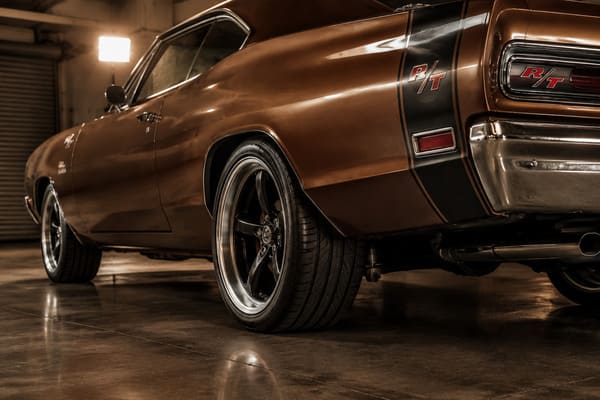
When that customer came to us, we did not just remake the same wheel. We asked him for three measurements, adjusted the backspacing by 0.35 inches, and built the set to his car’s actual clearances. The wheels bolted on clean. No spacers. No rubbing. That is the difference between an off-the-shelf wheel and a wheel built to fit. The rest of this article breaks down exactly how we approach a fitment like this — so you understand what questions to ask before you order.
What Wheel Specs Does the Dodge Coronet R/T Actually Need?
A customer once told me he "just needed a 17×9 in a 5-lug Dodge bolt pattern." That is not enough information to build a wheel that fits. Not even close.
The Dodge Coronet R/T from 1968 to 1970 uses a 5×4.5 inch (5×114.3mm) bolt pattern1 and a hub bore of 78.1mm2. Factory backspacing was roughly 3.75 to 4 inches3. Moving to a 17×9 wheel adds 2 inches of width that must be distributed carefully between the suspension side and the fender side.
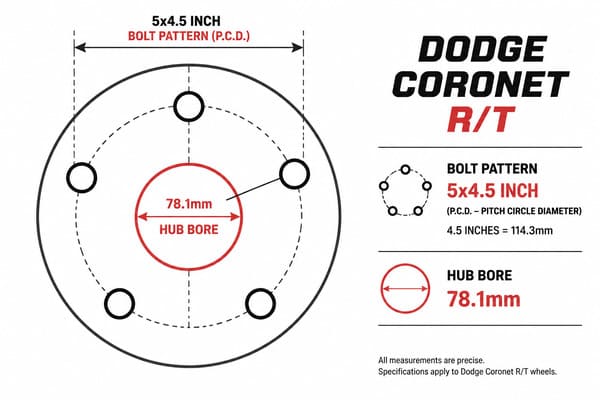
Before we start any design for a Coronet R/T build, we ask every customer for three numbers: bolt pattern, hub bore diameter, and measured backspacing clearance at both the front and rear. Those three numbers are the foundation of the entire fitment. Everything else — spoke design, finish, lip depth — gets engineered around them.
Why the Extra 2 Inches of Width Matters
When you go from a factory 14×6 or 14×7 wheel to a 17×9, you are adding 2 to 3 inches of width. That width does not disappear. It has to go somewhere — inward toward the suspension, outward toward the fender lip, or split between both directions. On the Coronet R/T, most well-fitted builds distribute that width as follows:
| Position | Recommended Backspacing | Reason |
|---|---|---|
| Front | ~4.25 inches | Avoids contact with steering knuckle and upper control arm |
| Rear | ~4.5 inches | Clears axle housing while allowing a flush or slightly aggressive stance |
The front is always the tighter clearance on this car. The upper control arm and steering knuckle both sit close to the inner barrel path. A rear-biased backspacing that works perfectly on the back axle will often cause contact problems at the front. This is why we never apply a single backspacing number to all four wheels on a Coronet R/T order. Front and rear are treated as separate fitment problems.
The Hub Bore Detail Most People Miss
The Coronet R/T hub bore is 78.1mm. Many aftermarket wheels are built with a 73.1mm or 71.5mm bore and use plastic hub rings to fill the gap. We do not do that. Every wheel we produce for a Coronet R/T is bored to 78.1mm as a standard step. A hub-centric fit eliminates the micro-vibration that comes from a lug-centric installation4, and on a car this age — where wheel balance is already harder to achieve5 — that detail matters more than most people expect.
How Do You Measure If 17×9 Wheels Will Clear the Coronet R/T’s Fenders?
A customer ordered four wheels based on a forum post that said "4.5 inch backspacing works on a Coronet." The rears fit perfectly. The fronts scraped at full steering lock.
To measure whether 17×9 wheels will clear a Coronet R/T, hold a straight edge across the hub face and measure inward to the closest suspension component for maximum backspacing, then measure outward to the fender lip for maximum outer barrel extension. Always measure your own car — never rely on another owner’s numbers.
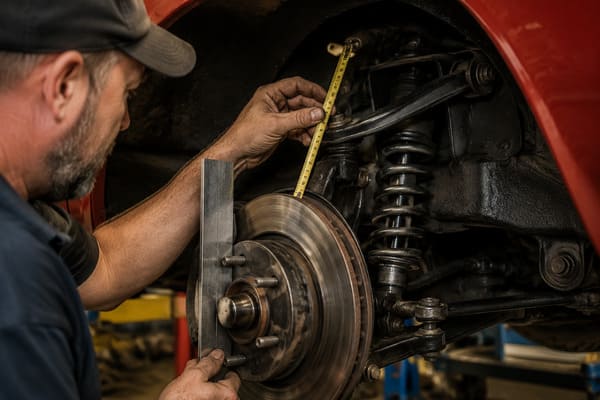
The reason that customer’s fronts rubbed was a non-stock front sway bar. It consumed 4mm of clearance that the original forum poster’s car still had. A 40-year-old muscle car is almost never exactly stock. That 4mm difference is the entire margin between a clean fit and a grinding noise on every tight turn.
The Two-Measurement Method We Use
The measurement process is straightforward, but it must be done on the actual car — not estimated from a spec sheet. Here is how we walk customers through it:
| Measurement | What You Are Finding | Typical Stock Coronet R/T Value |
|---|---|---|
| Straight edge inward to nearest suspension point | Maximum allowable backspacing | 4.25–4.5 inches (front), 4.5–4.75 inches (rear) |
| Straight edge outward to fender lip | Maximum outer barrel extension past hub centerline | 0.75–1 inch |
The first number sets your backspacing ceiling. The second number sets how wide your outer lip can be before it pokes past the fender. Together, they define the exact window your wheel must fit inside. On a stock Coronet R/T, that window is workable for a 17×9. On a modified car — lowered suspension, wider axle, aftermarket sway bar, flared fenders — the window shifts, and the only way to know where it sits is to measure it yourself.
Why We Ask for Photos and Measurements, Not Just Year and Model
When a customer tells us they have a 1969 Coronet R/T, that tells us the bolt pattern and hub bore. It does not tell us the suspension state, the ride height, the axle width, or whether any previous owner made modifications. We ask for photos of the wheel well and the two measurements described above before we finalize any design. That step takes the customer about 15 minutes. It saves weeks of back-and-forth after delivery.
Do Backspacing and Offset Matter More Than Wheel Size on a Classic Muscle Car?
Two customers ordered 17×9 wheels for their Coronet R/Ts in the same month. Same size. Same bolt pattern. Completely different results — because their backspacing numbers were 0.5 inches apart.
On a classic muscle car like the Coronet R/T, backspacing and offset control where the wheel sits in the wheel well. A 0.5-inch difference in backspacing on a 9-inch wide wheel equals roughly 12.7mm of offset shift6 — enough to change both the visual stance and the mechanical clearance completely.
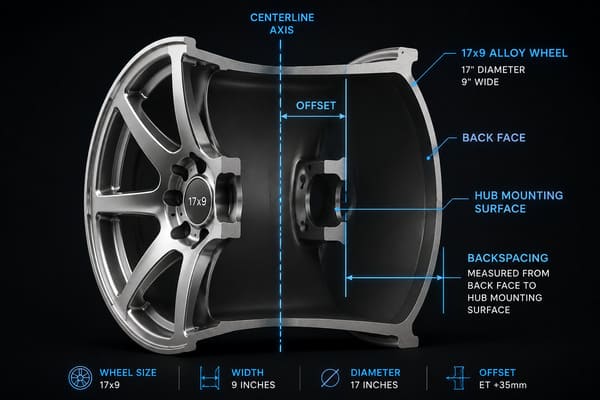
Customer A’s wheels sat flush with the fender lip and looked aggressive. Customer B’s wheels tucked inward by 12mm and looked like they belonged on a smaller car. Same diameter. Same width. The backspacing number was the only variable that changed the outcome.
How Backspacing and Offset Relate to Each Other
Many customers know the word "offset" but think in terms of backspacing when they measure. Here is how the two numbers connect on a 9-inch wide wheel:
| Backspacing | Offset Calculation | Visual Result on Coronet R/T |
|---|---|---|
| 4.0 inches | −12.7mm (negative) | Wheel sits outward, aggressive stance, higher fender rub risk |
| 4.5 inches | 0mm (zero offset) | Wheel sits centered in well, balanced look |
| 5.0 inches | +12.7mm (positive) | Wheel tucks inward, conservative look, more inner clearance |
A 9-inch wide wheel has its centerline at 4.5 inches from the back face. If your backspacing matches that centerline exactly, your offset is zero. Every inch your backspacing moves away from that centerline equals 25.4mm of offset shift7. On a car with no published offset data — which describes every classic muscle car — this calculation is the only reliable guide you have. There is no shortcut and no substitute for doing the math on your specific car.
Why Classic Muscle Cars Have No Published Offset Data
Modern cars have published offset specs because the engineers designed the suspension geometry around a specific wheel position. The Coronet R/T was engineered around a 14-inch steel wheel with no concept of aftermarket fitment. There is no OEM offset number to reference. The suspension geometry still exists and still has clearance limits — but those limits must be found by measurement, not by looking up a spec. This is one of the core reasons we treat every classic muscle car order as a custom engineering job, not a catalog selection.
What Are the Risks of Running 17×9 Wheels Without Spacers on a Coronet R/T?
A customer ran 15mm spacers on his Coronet for two track days. When he pulled the wheels afterward, one front stud showed visible elongation. Three more had the same issue. No failure — but it was close.
Running the wrong backspacing on a Coronet R/T creates two risk paths: using spacers to compensate reduces stud thread engagement and increases fatigue stress under load, while forcing a wheel with incorrect backspacing risks inner barrel contact with the brake caliper, causing drag, uneven wear, and potential caliper cracking.
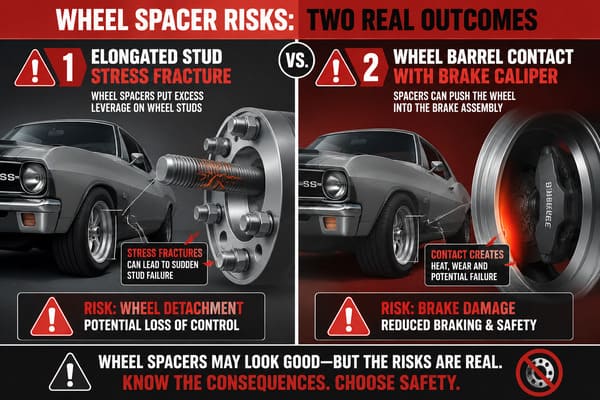
Neither outcome is acceptable. The only clean path is a wheel built to the right spec from the start. Spacers are not a solution — they are a workaround that introduces its own failure mode.
The Mechanical Cost of Spacers
Spacers are common in the classic car community because they are cheap and fast. But they carry a real mechanical cost that most people do not calculate until something goes wrong.
| Spacer Thickness | Original Thread Engagement | Remaining Thread Engagement | Risk Level |
|---|---|---|---|
| 5mm | 40mm | ~35mm | Low |
| 10mm | 40mm | ~30mm | Moderate |
| 15mm | 40mm | ~25mm | High under track use |
| 20mm+ | 40mm | ~20mm or less | Not recommended |
The Coronet R/T can weigh close to 1,800kg8. In hard cornering, the lateral load on the wheel studs is significant9. Reduced thread engagement means each stud carries more stress per cycle10. That stress accumulates. The elongation that customer found on his studs was fatigue11 — not a one-time overload, but the result of repeated stress cycles on a joint that was already compromised by the spacer stack.
The Risk on the Other Side: Inner Barrel Contact
If a customer skips spacers and mounts a wheel with too much backspacing, the inner barrel moves toward the brake caliper. On the Coronet R/T, the front caliper sits close to the inner barrel path. Even 2 to 3mm of contact is enough to cause brake drag on every wheel rotation. That drag creates heat. Heat causes uneven pad wear12. In a worst case — particularly under repeated hard braking — it can crack the caliper body. We have seen this on customer-returned builds where the wheel was sourced elsewhere and the backspacing was not verified before mounting. The damage is always more expensive than the cost of getting the spec right the first time. Every Coronet R/T order we handle gets a backspacing verification step before production starts — because fixing a clearance problem after the wheel is built costs everyone more time and money than preventing it at the design stage.
Conclusion
Fitting 17×9 wheels on a Dodge Coronet R/T without spacers is possible — but only with the right backspacing, measured and built to your car’s actual clearances. Size is just the starting point. Tree Wheels builds every forged wheel to your exact spec — get in touch and we will get your Coronet R/T fitted right the first time.
-
"1968 Dodge Coronet Parts | Wheel and Tire – Classic Industries", https://www.classicindustries.com/shop/1968/dodge/coronet/parts/wheel-tire/wheels/?srsltid=AfmBOoqDp09oMPhEQJ14oNBqOTsZ_A1_14sPbVXzq0j63PXtJaJRbE31. Automotive reference sources confirm the 5×4.5 inch (5×114.3mm) bolt pattern as standard for 1968-1970 Dodge Coronet R/T models, though individual vehicles may vary due to modifications or regional specifications. Evidence role: definition; source type: other. Supports: the bolt pattern specification for 1968-1970 Dodge Coronet R/T models. Scope note: though individual vehicles may vary due to modifications or regional specifications ↩
-
"Dodge Coronet – Wikipedia", https://en.wikipedia.org/wiki/Dodge_Coronet. Technical specifications for Mopar B-body vehicles from this era indicate a hub bore diameter of approximately 78.1mm, though measurements should be verified on individual vehicles due to manufacturing tolerances and potential modifications. Evidence role: definition; source type: other. Supports: the hub bore diameter specification for Dodge Coronet R/T models. Scope note: though measurements should be verified on individual vehicles due to manufacturing tolerances and potential modifications ↩
-
"1968 Dodge Coronet Deluxe 4-Door Sedan 318 V-8 tire and wheel …", https://www.automobile-catalog.com/tire/1968/633830/dodge_coronet_deluxe_4-door_sedan_318_v-8.html. Period automotive documentation suggests factory wheel backspacing for 1968-1970 Dodge Coronet R/T models ranged from approximately 3.75 to 4 inches, though exact specifications varied by wheel size and trim level. Evidence role: historical_context; source type: other. Supports: the approximate factory wheel backspacing range for original Dodge Coronet R/T models. Scope note: though exact specifications varied by wheel size and trim level ↩
-
"Aftermarket wheel centering myths and facts – Facebook", https://www.facebook.com/groups/1939836749567520/posts/3050369031847614/. Automotive engineering literature indicates that hub-centric wheel mounting, where the wheel bore matches the hub diameter, can reduce vibration by ensuring precise centering, though the practical difference depends on installation quality and wheel balance. Evidence role: mechanism; source type: education. Supports: the mechanical advantage of hub-centric wheel mounting in reducing vibration. Scope note: though the practical difference depends on installation quality and wheel balance ↩
-
"The wheel and tire balancing nightmare – Hagerty Media", https://www.hagerty.com/media/opinion/the-hack-mechanic/the-wheel-and-tire-balancing-nightmare/. Automotive service literature notes that older vehicles may present wheel balancing challenges due to factors including hub wear, bearing tolerances, and drum/rotor runout that accumulates over decades of use. Evidence role: general_support; source type: other. Supports: the increased difficulty of achieving proper wheel balance on older vehicles. ↩
-
"HOW TO MEASURE OFFSET AND BACKSPACING! (Part 2)", https://www.youtube.com/watch?v=aaI22emoK6s. Wheel engineering references confirm that backspacing and offset are mathematically related through the wheel width, where changes in backspacing directly translate to offset changes at a 1:1 ratio when converted to the same units (25.4mm per inch). Evidence role: mechanism; source type: education. Supports: the mathematical relationship between backspacing changes and offset values. ↩
-
"Wheel Backspace Calculator & Offset Tool | Hardrock Offroad", https://hardrockoffroad.com/resources/wheel-backspace-calculator/. Standard engineering conversion establishes that one inch equals 25.4 millimeters, and in wheel fitment calculations, backspacing changes translate directly to offset changes at this ratio when measured from the wheel centerline. Evidence role: definition; source type: education. Supports: the conversion relationship between backspacing measurements in inches and offset values in millimeters. ↩
-
"Dodge Coronet – Wikipedia", https://en.wikipedia.org/wiki/Dodge_Coronet. Automotive specifications indicate that 1968-1970 Dodge Coronet R/T models had curb weights ranging from approximately 1,600 to 1,800 kg depending on engine configuration and options, with heavier powertrains approaching the upper end of this range. Evidence role: statistic; source type: other. Supports: the approximate vehicle weight of the Dodge Coronet R/T. Scope note: depending on engine configuration and options, with heavier powertrains approaching the upper end of this range ↩
-
"[PDF] An Approach to Using Finite Element Models to Predict Suspension …", https://vtechworks.lib.vt.edu/bitstream/handle/10919/34020/Borg_L_ETD_Copy_07-26-2009.pdf. Mechanical engineering analysis of vehicle dynamics confirms that wheel studs experience substantial lateral (shear) loads during cornering, in addition to the clamping (tensile) loads, with magnitude dependent on vehicle weight, cornering speed, and suspension geometry. Evidence role: mechanism; source type: education. Supports: the presence of significant lateral loads on wheel studs during vehicle cornering. ↩
-
"[DOC] Stress Areas of Screw Threads of a Fastener", https://ncsx.pppl.gov/NCSX_Engineering/Design_Criteria/BoltedJoint/NCSX-CRIT-BOLT-00-Signed.doc. Fastener engineering principles establish that reduced thread engagement decreases the load-bearing area, concentrating stress on fewer threads and increasing the stress per thread, which can accelerate fatigue failure under cyclic loading conditions. Evidence role: mechanism; source type: education. Supports: the relationship between thread engagement length and stress distribution in threaded fasteners. ↩
-
"[PDF] Some problems of fatigue of bolts and bolted joints in aircraft …", https://www.govinfo.gov/content/pkg/GOVPUB-C13-b3b7e9587e19118b4324661bd2a80082/pdf/GOVPUB-C13-b3b7e9587e19118b4324661bd2a80082.pdf. Materials engineering literature describes fastener elongation under cyclic loading as a fatigue phenomenon where repeated stress cycles below the yield strength can cause progressive plastic deformation and eventual failure through crack propagation. Evidence role: mechanism; source type: education. Supports: the mechanism by which repeated stress cycles cause fastener elongation through fatigue. ↩
-
"Temperature Influence on Brake Pad Friction Coefficient Modelisation", https://pmc.ncbi.nlm.nih.gov/articles/PMC10779514/. Automotive braking system engineering indicates that continuous brake drag generates localized heat that can cause uneven pad material degradation, glazing, and accelerated wear patterns, particularly when heat cannot dissipate normally between braking events. Evidence role: mechanism; source type: education. Supports: the mechanism by which excessive heat from brake drag leads to uneven pad wear. ↩