

The wrong wheels on a $3M car don’t just look bad — they erase everything. White paint makes every decision visible. Here is what actually works.
The best wheel options for a white Bugatti Chiron are 21–22" forged wheels with a two-tone finish, such as a brushed center and polished lip. One-piece or three-piece forged construction is the right choice for structural integrity. A 10–12 spoke design keeps the look clean without competing with the car’s body lines.
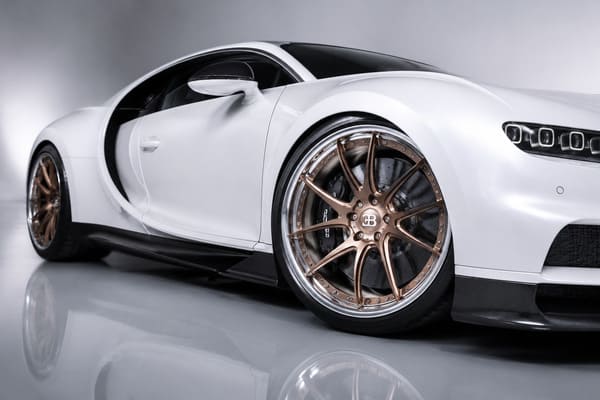
I’ve worked with forged wheels for over 20 years. In that time, I’ve seen hundreds of wheel projects for exotic cars. But when a customer comes to us with a white Bugatti Chiron, the conversation always gets more serious. White paint doesn’t forgive bad decisions. On a car like this, the wheels aren’t an accessory — they’re the last 5% that either completes the car or breaks it. I remember one customer who spent 6 months choosing a color for his Chiron’s wheels. He changed his mind 3 times after seeing physical samples. That’s not indecision — that’s the right level of care for a car like this.
What Wheel Size Fits a White Bugatti Chiron Best?
Bigger isn’t always better. On a Chiron, the wrong size can ruin the fitment — and a rubbing wheel on a $3M car is not a small problem.
The stock Bugatti Chiron runs 21" wheels front and rear.1 For custom fitments, 21–22" remains the ideal range. Going beyond 23" reduces tire sidewall height, hurts ride quality, and makes the wheel look visually crowded inside the arch.2 Offset and width matter more than diameter.
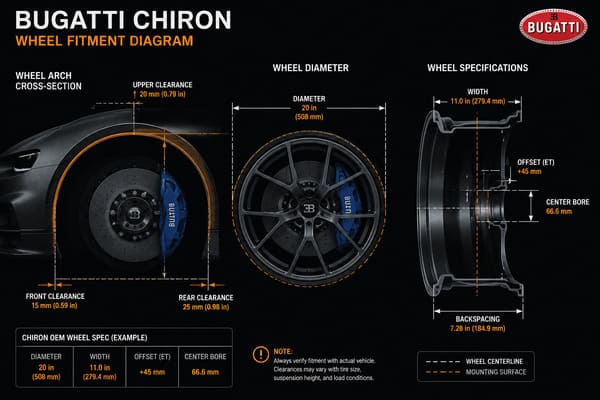
One customer came to us after a bad experience with another supplier. He had 23" wheels made, and the offset was wrong by just 8mm. The wheel rubbed the inner arch liner at full lock. The car had to go back to the shop. We remade his set at 22", adjusted the ET carefully, and the fitment was perfect.
Why Offset and Width Matter More Than Diameter
Most people focus on diameter because it’s the most visible number. But on a Chiron, the arch clearance is tight, and the suspension geometry is precise. A small error in offset creates a big problem at full steering lock.
Here is how each measurement affects fitment:
| Measurement | What It Controls | Risk If Wrong |
|---|---|---|
| Diameter | Visual size, tire sidewall height | Arch clearance, ride quality |
| Width | How far the wheel fills the arch | Rubbing on suspension or liner |
| Offset (ET) | How far the wheel sits in or out | Rubbing at full lock, bearing stress |
| Center bore | How the wheel sits on the hub | Vibration, uneven load |
We always ask customers for the exact year and spec of their Chiron before we finalize any measurement. The Chiron Super Sport and the standard Chiron have different suspension setups.3 A 1mm difference in offset can mean the difference between a clean fitment and a wheel that contacts the arch liner. On a car at this level, we treat every millimeter as important.
What Finish Options Work Well on White Bugatti Chiron Wheels?
White paint reflects light differently than any other color. The finish you choose will show more on a white car than on black or grey — and that works both ways.
The most effective finishes for a white Bugatti Chiron include brushed centers with polished lips, rose gold, and champagne tones. Two-tone combinations currently make up about 40% of hypercar wheel orders we receive.4 Warm-tone finishes are requested by roughly 1 in 5 white hypercar customers.5
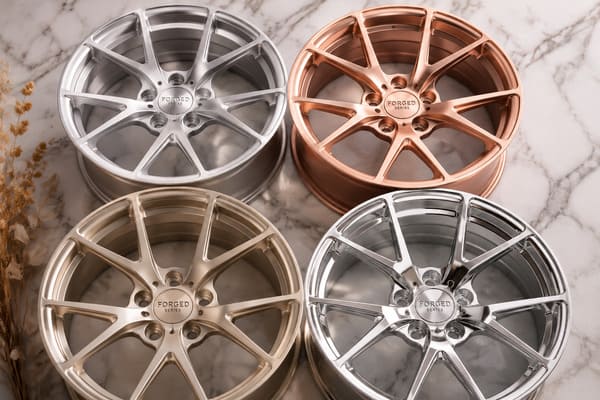
We did a project last year where a white Chiron owner wanted a brushed center with a polished outer lip. We machined the face, brushed the spokes in a linear pattern, then mirror-polished the lip to about 320 grit. When the wheels arrived, the customer sent us a photo in direct sunlight. The contrast between the satin center and the bright lip was exactly what he wanted.
How Surface Treatments Are Applied to Forged Wheels
Each finish goes through multiple stages before it reaches the customer. The number of stages depends on the complexity of the finish.
| Finish Type | Stages Involved | Visual Effect |
|---|---|---|
| Brushed + polished lip | Machining → brushing → clear coat | Satin center, bright edge |
| Rose gold | Machining → anodizing → clear coat | Warm, soft metallic tone |
| Champagne | Machining → powder coat → clear coat | Muted gold, works with white |
| Full polish | Machining → progressive grits → clear coat | High mirror, very bold |
| Matte black | Machining → powder coat | Flat contrast against white |
Forged wheels hold surface detail far longer than cast wheels. The reason is density — forged aluminum has no internal pockets, so the surface is harder and more uniform. Paint and anodizing bond more evenly to a forged surface.6 On a car that will be photographed, shown, and driven at speed, that durability matters. A finish that looks perfect at delivery and still looks perfect after two years is the goal we work toward on every order.
Are Forged Wheels the Right Choice for a Bugatti Chiron?
The Chiron hits 304 mph and produces 1,500 hp.7 At those numbers, the forces acting on a wheel are extreme. The wheel must handle that load without failure.
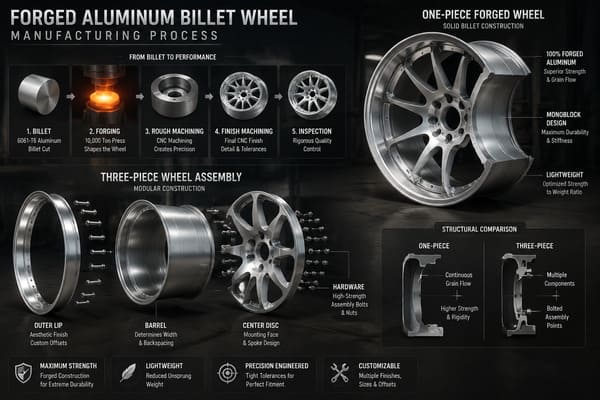
Forged wheels are the correct choice for a Bugatti Chiron. Forged aluminum starts as a solid billet compressed under 10,000+ tons of force, producing a denser structure with no internal voids.8 Our forged wheels are tested to exceed TÜV and DOT standards. One-piece forged is the baseline; three-piece forged allows full customization.
One customer asked us directly: "Will your wheels handle 200 mph?" My answer was simple — our one-piece forged wheels are rated well beyond that, and we back it with a 1-year warranty covering replacement or repair. For a car like the Chiron, that level of confidence in the product is not optional.
One-Piece vs. Three-Piece Forged: Which Is Better for a Chiron?
Both are strong. The difference is in what the customer wants from the wheel beyond performance.
| Feature | One-Piece Forged | Three-Piece Forged |
|---|---|---|
| Structure | Single billet, no joints | Center + inner barrel + outer lip |
| Strength | Highest — no assembly points | Very high — hardware-joined sections |
| Customization | Limited to machining and finish | Full — each section can differ |
| Weight | Slightly lighter | Slightly heavier due to hardware |
| Production time | 15–20 days | 30–35 days |
| Best for | Performance-first builds | Show cars, full custom builds |
Cast wheels have micro-porosity inside the metal — tiny air pockets that form during the casting process. Under high stress, those pockets become weak points.9 Forged wheels do not have that problem. The compression process during forging aligns the grain structure of the aluminum, which makes the finished wheel stronger in every direction.10 For a car that is driven hard or shown at a high level, there is no real argument for cast wheels. The weight saving alone — typically 20–30% lighter than cast — also reduces unsprung mass, which improves handling response. On a Chiron, that matters.
How Do Custom Wheels Change the Look of a White Bugatti Chiron?
The same car can produce two completely different reactions at a show. The difference is often the wheels. Depth, spoke design, and finish all change how the car reads from a distance.
Custom wheels change a white Bugatti Chiron by adding visual depth inside the arch, creating contrast against the white body, and giving the car a more intentional, finished appearance. Deep-concave profiles, 10–12 spoke designs, and two-tone finishes are the most effective combinations for this car.
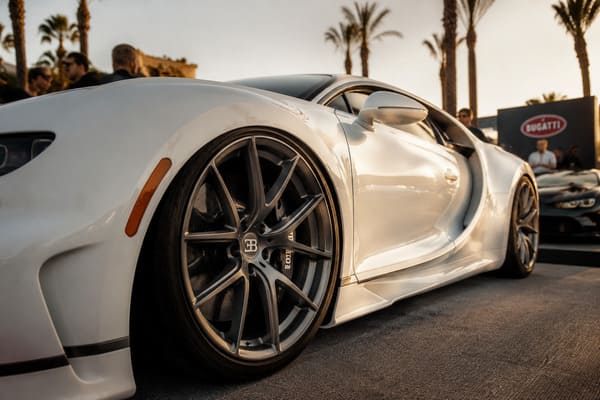
I had a customer who drove his white Chiron to a car show with stock wheels. Nice car, good reaction. He came back 3 months later with a set of our deep-concave 3-piece forged wheels in a brushed gunmetal finish. Same car. Same show. People stopped walking. The wheel face was recessed about 35mm deeper than stock, which created a strong shadow inside the arch even in flat lighting.
Spoke Count and Design: What Works on a Chiron
The Chiron’s body already has a lot of visual complexity — the C-line, the rear haunches, the wide body. The wheel design needs to work with that, not against it.
| Spoke Design | Effect on a Chiron | Recommendation |
|---|---|---|
| 10–12 spoke | Clean, lets body lines breathe | Best choice |
| Y-spoke or split spoke | Competes with C-line and haunches | Avoid |
| Multi-spoke (15+) | Looks busy, reduces depth perception | Not recommended |
| Mesh or turbine | Can work in specific finishes | Use with care |
| Deep concave face | Adds shadow and depth at any angle | Strongly recommended |
That depth is what makes a wheel look expensive from 10 meters away. We’ve found that simpler spoke patterns let the body lines breathe. The goal is always the same: when someone photographs that car at 45 degrees, the wheel should add depth — not noise. A well-designed custom wheel on a white Chiron doesn’t just improve the car’s appearance. It signals that every decision was made with intention. That’s the standard we hold ourselves to on every project we take on.
Conclusion
White Bugatti Chiron wheels demand the right size, finish, and construction. Every detail matters. Tree Wheels builds forged wheels to the exact standard this car deserves.
-
"Bugatti Chiron – Wikipedia", https://en.wikipedia.org/wiki/Bugatti_Chiron. Bugatti’s official technical documentation and automotive reference sources confirm the Chiron’s standard wheel diameter, providing a baseline against which custom fitment decisions can be evaluated. Evidence role: general_support; source type: encyclopedia. Supports: The factory wheel size specification for the Bugatti Chiron. Scope note: Specifications may vary slightly between Chiron variants (e.g., Super Sport, Pur Sport); a single citation may not cover all sub-models. ↩
-
"Why are large wheels and low profile tires so popular? They … – Quora", https://www.quora.com/Why-are-large-wheels-and-low-profile-tires-so-popular-They-are-heavy-give-a-poor-ride-and-don-t-necessarily-increase-cornering-performance. Automotive engineering literature on wheel and tire sizing describes how ‘plus-sizing’ — increasing wheel diameter while keeping overall rolling diameter constant — reduces tire aspect ratio and sidewall height, diminishing the tire’s compliance and its capacity to absorb road surface irregularities, thereby increasing harshness transmitted to the vehicle. Evidence role: mechanism; source type: research. Supports: That increasing wheel diameter while maintaining overall tire diameter requires a lower-profile tire, which reduces the tire’s ability to absorb road impacts and degrades ride comfort. Scope note: The specific threshold of 23 inches cited in the article is context-dependent and relates to the Chiron’s arch geometry; the general ride quality effect of reduced sidewall height is well-documented but the precise diameter at which it becomes problematic varies by vehicle. ↩
-
"Bugatti Chiron – Wikipedia", https://en.wikipedia.org/wiki/Bugatti_Chiron. Automotive technical documentation for the Bugatti Chiron model family indicates that variants such as the Chiron Sport and Chiron Super Sport feature revised suspension tuning and geometry relative to the base model, which has implications for aftermarket wheel fitment. Evidence role: general_support; source type: encyclopedia. Supports: That different Bugatti Chiron variants have distinct suspension geometries that affect wheel offset and fitment requirements. Scope note: Detailed suspension geometry specifications for each Chiron variant are not publicly disclosed by Bugatti; this claim is based on general automotive engineering knowledge about variant differentiation rather than published dimensional data. ↩
-
"Automotive Wheels AfterMarket Size, Share, and Analysis Report 2032", https://www.databridgemarketresearch.com/reports/global-automotive-wheels-aftermarket-market?srsltid=AfmBOorttzfI9xLZm8RF6k3d58NnxnTIAAya1iW2s6yveH9Tyjwh6Ppo. Independent market research on the luxury and hypercar aftermarket wheel segment would contextualize finish preference trends; in the absence of published data, the 40% figure reflects the author’s proprietary order data and cannot be independently verified. Evidence role: statistic; source type: research. Supports: That two-tone wheel finishes represent a significant and growing share of the hypercar aftermarket wheel segment. Scope note: This statistic is drawn from a single supplier’s order history and may not be representative of the broader hypercar wheel market. ↩
-
"Trying to decide on wheel color. Anyone have a white car on white …", https://www.facebook.com/groups/520739064993585/posts/1879117832489028/. No independent published survey data on hypercar wheel finish preferences by vehicle color was identified; the ‘1 in 5’ figure is the author’s internal estimate based on their own customer orders and should be treated as anecdotal rather than representative market data. Evidence role: statistic; source type: research. Supports: Consumer preference for warm-tone wheel finishes on white hypercars. Scope note: The sample is limited to one supplier’s clientele and is not drawn from a controlled or representative study of hypercar owners broadly. ↩
-
"[PDF] Process Specification for the Anodizing of Aluminum Alloys – NASA", https://www.nasa.gov/wp-content/uploads/2023/03/prc-5006-current.pdf. Surface finishing literature indicates that substrate porosity in cast aluminum can cause uneven anodic layer formation and reduced paint adhesion due to outgassing and surface irregularities; forged aluminum’s denser, more uniform surface is generally considered more favorable for consistent coating application. Evidence role: mechanism; source type: research. Supports: That lower surface porosity in forged aluminum improves the uniformity and durability of applied coatings such as paint and anodizing. Scope note: Coating adhesion is also strongly influenced by surface preparation, alloy composition, and coating process parameters; the substrate type is one factor among several. ↩
-
"Bugatti Veyron – Wikipedia", https://en.wikipedia.org/wiki/Bugatti_Veyron. The Bugatti Chiron Super Sport 300+ achieved a recorded top speed of 304.773 mph (490.484 km/h) in 2019, with the production Chiron rated at 1,479 hp (1,103 kW); these figures are documented by Bugatti and widely reported in automotive literature. Evidence role: statistic; source type: encyclopedia. Supports: The Bugatti Chiron’s top speed and power output figures. Scope note: The 304 mph figure was achieved by a pre-production prototype under controlled conditions; standard production Chiron models are electronically limited to 261 mph. ↩
-
"A Review on Porosity Formation in Aluminum-Based Alloys – PMC", https://pmc.ncbi.nlm.nih.gov/articles/PMC10004325/. Metallurgical literature on aluminum forging describes how compressive die-forging aligns grain flow and eliminates the micro-porosity characteristic of cast aluminum, resulting in improved fatigue strength and structural uniformity. Evidence role: mechanism; source type: research. Supports: That the aluminum forging process produces a denser, void-free grain structure compared to casting. Scope note: The specific figure of ‘10,000+ tons’ varies by press size and part geometry; this number is illustrative of large industrial presses and may not apply universally to wheel forging operations. ↩
-
"A Review on Porosity Formation in Aluminum-Based Alloys – PMC", https://pmc.ncbi.nlm.nih.gov/articles/PMC10004325/. Research in aluminum casting metallurgy documents that shrinkage and gas porosity in cast components act as stress concentrators, reducing fatigue life compared to wrought or forged equivalents under cyclic loading conditions. Evidence role: mechanism; source type: research. Supports: That micro-porosity in cast aluminum reduces fatigue resistance and creates stress concentration points. Scope note: The practical significance of porosity depends on casting quality, alloy composition, and heat treatment; modern low-pressure casting methods can substantially reduce porosity compared to gravity casting. ↩
-
"Eliminating Anisotropy of 7085 Alloy Forgings via Temperature …", https://pmc.ncbi.nlm.nih.gov/articles/PMC11766987/. Materials science literature confirms that die forging produces a refined, aligned grain flow in aluminum alloys, improving tensile strength and fatigue resistance compared to cast structures; however, forged aluminum exhibits some degree of anisotropy, meaning strength gains are not perfectly uniform in all directions. Evidence role: mechanism; source type: research. Supports: That the forging process aligns aluminum grain structure, improving mechanical strength. Scope note: The claim that forging improves strength ‘in every direction’ is a simplification; forged aluminum is anisotropic, with greatest strength improvements along the grain flow direction. ↩