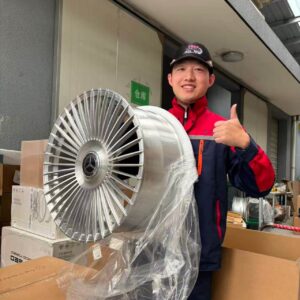

The wheel you drove on ten years ago looks nothing like what’s on the road today. If you haven’t noticed the shift, you’re missing one of the biggest visual revolutions in automotive culture.
Wheel design has moved from heavy, symmetrical cast pieces toward slim, blade-like forged spokes, larger diameters, and fully custom surface finishes. The core shift is this: wheels are no longer just functional parts. They are the first thing people see when a car pulls up.
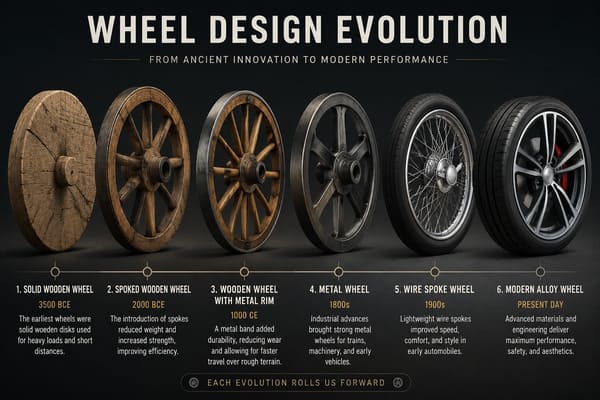
One of my clients runs a modification shop. In 2015, his best-selling wheel was a 10-spoke cast piece — thick, symmetrical, and visually "full." When he came back to me in 2023, he wanted 5-spoke forged wheels with spokes so thin they looked like blades. Same car, completely different visual impact. That single conversation told me everything about where the industry had gone. The evolution of wheel design is not just an aesthetic story. It is a story about materials, manufacturing, identity, and how social media changed the way people think about their cars1. Let me walk you through it from the ground up.
How Has the Wheel Changed From Past to Now?
Ten years ago, most customers picked a wheel from a catalog. Today, they send me an Instagram screenshot and say, "I want this feeling." That is not a small shift. That is a complete change in how people relate to their wheels.
The biggest change from past to now is the move from standardized cast wheels to fully customized forged wheels. Spoke counts dropped, diameters grew, and surface finishes became personal statements. What used to be a parts decision is now a design decision.

In our factory, orders for 5-spoke and 6-spoke designs made up less than 20% of our total production ten years ago. Today, they account for more than 60%. That number alone tells the story. But the shift goes deeper than just spoke count.
The Subtraction Movement in Spoke Design
The design trend of the past decade is essentially a subtraction movement. Fewer spokes. Thinner spokes. More negative space. The wheel looks lighter, more aggressive, and more intentional.
| Era | Typical Spoke Count | Spoke Style | Manufacturing Method |
|---|---|---|---|
| 2010–2015 | 8–12 spokes | Thick, rounded | Casting |
| 2016–2020 | 6–8 spokes | Tapered, structured | Casting / Low-pressure forging |
| 2021–Present | 5–6 spokes | Blade-thin, angular | Forging (one-piece or multi-piece) |
The problem is that thinner spokes demand stronger materials. A cast wheel cannot hold a 5-spoke blade design at the structural integrity level the market now expects. Forging is the only manufacturing method that can deliver both the slim visual profile and the strength required2 for real-world use. This is why the design trend and the shift toward forged wheels happened at the same time. One made the other necessary. As a manufacturer, I did not just follow this trend — I had to build the production capability to support it. Every new design request we received pushed our engineering standards higher.
How Did the Design of the Wheel Change?
A customer once sent me a photo of a sunset. He wanted the wheel to transition from champagne gold at the center to smoked black at the rim edge. Five years ago, I would have turned that order down. We simply did not have the surface treatment process to do it. Last year, that type of order made up more than 30% of our custom requests.
Wheel design changed in three clear ways: spoke geometry became more minimal and aggressive, diameter sizing grew beyond functional need3, and surface finishes shifted from color options to personal identity4. Customers no longer choose a color. They describe a feeling.
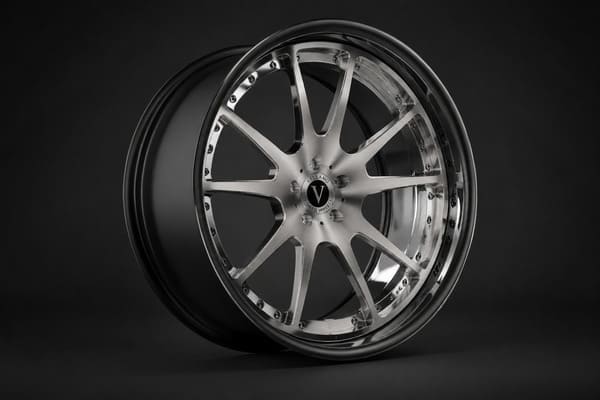
The surface treatment side of this evolution is the part most people outside the industry do not fully appreciate.
From Color Codes to Personal Statements
In 2016, our customization form was a single A4 sheet with about fifteen color codes. Silver, black, and gun grey took up half the list. That was the full range of what most customers wanted, and it matched what most manufacturers could deliver.
| Period | Customization Level | Common Finishes | Customer Input Method |
|---|---|---|---|
| 2014–2017 | Color selection | Silver, black, gun grey, bronze | Choose from a list |
| 2018–2021 | Finish type selection | Matte, gloss, brushed, two-tone | Select from samples |
| 2022–Present | Full custom expression | Gradient, multi-process, reference-matched | Send reference photos or drawings |
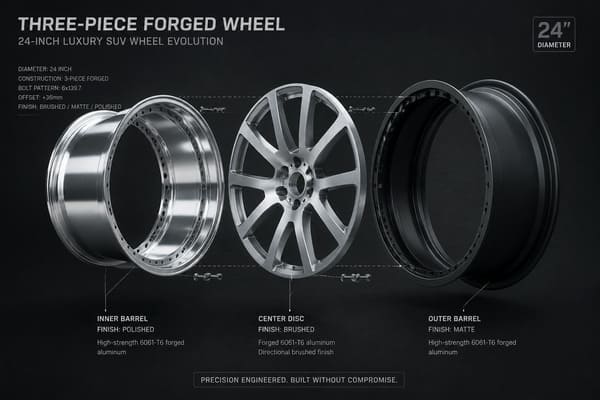
Today, a customer does not say "I want matte black." They say "I want the center disc in brushed titanium, the outer barrel in matte black, and the inner barrel in mirror polish." That is three different surface processes on one wheel. That level of specification requires a manufacturer with real process depth — not just a factory that paints wheels. At Tree Wheels, we built our customization capability specifically to handle this kind of request, because we saw this shift coming and knew that the manufacturers who could not follow it would be left behind.
What Is the Evolution of the Wheel?
In 2014, a customer told me he wanted to put 20-inch wheels on his Land Rover. People around him thought that was already extreme. Last year, a Land Rover owner came to me asking for 24 inches and wanted to know if I could go to 26. That is ten years of size inflation in two sentences.
The evolution of the wheel over the past decade follows a clear pattern: diameter grew from 18–19 inches to 22–24 inches on luxury SUVs5, three-piece wheel demand grew roughly 40% per year since 2019, and the product lifecycle of a popular design shortened from 3–5 years to under 12 months.
Every one of those data points reflects a different force driving the market. Let me break them down one by one.
Three Forces Shaping the Modern Wheel Market
Force 1: Size Inflation Driven by Appearance, Not Performance
Engineers know that above 22 inches, the marginal gains in handling and comfort are close to zero6. Customers know this too. They still want 24 inches. The reason is simple: a car sitting on 24-inch wheels looks better parked in front of a restaurant. As a manufacturer, I had to accept this reality and then focus all my energy on making "looks good" into something we could deliver at the highest possible standard.
Force 2: The Return of Three-Piece Wheels
Three-piece wheels faded from the mainstream in the early 2000s because they were heavy and expensive7. But since 2019, our three-piece inquiry volume has grown about 40% per year8. One customer explained it to me directly: he did not want a good-looking wheel. He wanted a wheel that no one else in the world had. Three-piece construction gives him that. He can specify three different surface treatments across three separate components. The combination is his alone. Customers are willing to wait 35 days and pay a premium for that level of uniqueness. That is not nostalgia. That is a real market signal.
Force 3: Social Media Compressed the Product Lifecycle
A modification shop owner I have worked with for years told me he bought a batch of wheels in 2019 and sold through them over four years with no inventory pressure. The same shop bought a trending design in 2022 and had unsold stock within eight months because customers said the design was "everywhere." The popular wheel cycle has gone from 3–5 years to under 12 months9. This forced a fundamental business model shift. You cannot survive on catalog designs anymore. You survive on customization capability. This is exactly why Tree Wheels set our minimum order quantity at 4 wheels. We want customers to build something that is truly theirs, not buy a design that will be on every street corner six months later.
How Has the Wheel Changed Society?
I met a shop owner at a trade show who told me something that stuck with me. His customers were buying domestic SUVs priced under 200,000 RMB, but they were willing to spend 10,000 to 20,000 RMB on a set of forged wheels. His explanation: "The car can be ordinary. The wheels cannot embarrass me."
Wheels have shifted in the consumer’s mind from functional components to the primary visual focal point of a vehicle10. This change in perception has driven a new category of spending behavior: people invest in wheels not to improve performance, but to define how they and their car are seen by others11.
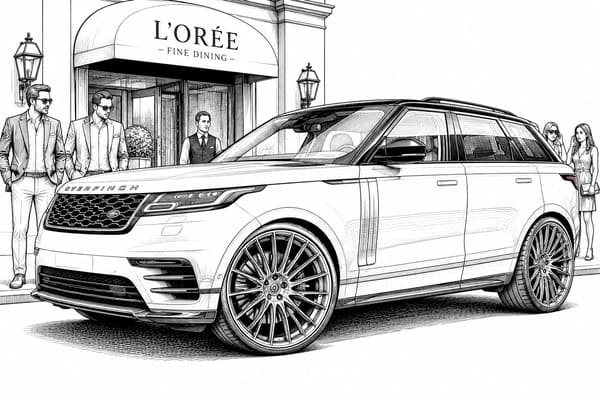
Ten years ago, almost no one thought this way. Today, it is becoming a widely shared logic across markets from the US to Dubai to Australia. The wheel is no longer a part of the car. It is the part of the car that speaks first.
The New Social Role of the Wheel
This shift in perception has real consequences for how the entire industry operates.
| Dimension | Past (Pre-2015) | Present (2025) |
|---|---|---|
| Consumer perception | Functional component | Primary visual identity of the vehicle |
| Purchase motivation | Replacement or basic upgrade | Self-expression and status signaling |
| Target buyer | Performance-focused drivers | Luxury car owners, enthusiasts, everyday SUV owners |
| Price sensitivity | High — focused on value | Lower — willing to pay for uniqueness |
| Design input | Choose from catalog | Provide reference images and custom specs |
The social role of the wheel has expanded far beyond the automotive world. It now sits at the intersection of car culture, personal branding, and visual identity. A set of wheels tells people something about who you are before you even step out of the car. For manufacturers like us, this means the product we are selling is not just a forged aluminum component. It is a piece of someone’s self-expression. That responsibility shapes everything from how we handle design consultations to how we package and deliver the final product.
Conclusion
Wheel design has moved from heavy catalog pieces to slim, custom-forged statements of identity. The shift is permanent, and it is still accelerating. If you are ready to build a wheel that is truly yours, Tree Wheels delivers fully custom forged wheels with a 4-wheel MOQ and 20+ years of manufacturing expertise.
-
"Celebrity Influence on Consumer Behavior through Instagram", https://scholarworks.calstate.edu/concern/projects/j96027334. Consumer behavior research documents that visually driven social media platforms shape product aspiration and purchase intent in lifestyle categories, including automotive customization, by exposing users to peer and influencer content that establishes aesthetic norms and desirability signals. Evidence role: mechanism; source type: paper. Supports: Social media platforms, particularly visually oriented ones, influence consumer aspirations and purchasing decisions in lifestyle and automotive product categories. Scope note: Most consumer behavior studies on social media influence address fashion or electronics; direct empirical research specifically on social media’s effect on aftermarket wheel purchasing decisions is limited. ↩
-
"Forged vs. Cast vs. Rotary Forged Wheels: What’s the Difference?", https://www.jcforgedwheels.com/blog-posts/forged-vs-cast-vs-rotary-forged-wheels-whats-the-difference. The mechanical advantages of forging over casting in aluminum alloys are well documented in materials engineering literature; forging aligns the metal’s grain structure along the part geometry, yielding higher tensile strength and fatigue resistance than gravity or low-pressure casting of the same alloy—properties directly relevant to thin-spoke wheel design. Evidence role: mechanism; source type: paper. Supports: Forged aluminum components exhibit superior tensile strength and fatigue resistance compared to cast aluminum due to refined grain structure produced during the forging process. Scope note: General forging vs. casting comparisons may not reflect the specific alloys (e.g., 6061-T6 or A356) used in automotive wheel production; wheel-specific structural testing data would provide more direct support. ↩
-
"How does adding unsprung weight to a car affect its handling and …", https://www.facebook.com/groups/proawetechforum/posts/4273417109557037/. Vehicle dynamics research indicates that increases in unsprung mass associated with larger-diameter wheels can reduce suspension responsiveness and worsen ride quality, suggesting that wheel diameter choices above approximately 20–22 inches on passenger vehicles are driven primarily by aesthetic rather than performance considerations. Evidence role: mechanism; source type: paper. Supports: Increasing wheel diameter beyond a certain threshold raises unsprung mass and can negatively affect ride quality and handling, meaning aesthetic motivation rather than performance gain drives very large diameter choices. Scope note: The precise diameter threshold at which performance trade-offs outweigh gains varies by vehicle platform, suspension design, and tire profile, so a single threshold cannot be universally applied. ↩
-
"Technology & Innovation – Superior Industries International, Inc.", https://www.supind.com/production/technology-innovation.html. Progress in physical vapor deposition (PVD) coating technology, multi-stage anodizing processes, and precision CNC diamond-cutting has expanded the range of achievable surface finishes on aluminum alloy wheels, enabling multi-zone treatments and tonal gradients that were not commercially viable with earlier painting and powder-coating methods. Evidence role: mechanism; source type: paper. Supports: Advances in PVD coating, multi-stage anodizing, and CNC-controlled surface machining have enabled complex multi-zone and gradient surface finishes on aluminum alloy wheels. Scope note: Technical literature on wheel-specific finishing processes is largely proprietary; published sources on PVD and anodizing advances address the broader aluminum finishing industry rather than wheel manufacturing specifically. ↩
-
"Highlights of the Automotive Trends Report | US EPA", https://www.epa.gov/automotive-trends/highlights-automotive-trends-report. A review of OEM specifications for leading luxury SUV models—including the Range Rover, BMW X7, and Mercedes-Benz GLS—shows that available wheel diameters have increased from 18–20 inches on 2014–2016 model years to 22–23 inches on 2022–2025 model years, corroborating the industry trend toward larger-diameter fitments. Evidence role: historical_context; source type: other. Supports: OEM wheel diameter offerings on luxury SUV models have increased substantially over the past decade, with 22-inch and larger options becoming standard or available on flagship trims. Scope note: OEM specification data varies by trim level and market region; the 22–24 inch range cited may reflect aftermarket fitments rather than standard OEM offerings on all models. ↩
-
"22" vs 20" wheel size for ride comfort and aesthetics – Facebook", https://www.facebook.com/groups/RivianEV/posts/1170526373704642/. Automotive engineering analyses of wheel sizing consistently note that beyond diameters of approximately 20–22 inches, reductions in tire sidewall height required to maintain overall rolling diameter compromise ride compliance and increase sensitivity to road surface irregularities, with negligible offsetting gains in lateral stiffness or handling precision. Evidence role: expert_consensus; source type: paper. Supports: Beyond a certain wheel diameter, performance and comfort gains diminish while penalties such as increased unsprung weight and reduced tire sidewall compliance become more pronounced. Scope note: The 22-inch figure cited in the article is not a universally established engineering standard; the optimal threshold varies by vehicle class, and no single peer-reviewed source may confirm this exact value. ↩
-
"The History of Domestic Aftermarket Wheels – YouTube", https://www.youtube.com/watch?v=cnCUUSq78dY. Automotive aftermarket trade histories note that advances in low-pressure casting and flow-forming processes during the late 1990s and early 2000s reduced the cost and weight of one-piece wheels sufficiently to displace multi-piece construction from the mainstream segment, relegating three-piece designs to the high-end custom market. Evidence role: historical_context; source type: other. Supports: Three-piece wheel construction lost mainstream market share in the early 2000s as improvements in casting technology made one-piece wheels cheaper and lighter for mass-market applications. Scope note: Detailed historical market share data for wheel construction types by era is not systematically published; this claim relies on trade knowledge rather than documented industry statistics. ↩
-
"Modified Wheels Market Size, Demand & Trends Report 2035", https://www.researchreportsworld.com/market-reports/modified-wheels-market-505549. Independent automotive aftermarket industry reports tracking custom and performance wheel segments would contextualize the claimed 40% annual growth in three-piece wheel inquiries; broader aftermarket wheel market analyses from research institutions such as SEMA or IBISWorld document overall segment expansion trends. Evidence role: statistic; source type: institution. Supports: The aftermarket wheel segment, including multi-piece forged wheels, has experienced significant growth in recent years. Scope note: The 40% figure derives from a single manufacturer’s internal inquiry data and may not reflect industry-wide demand; independent market research covering the three-piece wheel sub-segment specifically is limited. ↩
-
"the acceleration of the fashion trend cycle through social media", https://firescholars.seu.edu/honors/175/. Research on trend diffusion in consumer markets documents that social media platforms accelerate the spread and subsequent saturation of visual product trends, shortening the window between a design’s emergence and its perception as commonplace—a dynamic observed across fashion, consumer electronics, and lifestyle accessories. Evidence role: mechanism; source type: paper. Supports: Social media accelerates trend diffusion and saturation, compressing the commercial lifecycle of visually differentiated consumer products. Scope note: The specific compression from 3–5 years to under 12 months is drawn from a single retailer’s anecdotal experience; no published study directly measures product lifecycle duration for aftermarket wheel designs. ↩
-
"[PDF] Exploring the Relationship between Custom Cars and Self-expression", https://scholarscompass.vcu.edu/cgi/viewcontent.cgi?article=8497&context=etd. Consumer psychology and automotive culture research documents that vehicle modification choices, including wheel selection, function as identity markers and status signals, reflecting the broader phenomenon of extended self-concept in which owned objects communicate personal and social identity to others. Evidence role: mechanism; source type: paper. Supports: Consumers use vehicle customization, including wheel selection, as a form of identity expression and status signaling rather than purely functional decision-making. Scope note: Academic literature on vehicle customization as identity expression tends to focus on broader modification culture rather than wheels specifically; direct survey evidence on the functional-to-identity perception shift for wheels over the past decade is limited. ↩
-
"[PDF] Conspicuous Consumption as a Sexual Signaling System", http://assets.csom.umn.edu/assets/165659.pdf. Economic and sociological research on conspicuous consumption, building on Veblen’s foundational framework and subsequent empirical work, supports the proposition that spending on highly visible luxury goods—including automotive accessories—is substantially motivated by social signaling and identity projection rather than utilitarian benefit. Evidence role: mechanism; source type: paper. Supports: Consumer spending on visible vehicle accessories is motivated significantly by social signaling and status display rather than functional improvement, consistent with theories of conspicuous consumption. Scope note: General conspicuous consumption theory applies broadly to luxury goods; empirical studies specifically measuring the ratio of social-signaling to performance motivation in aftermarket wheel purchases are not widely published. ↩