

Getting the offset wrong on a classic F-100 is not just a cosmetic mistake. It can damage your bearings, stress your steering, and cost you far more than a new set of wheels.
+12mm offset on a classic Ford F-100 can work, but only under specific conditions. It pushes the wheel 7 to 13mm outward from stock, which widens the stance but increases scrub radius. For show trucks with low mileage, it is acceptable. For daily-driven restomods, it creates long-term mechanical stress on the front axle.
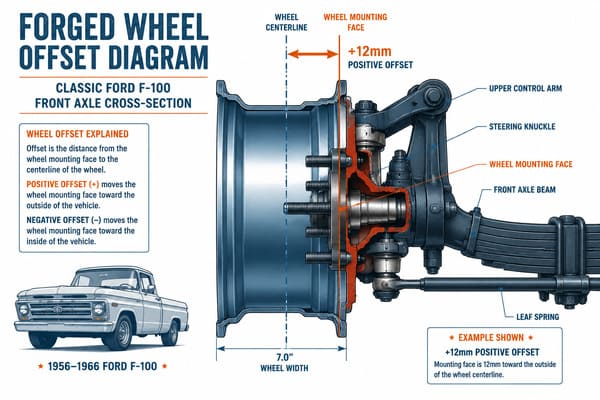
Offset is one of those specs that looks simple on paper but carries real consequences once the truck is moving. The F-100 is not a modern truck with generous suspension tolerances. It was designed in an era when wheel geometry had almost no margin for experimentation1. Every millimeter you move that wheel outward changes how the front end loads, steers, and wears. I want to walk through exactly what +12mm does to this truck — visually, mechanically, and practically — so you can make a decision based on facts, not guesswork.
What Does +12mm Offset Actually Mean for Your F-100?
Most people treat offset like a style number. They pick it because it looks good on a build sheet. But offset is a structural decision, and on an F-100, the structure does not forgive mistakes easily.
Offset is the distance between the wheel’s mounting face and its centerline. A +12mm offset means the mounting face sits 12mm toward the outside of the wheel. On a classic F-100, where factory offset typically runs between +19mm and +25mm2, a +12mm spec pushes the wheel 7 to 13mm further outward than the original design intended.
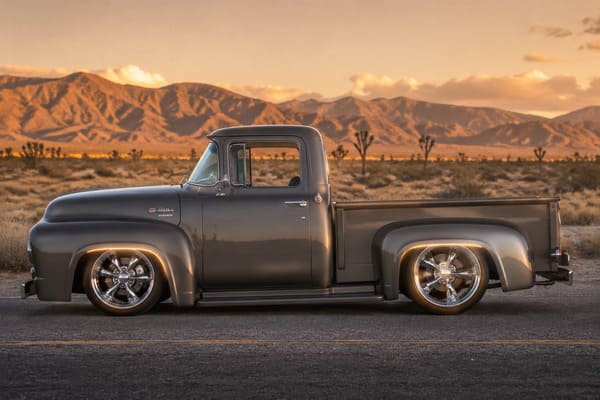
I had a customer come to me with a 1965 F-100. He wanted +12mm offset on a 9-inch-wide wheel. On paper, the numbers looked fine. But once we mapped the actual clearance between the inner wheel edge and the upper control arm, we had less than 8mm of breathing room on the front axle. One suspension compression event and that wheel would contact the control arm directly.
That kind of problem does not announce itself. It builds quietly — a small rub here, a vibration there — until something fails at the worst possible moment.
Why Scrub Radius Matters More Than Most People Think
The shift from stock offset to +12mm changes something called the scrub radius. This is the distance between where the tire contacts the ground and where the steering axis meets the ground3.
| Offset | Scrub Radius Effect | Real-World Result |
|---|---|---|
| +25mm (stock) | Minimal scrub radius | Light, neutral steering |
| +12mm | Increased scrub radius | Heavier steering, more pull under braking |
| 0mm or negative | High scrub radius | Significant steering effort, unstable under braking |
Every millimeter you add to the scrub radius makes the steering feel heavier. It also makes the truck pull harder to one side when you brake hard4. On a straight highway at steady speed, you will not notice the difference. In a panic stop, you will feel it immediately. The F-100’s original steering geometry was calibrated for a specific scrub radius range5. Moving outside that range does not break the truck overnight — it just makes every mile slightly harder on the components than it was designed to be.
How Does +12mm Offset Affect the Stance and Handling of a Classic F-100?
Stance and handling pull in opposite directions on a classic F-100. This is the tension that nobody talks about clearly, and it is the reason so many F-100 builds look great in photos but develop problems on the road.
A lower positive offset pushes the wheel outward, which creates a wider, more planted visual stance. But the F-100’s front suspension was not engineered to carry the additional mechanical load that comes with that wider position. The wider the wheel sits, the greater the stress on the spindle, bearings, and steering components over time.

I worked with a customer who built a 1969 F-100 restomod. He ran +12mm offset on 10-inch-wide wheels all around. The truck looked exactly how he wanted — wide, aggressive, and planted. Eighteen months later, he came back to me. He had worn through two sets of front wheel bearings6 and was seeing uneven tire wear across the front axle. The wider scrub radius was loading the spindle at a slightly wrong angle, every single mile, for thousands of miles.
The fix was not a new wheel. The fix was moving the front wheels to +20mm offset and running a 1-inch spacer on the rear axle only. That kept the rear stance wide and aggressive while removing the mechanical stress from the front geometry entirely.
The 500-Mile Rule for F-100 Offset Decisions
The right offset for your F-100 depends heavily on how you use the truck.
| Use Case | Recommended Front Offset | Notes |
|---|---|---|
| Show truck, under 500 miles/year | +12mm acceptable | Minimal mechanical wear at low mileage |
| Weekend driver, 500–3,000 miles/year | +15mm to +18mm | Balance between stance and durability |
| Restomod, highway miles | +18mm to +25mm | Protects bearings and steering geometry long-term |
| Daily driver | Stock range (+19mm to +25mm) | Maximum component life |
The trucks that develop problems are almost always the ones where the owner chose the offset for photos and then started driving the truck like a real vehicle. There is nothing wrong with either choice. But you need to make that choice consciously, before you order the wheels — not after the bearings start complaining.
What Wheel Specs Are Compatible with a +12mm Offset on an F-100?
The number that actually determines whether a wheel fits inside a fender is not offset. It is backspacing. Offset tells you where the wheel sits relative to its centerline. Backspacing tells you how much space exists between the mounting face and the inner edge of the wheel — and that is the number that determines real-world clearance.
Backspacing is calculated by taking half the wheel width, adding the offset converted to inches7, and that total gives you the distance from the mounting face to the inner lip. On an 18×9 wheel with +12mm offset, backspacing works out to approximately 4.97 inches. For a stock, unmodified late-1960s F-100, the safe front backspacing range is typically 4.5 to 5.25 inches8 — which puts an 18×9 at +12mm right at the edge of that window.
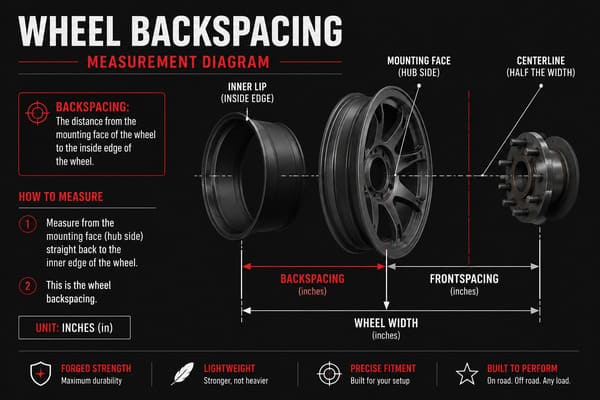
Sitting at the edge of the safe window is not the same as sitting comfortably inside it. There is almost no margin for error. If the suspension has been lowered, or if the steering has been modified, that window shifts. A wheel that technically fits a stock F-100 may not fit your specific truck at all.
The Three Questions I Ask Before Confirming Any F-100 Wheel Spec
Before I confirm offset, width, or backspacing for any F-100 order, I ask three questions every time.
| Question | Why It Matters |
|---|---|
| What year is your F-100? | Early and late F-100s have different suspension geometry and different safe backspacing ranges |
| Has the suspension been modified? | Lifts, lowering kits, and suspension conversions all change available clearance |
| What is your intended wheel width? | Wider wheels require more positive offset to maintain the same backspacing |
The bolt pattern also matters. Later F-100s use a 5×4.5 bolt pattern (5×114.3mm)9, but some earlier models differ from this. If a customer cannot answer all three questions with confidence, I will not quote a final offset spec until they can. Getting these answers wrong does not just mean the wheel looks wrong. It means the wheel may not physically clear the suspension under load.
What Offset Looks Best on Trucks?
The best-looking offset on any truck is the one that fills the fender without exceeding it. That is the honest answer, and it does not change regardless of truck model, wheel width, or build style.
The visual goal is a wheel face that sits flush — or just slightly recessed — relative to the outer edge of the fender opening. For most full-size American trucks, including the F-100, the offset range that achieves this look falls between 0mm and +25mm, depending on wheel width10. Wider wheels need more positive offset to stay tucked. Narrower wheels can run closer to zero.
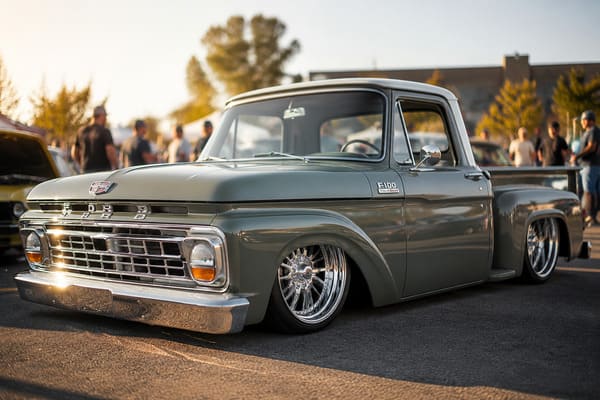
I had a customer build a 1962 F-100 with 20×10 wheels at +6mm offset. The truck looked correct from every angle. The wheel filled approximately 97% of the fender opening. That 3% of breathing room is what kept it clean instead of rubbing. Compare that to another customer who ran 20×12 wheels at -12mm offset on a similar F-100. The wheels poked 14mm past the fender edge, and the truck needed flares just to pass inspection in his state.
The 93–97% Fender Fill Rule
The trucks that look best are almost never the most extreme builds. They are the ones where the wheel fills between 93% and 97% of the fender opening — aggressive enough to look intentional, but never so wide that it looks like a mistake.
| Wheel Width | Offset Range for Best Visual Fit | Fender Fill Estimate |
|---|---|---|
| 8 inches | +15mm to +25mm | 90–94% |
| 9 inches | +10mm to +20mm | 93–96% |
| 10 inches | +6mm to +18mm | 94–97% |
| 12 inches | +12mm to +25mm | 93–96% |
The offset values in this table assume a stock or mildly modified F-100 with standard fender geometry. Modified fenders, flares, or suspension changes will shift these numbers. The principle stays the same regardless: fill the fender as completely as possible without letting the wheel break the plane of the body. That line between aggressive and excessive is where the best truck builds live.
Conclusion
+12mm offset works on a classic F-100 only when the wheel width, backspacing, and suspension geometry all support it. Know your specs before you order. At Tree Wheels, we help you get the fitment right the first time — custom forged wheels built to your exact specifications.
-
"[PDF] Design Data on Suspension Systems of Selected Rail Passenger Cars", https://railroads.dot.gov/sites/fra.dot.gov/files/fra_net/17253/DOT-FRA-ORD-96-01-Design%20Data%20on%20Suspension%20Systems%20of%20Selected%20Rail%20Passenger%20Cars.pdf. Automotive engineering histories note that 1950s–1970s light truck suspensions were designed primarily for load-carrying and durability under predictable operating conditions, with alignment specifications reflecting the limited adjustability of the era’s solid-axle and early independent front suspension designs. Evidence role: historical_context; source type: other. Supports: That mid-20th-century truck suspension systems were designed with narrower geometric tolerances than contemporary designs. Scope note: Direct comparative tolerance data between vintage and modern truck suspension systems is not widely published in accessible academic literature; this claim is largely supported by inference from design documentation of the period. ↩
-
"Ford F-100 – Specs of rims, tires, PCD, offset for each year and …", https://www.wheel-size.com/size/ford/f-100/. Ford F-100 factory service manuals and wheel specification databases document OEM offset values for each model year; the +19mm to +25mm range cited here should be verified against year-specific documentation, as suspension and hub designs changed across the 1953–1979 production run. Evidence role: statistic; source type: other. Supports: The original equipment wheel offset range for Ford F-100 trucks across production years. Scope note: Factory offset may vary by model year, cab configuration, and whether the truck was equipped with optional wider axles. ↩
-
"Scrub radius – Wikipedia", https://en.wikipedia.org/wiki/Scrub_radius. Scrub radius, also termed kingpin offset, is defined in automotive engineering literature as the horizontal distance at the road surface between the tire contact center and the point where the steering axis intersects the ground plane; this parameter directly influences steering returnability and braking stability (see, e.g., Gillespie, T.D., Fundamentals of Vehicle Dynamics, SAE International, 1992). Evidence role: definition; source type: encyclopedia. Supports: The geometric definition of scrub radius in vehicle steering systems. ↩
-
"Scrub radius – Wikipedia", https://en.wikipedia.org/wiki/Scrub_radius. Vehicle dynamics literature establishes that a larger positive scrub radius amplifies the steering torque produced by differential braking forces between left and right wheels, resulting in a tendency for the vehicle to pull toward the side with greater braking force (Milliken, W.F. & Milliken, D.L., Race Car Vehicle Dynamics, SAE International, 1995). Evidence role: mechanism; source type: paper. Supports: The mechanism by which increased scrub radius generates steering torque during asymmetric braking events. Scope note: Most formal studies address passenger cars or race vehicles; direct empirical data for vintage body-on-frame trucks such as the F-100 is limited. ↩
-
"Design and analysis of the front suspension geometry and steering …", https://dspace.mit.edu/handle/1721.1/92663. Factory alignment specifications published in Ford F-100 service manuals specify caster, camber, and kingpin inclination values that collectively define the intended scrub radius; deviations from OEM wheel offset alter this geometry in ways not accounted for in the original design. Evidence role: historical_context; source type: other. Supports: That Ford’s F-100 front suspension and steering geometry was designed to function within a defined scrub radius envelope. Scope note: Specific scrub radius targets are rarely stated explicitly in service manuals; the intended range must typically be inferred from the combination of published alignment angles and OEM wheel dimensions. ↩
-
"Scrub radius", https://en.wikipedia.org/wiki/Scrub_radius. Engineering analyses of wheel bearing loading demonstrate that displacing the wheel laterally outward from the designed hub centerline increases the bending moment applied to the spindle, reducing bearing fatigue life in proportion to the square of the additional moment arm (see bearing load rating standards, ISO 281 or equivalent). Evidence role: mechanism; source type: paper. Supports: The mechanism by which moving a wheel outward from its designed position increases bending moment on the spindle and accelerates wheel bearing fatigue. Scope note: Published bearing life calculations are typically derived from standardized test conditions; real-world wear rates on vintage trucks depend on additional variables including bearing quality, lubrication, and road conditions. ↩
-
"Wheel Backspace Calculator & Offset Tool | Hardrock Offroad", https://hardrockoffroad.com/resources/wheel-backspace-calculator/. The relationship between wheel backspacing (B), wheel width (W), and offset (O) is expressed as B = (W/2) + O, where all values are in consistent units; this formula is standard in automotive wheel fitment references and is used to determine inner clearance between the wheel and suspension components. Evidence role: definition; source type: encyclopedia. Supports: The standard formula relating wheel backspacing, wheel width, and offset. ↩
-
"What wheel/tire/size and offset/backspacing would you recommend …", https://www.facebook.com/groups/119350256892519/posts/812725234221681/. The 4.5–5.25 inch front backspacing range cited for late-1960s F-100 trucks reflects clearance constraints imposed by the twin I-beam or conventional front suspension geometry of that era; this range should be cross-referenced against Ford factory service documentation or established aftermarket fitment databases for the specific model year in question. Evidence role: statistic; source type: other. Supports: The acceptable front wheel backspacing range for unmodified late-1960s Ford F-100 trucks. Scope note: Backspacing tolerance varies with suspension condition, steering component wear, and any prior modifications; the stated range represents a general guideline rather than a certified engineering specification. ↩
-
"what wheel bolt pattern is the best for the f100? thanks – Facebook", https://www.facebook.com/groups/f100coyoteswaps/posts/9776672335737595/. Ford F-100 trucks produced in the later generations are commonly documented in aftermarket fitment references as using a 5×114.3 mm (5×4.5 in) bolt pattern; however, earlier production years and certain axle configurations may differ, and year-specific verification against Ford parts catalogs is advised. Evidence role: statistic; source type: other. Supports: The wheel bolt pattern specification for later-generation Ford F-100 trucks. Scope note: Bolt pattern data for vintage trucks is frequently compiled from aftermarket sources rather than original Ford engineering documents, and exceptions exist for fleet or special-order configurations. ↩
-
"How To Choose Wheel Offset For Your Ford F150 – YouTube", https://www.youtube.com/watch?v=ShP_CiSzCKY. Aftermarket wheel fitment guides for full-size American trucks of the 1950s–1970s, including the Ford F-100, Chevrolet C/K, and Dodge D-series, commonly document OEM and near-OEM offset values in the 0mm to +25mm range; the appropriate value within this range depends on wheel width and the specific suspension geometry of each platform. Evidence role: general_support; source type: other. Supports: That the 0mm to +25mm offset range generally produces flush fitment on full-size American trucks of the F-100 era. Scope note: The stated range is a generalization across multiple platforms and model years; individual trucks may fall outside this range depending on axle width, suspension modifications, and tire size. ↩