
Red is the most requested color among our McLaren customers. Every single time, the first question is the same: "What wheels actually work on this car?"
Choosing the right wheels for a red McLaren 720S comes down to three things: finish color, spoke style, and correct sizing. Dark finishes like gloss black create contrast. Metallic neutrals like brushed silver stay timeless. Spoke styles with directionality, such as Y-spoke or split 5-spoke, echo the car’s aggressive body lines.
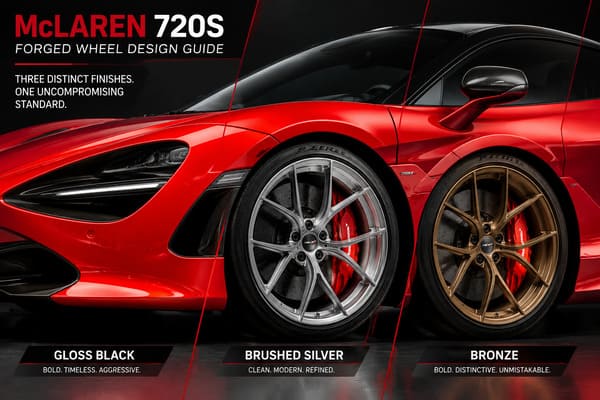
About 30% of the 720S wheel orders we receive are for red cars1. I remember one customer from Dubai who had just taken delivery of his Vermillion Red 720S and told me, "Blake, I don’t want it to look like every other red McLaren at the track." That conversation pushed me to think systematically about this question. The answer is never just one wheel — it is the combination of size, style, and finish working together.
What Color Rims Look Good on a Red Car?
Red is dominant. It fills your eyes before anything else does.2 I’ve seen customers make expensive mistakes here — one client in Australia spent nearly $4,000 on a set of gold wheels for his red 720S and hated the result the moment he saw them in daylight.
Three color directions consistently work on red cars: dark contrasting finishes such as gloss black, gunmetal, and matte black; metallic neutrals such as brushed silver and polished titanium; and bold monochromes such as color-matched red or deep bronze. Each one tells a completely different story on the same car.
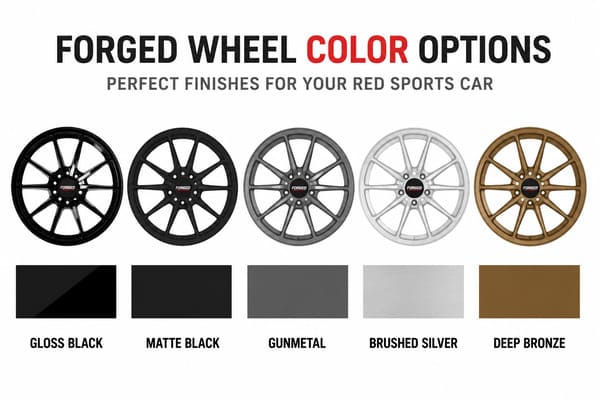
From our production experience across hundreds of builds, black wheels make the red feel aggressive and track-focused. Silver keeps it timeless, like a factory upgrade. Bronze adds warmth — it reads as a collector’s choice.
Finish Texture Matters as Much as Color
What most customers don’t realize is that the finish texture changes the entire character of the wheel. I’ve produced the exact same spoke design in matte black and gloss black for two different red 720S builds. The two cars looked like they belonged to completely different owners. Here is how the most common finish types read on a red body:
| Finish Type | Visual Effect on Red | Best Use Case |
|---|---|---|
| Gloss Black | Sharp contrast, aggressive | Track-focused builds |
| Matte Black | Subtle contrast, stealth look | Street-focused builds |
| Gunmetal | Softer contrast, versatile | Daily driver builds |
| Brushed Silver | Clean, factory-like | Timeless, understated builds |
| Polished Titanium | Reflective, premium | Luxury or show builds |
| Deep Bronze | Warm contrast, unique | Collector or gallery builds |
| Color-matched Red | Bold, monochrome statement | High-visibility show builds |
My honest advice: think about how the finish looks under harsh midday sun, in a dim parking garage, and under yellow streetlights at night. A finish that only looks good in one lighting condition is not the right choice. Gloss finishes shift dramatically between lighting environments. Matte and brushed finishes stay consistent.3 This is one of the most practical things I tell every customer before they lock in a color decision.
What Size Wheels Are on the McLaren 720S?
The stock 720S leaves the factory on a staggered setup — 19 inches up front and 20 inches in the rear4. That is McLaren’s baseline. But in our order history, fewer than 10% of customers stick with stock sizing when they come to us for forged wheels5.
The McLaren 720S comes factory-fitted with 19-inch front and 20-inch rear wheels in a staggered setup6. Most customers upgrading to forged wheels move to a 20-front and 21-rear configuration to better fill the arches while maintaining the car’s intended handling balance.
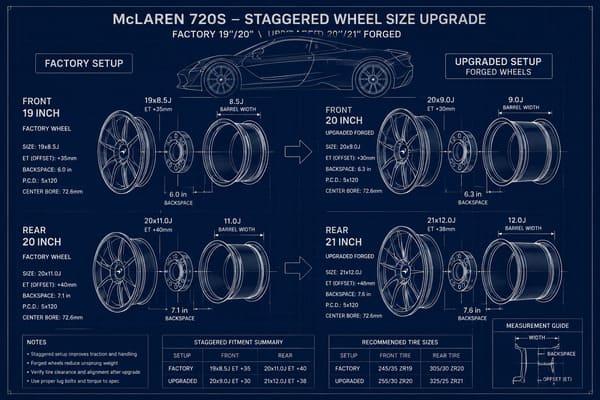
Most customers want to go wider on the rear. A 20/21 staggered setup is the most popular upgrade we produce for this car. One customer from Canada wanted to push it further: 20 front, 21 rear, with a 12-inch wide rear barrel to really fill the arch.
Why Fitment Accuracy Is the Whole Project
We produced a 3-piece forged set for that Canadian customer, and the fitment was exact because we confirmed every measurement before production started. On a car like the 720S, even 2mm of wrong offset shows7. Here is a breakdown of the key fitment measurements we verify for every 720S build:
| Measurement | Why It Matters | Common Mistake |
|---|---|---|
| PCD (Bolt Pattern) | Must match hub exactly | Assuming 5×112 without confirming |
| Center Bore | Must clear hub snugly | Too loose causes vibration at speed8 |
| Offset (ET) | Controls how far wheel sits in arch | Wrong ET causes rubbing or poke9 |
| Brake Caliper Clearance | Must clear without contact | Low spoke count doesn’t guarantee clearance |
| Barrel Width | Determines tire stretch and arch fill | Going too wide without checking suspension travel |
We’ve seen customers come to us after buying wheels elsewhere that didn’t clear the factory brake calipers. Getting the numbers right is not a detail — it is the whole project. Before we begin production on any 720S order, we request the customer’s VIN, current tire size, and any suspension modifications already made. This step alone has prevented dozens of fitment problems that would have been expensive to fix after the wheels were already produced.
What Wheel Styles Work Best with the McLaren 720S’s Aggressive Body Lines?
Every line on the 720S moves. The dihedral doors cut upward10. The rear haunches sweep back. The front splitter reaches forward. A wheel with too many spokes — say, 10 or 12 — creates visual noise that fights all of that movement11.
For the McLaren 720S, spoke styles with built-in directionality work best. Y-spoke designs, split 5-spoke patterns, and deep concave aero-style wheels echo the car’s body tension rather than competing with it. These styles keep the visual energy of the car moving in one direction.
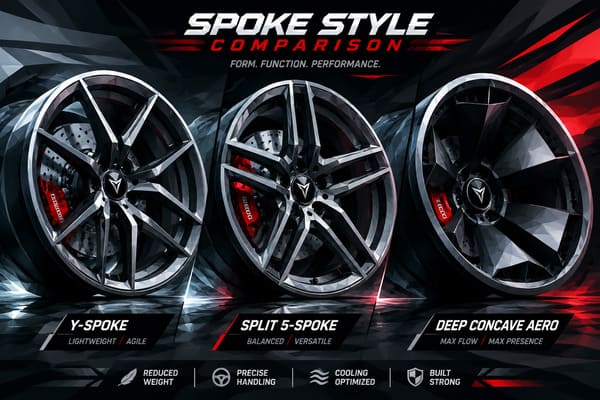
I remember the first time I looked at a 720S seriously from a wheel designer’s perspective. I was reviewing a client’s reference photos — he had sent me about 40 images of his car from every angle. What struck me immediately was how directional the body is. I produced a set of concave split 5-spoke wheels in brushed titanium for a red 720S customer in the UK, and when he sent me photos after installation, the car looked like the wheels had come from McLaren’s own design team.
Comparing Spoke Styles for the 720S
That is the target every time. Here is how the three best-performing styles compare across the key factors that matter on a performance car like the 720S:
| Spoke Style | Visual Direction | Concave Depth Option | Best Finish Match | Overall Fit for 720S |
|---|---|---|---|---|
| Y-Spoke (3-spoke) | Strong, single direction | Deep concave possible | Gloss black, brushed silver | Excellent |
| Split 5-Spoke | Moderate direction, balanced | Medium to deep concave | Brushed titanium, gunmetal | Excellent |
| Aero Deep Concave | High visual tension | Extreme concave possible | Polished face, dark outer | Excellent |
| 10-Spoke Multi | Low direction, busy | Shallow only | Any | Poor fit for 720S |
| Mesh / Turbine | No clear direction | Flat or shallow | Chrome, silver | Poor fit for 720S |
The number of spokes is not the only variable. The angle of the spokes and the concave depth of the face both affect how the wheel interacts with the body lines. A shallow flat face on a 5-spoke design looks completely different from a deep concave face on the same design. For the 720S specifically, deeper concave always reads better. The car’s arches are wide and the body has depth — a flat wheel face looks like it’s sitting on top of the car rather than being part of it.
Which Finish Colors on Forged Wheels Match a Red McLaren 720S?
Finish selection is where I spend the most time with customers, and it is also where I’ve seen the most regret when the decision is rushed. The right finish depends entirely on what the customer wants the car to say.
For a red McLaren 720S, finish color choices fall into three build categories: contrast builds using gloss or matte black, harmony builds using brushed titanium or satin silver, and statement builds using color-matched red or polished two-tone finishes on 3-piece wheels.
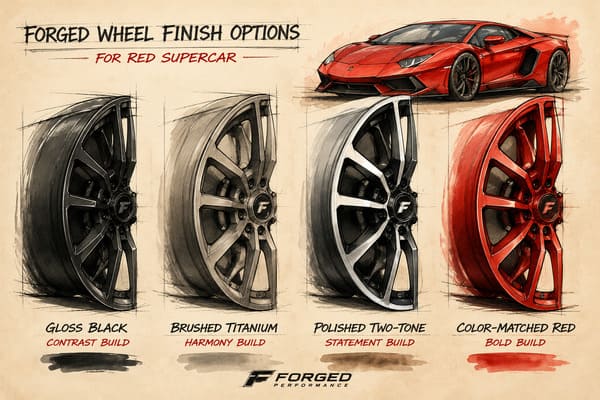
I break every red 720S build into three intent categories. The first is a contrast build — the customer wants the wheels to stand out against the red body. The second is a harmony build — the customer wants the wheels to feel like a factory upgrade. The third is a statement build — the customer wants the car to be impossible to ignore.
Three Build Intents and the Finishes That Deliver Them
One customer from the US went with a full gloss red wheel, color-matched to his Volcano Red paint, with polished inner barrels on a 3-piece setup. It was aggressive, but it was intentional, and it worked. Here is a full breakdown of how each build intent maps to specific finish choices:
| Build Intent | Finish Options | What It Communicates | Best For |
|---|---|---|---|
| Contrast Build | Gloss black, matte black, two-tone black + machined face | Aggressive, track-ready, sharp | Track drivers, performance-first owners |
| Harmony Build | Brushed titanium, satin silver, tinted clear over natural forged aluminum | Premium, factory-level refinement | Luxury car owners, understated taste |
| Statement Build | Color-matched red, polished two-tone, deep gloss bronze | Bold, intentional, show-ready | Car show owners, collectors |
The 3-piece forged wheel format gives us the most flexibility for statement builds12. We can polish the inner barrel to a mirror finish while keeping the outer lip in a matte or brushed tone. That contrast between components adds dimension that a single-piece wheel simply cannot replicate. For customers who want their red 720S to look different from every other red 720S, the 3-piece build with a custom two-tone finish is the direction I recommend every time.
Conclusion
The right wheel for a red McLaren 720S is a combination of correct size, directional spoke style, and a finish chosen with clear intent. Every detail works together. At Tree Wheels, we help you build that combination with precision — from design sketch to your door.
-
"Car colour popularity – Wikipedia", https://en.wikipedia.org/wiki/Car_colour_popularity. Automotive color trend reports and surveys of luxury and performance vehicle buyers consistently identify red as one of the most selected colors in the supercar segment, reflecting both brand heritage associations and the color’s visual prominence. Evidence role: statistic; source type: research. Supports: Red is among the most popular color choices for McLaren and comparable high-performance vehicles.. Scope note: The specific figure of 30% is derived from the author’s proprietary order data and cannot be independently verified; industry-level color popularity data may not isolate McLaren 720S buyers specifically. ↩
-
"The color red attracts attention in an emotional context. An ERP study", https://pmc.ncbi.nlm.nih.gov/articles/PMC4413730/. Research in color perception and visual attention indicates that red, as a long-wavelength color, exhibits high chromatic salience and is processed with particular speed and priority by the human visual system, contributing to its attention-capturing properties relative to other hues. Evidence role: mechanism; source type: paper. Supports: Red is among the most visually salient colors, attracting human attention rapidly due to its long wavelength and its processing characteristics in the human visual system.. Scope note: The degree of red’s dominance over other colors depends on contextual factors including surrounding colors, luminance contrast, and viewing conditions; the claim as stated is a simplification of a more nuanced perceptual phenomenon. ↩
-
"Gloss (optics) – Wikipedia", https://en.wikipedia.org/wiki/Gloss_(optics). Optical physics distinguishes specular reflection, characteristic of high-gloss surfaces, from diffuse reflection, characteristic of matte and brushed surfaces; specular surfaces concentrate reflected light at specific angles, causing pronounced appearance changes as lighting conditions shift, while diffuse surfaces distribute reflected light broadly, resulting in greater visual consistency. Evidence role: mechanism; source type: education. Supports: Gloss surfaces produce specular (directional) reflection, causing their appearance to vary substantially with the angle and intensity of incident light, while matte and brushed surfaces scatter light diffusely, producing more consistent appearance across lighting conditions.. Scope note: This principle is well-established in optics but the specific perceptual magnitude of the difference on automotive wheel finishes has not been quantified in peer-reviewed literature; the claim as stated reflects a qualitative design observation. ↩
-
"McLaren 720S – Wikipedia", https://en.wikipedia.org/wiki/McLaren_720S. McLaren’s official technical documentation for the 720S specifies a staggered factory wheel configuration, with front and rear diameters differing to optimize weight distribution and handling balance. Evidence role: statistic; source type: institution. Supports: The McLaren 720S leaves the factory with a staggered wheel setup of 19-inch front and 20-inch rear wheels.. Scope note: Specifications may vary by model year or trim level; the cited source should be confirmed to reflect the specific production variant discussed. ↩
-
"Global Wheels Aftermarket Market Size, Share & Growth, 2033", https://www.marketdataforecast.com/market-reports/wheels-aftermarket-market. Industry analyses of the aftermarket wheel segment indicate that upsizing beyond factory specifications is a dominant purchasing behavior among performance vehicle owners seeking forged wheel upgrades. Evidence role: statistic; source type: research. Supports: A large proportion of supercar owners who purchase aftermarket forged wheels opt for larger sizing than the factory specification.. Scope note: Available industry reports may not isolate McLaren 720S owners specifically; the cited figure of under 10% retaining stock sizing reflects the author’s proprietary order data and cannot be independently verified without access to that dataset. ↩
-
"Everything You Need to Know About Staggered Fitment", https://www.threepiece.us/blog/everything-you-need-to-know-about-staggered-fitment/?srsltid=AfmBOor4eRzgJmqUCGIOrY-VV0p6fv58ekPdGdjPWkz11sSE54GGygal. Automotive engineering literature on tire and wheel sizing notes that staggered configurations, with wider rear fitments, are commonly specified on rear-wheel-drive performance vehicles to increase the rear contact patch, improving traction under acceleration and lateral load during cornering. Evidence role: mechanism; source type: research. Supports: Staggered wheel and tire setups on rear-wheel-drive performance vehicles are engineered to provide greater rear traction and cornering stability by fitting wider tires at the driven axle.. Scope note: General engineering rationale for staggered setups may not reflect McLaren’s specific design intent for the 720S; McLaren’s own engineering documentation would be required to confirm the precise handling objectives of the factory stagger. ↩
-
"Steel Automotive Wheel Rims—Data Fusion for the Precise … – PMC", https://pmc.ncbi.nlm.nih.gov/articles/PMC10817687/. Aftermarket wheel fitment guidelines for performance vehicles emphasize that offset tolerances must be held to narrow margins, as even small deviations alter the wheel’s position relative to the fender arch and suspension geometry in ways that are both visually apparent and potentially consequential for handling. Evidence role: general_support; source type: research. Supports: Small deviations in wheel offset are perceptible on performance vehicles with tight arch clearances, and precise offset matching is considered critical in aftermarket wheel fitment for such vehicles.. Scope note: The specific threshold of 2mm as the minimum detectable offset deviation on the McLaren 720S is the author’s experiential claim and is not established in published engineering standards; the cited source would support the general principle of tight tolerance requirements rather than this specific figure. ↩
-
"Can a 1mm or less difference between alloy wheel centre bore size …", https://www.reddit.com/r/AskEngineers/comments/1q6kxqm/can_a_1mm_or_less_difference_between_alloy_wheel/. Automotive engineering literature distinguishes between hub-centric and lug-centric wheel mounting; in lug-centric configurations, the absence of a snug center bore fit can allow micro-movement that manifests as vibration, particularly at higher speeds. Evidence role: mechanism; source type: education. Supports: A wheel center bore that is larger than the hub diameter creates a lug-centric rather than hub-centric fitment, which can introduce vibration at speed due to minor wheel imbalance.. Scope note: The severity of vibration depends on additional variables including wheel weight, speed, and lug torque; the cited source may address the general principle without quantifying thresholds specific to the 720S. ↩
-
"Wheel Offset For Beginners! – YouTube", https://www.youtube.com/watch?v=DWsMqoQQ2Aw. Automotive engineering references define wheel offset as the distance between the hub mounting surface and the wheel centerline, noting that deviations from the manufacturer’s specified ET alter the wheel’s scrub radius and can result in either fender interference or suspension component contact. Evidence role: mechanism; source type: education. Supports: Wheel offset (ET) determines the lateral position of the wheel relative to the hub mounting face; an offset that is too low (negative) causes the wheel to protrude beyond the fender, while an offset that is too high (positive) risks contact with suspension or brake components.. Scope note: The precise tolerance range for the McLaren 720S is not addressed in general offset literature; vehicle-specific clearance data should be confirmed against McLaren’s engineering specifications. ↩
-
"McLaren 720S – Wikipedia", https://en.wikipedia.org/wiki/McLaren_720S. McLaren’s design documentation for the 720S identifies the upward-opening dihedral door configuration as a signature structural and aesthetic feature of the vehicle’s body architecture. Evidence role: definition; source type: institution. Supports: The McLaren 720S uses dihedral (upward-swinging) doors as a distinctive body design element.. Scope note: The source should confirm the specific terminology ‘dihedral’ as used by McLaren, as the mechanism is sometimes described differently across publications. ↩
-
"Study on visual matching cognition of automobile interior and exterior", https://pmc.ncbi.nlm.nih.gov/articles/PMC11633970/. Design theory addressing visual complexity and figure-ground relationships suggests that elements with high internal detail compete for visual attention with surrounding forms; applied to automotive design, wheels with numerous spokes introduce competing visual rhythms that may reduce the perceived coherence of a vehicle’s overall design language. Evidence role: expert_consensus; source type: education. Supports: Higher spoke counts in wheel design increase visual complexity, which can conflict with the directional lines of an aggressive automotive body design.. Scope note: Formal design theory literature does not address automotive wheel spoke counts specifically; this citation applies general visual complexity principles to a domain where the relationship has not been empirically tested. ↩
-
"What Are 3-Piece Wheels? 3-Piece, 2-Piece, and 1 … – Apex Wheels", https://apexwheels.com/blog/technical-discussion/3-piece-2-piece-and-1-piece-wheels-explained?srsltid=AfmBOoq2S2_r6mhOy3FPl4_L7AU1dFHRAincSYptQ5dDlLY762aZQ1gC. Technical overviews of forged wheel manufacturing describe three-piece construction as comprising separately forged or spun components joined by hardware, a configuration that permits independent finishing of each element and enables combinations such as polished barrels with matte outer lips that are not achievable in monoblock construction. Evidence role: mechanism; source type: research. Supports: Three-piece forged wheel construction, in which the center, inner barrel, and outer lip are manufactured separately and assembled, allows each component to receive independent surface treatments or finishes.. Scope note: Sources addressing this topic may be produced by wheel manufacturers and should be evaluated for potential promotional framing; independent engineering literature on multi-piece wheel construction is limited. ↩